Primary Definition
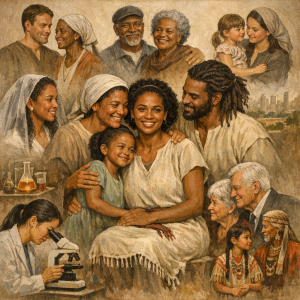
Daughter, in Torah or Biblical Common Law primary and natural-family usage, means a young woman or woman in relation to her father, mother, or parents. She is their daughter by birth and descent, or, where the relationship is expressly established, by adoption or another identified family relationship.
The word names a relationship, not merely an age category or biological classification. A woman remains her father’s or mother’s daughter throughout her life. Thus, “daughter” may properly describe an infant, a young woman, a married woman, an elderly woman, or a woman who is herself a mother or grandmother. The central meaning is family relation: daughter to father, mother, or parents.
This dictionary distinguishes that natural relational meaning from conventional statutory, bureaucratic, and classificatory wording. Standard dictionaries commonly use conventional classificatory wording that describes a daughter in relation to parents by sex and childhood status. That wording is useful for reporting conventional dictionary usage, medical classification, census language, and statutes that employ it. It is not this dictionary’s preferred primary expression, because “young woman or woman in relation to her father, mother, or parents” more directly identifies the human and familial relation conveyed by the word.
A daughter may be a daughter by birth, descent, or legal adoption. A woman may also be described in ordinary speech as a foster daughter, stepdaughter, spiritual daughter, honorary daughter, or daughter of a household or community. Those expressions can communicate genuine care and belonging, but they do not all create the same legal relationship. A stepdaughter is not necessarily an adopted daughter; a foster daughter is not necessarily an heir; and a “daughter-in-law” is not a daughter of the parents in the same sense, but ordinarily the wife of their son. Legal rights depend on the particular relationship and the governing law or instrument.
The term also has figurative uses built upon the idea of descent, derivation, or origin. A later language may be called a daughter language of an earlier language. A daughter cell comes from cell division. A daughter isotope or nuclide is produced by radioactive decay. A congregation established by another congregation may be called a daughter church. In each instance, the figurative use retains an underlying idea of proceeding from, belonging to, or being derived from an originating source.
Dictionary interpretive analysis: To call a woman a daughter is to recognize her place in a line of family, memory, care, ancestry, and responsibility. The word can carry affection and moral significance, but it should not be used to deny a daughter’s own dignity, maturity, judgment, or lawful standing.
Etymology and Origin
The English word daughter comes through Middle English forms such as doughter and doghter, from Old English dohtor. Old English used the word for a daughter considered in relation to her parents. It is one of the oldest surviving kinship words in the English language.
The word belongs to a broad Indo-European family of related terms. Cognates include Old Norse dóttir, Dutch dochter, German Tochter, Greek thygatēr, Sanskrit duhitṛ, and related forms in other Indo-European languages. Linguists commonly reconstruct an earlier ancestral form as *dʰugh₂tḗr or a similar transliteration. The reconstruction is linguistic: it identifies a probable ancestral word from patterns shared among later languages. It is not a record of a known historical family or a legal definition.
Some popular etymologies associate the ancient word with milking, dairy work, or an imagined household occupation. Such explanations remain uncertain and should not be presented as established fact. The sound resemblance between an ancient root and a proposed activity does not prove that the word originally meant “milkmaid” or assigned a fixed domestic role to daughters. What is well supported is the antiquity of the kinship term itself.
The spelling of daughter preserves evidence of earlier English pronunciation. The gh represented a sound that was pronounced in parts of Middle English and later disappeared from standard pronunciation. Similar historical spelling patterns appear in words such as night, thought, and though. Modern English speakers ordinarily pronounce the word without sounding the gh.
By late Old English and Middle English, daughter had acquired figurative applications. A woman could be called a daughter of her country, city, church, people, or culture. English later extended the word to institutions, sciences, and languages. These developments do not replace the natural-family meaning; rather, they borrow its language of descent and origin.
Cultural and Historical Context
The history of daughters is closely bound to the history of the household, lineage, marriage, inheritance, land, labor, education, and public authority. Across many societies, daughters occupied a recognized place in their birth household and could later become joined to another household through marriage. This made daughters important to family continuity, alliances between households, care of parents, transmission of property, and the preservation of family memory.
Historical conditions differed sharply by land, people, period, social rank, and legal order. It is therefore inaccurate to say either that daughters everywhere had no rights or that daughters everywhere stood on equal legal footing with sons. A daughter might receive land, movable goods, a marriage portion, household goods, maintenance, gifts, or an inheritance. Yet the nature of those rights was often limited by customs favoring sons, guardianship rules, marriage settlements, household authority, and restrictions on married women’s control of property.
Expressions such as “a daughter of the house,” “a devoted daughter,” and “her father’s daughter” may express affection, resemblance, gratitude, loyalty, or shared character. In a sound family setting, such language can honor belonging. Yet the same language can be misused when it assumes that daughters must be passive, dependent, silent, marriage-centered, or responsible for family burdens not expected of sons. The word itself does not require those assumptions.
In many cultural settings, daughters have also served as keepers of family history, caretakers of elders, bearers of family names in memory and genealogy, and participants in the spiritual and economic life of the household. These roles should be recognized as historical realities without turning them into compulsory roles for every woman.
Biblical / Torah Context
Ancient Israelite and Biblical Hebrew Setting
In the Ancient Israelite setting of the Torah and the Hebrew Scriptures, the principal Hebrew word translated “daughter” is bat (בַּת), with the plural banot (בָּנוֹת). In its ordinary family use, bat denotes a daughter in relation to father, mother, or household. The Hebrew term may also extend beyond an immediate household to a descendant, a woman belonging to a people, or a poetic representation of a town, city, or nation.
This is an Ancient Israelite and Biblical Hebrew context. It should not be anachronistically described as originating in later rabbinic practice, nor should later Jewish, Christian, or other religious interpretations be substituted for the Torah’s own setting. The Torah’s family and land rules arose within a tribal inheritance order connected with the covenant people of Israel and with the land allotted among tribes and clans.
The Daughters of Zelophehad
One of the Torah’s most important accounts concerning daughters appears in Numbers 27:1–11. Mahlah, Noah, Hoglah, Milcah, and Tirzah—the daughters of Zelophehad—came before Moses, Eleazar the priest, the leaders, and the assembly. Their father had died without sons. They asked that his name not disappear from among his clan and that they receive a possession among their father’s brothers.
Moses brought their cause before Yah, the Creator named in the Hebrew text by the four-letter Name YHWH. Yah affirmed that the daughters spoke rightly. The instruction given through Moses established that where a man died without a son, his inheritance would pass to his daughter. The passage then sets out a succession order for circumstances in which there was no son, no daughter, no brothers, no paternal uncles, and ultimately no nearer kinsman.
The account is significant because daughters brought a concrete inheritance claim before recognized authority and received a favorable ruling. It portrays their claim not as disorderly rebellion but as a matter heard and answered within the lawful order of the people. The narrative affirms the preservation of their father’s name and inheritance when no son was present.
Numbers 36 returns to the same family and addresses the preservation of tribal land. The daughters who inherited land were instructed to marry within the clan of their father’s tribe so that inherited land would not pass permanently from one tribe to another. This instruction belongs to the Torah’s tribal-land system. It is neither a universal civil rule for every people nor a direct substitute for modern probate law.
“Daughter” in Biblical Poetry and Prophecy
Scripture also uses daughter language collectively and poetically. “Daughter of Zion,” “daughter of Jerusalem,” “daughter of Judah,” and “daughter of Babylon” ordinarily personify a city, people, or community. The expression is not normally a statement about a literal daughter. Depending upon its context, it can convey beauty, vulnerability, grief, humiliation, captivity, hope, restoration, or covenantal identity.
Later Christian Scriptures use the Greek word thygatēr for daughter. In the Gospel accounts, the word may describe a natural family relationship or be used as an address of compassion and restoration. Christian readers often understand Messiah’s address “Daughter” to a healed woman as language of recognition and belonging. That is a theological interpretation; it should not be confused with a universal legal formula or an automatic grant of civil status.
Legal Implications
Natural Relation and Legal Classification
At common law and in ordinary life, daughter identifies a natural family relation. In modern legal writing, however, statutes often employ broader technical words such as child, issue, descendant, heir, beneficiary, or dependent. These terms are not always interchangeable with daughter. They may include or exclude adopted daughters, stepdaughters, descendants of a deceased daughter, or others according to a statute, court order, trust, deed, insurance policy, or will.
A daughter is not automatically an heir in every legal circumstance. An heir is one entitled to take property under applicable intestate-succession law when someone dies without a valid testamentary disposition controlling that property. A beneficiary is one designated to receive property or benefits under a will, trust, insurance policy, retirement account, deed, or other instrument. A daughter may be either, both, or neither, depending on the facts and governing law.
Historical English Common Law
Historical English common law included rules that often favored an eldest son in the descent of certain real property. Under male-preference primogeniture, the eldest son could take before daughters. But the historical common law did not simply erase daughters from inheritance. Where a landholder died without a son, daughters could inherit together as coparceners. Blackstone explained that where there were two daughters and no son, both daughters could inherit the estate as coparceners.
Coparcenary was a particular historical form of co-ownership arising by descent. It did not mean that daughters had an unrestricted and equal right to every kind of family property in every circumstance. The result could depend upon land tenure, the presence or absence of sons, testamentary disposition, settlements, local custom, and other rules of property law. Nor should historical English common law be confused with Roman law, which developed in a distinct legal tradition, or with equity, which developed separate doctrines and remedies in the English Court of Chancery.
Equity became especially relevant to marriage settlements, trusts, separate estates, and arrangements intended to protect or manage a married woman’s property. The historical relationship between common law, equity, and married women’s property was complex. It should not be reduced to the claim that daughters or wives universally held no property, nor to the opposite claim that historical law generally treated them as fully equal in property control.
American Statutes and Current Law
In the United States, inheritance law is principally statutory and varies by state, territory, tribal jurisdiction where applicable, and the terms of the relevant estate instrument. Colonial jurisdictions received substantial influence from English inheritance law, but colonial and post-Independence legislatures changed it. Many American jurisdictions rejected or abandoned primogeniture and enacted statutes allowing sons and daughters to receive shares of an estate.
Current estate disputes therefore cannot properly be decided by reciting an old English common-law rule alone. Questions may require examination of the decedent’s domicile, the location of real property, the parentage law of the jurisdiction, adoption records, survivorship requirements, probate statutes, tribal law where applicable, and the exact wording of a will, trust, deed, or beneficiary designation.
Adoption ordinarily creates a legal parent-and-daughter relationship, but the legal consequences of adoption—including inheritance through or from birth relatives—vary by jurisdiction and by the form and date of adoption. A stepdaughter may be fully loved as family without automatically receiving inheritance rights from a stepparent. At historical common law, the stepparent-stepdaughter relationship itself generally did not create rights and duties equivalent to adoption. Today, statutes, wills, trusts, and other documents may alter that result.
The United States Supreme Court’s decision in Trimble v. Gordon, 430 U.S. 762 (1977), is an important constitutional inheritance case. The Court held that an Illinois intestacy provision broadly preventing a daughter born outside marriage from inheriting from her father violated the Equal Protection Clause. The decision did not eliminate all requirements for proving parentage. It did reject a sweeping statutory disinheritance based on the circumstances of birth.
For estate planning, precision matters. A will or trust that uses “my daughters,” “my children,” “my descendants,” or “my issue” may produce different results depending on governing law and the instrument’s definitions. A careful drafter may need to specify whether the intended class includes adopted daughters, stepdaughters, daughters conceived after a parent’s death, or daughters born through assisted reproduction. This entry provides general educational information and is not legal advice.
Spiritual Meaning
In spiritual and devotional use, daughter often conveys belonging, love, inheritance, continuity, and responsibility within a household or covenant people. The term can remind a woman that she is not merely an isolated unit but stands within relationships of ancestry, family memory, obligation, and care.
The daughters of Zelophehad are often read as an example of courage, faithfulness, and lawful petition. They brought their matter openly before Moses and the assembly, and Moses brought it before Yah. This reading does not mean that every modern inheritance claim has the same outcome. It does, however, support the moral observation that daughters’ claims to family memory, inheritance, and justice deserve to be heard rather than dismissed.
“Daughter of Zion” and related biblical expressions have long been used in later Jewish and Christian worship, teaching, and literature. Because these phrases personify a people or city, interpreters should avoid using them carelessly to impose spiritual stereotypes or burdens upon individual women.
Modern Usage
In modern English, daughter remains a common and durable family word. It appears in conversation, genealogy, family histories, memorial notices, medical histories, adoption records, family-law proceedings, estate planning, and ordinary descriptions of family life. The word applies equally to a young daughter and to an adult woman speaking of her parents.
Modern families may include daughters by birth, adoption, remarriage, foster care, kinship care, or longstanding household relationship. The most respectful ordinary practice is to use the family language that the woman and her family use for their own relationship, while recognizing that legal documents may require more exact classifications.
- Daughter cell: a cell resulting from the division of another cell.
- Daughter isotope or daughter nuclide: a nuclide produced by the radioactive decay of another nuclide.
- Daughter language: a language descended from an earlier parent language.
- Daughter church: a congregation established or planted by another congregation.
- Daughter company: an older or less formal business expression for an organization derived from or controlled by another organization; subsidiary is usually the more precise modern business term.
Controversies / Criticisms
Most controversy concerns not the basic meaning of daughter, but the social and legal systems historically attached to daughters. Critics of patriarchal inheritance systems rightly observe that daughters were often disadvantaged in succession, education, property control, public authority, and household decision-making. Customs that treated daughters chiefly as marriage arrangements, dependents, or channels through which property passed have been criticized for limiting women’s agency and dignity.
There are also concerns about language that infantilizes adult women. Expressions such as “daddy’s girl,” “good daughter,” or “obedient daughter” can be affectionate in a particular family, but may also carry expectations of submission, dependency, or unequal treatment. Meaning depends on context, tone, consent, and the actual character of the relationship.
Claims that the word daughter has a hidden legal meaning that automatically determines citizenship, taxation, court jurisdiction, parental authority, political status, or inheritance are not supported by ordinary English usage, historical common law, or general American law. Legal consequences arise from actual law, established facts, valid instruments, and court decisions—not from privately redefining a familiar family term.
Conclusion
A daughter is, in the natural and familial sense, a young woman or woman in relation to her father, mother, or parents. The word is ancient, enduring, and relational. It speaks first of family descent and belonging, while its figurative uses in language, science, religion, and institutions draw upon the same idea of origin.
Ancient Israelite Scripture gives the term particular weight in the account of the daughters of Zelophehad, whose inheritance claim was heard and affirmed within the Torah’s tribal land order. English common law historically gave daughters a qualified but real place in inheritance through coparcenary when no son existed, even while other rules often favored sons. Modern American law is chiefly statutory and jurisdiction-specific. Whether a daughter inherits today depends on the applicable parentage rules, adoption law, will or trust language, probate statute, and facts of the case.
Sources / Further Reading
- Online Etymology Dictionary, “Daughter”: https://www.etymonline.com/word/daughter
- Merriam-Webster, “Daughter”: https://www.merriam-webster.com/dictionary/daughter
- Mechon Mamre, Hebrew Bible, Numbers 27: https://www.mechon-mamre.org/p/pt/pt0427.htm
- Mechon Mamre, Hebrew Bible, Numbers 36: https://www.mechon-mamre.org/p/pt/pt0436.htm
- Sir William Blackstone, Commentaries on the Laws of England, Book II, discussion of descent and coparcenary: https://tile.loc.gov/storage-services/service/rbc/rbc0001/2021/2021madison38676/2021madison38676.pdf
- Library of Congress, “United States: Inheritance Laws in the 19th and 20th Centuries”: https://wwws.loc.gov/law/help/inheritance-laws/unitedstates.php
- Cornell Legal Information Institute, “Inheritance”: https://www.law.cornell.edu/wex/inheritance
- Cornell Legal Information Institute, “Stepchild”: https://www.law.cornell.edu/wex/stepchild
- Cornell Legal Information Institute, “Primogeniture”: https://www.law.cornell.edu/wex/primogeniture
- United States Reports, Trimble v. Gordon, 430 U.S. 762 (1977): https://tile.loc.gov/storage-services/service/ll/usrep/usrep430/usrep430762/usrep430762.pdf