Ma’dam
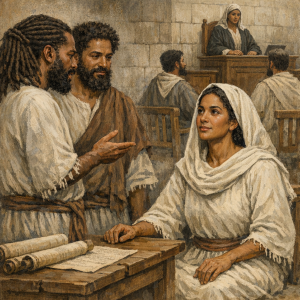
Primary Definition
Madam is an English title and form of address for a woman, historically derived through French madame, from ma dame, meaning “my lady.” It originally functioned as a title of respect, rank, social standing, or authority and later produced the contracted English form MADAM → MA’AM. However, madam also developed a well-established English meaning for a woman who manages, operates, or exercises authority over a brothel or house of prostitution, including one who supervises or arranges prostitution within such an establishment. Therefore, madam carries two sharply contrasting English senses: an honorific meaning associated with respect and social status, and a brothel-related meaning associated with prostitution and sexual commerce. A complete definition should disclose both meanings rather than presenting madam solely as a respectful title.
From an Israelite and biblical frame of reference, madam is not a scripturally established title of honor for a woman and is not necessary for demonstrating respect. Scripture instead identifies women through meaningful relationships, standing, and responsibilities—such as woman, wife, mother, daughter, sister, widow, or elder woman. While madam may function as an honorific within the English and European cultural construct, an Israelite may reasonably reject or avoid the title because it is foreign to biblical Israelite terminology and because the word later acquired a recognized association with brothel management and prostitution. This does not mean that prostitution was the original meaning of madam; historically, its earlier meaning was “my lady.” The distinction is important because the full semantic history reveals both the socially honorable usage and the later derogatory or sexually associated usage.
Ma’dam, as supplied with an apostrophe, is not the ordinary modern dictionary spelling of an English word. In ordinary English usage, it is most plausibly a nonstandard or stylized rendering intended to evoke madam, madame, or perhaps ma’am. The standard English word is madam: a formal, respectful form of direct address to a woman, especially where the speaker does not use the woman’s name; it may also be used before an office or position, as in “Madam Chair,” “Madam President,” or “Madam Justice.” Madame is the French spelling and remains common in French titles and names. Ma’am is the usual English contraction in speech and informal writing.
The apostrophe in Ma’dam has no established legal, grammatical, or historical function in standard English. Apostrophes commonly mark possession or omitted letters, as in ma’am, where letters have been omitted from madam. But Ma’dam leaves the letters of madam intact while inserting punctuation. It should therefore be read cautiously: it may be a personal stylistic choice, a branding form, an unconventional spelling, or a mistaken attempt to write ma’am. The spelling itself does not create a distinct title, office, status, or legal category.
In its central and neutral sense, madam conveys civility and recognition. Its tone depends heavily on setting, region, age, voice, and relationship. In one setting it can signal professional respect; in another it can sound ceremonious, old-fashioned, sarcastic, or overly familiar. Modern dictionaries record both the formal address sense and specialized meanings that developed later. ([oxfordlearnersdictionaries.com](https://www.oxfordlearnersdictionaries.com/definition/english/madam?utm_source=openai))
Etymology and Origin
The documented origin of madam is linguistic rather than legal. English borrowed the word from Old French ma dame, literally “my lady.” The French expression combines ma (“my”) and dame (“lady”). Dame ultimately derives from Latin domina, meaning a lady, female head of a household, or mistress of a house. Related forms appear across European languages: French madame, Italian madonna, Spanish doña, and English dame.
The phrase’s literal structure is important. “My lady” was historically a formula of respect, not ordinarily a statement that the addressed woman was the personal property of the speaker. Like “my lord,” “your honor,” or “your grace,” it arose from social conventions of courtesy and hierarchy. The possessive element functioned as part of a respectful address formula. The French Academy identifies madame as composed of ma and dame, and records its early use as a title for women of rank before its broader use for married women and, in modern French practice, women generally. ([dictionnaire-academie.fr](https://www.dictionnaire-academie.fr/article/A9M0093?utm_source=openai))
English madam entered during the Middle English period, around the thirteenth or fourteenth century. At first it was associated particularly with women of rank, authority, or household standing. Over time it broadened into a conventional polite address for women more generally. Etymological sources also record later, sometimes disparaging senses: a woman considered pretentious or domineering; a young girl acting imperiously (“a little madam”); and, by extension, the woman who manages a brothel. Those meanings are historical developments of the English word; they do not alter the original “my lady” derivation. ([etymonline.com](https://www.etymonline.com/word/madam?utm_source=openai))
Madam, Madame, and Ma’am
- Madam is the standard English form, especially in formal direct address: “Yes, madam.”
- Madame is the French form. In English it may be used for a French-speaking woman, a French cultural title, or a deliberately French style.
- Ma’am is a contracted English form of madam, common in North American speech and in institutional settings such as the military, customer service, schools, and government.
- Ma’dam is not the conventional spelling for any of those forms. Its apostrophe should not be treated as evidence of an ancient contraction, a separate legal term, or a special linguistic origin.
Cultural and Historical Context
The history of madam reflects changes in class, gender, etiquette, and public language. In medieval and early modern Europe, titles of address often marked rank. A lady of a noble household, a woman exercising authority within an estate, or the wife of a prominent man might be addressed with an honorific that ordinary women did not receive. As social forms became less rigid, madam expanded beyond the nobility. Its broadening followed a familiar linguistic pattern: a status title becomes a general courtesy title.
French retains Madame as a normal form of address and title. English retained madam, but its everyday use became more limited and context-sensitive. In contemporary American English, ma’am is often more natural in direct speech. In parts of the southern United States and in military culture, it may be a routine marker of respect. Elsewhere, some women dislike it because they associate it with unwanted assumptions about age, distance, or formality. Neither reaction changes the basic dictionary meaning; it illustrates that respectful language is always shaped by social reception.
The word has also accumulated opposing associations. It can be dignified, as in “Madam Speaker,” while its use for a brothel manager can be pejorative or sensationalized. The coexistence of these meanings is not a contradiction in etymology. A word may acquire specialized senses through social history, metaphor, and occupational usage while preserving a neutral primary sense in other contexts. Dictionaries accordingly distinguish the respectful form of address from the specialized prostitution-related meaning. ([oxfordlearnersdictionaries.com](https://www.oxfordlearnersdictionaries.com/definition/english/madam?utm_source=openai))
Biblical / Torah Context
Madam is not a Hebrew or Greek biblical term, and Ma’dam is not a Torah word. The Hebrew Bible/Torah was written principally in Biblical Hebrew, with limited Aramaic passages; the New Testament was written in Koine Greek. Therefore, claims that the English spelling Ma’dam carries an original Hebrew, Mosaic, apostolic, or biblical legal meaning are unsupported by the linguistic record.
English Bible translations may use titles such as “lady,” “mistress,” “woman,” “queen,” or “madam” in explanatory notes, paraphrases, commentary, or later English prose. Such English choices should not be confused with the vocabulary of the ancient manuscripts. For example, a translation note on John 8 explains that the Greek form conventionally translated “woman” can function as a polite address, comparable in some English contexts to “Madam” or “Ma’am.” That is an observation about translation and social tone, not proof that Jesus used an English honorific or that madam appears in the Greek text. ([beta.biblegateway.com](https://beta.biblegateway.com/passage/?search=John.8&version=NET%3BKJV%3BESV%3BNIV&utm_source=openai))
A separate biblical name, Medan, appears in Genesis 25:2 and 1 Chronicles 1:32 as a son of Abraham by Keturah. It is not etymologically the English word madam, and similarity in English letters or sound does not establish a connection. Responsible word study distinguishes an English honorific borrowed from French from an ancient Semitic personal name. ([blueletterbible.org](https://www.blueletterbible.org/lexicon/h4091/bes/wlc/0-1/?utm_source=openai))
Legal Implications
Common Law and Historical Usage
Madam is an honorific, not a term of art that independently confers legal rights, rank, sovereignty, immunity, marital status, property rights, or jurisdictional status. Historical common law used technical categories concerning women, including feme sole for an unmarried woman and feme covert for a married woman under the old doctrine of coverture. Those expressions belonged to Law French and common-law doctrine; madam did not replace them as legal classifications.
Historical coverture was a real and consequential common-law doctrine. Blackstone described the married woman’s constrained legal position under the common law of his time, though the rule was modified and displaced over time through legislation and judicial development. The history of coverture helps explain why titles for women can appear in old legal materials, but it does not make “Madam” a legal estate or capacity. A polite title and a legal classification are different things. ([avalon.law.yale.edu](https://avalon.law.yale.edu/18th_century/blackstone_bk2ch19.asp?utm_source=openai))
Nor does the Latin ancestry of domina make madam a rule of Roman law. Etymological descent from Latin is not the same as doctrinal descent from Roman civil law. English common law, Roman law, equity, canon law, statutes, and modern administrative law have distinct histories, even where their vocabularies sometimes overlap. The word’s origin is a matter of language; its legal effect, if any, arises only when an actual constitution, statute, rule, contract, court order, or legally operative instrument gives a term defined consequences.
Modern Legal and Governmental Usage
In current governmental and legal settings, Madam commonly operates as a courtesy form before an office: “Madam Speaker,” “Madam President,” “Madam Chair,” “Madam Clerk,” or “Madam Judge.” Such usage acknowledges the officeholder and maintains institutional decorum. Official federal materials, court transcripts, and legislative records contain these forms of address. They describe or honor a person occupying an office; the title does not itself appoint the officeholder or grant the office’s powers. ([uscourts.gov](https://www.uscourts.gov/sites/default/files/congressional_package_final_0.pdf?utm_source=openai))
The word can also appear in statutes, prosecutions, and legal commentary in its specialized sense of a woman who manages prostitution or a brothel. That is a contextual occupational description, not a definition applicable to every woman called “madam.” Criminal liability, where relevant, comes from the governing statute and proven conduct—such as trafficking, promoting prostitution, operating an unlawful enterprise, or related acts—not from the mere use of the word. ([law.cornell.edu](https://www.law.cornell.edu/wex/panderer?utm_source=openai))
Names, Punctuation, and Legal Identity
A person may choose to style a name, signature, business identity, artistic name, or online profile as “Ma’dam.” But styling alone does not ordinarily change the person’s legal identity in official records. Name rules are jurisdiction-specific. In the United States, common-law traditions concerning assumed or customary names coexist with state statutes, court procedures, agency identification requirements, anti-fraud rules, and document-specific naming standards. Government identification, court filings, deeds, tax records, passports, and contracts may require consistency with recognized records or disclosure of aliases.
Accordingly, an apostrophe in Ma’dam should not be assumed to alter legal capacity, create an “estate,” separate a natural person from a legal person, reserve rights, or defeat a court’s jurisdiction. Such propositions are sometimes asserted in pseudo-legal materials, but no generally recognized rule of American common law gives punctuation in an honorific those effects. Anyone considering a formal name change or using a variant name in a legal transaction should consult the applicable state law, court clerk, or qualified local attorney rather than rely on wordplay. The U.S. Department of State’s guidance illustrates the practical point that name usage and name-change documentation are handled through specified administrative rules, not through punctuation alone. ([fam.state.gov](https://fam.state.gov/fam/08fam/08fam040301.html?utm_source=openai))
Spiritual Meaning
There is no fixed spiritual meaning inherent in Ma’dam, madam, or ma’am. The word’s documented origin is a secular French courtesy expression: “my lady.” It is not a divine name, sacred Hebrew title, sacramental formula, or scriptural office.
Interpretively, a speaker may use madam to express dignity, honor, hospitality, or recognition of another person’s worth. Those are moral and relational values found in many religious and ethical traditions. Yet that is an application of a general principle of respectful speech, not a hidden spiritual definition embedded in the word’s spelling. A sound spiritual reading should therefore distinguish personal symbolism from documented etymology.
Modern Usage
Modern usage is highly contextual. In formal correspondence, “Dear Madam” may be used where the recipient’s name is unknown, although many organizations now prefer more specific or gender-neutral salutations when possible. In person, “madam” can be appropriate in formal service, ceremonial, judicial, or governmental environments. “Ma’am” is more conversational in American English, while “madame” retains French cultural, diplomatic, culinary, artistic, and titular associations.
Examples of neutral modern use include:
- “How may I assist you, madam?”
- “Madam Chair, I move that the report be received.”
- “The court will hear from counsel, Madam Justice.”
- “Dear Sir or Madam” in a traditional form letter.
Writers should avoid using madam when its tone could distract from the communication. In many ordinary business settings, a person’s stated name and pronouns, or a neutral greeting, will be clearer and more welcome. The most respectful form of address is ordinarily the one the person requests.
Controversies / Criticisms
The principal controversy surrounding madam is not its origin but its social tone. Some regard it as polite and disciplined; others hear it as stiff, age-marking, patronizing, or gendered. These reactions vary by culture and generation. The word should not automatically be classified as respectful or disrespectful without considering context and the preference of the person addressed.
A second issue is semantic ambiguity. Because madam has a specialized meaning relating to brothel management, careless use can invite an unintended association. That specialized sense is documented, but it is not the word’s default meaning in ordinary formal address. Context resolves the difference.
A third issue concerns unsupported “word magic” claims: assertions that spelling a word with unusual punctuation changes one’s legal standing, releases one from statutory obligations, creates a separate legal entity, or restores an alleged ancient status. Such claims conflate language, historical titles, and legal doctrine. The documented record supports the much narrower conclusion that madam is a courtesy term with French and ultimately Latin linguistic ancestry.
Conclusion
Ma’dam is best understood as a nonstandard spelling or stylized presentation related to the standard English honorific madam. The established word means a respectful form of address to a woman and descends through French ma dame, “my lady,” from Latin-rooted vocabulary of household and female authority. Its history includes noble and formal usage, broader social courtesy, governmental forms of address, and certain later specialized or disparaging senses.
It has no demonstrated independent status in biblical languages, Torah law, Roman law, English common law, equity, military law, or modern governmental law. In legal matters, it is a courtesy expression unless a particular document expressly defines it otherwise. The apostrophe in Ma’dam does not create a special legal or spiritual meaning. Clear usage requires distinguishing documented etymology from personal interpretation and distinguishing a title of respect from a source of legal authority.
Sources / Further Reading
- Online Etymology Dictionary, “madam” — https://www.etymonline.com/word/madam
- Oxford Advanced Learner’s Dictionary, “madam” — https://www.oxfordlearnersdictionaries.com/definition/english/madam
- Dictionnaire de l’Académie française, “Madame” — https://www.dictionnaire-academie.fr/article/A9M0093
- Cornell Legal Information Institute, “Panderer” — https://www.law.cornell.edu/wex/panderer
- Yale Law School Avalon Project, Blackstone’s Commentaries, Book II, Chapter 19 — https://avalon.law.yale.edu/18th_century/blackstone_bk2ch19.asp
- U.S. Department of State, 8 FAM 403.1, Name Usage and Name Changes — https://fam.state.gov/fam/08fam/08fam040301.html
- Bible Gateway, John 8 translation notes — https://beta.biblegateway.com/passage/?search=John.8&version=NET%3BKJV%3BESV%3BNIV