Israelite
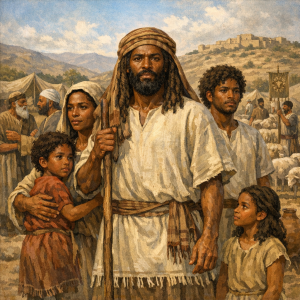
Primary Definition
An Israelite is, in the primary ancient and biblical sense, a member of Israel: the covenant people identified in the Hebrew Scriptures as the descendants, household, tribes, or national community of Jacob after he was given the name Israel. The central biblical expression is benei Yisra’el, commonly translated “children of Israel” or “sons of Israel.” In context, the phrase can mean Jacob’s direct descendants, the twelve-tribe community, the people assembled for covenantal purposes, or the nation known as Israel.
The term should be situated first in the Ancient Israelite and Biblical Hebrew setting. “Israelite” is an English word used to represent an ancient identity expressed in Hebrew through terms such as Yisra’el (Israel), benei Yisra’el (children of Israel), and, in some contexts, ish Yisra’el (a man or person of Israel). It is not originally the name of a modern nationality, race, denomination, or private political theory.
In historical scholarship, Israelite ordinarily refers to the populations of ancient Israel and, more broadly, ancient Israel and Judah during the Iron Age, while recognizing that identity could be tribal, familial, local, religious, and political rather than uniform in every period. In the biblical narrative, an Israelite is defined fundamentally by belonging to Israel under the covenant of Yah/Yahuah. In historical and archaeological discussion, the term identifies an ancient people or peoples of the southern Levant whose identity developed over time.
“Israelite” must be distinguished from Israeli, which denotes a citizen or national of the modern State of Israel, established in 1948. It should also not be used carelessly as a simple synonym for “Jew.” The terms overlap in important historical and religious ways, especially through the later development of Judahite and Jewish identity, but they are not identical in every ancient, biblical, historical, or modern context. ([openmedia.yale.edu](https://openmedia.yale.edu/projects/iphone/departments/rlst/rlst145/transcript13.html?utm_source=openai))
Etymology and Origin
The English word Israelite entered English through Middle English and Late Latin Israelita, derived from Greek Israēlitēs, “an Israelite,” and ultimately from Hebrew Yisra’el, Israel. The English suffix -ite functions as a gentilic or people-name suffix: an Israelite is a person belonging to Israel. Major English dictionaries record the word in English from the fourteenth century. ([oxfordlearnersdictionaries.com](https://www.oxfordlearnersdictionaries.com/definition/english/israelite?utm_source=openai))
The deeper issue is the meaning of Yisra’el. In Genesis 32:28, Jacob receives the name Israel after struggling through the night with a mysterious man or divine being. The narrative explains the name through a Hebrew wordplay: Jacob has striven or contended “with God” and with men, and has prevailed. This is the biblical explanation and has enduring theological importance.
From a linguistic standpoint, scholars generally recognize El as the final element of the name. El is a Northwest Semitic word for “God” and also appears in many ancient personal names. The first element is debated. Proposed senses include “El strives,” “El rules,” “God contends,” or, in light of the Genesis wordplay, “one who strives with God.” Therefore, a responsible dictionary definition should not present one reconstruction as undisputed fact. The Torah’s explanation gives the name a covenantal and narrative meaning; comparative Semitic linguistics examines the name as an older theophoric personal name whose original grammar cannot be fixed with complete certainty.
The biblical story traces Israelite origin through Abraham, Isaac, and Jacob/Israel. Jacob’s sons become the ancestral heads of the tribes of Israel, and Exodus depicts their descendants as a people delivered from bondage and brought into covenant at Sinai. This is the scriptural account by which Israel knows itself. Historical inquiry, however, asks different questions about the formation of ancient Israel and relies on inscriptions, archaeology, comparative language, and critical study of biblical texts. The two approaches should be distinguished rather than forced into a false choice.
Cultural and Historical Context
The earliest widely accepted extra-biblical reference to Israel appears in the Egyptian victory inscription commonly called the Merneptah Stele, dated approximately 1208/1207 BCE. The Egyptian writing identifies Israel with a determinative ordinarily used for a people rather than a walled city-state. This establishes that a people known as Israel was recognized in Canaan by the late thirteenth century BCE; it does not, by itself, settle the full biblical chronology, the size of that people, or every question concerning Israel’s origins. ([oi.uchicago.edu](https://oi.uchicago.edu/sites/default/files/uploads/shared/docs/oimp31.pdf?utm_source=openai))
During the early Iron Age, communities associated with Israel developed in the highlands of the central southern Levant. Their material culture shared much with surrounding Canaanite populations. For that reason, many historians understand early Israel as emerging substantially from within the land of Canaan, possibly alongside smaller groups and memories originating elsewhere. Other reconstructions assign greater weight to migration, conquest traditions, pastoral groups, an Exodus-linked community, or a combination of these factors. Archaeological evidence is important but incomplete; it cannot simply be made to say more than it does.
In the biblical historical presentation, Israel passed through periods of tribal leadership, judges, monarchy, division into northern Israel and southern Judah, Assyrian conquest of the northern kingdom, Babylonian conquest of Judah, exile, and restoration under Persian authority. The northern kingdom of Israel fell to Assyria in the late eighth century BCE; Judah fell to Babylon in the early sixth century BCE. These events profoundly changed how descendants of Israel understood land, temple, kingship, law, ancestry, and covenant.
After the Babylonian and Persian periods, Judahite—from Judah—became increasingly significant as an identity connected with the province of Yehud. The later English term Jew derives through this Judahite/Judean line. Yet “Israel” remained a powerful covenantal designation. Biblical books written or edited in later periods can address restored Judahites while also presenting them as Israel, heirs of the ancestral promises and covenant. Thus, the transition from Israelite to Judean and Jewish usage was historical and complex, not a single instant in which one people simply ceased to exist.
Israelite, Hebrew, Judahite, Jew, and Samaritan
Hebrew is another ancient designation, but it has a different range of usage. In the Torah, it often appears in settings of contrast or contact with outsiders, such as Egyptians calling the enslaved people “Hebrews.” “Israelite” more directly expresses membership in Israel. Judahite refers particularly to Judah, its kingdom, people, and later province. Jew is the later English form associated especially with Judean and Jewish identity. Samaritan refers to a distinct Israelite-related community centered historically in Samaria and maintaining its own Torah tradition and Mount Gerizim as a sacred center. These categories may overlap historically but should not be collapsed into one another.
Biblical / Torah Context
In the Torah, Israelite identity is covenantal before it is merely territorial. Yah/Yahuah declares Israel to be His people, and Israel is called to hear, obey, remember, worship faithfully, practice justice, and reject foreign worship. Exodus 19:5–6 describes Israel’s vocation in terms of covenant obedience, a treasured possession, a kingdom of priests, and a holy nation. This language presents election not as a license for arrogance but as a calling to responsibility.
The Torah repeatedly joins identity to remembrance: Israel is to remember deliverance from Egypt, the giving of commandments, the wilderness journey, and the covenant. It also ties Israelite life to concrete moral duties: honest measures, impartial judgment, care for the poor, protection for the resident stranger, regard for the fatherless and widow, Sabbath rest, and limits upon debt, servitude, and exploitation. An Israelite, in this scriptural sense, is not defined by ancestry alone but by life under the instruction of Yah/Yahuah.
The common English title Lord, when used in translations for Hebrew Adon or Adonai, carries the ordinary sense of master, ruler, or sovereign. In this dictionary’s Ancient Israelite heritage usage, Master is often the clearer English sense where the Hebrew word means a master or sovereign. The personal covenant Name written in the Hebrew text with the four consonants YHWH is commonly rendered by scholars as Yahweh; this dictionary uses Yah/Yahuah in keeping with its stated heritage perspective. Transliteration and vocalization practices differ, and readers should distinguish the Hebrew written form from later English conventions.
The prophets expand the meaning of Israelite faithfulness. They condemn idolatry, oppression, corrupt rulers, false weights, bribery, empty ritual, and neglect of the vulnerable. They also proclaim judgment, restoration, return, and renewal of the heart. In this setting, “Israel” may refer to the northern kingdom, the whole covenant people, the surviving remnant, or an ideal restored people. Context must govern interpretation.
Legal Implications
In ancient Israelite society, law was embedded in covenant, kinship, worship, landholding, household life, and royal authority. Biblical legal materials include the Covenant Code in Exodus 20–23, laws in Leviticus including the Holiness collection, and the Deuteronomic laws in Deuteronomy 12–26. These texts address matters such as homicide, bodily injury, theft, property, debt, slavery or servitude, sexual conduct, ritual purity, festivals, tithes, judges, warfare, kingship, and treatment of vulnerable persons.
It is inaccurate to describe these biblical laws as English common law. Historical common law developed in medieval England through royal courts, judicial decisions, writs, custom, and precedent. Roman law arose in a different legal civilization. Equity developed in England as a distinct body of remedies and principles administered historically through chancery. Ancient Israelite law belongs to none of these categories. It is an ancient Near Eastern body of covenantal, customary, priestly, and royal legal tradition preserved and edited within biblical literature.
Nor does “Israelite” create a separate legal status in current United States law merely by self-description, ancestry claim, religious conviction, or scriptural interpretation. Modern legal rights and duties ordinarily arise from constitutions, statutes, regulations, treaties, and judicial decisions, not from an individual’s assertion of ancient tribal identity. Religious belief is protected within constitutional limits, but it does not by itself exempt a person from generally applicable laws, establish sovereignty, nullify citizenship, or create a private court with governmental authority.
Claims sometimes made in “common law” or sovereign-citizen-style materials that a person can avoid public law by declaring himself or herself an “Israelite,” “Moor,” “national,” or other historical identity are not established doctrines of American common law. Such assertions should be evaluated carefully against actual statutes and controlling court decisions in the relevant jurisdiction. A dictionary entry should distinguish spiritual, historical, and genealogical claims from enforceable legal rights.
Spiritual Meaning
Spiritually, “Israelite” signifies belonging to a people called into covenant with Yah/Yahuah. The name recalls Jacob’s struggle, the deliverance from Egypt, the Sinai covenant, the journey through the wilderness, and the continuing demand for faithfulness. It therefore carries themes of perseverance, repentance, obedience, justice, remembrance, and hope.
The biblical portrayal is not one of flawless ancestry or automatic righteousness. Israel repeatedly fails, complains, worships other powers, mistreats neighbors, and breaks covenant. Yet the same Scriptures portray Yah/Yahuah as merciful, faithful to His promises, and willing to restore a repentant people. The spiritual force of the term lies partly in that tension: Israel is chosen for service, judged for disobedience, and called back to covenant faithfulness.
Later Jewish, Christian, Samaritan, Messianic, Hebrew Israelite, and other communities have interpreted Israelite identity in differing ways. Some emphasize physical descent, some covenant membership, some faith, some restoration of dispersed tribes, and some a combination of ancestry and obedience. Those are later interpretive developments and should be identified as such rather than projected unchanged onto every ancient biblical text.
Modern Usage
In modern academic writing, museums, Bible translations, and historical studies, Israelite usually means an inhabitant or member of ancient Israel or Judah in the biblical world. The adjective Israelite may describe religion, law, inscriptions, architecture, pottery, social organization, or literature associated with ancient Israel.
In religious use, the word may function as a covenantal self-description. Some people use it broadly for the biblical people of Israel; others reserve it for ancient descendants of Jacob; still others use it in connection with claimed descent from particular tribes. Such usage needs contextual care. A claim to Israelite identity may be theological, cultural, genealogical, symbolic, or political, and these are not interchangeable kinds of claim.
Modern Black Hebrew Israelite movements are diverse religious movements, chiefly developing in the United States from the late nineteenth and early twentieth centuries. Some groups teach that people of African descent, particularly African Americans, are descendants of biblical Israelites. Scholars describe substantial diversity among these communities: some are peaceful, scripturally focused, and engaged in forms of Jewish or Christian practice; others advance separatist or hostile teachings. No blanket description should be applied to every person or congregation using the label. ([academic.oup.com](https://academic.oup.com/book/10736?utm_source=openai))
Controversies / Criticisms
Several controversies surround the term. First, scholars debate the precise historical formation of early Israel. The biblical account supplies Israel’s own covenant history, while archaeology and historical criticism offer reconstructions that may differ in chronology, emphasis, and conclusions. It is sound practice to state whether a claim is drawn from the biblical narrative, archaeological evidence, or a modern scholarly reconstruction.
Second, the meaning of the name Israel is debated linguistically. Genesis provides a meaningful narrative explanation connected with struggle and prevailing; philologists debate the original verbal form. Neither the biblical wordplay nor a proposed linguistic reconstruction should be treated as though it eliminates the other.
Third, claims of exclusive modern descent from ancient Israelites are frequently contested. Genealogy across more than two millennia is difficult to demonstrate, and ancient populations experienced migration, intermarriage, conquest, exile, conversion, and cultural change. Religious conviction and communal identity may be sincerely held, but they are not automatically historical proof. Likewise, polemics that deny the historical connections of Jewish, Samaritan, African, Middle Eastern, or other communities to Israelite traditions should not be accepted merely because they are forcefully stated.
Finally, the term can be misused to promote racial superiority, ethnic hostility, antisemitism, anti-Black prejudice, or political exclusion. Such uses conflict with both sound historical method and the Torah’s repeated ethical commands concerning justice, truthful judgment, and treatment of the stranger.
Conclusion
An Israelite is, first and foremost, a member of ancient Israel: the people known in the Hebrew Scriptures as the children of Israel and called into covenant with Yah/Yahuah. The word carries historical, biblical, legal, and spiritual significance, but each field uses it with its own necessary limits. Historically, it refers to ancient peoples and polities of the southern Levant. Biblically, it expresses covenant identity descended from Jacob/Israel. Legally, it describes an ancient context and does not itself establish special status under modern common law or statutory law. Spiritually, it evokes a calling to faithful worship, justice, humility, and remembrance.
Sources / Further Reading
- Yale University, Christine Hayes, “Introduction to the Old Testament (Hebrew Bible), Lecture 13” — https://openmedia.yale.edu/projects/iphone/departments/rlst/rlst145/transcript13.html
- University of Chicago, Oriental Institute, Ancient Israel (Merneptah Stele discussion) — https://oi.uchicago.edu/sites/default/files/uploads/shared/docs/oimp31.pdf
- Oxford Academic, Historical and Biblical Israel: The History, Tradition, and Archives of Israel and Judah — https://academic.oup.com/book/27089
- Society of Biblical Literature, Introducing the Hebrew Bible — https://www.sbl-site.org/wp-content/uploads/2024/10/GravettHebrew.pdf
- Merriam-Webster, “Israelite” — https://www.merriam-webster.com/dictionary/Israelite
- Oxford Academic, Jacob S. Dorman, Chosen People: The Rise of American Black Israelite Religions — https://academic.oup.com/book/10736
- Cambridge University Press, Black Hebrew Israelites — https://www.cambridge.org/core/books/black-hebrew-israelites/88E127963EB4F0990717BE6BD47044C8