Married
Primary Definition
Married is the past participle and adjective formed from marry. In its primary and ordinary sense, it describes a person who has entered into a marriage and who presently holds the social, relational, and, where the law recognizes the union, legal status of a spouse. Thus, a person may be described as “married,” two persons may be described as “married to each other,” and a couple may be said to be “married” following a ceremony or other legally sufficient act of marriage.
The word has several connected but distinct applications:
- Personal and relational: joined to another person as a spouse.
- Legal: possessing the civil status created by a valid marriage under the law that governs the parties.
- Religious or customary: united according to the rites, covenantal understanding, or customs of a religious community or culture.
- Figurative: closely or permanently joined to an activity, idea, design, or occupation, as in “married to his work” or “married to a particular method.”
In legal usage, being married is more than a description of affection, cohabitation, sexual relationship, ceremonial participation, or shared residence. It ordinarily identifies a recognized civil status. That status may carry reciprocal rights and duties concerning property, inheritance, decision-making, taxation, support, benefits, parentage, divorce, and survivorship. The exact consequences depend upon the jurisdiction, the terms of applicable statutes, and the facts of the particular relationship.
In ordinary speech, “married” often assumes a public commitment and a household or family relationship. Yet language should not be confused with law. A wedding celebration may have deep family and religious significance but fail to create a civil marriage if legal prerequisites were not satisfied. Conversely, a legally valid civil marriage may exist even where no religious ceremony occurred. The word therefore has a core meaning of spousal union, while its legal effects depend on the law that recognizes or regulates that union.
Etymology and Origin
Married comes from the verb marry. English received the verb through Middle English marien and Anglo-French marier, which trace to Latin maritare, “to marry,” and maritus, “married” or “husband.” The English verb is recorded from the fourteenth century. The ending -ed marks the completed action: one who has married is “married.”
This linguistic descent from Latin does not establish that the present English legal institution of marriage is simply Roman law, nor does it prove that every modern rule concerning spouses arose from Rome. Etymology explains the history of a word; it does not by itself determine the legal meaning of the word in every country, faith, or historical period. English marriage law developed through a mixture of local custom, canon law, ecclesiastical courts, parliamentary statutes, common-law decisions, equity, and later constitutional and statutory law.
The related word matrimony comes from Latin matrimonium, traditionally associated with mater, meaning “mother.” That word history reflects ancient Roman categories and social assumptions about family and legitimacy, but it should not be treated as a complete definition of marriage. People may be married without having children, desiring children, or being capable of having children. Modern legal systems generally recognize marriage as a civil status between spouses rather than as a status conditioned upon procreation.
Cultural and Historical Context
Marriage has existed in many forms across cultures and eras. It has served functions involving kinship, household formation, inheritance, alliance between families, care of children, economic cooperation, religious observance, and personal companionship. For that reason, one must be cautious about claiming that a single historical model explains all marriages. The institution has shown both continuity and substantial change.
In older European legal traditions, marriage was often discussed as a contract, a moral relation, and a civil status. These descriptions overlap but are not identical. A contract emphasizes consent; a status emphasizes the legal consequences that follow once the union exists; and a religious covenant emphasizes duties understood to arise before God. English common-law thought historically treated marriage as a voluntary agreement that established the relation of husband and wife, while later statutes increasingly regulated the formalities for entering and dissolving that relation.
Historically, marriage law frequently imposed unequal rules on husbands and wives. One notable common-law doctrine was coverture, under which a married woman’s separate legal identity and property rights were substantially restricted in favor of her husband’s legal authority. Over time, married women’s property acts, constitutional principles, and changing family-law rules dismantled those disabilities. The historical fact that marriage has been regulated does not mean that every older rule remains part of present common law; many have been abolished by statute, judicial decision, or constitutional law.
Marriage has also changed in relation to race, consent, gender roles, divorce, and the relationship between church and state. In the United States, laws prohibiting interracial marriage were held unconstitutional in Loving v. Virginia in 1967. In Obergefell v. Hodges in 2015, the United States Supreme Court held that states could not deny same-sex couples the right to marry. These developments illustrate that the legal meaning and availability of marriage have been shaped not only by inherited tradition but also by constitutional guarantees of liberty and equal protection.
There is no special military meaning inherent in the word married. Military institutions may recognize a member’s marital status for housing, benefits, dependent support, deployment paperwork, survivor benefits, and similar administrative purposes, but those effects arise from military and federal statutes or regulations rather than from a distinct military definition of marriage.
Biblical / Torah Context
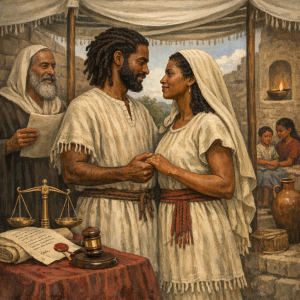
Marriage is genuinely relevant to the Biblical and Torah context because Scripture repeatedly addresses spousal union, household life, sexual conduct, inheritance, faithfulness, divorce, and family obligations. The foundational passage commonly associated with marriage is Genesis 2:24: a man leaves father and mother, is joined to his wife, and the two become “one flesh.” In its literary setting, the passage describes the formation of a new kinship union and has been widely understood by Jewish and Christian readers as foundational to marital union.
The Torah does not present a single modern civil-licensing system. Rather, it contains narratives and laws arising from an ancient Israelite setting. Those materials address betrothal, marriage, bridewealth, inheritance, kinship obligations, prohibited relationships, divorce writings, widows, and household responsibilities. Deuteronomy 24:1–4, for example, discusses a written certificate of divorce and the consequences of remarriage. Such provisions demonstrate that marriage in the Torah had recognized social and legal dimensions; they should not be casually equated with the procedures of a modern American courthouse.
Jewish legal tradition later developed detailed rules concerning kiddushin (betrothal or consecration), nissu’in (the completion of marriage), the ketubah, marital duties, and the get, or bill of divorce. Rabbinic discussions preserved in tractate Kiddushin analyze modes of entering the marital relationship and the legal consequences of that status. These sources are important for understanding Jewish law, but they are not identical to English common law or current American civil law.
Within the New Testament, Jesus cites Genesis 1 and 2 when addressing divorce, affirming the “one flesh” language and the seriousness of marital union. Christian traditions commonly regard marriage as a covenantal relationship marked by fidelity, mutual service, and permanence. Ephesians 5 uses marriage as an analogy for Christ and the Church. Interpretations differ among denominations, however, especially concerning sacramental status, divorce and remarriage, marital authority, gender roles, and the application of Biblical texts to civil marriage law.
A responsible reading should also acknowledge that Biblical narratives include practices that many contemporary Jewish and Christian communities do not regard as their present norm, including polygyny, arranged marriages, concubinage, and patriarchal household structures. Therefore, claims that “Biblical marriage” can be reduced to one simple legal formula are interpretive claims, not a complete description of every marriage-related practice found in Scripture.
Legal Implications
Marriage as Civil Status
In American law, marriage is generally a legal union that changes the civil status of the spouses. State law chiefly governs eligibility, licensing, solemnization, annulment, divorce, property consequences, and many domestic-relations matters. The usual elements include legal capacity, mutual consent, and compliance with the jurisdiction’s requirements for formation. A person who is married may acquire rights and responsibilities concerning support, marital property, inheritance, medical decision-making, insurance, parental presumptions, and court proceedings.
Being “married” does not mean that spouses surrender all separate legal identity or property. The old doctrine of coverture no longer governs modern American law in its historic form. Nor does marriage make one spouse automatically liable for every debt, tort, or criminal act of the other. Particular obligations depend upon state law, federal law, the type of claim, property arrangements, and the facts at issue.
Common Law Marriage
The phrase common-law marriage is frequently misunderstood. It does not mean that any unmarried couple becomes married after living together for a certain number of years. Mere cohabitation, shared bills, a shared surname, a religious commitment, or having children together does not by itself establish a common-law marriage.
Historically, English common law recognized informal marriages based largely upon present consent to be husband and wife, though rules and ecclesiastical practice changed over time. In the United States, some jurisdictions developed or retained forms of common-law marriage, typically requiring more than cohabitation: a present mutual agreement to be married, conduct holding the couple out to others as married, and satisfaction of other state-specific elements. Many states have abolished the formation of new common-law marriages, while some recognize marriages formed under earlier law or recognize valid common-law marriages formed in another jurisdiction.
Accordingly, no one should assume a common-law marriage exists without examining the law of the relevant state and the evidence of the parties’ agreement and conduct. Questions of marital status can affect probate, taxes, child support, property division, wrongful-death claims, benefits, and medical decisions. Legal advice from a qualified attorney in the applicable jurisdiction is appropriate where rights depend on whether a couple was legally married.
Federal and Constitutional Law
Federal law may recognize a marriage for particular federal purposes, including taxation, immigration, benefits, and certain survivorship or administrative matters. Federal recognition often depends upon whether the marriage was valid where it was entered. Federal rules are not identical in every program, and a marriage recognized for one purpose may require separate proof or meet additional requirements for another.
The constitutional history is important. Loving v. Virginia rejected racial restrictions on marriage. United States v. Windsor invalidated the federal definition in the Defense of Marriage Act that excluded lawful same-sex marriages from federal recognition. Obergefell v. Hodges then held that the Fourteenth Amendment requires states to license marriages between two people of the same sex and to recognize such lawful marriages. Congress later enacted the Respect for Marriage Act in 2022, repealing the former federal statutory definition contained in the Defense of Marriage Act and providing federal recognition and interstate-recognition protections as defined by that statute.
These are matters of public law, not merely dictionary preference. A person may hold a religious conviction about marriage while the civil law separately determines who is legally married and what civil consequences follow. The First Amendment protects religious belief and religious exercise subject to applicable law, but it does not make every private definition the controlling definition for civil records, tax administration, inheritance, or court proceedings.
Spiritual Meaning
Spiritually, many believers understand being married as entering a covenant of faithful union rather than merely obtaining a governmental status. In Jewish and Christian thought, marriage is often associated with loyalty, mutual obligation, hospitality, sexual faithfulness, the formation of a household, and the care of family. The “one flesh” language of Genesis is commonly understood to signify a profound joining of lives that includes bodily union but is not exhausted by it.
Christian interpretation often emphasizes sacrificial love, mutual honor, forgiveness, service, and faithfulness. Some traditions call marriage a sacrament; others call it a covenant or holy estate without using sacramental terminology. Jewish teaching likewise gives marriage a sacred and communal significance, while regulating it through distinctive religious-law categories. These views are theological and devotional interpretations. They should be respected as such, but they should not be confused with a universal civil-law definition.
At its healthiest, the spiritual use of married points to an obligation of truthfulness and faithfulness rather than ownership by one spouse over another. Spiritual appeals to marriage should never be used to excuse coercion, violence, financial exploitation, or deprivation of a spouse’s lawful rights. A covenantal understanding of marriage properly strengthens duties of care and accountability.
Modern Usage
Modern English uses married both as an adjective and as part of verbal constructions. Common examples include “they are married,” “she has been married for ten years,” “he married in June,” and “they were married by a judge.” In careful usage, “married to” ordinarily identifies the spouse: “married to Jordan.” “Married with children” is also widely understood, although “married and has children” may be clearer where the relationship between the ideas matters.
The figurative use remains common: a person can be “married to” a job, plan, ideology, or design. In that sense, the word means strongly attached, committed, or unwilling to depart from something. The figurative use should not obscure the primary sense of marriage as a spousal relationship.
Modern public records may use terms such as marital status, spouse, surviving spouse, married filing jointly, or married filing separately. Each phrase can have a technical definition in its particular legal or administrative setting. A dictionary definition offers orientation; it does not replace the governing statute, regulation, contract, court order, or agency rule.
Controversies / Criticisms
Marriage is a contested subject because it touches religion, sexuality, family formation, inheritance, public benefits, private conscience, and state authority. Disputes commonly arise over whether marriage is fundamentally a religious covenant, a civil contract, a civil status, a family institution oriented toward children, a union centered on adult commitment, or some combination of these descriptions. Different communities answer differently.
One controversy concerns the relationship between traditional religious definitions and civil recognition of same-sex marriage. Many Jewish and Christian believers hold, on theological grounds, that marriage is a covenant between one man and one woman. Others maintain that civil marriage should be equally available to same-sex couples and that committed same-sex marriages can be ethically and spiritually affirmed. In the United States, the civil-law question was resolved at the constitutional level by Obergefell, while theological disagreement continues among and within religious communities.
Another criticism concerns historical inequality. Feminist legal scholars and historians have criticized marriage law for its past connection to coverture, restricted property rights, marital power imbalances, and the treatment of wives as legally subordinate. These criticisms are historically significant. They caution against presenting every inherited marital custom as morally ideal or presently binding.
There are also recurring “common-law” claims asserting that a private declaration, a self-created contract, or a particular form of words automatically establishes a marriage outside statutory requirements. Such claims are frequently overstated. Private agreements may have some contractual significance, but they do not necessarily create the civil status of marriage. A purported common-law marriage must satisfy the actual law of the jurisdiction that is asked to recognize it.
Conclusion
Married primarily describes the condition of being joined to another person as a spouse. The word carries personal, social, religious, and legal significance, but its consequences are not identical in every setting. Its English linguistic history reaches through French to Latin; its legal history in English-speaking countries reflects common law, ecclesiastical influence, statutes, equity, constitutional decisions, and modern administrative law; and its Biblical significance is rooted in Scriptural teachings about covenant, kinship, faithfulness, and household life.
For common-law purposes, the central caution is that marital status is not created merely by sentiment, cohabitation, or terminology. It depends on the law that governs formation and recognition. For spiritual purposes, marriage is often understood as a solemn covenant calling spouses to fidelity, mutual care, and responsibility. For modern civil purposes, it remains a legal status with substantial consequences that must be determined by current law in the relevant jurisdiction.
Sources / Further Reading
- Merriam-Webster Dictionary, “Marry”
- Cornell Legal Information Institute, “Marriage”
- Cornell Legal Information Institute, “Common-Law Marriage”
- Obergefell v. Hodges, 576 U.S. 644 (2015)
- 26 C.F.R. § 301.7701-18, Federal Tax Recognition of Marriage
- United States Code, Notes Regarding the Respect for Marriage Act
- Sefaria, Genesis 2:24
- Sefaria, Babylonian Talmud, Kiddushin
- Bible Gateway, Genesis 2:24–25 and Matthew 19:4–6