Common Law
Primary Definition
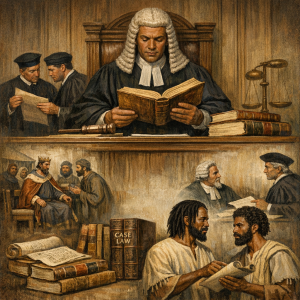
Common law is a body of legal principles developed and expressed through judicial decisions, especially decisions that interpret earlier cases, customs, and established legal doctrines. In its central modern sense, it is law derived from precedent rather than rules created exclusively by a legislature in statutes or by an executive agency in regulations. A common-law rule remains subject to constitutions, valid legislation, and other superior legal authority.
The term has several related meanings that must be distinguished:
- Judge-developed law: Rules articulated through court decisions, such as many traditional principles of contracts, torts, property, agency, and remedies.
- A legal tradition: The family of legal systems descended substantially from English law, including those of England and Wales, the United States, Canada outside Quebec’s private-law system, Australia, New Zealand, and numerous other jurisdictions.
- Law contrasted with equity: Historically, “common law” referred to rules and remedies administered by the royal common-law courts, as distinguished from equitable doctrines administered by the Court of Chancery.
- Law common to the realm: In medieval England, the expression identified law administered through royal institutions throughout the kingdom, as opposed to customs confined to a particular locality, manor, or community.
Common law is not simply any unwritten moral principle, nor is it whatever an individual considers naturally just. It is an institutional form of law recognized and applied by courts possessing lawful jurisdiction. Although historically described as “unwritten law,” it has long been preserved in plea rolls, Year Books, judicial reports, treatises, and modern electronic databases.
Etymology and Origin
The expression developed from Middle English forms such as comune lawe and the Anglo-Norman legal phrase commune ley, meaning law shared or held in common. The word “common” referred primarily to the law’s general application across the jurisdiction, not to law privately created by ordinary people and not specifically to communal ownership.
The English common law emerged gradually after the Norman Conquest of 1066. Its decisive institutional development is generally associated with the royal courts and administrative reforms of the twelfth century, particularly during the reign of Henry II from 1154 to 1189. Royal justices travelled in circuits, heard disputes, applied royal procedures, and brought knowledge of regional practices back to the central courts. Through repeated adjudication, selected customs and royal rules became increasingly uniform. The Courts and Tribunals Judiciary of England and Wales describes these national rules as “common to all,” in contrast with the local customs they displaced or absorbed. ([judiciary.uk](https://www.judiciary.uk/about-the-judiciary/history-of-the-judiciary-in-england-and-wales/history-of-the-judiciary/?utm_source=openai))
This origin should not be oversimplified. Common law was neither invented at one moment by Henry II nor merely discovered intact in ancient popular custom. It grew from royal authority, customary practices, procedural writs, jury institutions, judicial reasoning, feudal relationships, and changing social conditions. Canon law, merchant custom, Roman legal learning, and other bodies of thought influenced particular areas, but English common law remained institutionally distinct from the university-based Roman and canon-law tradition known in continental Europe.
Cultural and Historical Context
Royal Courts, Writs, and Precedent
Early common-law litigation depended heavily on the royal writ system. A claimant ordinarily needed an authorized form of action before a royal court would hear the dispute. Different writs carried different procedures, elements, and remedies. This structure promoted regularity but could also become rigid: a person might suffer a genuine wrong yet fail because no suitable form of action existed or because the wrong procedure had been selected.
Judicial decisions were recorded and discussed in medieval Year Books and, later, in named law reports. Over time, lawyers treated prior decisions as persuasive evidence of the law. The modern doctrine of stare decisis—standing by matters decided—developed into a more systematic rule under which lower courts generally follow relevant holdings of superior courts. The controlling component of a decision is commonly called its ratio decidendi, the legal reasoning necessary to the result. Other observations, called obiter dicta, may be influential without being binding.
Precedent does not require mechanically identical outcomes. Courts may distinguish an earlier decision because of materially different facts, narrow its interpretation, reconcile it with another line of authority, or, when institutionally permitted, overrule it. Consequently, common law combines continuity with gradual change.
Magna Carta, Coke, and Blackstone
Magna Carta was not the beginning of common law, but it became an important symbol within the broader common-law constitutional tradition. The charter of 1215 addressed feudal grievances and baronial rights, while later reissues preserved principles associated with lawful judgment, the law of the land, and the refusal to sell, deny, or delay justice. Its historical beneficiaries were initially limited, but later generations interpreted its language more broadly as a restraint upon arbitrary government. ([archives.gov](https://www.archives.gov/exhibits/featured-documents/magna-carta?utm_source=openai))
Sir Edward Coke’s writings and William Blackstone’s four-volume Commentaries on the Laws of England, published from 1765 to 1769, helped organize and transmit the tradition. Blackstone described general customs as forming the common law and treated judicial decisions as principal evidence of those customs. This “declaratory theory” maintained that judges declared pre-existing law rather than created it. Modern legal historians generally consider that description incomplete, because adjudication plainly develops, modifies, and sometimes creates operative rules even when judges present their work as interpretation. ([gutenberg.org](https://www.gutenberg.org/files/30802/30802-h/30802-h.htm?utm_source=openai))
Expansion Beyond England
English settlers and colonial governments carried common-law concepts into North America and other territories. After American independence, states generally retained portions of English law through constitutions, reception statutes, or judicial practice, but only insofar as those rules were applicable to local conditions and had not been displaced. American common law therefore developed into the separate law of the several states rather than remaining a single body controlled by English courts.
The spread of common law across the world was also connected to British imperial expansion. That history produced durable judicial institutions and transnational legal vocabulary, but it also involved the displacement or subordination of Indigenous and local legal orders. Modern common-law jurisdictions consequently differ substantially from one another and may combine English-derived doctrine with constitutions, comprehensive statutes, customary law, religious law, or mixed civil-law elements.
Biblical / Torah Context
The Torah is not the documented institutional origin of English common law. Biblical law, Jewish law, canon law, natural-law theory, and common law are related in parts of Western intellectual history, but they are not interchangeable systems.
The Torah nevertheless contains principles relevant to judicial responsibility. Exodus 18 describes the delegation of disputes among judges, with difficult matters referred to Moses. Deuteronomy 16:18–20 commands the appointment of judges and officials, condemns partiality and bribery, and calls for the pursuit of justice. Deuteronomy 17:8–13 provides for difficult controversies to be submitted to an authoritative tribunal. These passages concern ordered adjudication, institutional responsibility, and righteous judgment, themes that can be compared with later ideas of appellate authority and the rule of law. Such comparisons are interpretive analogies, not proof that the English doctrine of precedent originated in the Torah. ([sefaria.org](https://www.sefaria.org/Deuteronomy.16?utm_source=openai))
Jewish law developed its own extensive jurisprudence through written Torah, oral tradition, rabbinic interpretation, responsa, communal enactments, and courts applying halakhic authority. It should not be relabelled “common law” merely because judges interpreted inherited rules or reasoned from earlier decisions. Similar methods can arise within legally distinct traditions.
Biblical ideas did influence portions of English and American legal culture. Christianity shaped medieval institutions, and some colonial governments—especially Puritan settlements in New England—expressly drew upon biblical norms. Scholars dispute the extent to which specific common-law doctrines can be traced directly to Scripture rather than to Germanic custom, royal administration, canon law, Roman law, political conflict, or later judicial innovation. Claims that the whole common law is simply Christianity or Mosaic law should therefore be identified as theological or historical arguments, not settled legal history. ([academic.oup.com](https://academic.oup.com/edited-volume/28285/chapter-abstract/214479165?utm_source=openai))
Legal Implications
Authority and Hierarchy
A common-law rule operates within a hierarchy of authority. In the United States, a valid constitutional provision controls conflicting statutes and judicial doctrines; a valid statute ordinarily displaces inconsistent common law; and administrative regulations may control when issued under lawful delegated authority. Courts frequently presume that legislation does not abolish longstanding common-law principles beyond what the statutory language and purpose require, but the applicable rule varies by jurisdiction and subject.
Legislatures may codify, modify, or abolish common-law doctrines. A rule may therefore begin in judicial decisions, be restated by statute, and later be interpreted through another series of decisions. Calling a jurisdiction “common law” does not mean that it lacks codes. Modern common-law nations possess extensive statutory and regulatory systems.
United States Federal and State Law
Most American common law is state law. Each state has its own courts, precedents, reception history, and statutory modifications. A tort or contract rule recognized in one state may differ from the rule applied in another.
In Erie Railroad Co. v. Tompkins, decided in 1938, the United States Supreme Court rejected the former idea of a general federal common law. Federal courts adjudicating state-law issues must apply the relevant state substantive law, including authoritative state judicial decisions. Limited federal common law continues in defined areas involving distinct federal interests, but federal courts do not possess an unrestricted authority to create a general national law of contracts, torts, or property. ([law.cornell.edu](https://www.law.cornell.edu/wex/erie_doctrine?utm_source=openai))
The Seventh Amendment’s reference to “Suits at common law” uses the expression in its historical law-versus-equity sense. It protects the civil jury right in legal actions of the relevant kind, rather than converting every dispute involving judge-made doctrine into a jury case. ([constitution.congress.gov](https://constitution.congress.gov/browse/amendment-7/?utm_source=openai))
Common Law and Equity
Equity developed partly because the forms and remedies of the common-law courts could be too narrow. Petitioners sought relief through the Chancellor, whose court developed doctrines such as trusts, fiduciary duties, specific performance, injunctions, equitable estoppel, and the requirement of clean hands. Common-law courts traditionally awarded damages, while equity could order a person to act or refrain from acting.
England’s Judicature Acts of 1873 and 1875 unified the administration of law and equity. In the United States, the Federal Rules of Civil Procedure merged their federal procedural administration in 1938. The historical distinction still matters when determining remedies, jury rights, defenses, and standards of review. Procedural merger did not erase the substantive characteristics of equitable relief. ([law.cornell.edu](https://www.law.cornell.edu/wex/court_of_equity?utm_source=openai))
Criminal and Military Law
Historically, common-law courts recognized offenses such as murder, burglary, and larceny before comprehensive criminal codes existed. Modern American criminal law is predominantly statutory, and many jurisdictions do not permit punishment for an offense unless legislation defines it. Common-law history may still assist courts in interpreting statutory terms, elements, defenses, and required mental states.
Military law should not be confused with civilian common law. The present United States military justice system is principally governed by the congressionally enacted Uniform Code of Military Justice, together with executive rules and military appellate precedent. Common-law reasoning may influence interpretation, but it cannot supersede controlling constitutional and statutory military authority. ([law.cornell.edu](https://www.law.cornell.edu/wex/ucmj?utm_source=openai))
Spiritual Meaning
In spiritual or philosophical discussion, common law may symbolize the disciplined pursuit of justice through accumulated communal experience. Its reliance on reasoned decisions can represent humility: a present judge does not begin with a blank slate but receives an inheritance, examines how it operated, and remains accountable for any departure.
This perspective may connect common law with moral themes such as impartial judgment, protection of the weak, fidelity to promises, restitution for injury, and restraint of arbitrary power. The ideal is not that inherited rules are automatically righteous, but that judgment should be reasoned, public, consistent, and capable of correction.
These are interpretive meanings rather than enforceable definitions. A spiritual conviction, private declaration, or appeal to “higher common law” does not by itself create jurisdiction, nullify legislation, discharge a debt, or excuse noncompliance with a lawful court order.
Modern Usage
Modern speakers use the term in several settings:
- Common-law claim: A cause of action substantially developed through cases, such as negligence, defamation, fraud, or breach of fiduciary duty, subject to jurisdictional differences and statutory alteration.
- Common-law system: A jurisdiction in which precedent and adversarial adjudication occupy an important role, even though legislation may supply most operative rules.
- Common-law marriage: A legally recognized marital relationship arising without a conventional license or ceremony when the requirements of the governing jurisdiction are satisfied. Mere cohabitation does not automatically create such a marriage everywhere.
- Common-law rights: Rights recognized without reliance upon the particular statutory registration system under discussion, as in certain uses of trademarks and property doctrines.
- Common-law remedy: Traditionally, a remedy at law—most notably damages—as distinguished from an equitable remedy such as an injunction.
The meaning must always be determined from context. “Common law” may refer to a source of rules, an entire legal family, a historical court system, or a specialized doctrine.
Controversies / Criticisms
Supporters praise common law for flexibility, practical reasoning, and the ability to adapt doctrine incrementally to new circumstances. Critics answer that judicial development may be slow, expensive, difficult for nonlawyers to discover, and dependent upon litigants having sufficient resources to bring suitable cases.
A continuing constitutional debate concerns judicial lawmaking. One view holds that judges legitimately develop law when they resolve actual disputes within inherited doctrine. Another warns that major policy choices should be made by elected legislatures rather than unelected courts. The declaratory language of “finding” law can obscure the degree of choice involved in extending, distinguishing, or overruling precedent.
Historical criticism also observes that common-law rules sometimes reflected feudal hierarchy, colonial power, restrictions on women’s legal capacity, racial exclusion, and economic privilege. The fact that a rule is ancient does not establish that it is just. The tradition has endured partly because constitutions, statutes, courts, and social movements have repeatedly revised it.
Finally, “common law” is sometimes invoked in sovereign-citizen, tax-protester, or self-created tribunal theories. Such arguments may claim that an individual can opt out of statutes, defeat governmental jurisdiction through special wording, or establish a private “common-law court” whose documents bind public institutions. These propositions are not part of recognized modern common law and have repeatedly been rejected by courts. Reliance upon them can result in dismissal, sanctions, tax penalties, or criminal liability. ([irs.gov](https://www.irs.gov/privacy-disclosure/the-truth-about-frivolous-arguments-section-i-a-to-c?utm_source=openai))
Conclusion
Common law is an evolving legal tradition rooted in the royal justice of medieval England and carried into numerous legal systems. Its distinguishing method is reasoned development through decided cases, institutional precedent, and application of inherited doctrine to new facts. It is neither purely unwritten custom nor a private moral code standing outside government.
Its authority depends upon jurisdiction and legal hierarchy. Constitutions, statutes, regulations, equity, and specialized systems such as military law interact with or limit common-law rules. Biblical and Torah principles provide meaningful comparisons concerning justice, impartiality, and judicial responsibility, but the claim that English common law originated wholly in Scripture is historically disputed.
Properly understood, common law represents both inheritance and revision: past judgments constrain present decision-makers, yet no human legal tradition is beyond examination, correction, or lawful change.
Sources / Further Reading
- Cornell Legal Information Institute, “Common Law”: https://www.law.cornell.edu/wex/common_law
- Courts and Tribunals Judiciary, “Overview of the Judiciary”: https://www.judiciary.uk/about-the-judiciary/history-of-the-judiciary-in-england-and-wales/history-of-the-judiciary/
- William Blackstone, Commentaries on the Laws of England, Book I: https://www.gutenberg.org/files/30802/30802-h/30802-h.htm
- United States National Archives, “Magna Carta”: https://www.archives.gov/exhibits/featured-documents/magna-carta
- Erie Railroad Co. v. Tompkins, 304 U.S. 64 (1938): https://www.law.cornell.edu/supremecourt/text/304/64
- Congress.gov, Constitution Annotated, Seventh Amendment: https://constitution.congress.gov/browse/amendment-7/
- Courts and Tribunals Judiciary, “Introduction to the Chancery Division”: https://www.judiciary.uk/courts-and-tribunals/business-and-property-courts/chancery-division/the-work-of-the-chancery-division/introduction-to-the-chancery-division/
- Sefaria, Deuteronomy 16:18–20: https://www.sefaria.org/Deuteronomy.16.18-20
- Cornell Legal Information Institute, Uniform Code of Military Justice: https://www.law.cornell.edu/uscode/text/10/subtitle-A/part-II/chapter-47
- Internal Revenue Service, “The Truth About Frivolous Arguments”: https://www.irs.gov/privacy-disclosure/the-truth-about-frivolous-tax-arguments-introduction