S
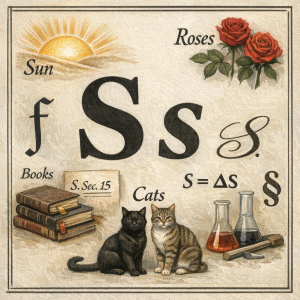
Primary Definition
In this entry, the term refers to the character S, and, where context requires, its lowercase form s. It is the nineteenth letter of the modern English alphabet and ordinarily represents a sibilant consonant sound: most commonly the voiceless sound heard at the beginning of sun, and, in other positions, often the voiced sound heard in rose. The letter may also function as a written marker rather than a sound, including in plurals, possessives, abbreviations, symbols, names, classifications, and technical notation.
A letter is not, by itself, a complete word, legal rule, office, title, or spiritual doctrine. Its meaning depends on the system in which it appears. Thus, S may identify a sound in ordinary writing; s may mark a plural or possessive; S. may be an abbreviation; and S in a scientific or administrative document may have a specialized meaning established by that document’s conventions. Sound interpretation therefore begins with context, capitalization, punctuation, neighboring words, and the governing field of use.
In ordinary English, the letter is named ess. Its common forms include capital S, lowercase s, cursive forms, and historical typographic forms such as the long s, ſ. The letter occurs with exceptional frequency in English because it serves many grammatical and lexical functions in addition to appearing in the roots of ordinary words.
Etymology and Origin
The English name ess comes through Old English and Latin naming traditions for the letter. The modern Roman character belongs to the Latin alphabet, but its ancestry reaches further back through Greek sigma and ultimately to a Semitic letter commonly identified as shin. The precise forms, sound values, and routes of transmission changed across writing systems and periods; the broad Semitic-to-Greek-to-Latin line of development is well established, while reconstructions of the earliest pictorial stages are more interpretive.
The Hebrew letter shin (ש) is related historically to the ancestral family from which Greek sigma and Latin S developed, but it is not the same character as the English letter. Nor should the English alphabetic character be treated as a direct substitute for Hebrew spelling, grammar, or theology. Similarity of historical descent does not create identity of meaning across languages.
Over time, the Roman letter acquired a form recognizable to modern readers as S. The written shape underwent substantial variation in inscriptions, manuscripts, printing, handwriting, and type design. In English printing before the nineteenth century, a long s (ſ) was often used within or at the beginning of words, while the familiar round s generally appeared at word endings. Modern readers can mistake the long s for an f, especially where the cross-stroke is absent or slight. The decline of the long s in English typography helped standardize the familiar modern form.
Its phonetic history is likewise varied. Although S most often signals /s/, English spelling preserves historical sound changes and borrowings. It can represent /z/ in words such as is, has, and rose; it can combine with other letters in digraphs and clusters, such as sh, ch in certain borrowed words, and sc; and it may be silent in a limited number of words. The written letter is therefore a conventional sign, not an infallible one-to-one transcription of sound.
Cultural and Historical Context
Alphabetic letters are instruments of literacy, recordkeeping, education, commerce, and public communication. The development of alphabetic writing made it possible to record names, transactions, laws, correspondence, religious texts, and literature with a relatively small inventory of reusable signs. Within English-speaking cultures, learning the alphabet has long been a foundational educational practice, and S commonly appears in primers, copybooks, samplers, signage, and typographic design.
The long s provides a useful reminder that the visual appearance of writing is historical. A reader encountering eighteenth-century books, early American documents, or older legal print may see ſ where modern spelling would use s. This is ordinarily a typographic convention, not proof of a different word, hidden legal capacity, or altered legal meaning. In particular, the long s should not automatically be read as an f. Accurate reading requires attention to the word as a whole and to the conventions of the document’s date and place.
In popular culture, S has often acquired symbolic force because of its shape, its initial position in salient words, or its connection to names and brands. It may suggest speed, secrecy, strength, south, smallness, size, or a person or institution whose name begins with the letter. Those associations are cultural and contextual, not inherent properties of the character.
The letter’s role in English morphology is especially important. Lowercase s commonly marks:
- the plural of many nouns, as in books;
- the third-person singular present form of many verbs, as in she writes;
- the possessive of a singular noun, as in the witness’s statement;
- the possessive of many plural nouns ending in s, ordinarily by an apostrophe after the s, as in the witnesses’ statements; and
- contractions, as in it’s for it is or it has.
These functions can produce materially different meanings. For example, citizen, citizens, citizen’s, and citizens’ do not say the same thing. In legal drafting, grammar may affect whether a duty, right, ownership interest, or group reference is singular or plural. Yet the grammatical role arises from the words and syntax, not from any independent sovereignty or legal power residing in the letter itself.
Biblical / Torah Context
The Latin letter S does not appear in the Hebrew text of the Torah. The Torah is written in Hebrew script, and responsible interpretation should not confuse an English or Latin letter with a Hebrew letter merely because a translator uses the English sound “sh” or “s.” The historically related Hebrew letter shin (ש) has its own name, shape, phonetic roles, numerical use in traditional systems, and place in Hebrew language and Jewish practice.
In Hebrew, shin may represent the “sh” sound, while a visually similar dotted form may represent an “s” sound in particular orthographic usage. This fact illustrates why an English reader should not assume that the Roman S maps neatly onto a single Hebrew character. Hebrew also has samekh (ס), a different letter associated with an s sound. Transliteration systems vary, so scholarly and religious materials may use different English-letter combinations to represent Hebrew sounds.
Shin is visibly associated with Jewish religious life. A shin may appear on a mezuzah case and is commonly understood as referring to Shaddai, a divine name used in Jewish tradition. The mezuzah itself is connected to the Torah command to inscribe divine words upon the doorposts of one’s house and gates. The religious obligation concerns the properly prepared mezuzah scroll and its prescribed text and placement; a decorative letter or emblem alone is not equivalent to the commandment.
Some Jewish interpretive and mystical traditions draw spiritual associations from the form, name, and numerical value of Hebrew letters, including shin. Those readings should be identified as religious interpretation or tradition, rather than as a linguistic rule proving that every occurrence of the English S carries the same meaning. The historical kinship between shin and S may be of genuine interest, but it does not authorize treating the Roman letter as a Torah symbol in all settings.
Legal Implications
There is no single, free-standing “common-law definition” of the isolated letter S. Historical common law developed through judicial decisions and legal custom; it did not make every alphabetic character a separate substantive legal person, jurisdiction, status, or source of authority. Roman law likewise does not supply a general rule that transforms S, standing alone, into a universal legal term. Equity, statutes, court rules, contracts, administrative forms, and legal citation manuals may assign particular meanings to letters or abbreviations, but those meanings are local to the applicable instrument or convention.
Statutes, Cases, and Drafting
In legal writing, letters can matter greatly when they occur as part of enacted text, a defined term, a party name, an exhibit label, a form field, or an abbreviation. A statute may divide provisions into subsections such as “(a),” “(b),” or “(s).” A contract may define “Schedule S,” “Class S,” or “Seller.” A court record may use an initial to identify a party whose full identity is protected. None of these usages creates a universal legal meaning for S; each must be read according to the document’s definitions, surrounding provisions, and governing law.
Courts ordinarily interpret legal text in context. A disputed letter, capitalization choice, punctuation mark, or abbreviation may be relevant if it changes the ordinary reading of the instrument. But the proper inquiry is not whether the character possesses a hidden legal meaning. It is whether the legislature, parties, court, agency, or established drafting convention assigned it a meaning in that specific setting. Applicable statutes, rules of construction, precedent, and admissible evidence may all be relevant.
Citation and Abbreviation
In United States legal citation, the section symbol §, not the letter S, ordinarily introduces a statutory or regulatory section number. For example, “42 U.S.C. § 1983” identifies section 1983 of Title 42 of the United States Code. In some British and Commonwealth legal materials, s. may abbreviate section, while ss. may indicate multiple sections. Citation style varies by jurisdiction, court, publisher, and document type.
Similarly, S may appear within names of courts, reporters, statutes, agencies, or parties. It can mean “South,” “Supreme,” “Senate,” “Schedule,” “Series,” “State,” or something else only when the pertinent citation system, statute, form, or record establishes that usage. A reader should not detach an initial from its document and assign it a different legal effect.
Signature, Name, and Authentication
An initial may sometimes appear in a signature, attestation, exhibit label, or identifying mark. Whether it is legally sufficient depends on the law governing the transaction and the facts of execution, intent, authentication, authority, and any applicable statutory formalities. An S may be part of a valid signature if adopted with intent to authenticate a record, but it is not automatically a signature merely because the character appears on paper. Conversely, a signature need not always be written in full legal name. The governing law and evidence, not folklore about letters, determine the issue.
Governmental and Military Usage
Government and military organizations use S in specialized administrative classifications. In United States Army battalion and brigade staff usage, for example, S-1 commonly refers to personnel functions, S-2 to intelligence, S-3 to operations, and S-4 to logistics. This is an organizational nomenclature, not a common-law doctrine and not a general civilian legal definition. Other armed forces, agencies, and governments may use different systems.
Spiritual Meaning
As a matter of documented linguistic fact, S is a letter. Spiritual meaning arises when a religious or philosophical tradition, community, or individual gives the character symbolic significance. Such meaning can be sincere and valuable to adherents, but it should not be confused with universally binding historical fact.
For Jewish readers, the relevant spiritual discussion ordinarily concerns shin rather than the Roman S. Shin’s use in connection with the divine name Shaddai and the mezuzah has established traditional significance. In Christian, esoteric, and popular symbolic writing, authors sometimes attach broad ideas—such as salvation, spirit, serpent, sound, or sovereignty—to S. These associations vary sharply between sources and are often interpretive rather than textually required.
The dictionary’s interpretive analysis is therefore cautious: a letter may serve as a prompt for contemplation, memory, prayer, or identity within a defined tradition, but a symbol should not be made to carry legal, theological, or personal claims beyond what the relevant text, tradition, and evidence support.
Modern Usage
Modern usage is extensive and discipline-specific. In addition to ordinary spelling and grammar, S may appear in the following ways:
- Science: S is the chemical symbol for sulfur; lowercase s is the International System of Units symbol for the second.
- Mathematics and logic: S may denote a set, a sum, a surface, a sample, or another variable chosen by the author. It has no fixed meaning without definitions.
- Geography: S may abbreviate south on maps, directions, and navigational materials.
- Education and grading: an institution may use S for “satisfactory,” but grading systems are not uniform.
- Music: S may appear in performance directions, voice-part labels, catalogues, or chord notation, according to the relevant convention.
- Commerce: S may be a size, model, stock class, product designation, or brand element, with meaning set by the seller or manufacturer.
- Digital communication: S may be used as an initial, username element, command notation, programming variable, or component of an acronym.
Capitalization is often decisive. Lowercase s may be a grammatical ending or unit symbol, while uppercase S may be a proper initial, chemical symbol, directional abbreviation, or variable. Technical standards generally distinguish upper- and lowercase symbols; substituting one for the other can alter meaning.
Controversies / Criticisms
Claims about letters often become controversial when ordinary typography is treated as hidden proof of legal or spiritual propositions. A frequent error is to infer that capitalization, a stylized signature, a long s, an initial, or an abbreviation automatically changes a person’s legal status or creates a separate legal entity. Such claims require actual legal authority: an applicable statute, case, rule, contract, or documented administrative practice. Mere visual resemblance, wordplay, or unsupported assertion is not legal proof.
Another error is to impose a modern symbolic reading on ancient scripts without distinguishing historical evidence from devotional interpretation. The Latin S has a documented ancestral relationship to Semitic letter forms, but that relationship does not mean that every English S conveys the religious meaning of shin, nor that modern English documents contain concealed Hebrew theology.
Finally, readers should be cautious with claims that an isolated letter has a universal military, governmental, commercial, or legal meaning. Abbreviations are useful precisely because institutions define them for limited contexts. A sound method is to identify the document, date, jurisdiction, issuing body, and applicable glossary or citation manual before drawing conclusions.
Conclusion
S is a foundational alphabetic character whose significance is broad because writing systems reuse it in language, grammar, classification, symbolism, and technical notation. Its primary meaning is straightforward: it is the nineteenth letter of the English alphabet, usually named ess. Its deeper historical interest lies in its development through the Latin and Greek alphabets from an older Semitic letter tradition, its changing typographic forms, and its many contextual functions.
In law, S has no universal common-law power or independent juridical definition. Its legal effect, if any, comes from the particular statute, case citation, contract, form, signature, or institutional convention in which it appears. In Torah and Jewish tradition, discussion should distinguish the Roman S from Hebrew shin and samekh, while recognizing shin’s genuine historical and religious importance. Careful reading requires context, source-based research, and a clear separation between documented fact, interpretive meaning, and disputed assertion.
Sources / Further Reading
- Oxford Advanced Learner’s Dictionary, “S”
- Ancient Hebrew Research Center, “The Ancient Hebrew Alphabet: Shin”
- Smithsonian National Museum of American History, “American Samplers”
- Library of Congress, “Cadmus and Ts’ang Chieh”
- Cornell Law School Legal Information Institute, “Basic Legal Citation”
- United States Army, “Functional and Integrating Cells Within Sustainment Brigade Staffs”
- Chabad.org, Torah commentary concerning mezuzah and the name Shaddai