Woman
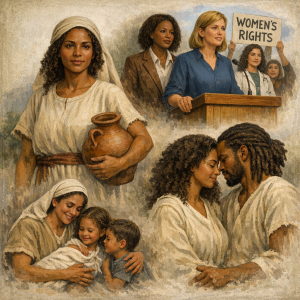
Primary Definition
In ordinary modern English, woman most commonly means an adult female human being. The word may also be used collectively, as in “women” or “womanhood,” to refer to females as a class, or more particularly to refer to an individual’s social, familial, civic, religious, or personal identity. Dictionaries commonly distinguish an adult woman from a girl, while also recognizing broader uses that refer to females generally or to women as a group. ([merriam-webster.com](https://www.merriam-webster.com/dictionary/women?utm_source=openai))
A dictionary definition should identify the ordinary meaning without pretending that every context uses the word in exactly the same way. In biological, reproductive, medical, and many sex-specific legal contexts, woman ordinarily refers to an adult human female. In social and personal contexts, the word may be used in relation to gender identity, social role, self-description, or presentation. The relationship between sex, gender, identity, language, and law is now a subject of substantial public disagreement. Therefore, a careful reader should ask: Who is using the word, for what purpose, and under what governing rule?
This entry uses “female” in its ordinary sex-based sense when discussing biology, historical sex classifications, or laws that expressly employ sex-based categories. It uses “gender identity” for a person’s internal sense or public identification as a woman, man, both, neither, or another identity. These categories may overlap in many people’s lives, but they are not treated as identical in every discipline, institution, or legal system.
Etymology and Origin
The English word woman comes from Old English wīfmann, formed from wīf, then meaning “woman” or “female,” and mann, then meaning a human person. It entered Middle English in changing forms, including wimman and womman, before developing into the modern spelling and pronunciation. The plural women preserves an older vowel pattern in pronunciation. ([merriam-webster.com](https://www.merriam-webster.com/dictionary/women?utm_source=openai))
The modern appearance of the ending -man often causes people to suppose that woman literally means “a man with a female prefix” or that the word was created to define females as derivative of males. That is not a sound account of the Old English terms. In the relevant historical period, mann could mean “person” or “human being” without necessarily identifying a male. Thus, wīfmann meant, in substance, a female human person. The later narrowing of man toward “adult male” can make the older compound look different to a modern reader than it was historically.
Nor is woman derived from “womb-man.” That explanation is a folk etymology, not a documented linguistic origin. The resemblance between woman and womb in present-day spelling and sound does not establish a shared formation. Likewise, the word’s derivation from wīf should not be confused with a claim that every woman is a wife. In Old English, the ancestor of wife had a wider meaning than the present word.
Alternative spellings such as womyn, wimmin, and womxn are modern, deliberate constructions rather than historical ancestors of the ordinary English word. Some writers have adopted them to reject what they view as male-centered language, to signal feminist or gender-inclusive commitments, or to distinguish particular communities and political perspectives. Others object that such spellings obscure established language, create confusion, or imply an etymology that is not historically correct. Their use is therefore primarily expressive and ideological, rather than lexicographical.
Cultural and Historical Context
The meaning of woman has always been shaped by more than anatomy. In many societies, women’s lives have been organized around kinship, marriage, motherhood, household labor, inheritance, religion, and political status. These arrangements varied significantly by time and place. It is inaccurate to describe all historic women as having had one uniform condition, just as it is inaccurate to assume that a word’s ordinary meaning alone determines the rights a society grants to the people described by it.
In English legal and social history, a major distinction was often drawn between an unmarried woman, a married woman, and a widow. Marriage could change a woman’s capacity to own, control, convey, or recover property; enter contracts; bring legal actions; or exercise independent authority. Under the common-law doctrine generally called coverture, husband and wife were treated, for many legal purposes, as one legal person. Blackstone’s eighteenth-century description stated that a married woman’s legal existence was, in important respects, merged into that of her husband. That statement describes an historical legal doctrine, not a rule of current American law. ([avalon.law.yale.edu](https://avalon.law.yale.edu/18th_century/blackstone_bk2ch29.asp?utm_source=openai))
The legal effects of coverture were neither completely uniform nor absolute. Courts of equity developed devices by which married women could hold separate estates in some circumstances, and statutes later expanded married women’s property and contractual rights. The historical record therefore should not be reduced either to the claim that women had no legal interests whatever or to the opposite claim that coverture imposed no serious legal disability. The better conclusion is that women’s independent legal capacity was materially restricted in many common-law settings, though modified by equity, custom, settlements, local statutes, and changing judicial practice.
In the United States, women’s political and civil status changed through state legislation, constitutional developments, court decisions, social reform, and organized advocacy. The Nineteenth Amendment, proposed by Congress on June 4, 1919, and ratified on August 18, 1920, prohibited denial or abridgment of the right to vote on account of sex. Its adoption was a major constitutional milestone, although practical access to voting continued to be impaired for many women—particularly Black women in parts of the country—by racial discrimination and other unlawful barriers. ([guides.loc.gov](https://guides.loc.gov/19th-amendment?utm_source=openai))
During the twentieth century, the word increasingly appeared in discussions of equal citizenship, access to education, employment, property, jury service, public office, family autonomy, sexual violence, reproductive questions, and equal protection. Feminist movements have not been a single doctrine. Liberal, radical, socialist, religious, maternal, Black, Indigenous, lesbian, conservative, and other feminist traditions have often agreed that women should not be treated as inferior, while disagreeing sharply about family, sexuality, work, law, race, religion, and the basis of womanhood itself.
Biblical / Torah Context
The English word woman does not come from Hebrew, Greek, Latin, Roman law, or biblical translation. Biblical passages may shape the religious understanding of women for Jews and Christians, but they do not provide the etymology of the English term.
In the Torah’s creation narrative, Genesis 2:23 contains a Hebrew wordplay between ish (man) and ishah (woman): the woman is described in relation to the man from whom she was formed in the narrative. This is a Hebrew literary and theological wordplay, not the origin of the English words man and woman. Genesis 1:27 also presents humankind as created male and female and describes both as bearing the image of God. Jewish and Christian interpreters have drawn differing conclusions from these passages regarding equality, marriage, authority, family, and vocation.
Other biblical texts portray women in diverse roles: mothers, daughters, wives, widows, prophets, judges, workers, patrons, disciples, rulers, and covenant participants. Miriam, Deborah, Ruth, Hannah, Esther, Huldah, Mary, Mary Magdalene, Priscilla, Lydia, and Phoebe are among the women given significant places in biblical literature and later Jewish or Christian interpretation. The existence of these accounts does not eliminate difficult passages concerning patriarchy, inheritance, purity, marriage, divorce, or authority; rather, it shows that biblical treatment of women is extensive and cannot fairly be reduced to one verse or slogan.
Within Torah law, women are moral persons under covenantal obligations and protections, while certain rules distinguish male and female roles in matters such as ritual status, inheritance, vows, marriage, and lineage. Modern Jewish communities interpret and apply those texts differently. Orthodox, Conservative, Reform, Reconstructionist, secular Jewish, and other approaches may reach different conclusions about women’s ritual obligations and leadership. A dictionary entry should recognize both the texts and the reality of interpretive diversity.
Legal Implications
Historical Common Law, Equity, and Civil-Law Concepts
Historically, English common law used terms such as woman, wife, feme sole, and feme covert to identify legal status. A feme sole was generally an unmarried woman with legal capacity to act in her own name; a feme covert was a married woman whose legal position was affected by coverture. These are historical common-law classifications. They should not be casually cited as if they remain controlling descriptions of women’s legal capacity in the United States today.
Equity did not simply duplicate common law. Chancery courts could recognize separate property arrangements and trusts for married women, softening some common-law consequences of coverture. Roman law had its own institutions concerning family authority, marriage, property, and guardianship; those institutions are not the source of every English or American rule concerning women. Claims that all current legal meanings of woman derive directly from Roman law, ecclesiastical law, or a single ancient legal system ordinarily overstate a far more complex history.
Current United States Law
There is no one universal definition of woman that controls every American legal question. Statutes, regulations, judicial decisions, constitutional provisions, agency rules, contracts, institutional policies, and state laws may use different terms and pursue different purposes. A definition applicable to a medical record, prison housing policy, athletic eligibility rule, anti-discrimination statute, passport record, family-law proceeding, or private organization may not automatically control another setting.
Federal civil-rights law often uses the term sex, rather than defining woman in a single general provision. Title VII prohibits covered employment discrimination because of sex, among other protected characteristics. In Bostock v. Clayton County (2020), the United States Supreme Court held that an employer who fires an individual merely for being gay or transgender violates Title VII’s prohibition on discrimination because of sex. The Court decided an employment-discrimination question under Title VII; it did not issue a comprehensive dictionary definition of woman for all federal or state law. ([supremecourt.gov](https://www.supremecourt.gov/opinions/19pdf/590us2r44_6kgn.pdf?utm_source=openai))
Title IX provides that no person in the United States shall, on the basis of sex, be excluded from participation in, denied benefits of, or subjected to discrimination under covered education programs receiving federal financial assistance, subject to statutory exceptions. Questions concerning sex-separated sports, facilities, admissions, privacy, and gender identity have produced changing regulations, litigation, and conflicting public arguments. The statutory text, applicable regulations, and controlling court decisions should be consulted for the particular jurisdiction and issue. ([law.cornell.edu](https://www.law.cornell.edu/uscode/text/20/1681?utm_source=openai))
On January 20, 2025, President Donald J. Trump issued Executive Order 14168, titled “Defending Women From Gender Ideology Extremism and Restoring Biological Truth to the Federal Government.” The order directs the executive branch, for federal administrative purposes, to treat sex as an immutable biological classification of male or female and defines “women” and “girls” as adult and juvenile human females, respectively. An executive order directs executive-branch policy and administration; it does not by itself amend the Constitution, repeal statutes, decide all private disputes, or settle the meaning of every state law. Its implementation may also be subject to statutory limits and judicial review. ([whitehouse.gov](https://www.whitehouse.gov/presidential-actions/2025/01/defending-women-from-gender-ideology-extremism-and-restoring-biological-truth-to-the-federal-government/?utm_source=openai))
Accordingly, legal assertions about woman should be stated precisely. It is sound to say that sex-based classifications have long been used in law and that many current laws protect women and girls as females. It is also sound to say that federal employment law, under Bostock, protects transgender persons from specified forms of employment discrimination. It is not sound to claim, without identifying the jurisdiction and rule, that one contested definition conclusively answers every legal question.
Spiritual Meaning
Spiritually, womanhood is understood in many ways. Some religious believers emphasize woman as a created, embodied reality connected with daughterhood, marriage, motherhood, nurture, wisdom, strength, and service. Others emphasize the equal spiritual worth of women and men, the individual calling of each person, and the danger of reducing a woman’s identity to reproductive capacity, marital status, appearance, or domestic role.
In Jewish and Christian thought, many interpreters find in the creation accounts both sexual distinction and shared human dignity. Other interpreters stress passages that speak of mutual responsibility, justice, mercy, and the spiritual equality of persons before God. These are theological interpretations, not scientific measurements or self-executing legal rules. A spiritually serious use of the word should avoid contempt for women, denial of their moral agency, or the treatment of women as mere instruments for another person’s purposes.
Modern Usage
In contemporary speech, woman is ordinarily the respectful general term for an adult female human being. It is generally preferable to identify an adult person as a “woman” rather than a “girl,” unless youth is relevant or the person is in fact a child. The term lady can be courteous but may carry connotations of manners, social class, or traditional femininity. The noun female is often appropriate in scientific, medical, demographic, or legal writing, though some speakers regard using it as a standalone noun for a woman as impersonal in ordinary social conversation. ([merriam-webster.com](https://www.merriam-webster.com/grammar/lady-woman-female-usage?utm_source=openai))
The word also appears in compound expressions: businesswoman, spokeswoman, policewoman, woman-owned, women’s health, women’s shelter, women’s sports, and women’s rights. Some occupational compounds are declining as gender-neutral titles become more common—for example, police officer, firefighter, or chair. Yet sex-specific terms remain important where the sex-based character of a service, study, organization, opportunity, injury pattern, or protected class is relevant.
Respectful communication requires attention to context. A person writing a medical policy may need sex-specific language. A person addressing an individual socially may choose the terms by which that individual asks to be known. Neither consideration eliminates the other. Precision, candor, courtesy, and refusal to use language as a tool of humiliation are compatible aims.
Controversies / Criticisms
The central contemporary dispute concerns whether woman should be defined exclusively by biological sex or may also include adult persons whose gender identity is female. Sex-based feminists and others argue that woman must retain a sex-based definition because female people have sex-specific bodies, medical needs, reproductive realities, historical discrimination, privacy interests, and athletic concerns. They contend that sex-based rights become unclear if the category is separated from biological sex.
Transgender-inclusive advocates argue that transgender women live socially as women and may face discrimination, violence, exclusion, and hardship specifically connected to their female gender identity or presentation. They maintain that an identity-inclusive use of woman promotes dignity and equal treatment, particularly in ordinary social life and in anti-discrimination settings.
These positions create difficult questions in particular settings, including competitive sports, detention facilities, domestic-violence shelters, changing areas, medical data collection, identification documents, education, employment, and speech. Reasonable people may disagree strongly about policy outcomes. A responsible discussion should not erase females as a sex class, nor should it deny the humanity or civil dignity of transgender people. It should distinguish a disagreement over classification or policy from permission to harass, threaten, discriminate unlawfully, or commit violence against any person.
Conclusion
Woman is an old English word with a straightforward historical formation: a female human person. Its ordinary modern sense remains an adult female human being, but its social and legal application has become disputed in some contemporary contexts involving gender identity. The word carries a long history of women’s family roles, legal disabilities, religious interpretations, civic advancement, and continuing claims to dignity and equal justice.
For legal purposes, the correct meaning depends on the governing text, jurisdiction, and factual setting. Historical common law, equity, statutory law, executive policy, and judicial precedent must not be confused with one another. For moral and civic purposes, the word should be used with both truthfulness and respect: recognizing the sex-based reality and history of women while treating every person with basic human dignity.
Sources / Further Reading
- Merriam-Webster, “Woman.”
https://www.merriam-webster.com/dictionary/woman - Oxford Advanced Learner’s Dictionary, “Woman.”
https://www.oxfordlearnersdictionaries.com/us/definition/english/woman - Yale Law School, Avalon Project, William Blackstone, Commentaries on the Laws of England, Book I, Chapter 15, “Of Husband and Wife.”
https://avalon.law.yale.edu/18th_century/blackstone_bk1ch15.asp - Yale Law School, Avalon Project, William Blackstone, Commentaries on the Laws of England, Book II, Chapter 29.
https://avalon.law.yale.edu/18th_century/blackstone_bk2ch29.asp - Library of Congress, “19th Amendment to the U.S. Constitution: Primary Documents in American History.”
https://guides.loc.gov/19th-amendment - United States Code, 42 U.S.C. § 2000e-2, unlawful employment practices.
https://www.law.cornell.edu/uscode/text/42/2000e-2 - United States Code, 20 U.S.C. § 1681, Title IX sex-discrimination prohibition.
https://www.law.cornell.edu/uscode/text/20/1681 - Supreme Court of the United States, Bostock v. Clayton County, 590 U.S. 644 (2020).
https://www.supremecourt.gov/opinions/19pdf/17-1618_hfci.pdf - The White House, Executive Order 14168, January 20, 2025, “Defending Women From Gender Ideology Extremism and Restoring Biological Truth to the Federal Government.”
https://www.whitehouse.gov/presidential-actions/2025/01/defending-women-from-gender-ideology-extremism-and-restoring-biological-truth-to-the-federal-government/ - Sefaria, Genesis 1–2, Hebrew and English text.
https://www.sefaria.org/Genesis.1.27?lang=bi
https://www.sefaria.org/Genesis.2.23?lang=bi