Worship
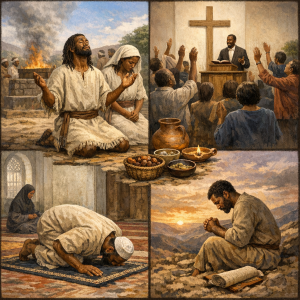
Primary Definition
Worship is the act, practice, or disposition of giving profound honor, reverence, devotion, obedience, or adoration to that which a person or community regards as supremely worthy. In its principal religious sense, worship is directed toward God, a deity, or the sacred. It may be expressed inwardly through faith, gratitude, repentance, meditation, and submission, and outwardly through prayer, singing, sacrifice, offerings, fasting, sacred assemblies, ritual observances, service, or bodily gestures such as kneeling and bowing.
The term has both a broad and a narrow use. Broadly, it can mean exceptionally high esteem for a person, object, idea, institution, or desire: one may speak critically of the “worship” of money, celebrity, power, the state, or technology. Narrowly, it refers to formal or informal religious devotion. The narrow religious sense is usually intended when a statute, constitution, religious text, or public discussion refers to a “place of worship,” “freedom of worship,” or “religious worship.”
In dictionary usage, worship includes both the inward attitude of reverence and the outward expression of that reverence. It is therefore more than attendance at a service, recital of prescribed words, or participation in a ceremony. A person may attend a worship service without inward devotion, while another may worship privately without a congregation, building, clergy member, or formal liturgy. Conversely, many religious traditions maintain that corporate worship has a distinctive communal character that cannot be reduced to private belief alone.
In the interpretive sense used here, worship concerns the ordering of human loyalty. What a person treats as of ultimate worth tends to shape conscience, conduct, identity, sacrifice, and obedience. This observation is philosophical and spiritual analysis, not a claim that every strong interest is legally or theologically equivalent to religious worship.
Etymology and Origin
The English word worship is Germanic in origin. It comes through Middle English forms such as worþschipen and worschepen, from Old English weorþscipe or wurþscipe. The underlying elements are weorþ, meaning “worth,” “value,” or “worthy,” and the suffix -scipe, which became the modern English suffix -ship. In its oldest English sense, worship meant worthiness, honor, dignity, esteem, or recognized social standing.
This history matters because the word did not originally mean religious adoration only. It first carried the wider idea of giving due honor or acknowledging worth. Over time, English speakers increasingly used it for reverence rendered to God or to a deity, while some older secular senses survived in ceremonial language. The English honorific “Your Worship,” used for certain magistrates and municipal officials in some jurisdictions, preserves this older sense of dignity or office; it does not mean that the official is being treated as a god.
The word is not derived from Latin, Greek, Roman civil religion, canon law, or a hidden legal formula. Although Roman, Greek, Jewish, Christian, Islamic, Hindu, Buddhist, Indigenous, and other traditions each have their own concepts and vocabulary for devotion, the English word worship is an English-language term that may be used to translate many distinct religious practices. Care is therefore necessary: an English translation may communicate a general concept while obscuring important differences among the original terms.
For example, biblical Hebrew uses several words that English Bibles may translate as worship depending on context. Avodah can mean work, service, or sacred service; hishtachavah commonly refers to bowing down or prostrating oneself. Greek biblical texts use terms such as proskynesis, relating to bowing or reverence, and latreia, relating to service rendered to God. These are related concepts, but they are not etymological ancestors of the English word worship.
Cultural and Historical Context
Human communities have long marked what they consider sacred through recurring acts of devotion. Ancient worship frequently involved altars, offerings, processions, festivals, sacred meals, prayers, priestly offices, temples, music, and public vows. Such practices were often interwoven with family life, agricultural cycles, kingship, warfare, law, and civic identity. Yet no single historical model accounts for all worship. Some traditions center sacrifice; others emphasize prayer, recitation, meditation, study, ethical action, pilgrimage, chanting, silence, communal meals, or disciplined daily life.
In the ancient Near East, temple worship often involved the service of priests and offerings at designated sanctuaries. In the Hebrew Bible, worship of the God of Israel was connected with covenant obligations and was repeatedly distinguished from the worship of other gods. Israel’s prophets also criticized ritual practice detached from justice, mercy, truthfulness, and faithfulness. Thus, the biblical record does not present worship merely as ceremony; it presents it as inseparable, at least in principle, from a moral and covenantal life.
In Christianity, worship developed from Jewish patterns of prayer, Scripture reading, psalmody, feasts, and communal assembly, while taking distinctive forms centered on Jesus Christ. Liturgical churches commonly organize worship around set prayers, Scripture readings, sacraments, the Eucharist or Communion, a church calendar, and ordained ministry. Other Christian communities emphasize extemporaneous prayer, preaching, congregational singing, testimony, revival meetings, or less formal gatherings. These approaches differ in form but commonly understand worship as directed to God rather than as entertainment or mere instruction.
Islamic worship includes prescribed prayer, fasting, almsgiving, pilgrimage, recitation of the Qur’an, remembrance of God, and submission to God’s will. Hindu traditions include diverse forms of puja, devotion, offerings, temple practice, pilgrimage, meditation, and household observance. Buddhist practice varies widely and may involve chanting, meditation, offerings, veneration, ethical discipline, and devotion, though Buddhism’s doctrinal frameworks differ substantially from theistic worship. Jewish worship developed from Temple-centered sacrificial service into forms centered especially on prayer, Torah reading, study, communal life, and observance after the destruction of the Second Temple in 70 C.E.
Modern English sometimes uses “worship” carelessly as if every religion has identical beliefs about God, ritual, prayer, sacred images, sacrifice, or salvation. That is inaccurate. The word is useful as a broad descriptive category, but responsible use requires attention to the specific tradition and to the meanings its adherents give their own practices.
Biblical / Torah Context
Torah and the Hebrew Bible
The Torah places exclusive devotion to the God of Israel at the center of covenant life. The commandment against having other gods and against making or serving idols is foundational to the biblical understanding of worship. In this setting, worship is not simply private sentiment. It includes loyalty, obedience, prayer, sacred time, offerings, communal assembly, and the rejection of idolatry.
Avodah, often translated “service,” is especially important. It may describe ordinary labor, service to a master, or the sacred duties associated with the tabernacle and later the Temple. The overlap is meaningful: worship can be understood as service to God, not merely an emotional experience. Jewish sources also use the expression avodah zarah, literally “strange” or “foreign service,” for idolatry or worship directed away from the God of Israel.
The Torah establishes the Sabbath and annual appointed times as sacred rhythms. Passover, the Feast of Weeks, the Feast of Booths, the Day of Atonement, and other observances joined memory, communal identity, rest, thanksgiving, repentance, and devotion. The Temple sacrificial system had a historical role in Israelite worship, but it should not be assumed that sacrifice exhausts the biblical meaning of worship. Prayer, blessing, hearing the law, thanksgiving, covenant faithfulness, and acts of justice also figure prominently in the biblical record.
The prophets strongly warn against hypocrisy: outward offerings cannot justify oppression, dishonesty, violence, or disregard for the poor. This prophetic critique does not necessarily reject worship itself; rather, it rejects the use of religious ritual as a substitute for righteousness. That distinction remains influential in Jewish and Christian moral teaching.
New Testament Context
The New Testament continues the Jewish language of prayer, praise, Scripture, thanksgiving, fasting, feasts, and communal gathering. It also presents worship as involving the whole life of the believer. Christians commonly cite passages that speak of offering oneself to God, praying in spirit and truth, gathering for teaching and fellowship, singing psalms and hymns, and remembering Christ in the breaking of bread.
Christian theology differs among denominations concerning sacraments, ordained ministry, saints, icons, the Eucharist, and the proper forms of corporate worship. Roman Catholic, Eastern Orthodox, and many Anglican and Lutheran traditions carefully distinguish adoration due to God from honor or veneration given to saints. Many Protestant traditions reject practices they believe may blur that distinction. These are genuine theological disagreements; they should not be settled merely by asserting that one group “worships” what another calls veneration.
Legal Implications
In common-law history, worship was not a technical word that independently created jurisdiction, property rights, immunity, or exemption from law. Its older secular usage appears in titles of honor and in references to dignitaries, corporations, guilds, and municipal offices. “Your Worship” is an honorific form of address in certain legal and civic settings. It recognizes office or dignity; it does not establish a separate legal status, transform a court into an ecclesiastical body, or require personal religious reverence.
In the United States, legal protection for worship arises principally from constitutional law, statutes, and judicial decisions, rather than from the English common-law meaning of the word. The First Amendment provides that Congress shall make no law respecting an establishment of religion or prohibiting the free exercise thereof. Through the Fourteenth Amendment, these protections apply to state and local governments as well.
The Free Exercise Clause protects religious belief absolutely in the ordinary constitutional sense, but religiously motivated conduct may sometimes be regulated. Under Employment Division v. Smith (1990), a neutral law of general applicability ordinarily does not violate the Free Exercise Clause merely because it incidentally burdens religious conduct. However, a law that targets religious practice or is not generally applicable may be subject to strict scrutiny. In Church of Lukumi Babalu Aye, Inc. v. City of Hialeah (1993), the United States Supreme Court held that city ordinances directed at Santería animal-sacrifice practices were neither neutral nor generally applicable and therefore violated the Free Exercise Clause.
Congress enacted the Religious Freedom Restoration Act of 1993 (RFRA) in response to Smith. RFRA generally provides that the federal government may not substantially burden a person’s exercise of religion unless it demonstrates a compelling governmental interest pursued through the least restrictive means. The Supreme Court later held in City of Boerne v. Flores (1997) that RFRA could not constitutionally be applied to state and local governments through Congress’s Fourteenth Amendment enforcement power. RFRA nevertheless remains applicable to the federal government, while many states have their own constitutional protections, statutes, or state-level religious-freedom restoration acts.
The Establishment Clause supplies the corresponding limitation: government may not establish an official religion, coerce worship, or improperly favor one religion over another. The Constitution protects the liberty to worship, but also the liberty not to worship. Governmental neutrality does not require hostility toward religion, nor does it permit governmental compulsion of religious observance.
Legal controversies concerning worship may involve zoning and land use, access to places of worship, prison religious exercise, workplace accommodation, school policies, public prayer, religious dress, sacred objects, and ceremonial practices. The answer depends on the governing constitution, statute, regulation, and facts of the specific case. No general assertion of “freedom of worship” automatically overrides every neutral law, contract, court order, public-safety rule, or the legally protected rights of other persons.
Spiritual Meaning
Spiritually, worship is often understood as a right response to the holy: recognition of divine greatness, gratitude for life and mercy, confession of human limitation, and willing alignment with truth. In many traditions, worship is not chiefly about obtaining material benefit. It is an act of acknowledging that the worshipper is not the ultimate center or authority.
This perspective also explains why idolatry is treated seriously in biblical and many other religious teachings. Idolatry may refer literally to devotion before an image or another god, but it can also function as a moral and spiritual diagnosis of misplaced ultimate loyalty. Wealth, nation, ideology, appetite, status, fear, and personal autonomy may become “idols” when they are treated as absolute and permitted to govern conscience. This extended use is interpretive and devotional; it should not be confused with a legal definition of idolatry or used to condemn others casually.
Authentic worship, by this understanding, bears fruit in humility, justice, mercy, truthfulness, self-restraint, courage, and service. Ritual without moral transformation can become empty formalism; moral activism without reverence may likewise lose the spiritual orientation that worship seeks to preserve. Different faiths describe the relationship between devotion and ethical life differently, but the connection is widespread.
Modern Usage
Today, worship commonly refers to a religious service, especially in Christian settings: “Sunday worship,” “a worship team,” or “a worship service.” The phrase may refer narrowly to congregational music, although historically and theologically worship is broader than singing. Prayer, preaching, sacraments, Scripture reading, silence, giving, confession, and acts of service may all be understood as parts of worship.
The expression “place of worship” is widely used in law and public administration as an inclusive category for churches, synagogues, mosques, temples, meetinghouses, shrines, and other locations used for religious assembly. The phrase should not imply that all faiths worship in the same way or require the same kind of building.
In secular speech, “worship” is often deliberately hyperbolic or critical: “hero worship,” “celebrity worship,” “the worship of success,” or “the worship of the market.” Such uses retain the older idea of assigning excessive worth or devotion. They may be rhetorically effective, but they can also obscure the difference between admiration and actual religious practice.
Controversies / Criticisms
One controversy concerns whether worship is primarily inward, outward, individual, or communal. Some believers emphasize personal prayer and conscience; others stress that worship properly includes a gathered body, inherited liturgy, sacraments, or authoritative communal practice. These views may overlap, but they are not identical.
Another controversy involves the line between reverence, honor, veneration, and worship. The distinction is particularly important in debates concerning religious images, saints, relics, sacred sites, clergy, national symbols, and ceremonial acts. Participants should define their terms rather than assume that the English word resolves the theological dispute.
Public controversy also arises where worship intersects with governmental authority. Religious citizens may seek accommodation for sincere observance, while others warn that accommodation can become unequal privilege or may burden third parties. Courts attempt to distinguish private religious exercise from governmental establishment or coercion, but difficult cases remain. Sound analysis requires attention to the actual law, the specific practice, neutrality, equal treatment, public interests, and the rights of all affected persons.
Finally, the language of worship can be misused to manipulate. Religious leaders, political movements, and commercial institutions may seek unquestioning loyalty, suppress dissent, demand financial sacrifice, or shield wrongdoing from scrutiny. A claim that an act is “worship” does not excuse fraud, abuse, coercion, violence, or violations of law. The moral legitimacy of worship depends not only on outward intensity but also on truth, freedom of conscience, and the character of the authority or object being honored.
Conclusion
Worship is the rendering of ultimate or sacred honor, expressed through inward devotion and outward practice. Its English origin points to “worth” and the recognition of what is worthy; its religious development points toward adoration, service, obedience, prayer, sacrifice, praise, and communal life. In biblical thought, worship is inseparable from covenant loyalty and moral responsibility. In modern law, it is protected as an aspect of religious exercise, but it is neither a private license to disregard all law nor a power for government to compel.
Used carefully, the term identifies a central human question: what is regarded as worthy of deepest trust, allegiance, sacrifice, and service? The answer may be religious, philosophical, or practical, but worship in its fullest sense concerns the direction of the heart, conscience, and life.
Sources / Further Reading
- Merriam-Webster, “Worship” (definition and word history): https://www.merriam-webster.com/dictionary/worship
- Legal Information Institute, Cornell Law School, “Free Exercise Clause”: https://www.law.cornell.edu/wex/free_exercise_clause
- Legal Information Institute, Cornell Law School, “Religion and the Constitution”: https://www.law.cornell.edu/wex/religion_and_the_constitution
- Congress.gov, Religious Freedom Restoration Act of 1993, enrolled text: https://www.congress.gov/bill/103rd-congress/house-bill/1308/text/enr
- United States Supreme Court, Kennedy v. Bremerton School District (2022): https://www.supremecourt.gov/opinions/21pdf/597us2r62_d92h.pdf
- Oyez, Church of Lukumi Babalu Aye, Inc. v. City of Hialeah (1993): https://www.oyez.org/cases/1992/91-948
- Bible Odyssey / HarperCollins Bible Dictionary, “Feasts, Festivals, and Fasts”: https://www.bibleodyssey.org/dictionary/feasts-festivals-and-fasts/
- Sefaria, materials on avodah and avodah zarah: https://www.sefaria.org/