Dismissed
Primary Definition
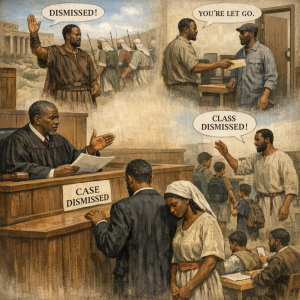
In its broadest sense, dismissed means formally sent away, released, removed, discontinued, or brought to an end by a person or body having authority to do so. The precise meaning depends upon the object being described. A court may dismiss a case, claim, charge, appeal, motion, juror, or party; an employer may dismiss an employee; a military commander may dismiss troops; a school may dismiss students; and an assembly may be dismissed when its business is concluded.
In legal usage, the word ordinarily describes a procedural act or judicial disposition rather than a universal declaration about truth, guilt, innocence, rights, or facts. A lawsuit may be dismissed because the court lacks authority to hear it, because the pleadings are insufficient, because a party failed to prosecute it, because the parties settled, or because the claim has already been finally resolved. Therefore, the statement that a matter was “dismissed” is incomplete unless the order, stated ground, jurisdiction, and whether the dismissal was with prejudice or without prejudice are known.
The dictionary’s interpretive emphasis is that dismissal generally concerns the removal or ending of a matter from a particular proceeding. It does not automatically establish that the underlying accusation was false, that the defendant was vindicated on every issue, that a claimant lacked all rights, or that no future proceeding is possible. Those consequences arise, if at all, from the particular law, order, judgment, and procedural posture involved.
Etymology and Origin
The English verb developed in the late Middle Ages from forms related to Latin dimittere, meaning to send away, let go, release, disperse, discharge, abandon, or break up. The Latin word combines dis-, conveying separation or apartness, with mittere, “to send” or “let go.” English forms such as dimit, dismit, and dismiss appeared before the modern spelling became standard.
Early English legal usage included the sense of release from court restraint or legal charges. The word subsequently broadened into ordinary institutional use: removal from office or service, permission or direction to depart, termination of employment, rejection of an idea, and ending a gathering. The underlying image remains consistent: an authority causes a person, claim, body, or controversy to depart from its present place or status.
The Latin linguistic ancestry of the word should not be confused with a claim that modern Anglo-American dismissal doctrine is simply Roman law. English common law, the law of equity, statutes enacted by legislatures, procedural rules, and judicial decisions developed through different institutions and historical periods. Etymology may help explain a word’s basic image; it does not itself determine the legal effect of a modern court order.
Cultural and Historical Context
Dismissal has long been associated with ordered institutions. In a household, school, court, church, legislature, military formation, or workplace, dismissal marks the end of a period of attendance, service, or deliberation. A person who is dismissed may be permitted to depart, directed to depart, excused from a duty, or removed from a position. The word can therefore carry either a neutral or an adverse meaning.
For example, a teacher’s dismissal of a class is normally routine and non-punitive. A commander’s dismissal of a formation ordinarily means that the formation has ended and personnel may depart or return to assigned duties. By contrast, dismissal from employment commonly means removal from a job, and dismissal of a lawsuit means that the court will not continue that action in its present form.
In political and governmental language, a ministry, official, legislative body, petition, or proceeding may be described as dismissed. The common element is not necessarily punishment. Rather, the responsible authority ends the body’s tenure, removes an officer, declines the request, or closes the proceeding under the governing constitutional, statutory, or institutional rules.
Military Context
Military usage retains the older “send away” sense. Troops may be dismissed from parade, formation, drill, or duty at the conclusion of an event. This should not be confused with a punitive military discharge, separation from service, court-martial conviction, or administrative action. A command to dismiss a formation concerns immediate order and movement; a discharge or separation concerns military status and may have separate legal consequences.
Biblical / Torah Context
The English word is not a controlling Torah legal term in the modern Anglo-American procedural sense. Nevertheless, the broader idea of sending away, releasing, or allowing departure appears in biblical narrative and law. In Exodus 18:27, Moses allows his father-in-law Jethro to depart after receiving counsel concerning the organization of judges. English translations vary between expressions such as “let depart,” “sent away,” or similar wording.
The Torah’s larger legal context is more significant than the English translation choice. Exodus 18 describes the appointment of capable judges to hear disputes, distinguish matters appropriate for resolution, and preserve ordered administration of justice. This offers a historical and spiritual picture of delegated judgment, responsibility, and orderly resolution, but it does not create the modern procedural rules governing dismissal in American or other contemporary courts.
In later biblical usage, English translations may use “dismiss” for sending crowds, persons, spouses, servants, or petitioners away. Such uses should be interpreted in their respective Hebrew, Aramaic, Greek, literary, and covenantal contexts. It is inaccurate to treat every English occurrence of “dismiss” as proof of a single universal legal doctrine.
Legal Implications
General Legal Meaning
A dismissal is generally an order, ruling, filing, or procedural result that ends all or part of a case or removes a matter from the court’s active consideration. It may concern an entire action, a particular claim, one defendant, an indictment, a complaint, an appeal, or a motion. A dismissal can be voluntary, agreed upon, involuntary, jurisdictional, procedural, merits-based, temporary in practical effect, or final in law.
In the United States federal civil system, the Federal Rules of Civil Procedure distinguish between dismissals requested by a plaintiff and dismissals imposed by a court. Rule 41 addresses voluntary and involuntary dismissal of actions, while other rules, including Rule 12, address threshold objections such as lack of subject-matter jurisdiction, lack of personal jurisdiction, insufficient process or service, improper venue, failure to join a required party, and failure to state a claim upon which relief can be granted.
With Prejudice and Without Prejudice
A dismissal with prejudice ordinarily means that the same claim may not be refiled in that court and may carry claim-preclusive effect. The phrase generally signals a final disposition of the claim for purposes of further litigation between the relevant parties, subject to appeal, post-judgment relief, and the limits of the governing law.
A dismissal without prejudice ordinarily means that the dismissal does not itself prevent a new action based on the same claim. It does not guarantee that refiling will succeed. A later filing may still be barred by a statute of limitations, a missed deadline, lack of jurisdiction, failure to satisfy a prerequisite, a settlement agreement, a different preclusion rule, or another procedural defect.
Under Federal Rule of Civil Procedure 41, a plaintiff may in specified circumstances voluntarily dismiss an action without a court order, including by timely notice before the opposing party serves an answer or motion for summary judgment, or by a stipulation signed by all appearing parties. Unless the notice or stipulation states otherwise, such a dismissal is generally without prejudice; however, the rule contains a “two-dismissal” provision that can make a second notice dismissal of the same claim operate as an adjudication on the merits.
An involuntary dismissal under Rule 41(b), including dismissal for failure to prosecute or comply with rules or court orders, generally operates as an adjudication on the merits unless the dismissal rests on lack of jurisdiction, improper venue, or failure to join a required party. The specific order matters. Courts and jurisdictions may also apply rules concerning sanctions, amendments, removal, remand, bankruptcy, arbitration, and administrative proceedings that affect the result.
Civil Claims, Common Law, Equity, and Statutes
Historically, common-law courts used various procedural devices to terminate actions, reject defective pleadings, discontinue proceedings, enter nonsuits, or dispose of claims. Courts of equity developed their own procedures and remedies. Modern American procedure has combined and replaced many older forms through statutes, court rules, and rules of civil procedure. Thus, an older common-law term may be historically informative, but present legal consequences normally depend on the current statute, rule, and controlling case law of the jurisdiction.
Modern dismissal doctrine also intersects with the judicially developed principle commonly called res judicata or claim preclusion. When a competent court enters a final judgment that has preclusive effect, the parties may be barred from relitigating the same claim. Yet not every order labeled “dismissed” has that effect. The United States Supreme Court has explained that the phrase “with prejudice” must be read in procedural context; the consequences of a federal dismissal can depend upon the basis for the dismissal and the law governing preclusion.
Criminal Cases
In criminal matters, dismissal of a charge is not necessarily the same as an acquittal. An acquittal is a determination that constitutionally carries particular finality when it rests on a finding that the prosecution failed to prove criminal liability. A dismissal may instead arise from a defective charging document, lack of jurisdiction, unnecessary delay, a procedural violation, prosecutorial discretion, a plea agreement, or another legal ground.
Federal Rule of Criminal Procedure 48 provides that the government may, with leave of court, dismiss an indictment, information, or complaint, and that a court may dismiss when unnecessary delay occurs in presenting a charge, filing an information, or bringing a defendant to trial. The Rule’s advisory history recognizes the older common-law practice of nolle prosequi, by which a public prosecutor discontinued a prosecution. Modern Rule 48 is a rule-based federal procedure, not merely an invocation of historical common law.
Whether a dismissed criminal charge may be refiled depends on facts that cannot be assumed from the word alone. Important issues can include whether jeopardy attached, whether there was an acquittal, whether the dismissal was with or without prejudice, speedy-trial law, constitutional double-jeopardy protections, statutes of limitation, prosecutorial authority, and state law. A docket entry stating “dismissed” should therefore never be treated as a complete legal analysis of guilt, innocence, or future prosecutorial power.
Appeals and Administrative Matters
An appeal may be dismissed for lack of appellate jurisdiction, untimeliness, failure to comply with briefing or filing requirements, settlement, mootness, or voluntary withdrawal. Dismissal of an appeal often leaves the lower court’s judgment in place, but the legal effect depends upon the appellate order and the procedural posture.
Administrative agencies, licensing boards, tribunals, and other governmental bodies may dismiss complaints, petitions, appeals, or enforcement matters under their own statutes and regulations. Administrative dismissal should not automatically be equated with a judicial judgment. The agency’s authority, the stated reason, available internal review, judicial-review deadlines, and applicable due-process requirements must be examined separately.
Spiritual Meaning
Spiritually considered, dismissal may symbolize release, completion, separation, or the end of a season of obligation. A person may experience dismissal from a role as rejection, loss, correction, or providential redirection. Those meanings are interpretive and personal rather than fixed legal definitions.
A careful spiritual reading should avoid claiming that every closed opportunity, terminated relationship, or court dismissal is a direct divine judgment. Human institutions act through human decision-makers and imperfect procedures. A more restrained interpretation recognizes that endings may call for reflection, accountability, repentance where wrongdoing exists, gratitude where service is completed, and wise discernment about the next lawful and ethical step.
Modern Usage
Modern speech uses the term in several principal ways:
- Court proceeding: “The complaint was dismissed without prejudice.”
- Criminal charge: “The charge was dismissed before trial.”
- Employment: “The employee was dismissed from the position.”
- School or gathering: “Students were dismissed for the day.”
- Military formation: “The unit was dismissed after the ceremony.”
- Idea or concern: “The objection was dismissed as unsupported.”
The last use may be literal or rhetorical. To “dismiss” an argument can mean to reject it as unpersuasive, irrelevant, immaterial, or insufficiently supported. In public discourse, however, the word can be used too casually to avoid serious engagement. A claim should be dismissed only after identifying the proper standard and reasons for rejecting it.
Controversies / Criticisms
A recurring error is to equate dismissal automatically with exoneration. A dismissal may be favorable to a defendant, but it may rest upon a procedural defect rather than a factual determination. Conversely, dismissal of a civil claim does not necessarily establish that the claimant acted dishonestly; a claim may fail because it was filed in the wrong court, was premature, omitted necessary allegations, or was pursued after an applicable deadline.
Another error is to assume that “without prejudice” means the matter has no consequences. Although it usually preserves the possibility of refiling, practical and legal obstacles may still prevent a renewed action. Likewise, “with prejudice” is powerful language, but its scope, appealability, and preclusive effect must be determined from the order and governing law rather than from a slogan.
Some advocates use the historical roots of words to argue that a court’s use of “dismissed” proves a particular theory of sovereignty, jurisdiction, contract, or personal status. Such arguments are generally unsound when they rely on etymology alone. Courts derive authority and procedure from constitutions, statutes, rules, precedent, and legally established facts—not from private redefinitions of ordinary legal vocabulary.
Finally, the term can obscure unequal practical consequences. A case dismissed for a technical defect may be legally correct while still imposing significant cost, delay, anxiety, or loss on the parties. Access to counsel, filing fees, procedural complexity, and institutional power can shape whether dismissal functions as a fair correction, a necessary case-management tool, or a barrier to adjudication. These policy concerns are legitimate subjects for reform, but they do not change the legal meaning of a particular dismissal order.
Conclusion
Dismissal is the formal ending, removal, release, or sending away of a person, claim, charge, proceeding, or body from a particular setting. Its central legal meaning is procedural: something has been removed from the court’s present consideration or brought to an end under the authority of the applicable tribunal.
No sound conclusion should be drawn from the word alone. The careful reader should identify what was dismissed, who dismissed it, the stated reason, the controlling jurisdiction, whether the ruling was with or without prejudice, whether an appeal or refiling remains available, and whether the disposition was procedural or on the merits. Those facts—not etymology, assumption, or rhetoric—determine the actual legal effect.
Sources / Further Reading
- Online Etymology Dictionary, “Dismiss” — https://www.etymonline.com/word/dismiss
- Legal Information Institute, Cornell Law School, “Dismissal” — https://www.law.cornell.edu/wex/dismissal
- Legal Information Institute, Cornell Law School, Federal Rule of Civil Procedure 41 — https://www.law.cornell.edu/rules/frcp/rule_41
- United States Courts, Federal Rules of Civil Procedure — https://www.uscourts.gov/forms-rules/current-rules-practice-procedure/federal-rules-civil-procedure
- Legal Information Institute, Cornell Law School, Federal Rule of Criminal Procedure 48 — https://www.law.cornell.edu/rules/frcrmp/rule_48
- Library of Congress, Constitution Annotated, “Overview of Re-Prosecution After Acquittal” — https://constitution.congress.gov/browse/essay/Amdt5-3-6-1/ALDE_00000861
- United States Supreme Court, Semtek International Inc. v. Lockheed Martin Corp. — https://www.law.cornell.edu/supct/html/99-1551.ZO.html