Israel
Primary Definition
In its oldest biblical-Hebrew setting, Yisra’el (יִשְׂרָאֵל), conventionally rendered “Israel,” is first the covenant name given to Jacob, son of Isaac and grandson of Abraham. In the Torah narrative, the name becomes the identifying name of his descendants: the twelve tribes and the people brought into covenant with Yah/Yahuah. Thus, the primary ancient sense is neither merely a modern nationality nor a later religious label. It is a personal, familial, covenantal, and national name rooted in the ancestral account of the Hebrew people.
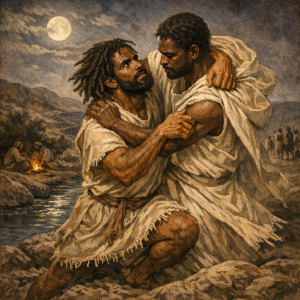
Genesis associates the name with Jacob’s night-long struggle before meeting Esau. The narrative explains the renaming by connecting it with Jacob’s striving with Elohim and with men, followed by prevailing. The immediate biblical explanation therefore supports the sense “one who strives with God,” “one who contends with God,” or, more literally in the name’s verbal construction, possibly “El strives” or “El fights.” The ending -el is a Northwest Semitic divine element meaning “God” or “Mighty One.” Scholars recognize that the precise grammatical derivation remains debated, even though Genesis itself deliberately supplies a theological wordplay based on striving or contending.
“Israel” subsequently has several connected senses which must not be carelessly collapsed:
- Jacob/Israel: the individual patriarch who receives the name.
- The children of Israel: the descendants of Jacob, organized in the Torah as tribes and a covenant people.
- The united kingdom: the kingdom traditionally associated with Saul, David, and Solomon in the biblical historical narrative.
- The northern kingdom of Israel: the post-Solomonic kingdom distinguished from the southern kingdom of Judah.
- The land: a geographical expression whose meaning varies with biblical, imperial, administrative, and modern political usage.
- The modern State of Israel: a sovereign state proclaimed on May 14, 1948, legally and historically distinct from ancient tribal Israel, the biblical kingdoms, and every religious use of the name.
A sound dictionary definition must preserve these distinctions. A person can speak of “Israel” in Scripture, archaeology, theology, international law, ethnicity, government, or modern politics, while referring to related but not identical things.
Etymology and Origin
The Hebrew form is Yisra’el. The final element El is well established in Semitic personal names and refers to God. The first portion is less certain. The Torah’s own explanation in Genesis 32:28 links the name to the Hebrew root commonly transliterated sarah, involving striving, contending, ruling, or exerting power. On that basis, English translations commonly give “he struggles with God,” while some scholars prefer formulations such as “God strives,” “God fights,” or “God rules.” These alternatives arise because ancient names can preserve older grammatical forms and because a narrative wordplay need not settle every linguistic question.
The dictionary’s interpretive analysis is that the biblical presentation supplies the controlling meaning within the Hebrew covenant story: Israel is a name of struggle, preservation, and divine encounter. It does not present Jacob as self-deified or as defeating the Creator. Rather, the account portrays a transformative encounter in which a man is wounded, blessed, renamed, and redirected. The name therefore bears both human striving and divine sovereignty.
The Hebrew Bible uses related expressions including beney Yisra’el, “children/sons of Israel,” and beit Yisra’el, “house of Israel.” These terms can refer broadly to the covenant people, even when the tribes are scattered or politically divided. In later prophetic writing, “Israel,” “Jacob,” “Ephraim,” “Judah,” “Zion,” and “Jerusalem” may function differently depending upon context. They should not automatically be treated as interchangeable.
Cultural and Historical Context
The ancestral setting of Israel belongs to the world of the ancient Levant: a region of city-states, kinship groups, agricultural settlements, trade routes, empires, and competing local powers. The biblical account places the ancestors in and around Canaan, Egypt, the wilderness, and Transjordan. In that setting, a person’s name could express ancestry, a remembered event, a prayer, a divine attribute, or a covenant claim. Israel became the shared name of a people whose identity was understood through descent, deliverance, law, worship, land, and allegiance to Yah/Yahuah.
Within the Torah and former prophets, the people of Israel are described as leaving Egyptian bondage, receiving instruction through Moses, entering the land, and being organized in tribal form. The account is not simply an origin myth in the modern sense; it is also a covenant constitution within the biblical narrative. It joins worship of Yah/Yahuah with commands governing justice, family life, land use, courts, debt, warfare, treatment of strangers, and communal responsibility.
Outside the Bible, the name Israel appears in Egyptian evidence generally dated to the late thirteenth century BCE. The Merneptah Stele contains the earliest widely accepted extra-biblical reference to Israel. Its Egyptian determinative identifies Israel as a people rather than a fortified city-state. That inscription does not prove every event in the Torah or settle the chronology of Israel’s origins, but it is significant evidence that a group called Israel was known in Canaan by that period.
In the biblical historical account, a united monarchy was later followed by division: the northern kingdom retained the name Israel, while the southern kingdom was Judah. The Assyrian conquest of the northern kingdom in the eighth century BCE profoundly altered the political use of “Israel.” Yet prophets continued to use the term in wider covenantal and restoration senses. After Babylon’s destruction of Jerusalem and exile of many Judeans in the sixth century BCE, communal identity was again reshaped. The later history of Judeans, Samaritans, diaspora communities, Second Temple developments, rabbinic Judaism, Christianity, Islam, and modern national movements added layers of meaning that must be dated rather than projected backward onto the earliest Israelite setting.
Biblical / Torah Context
Jacob’s Renaming
Genesis presents Jacob’s new name in connection with a decisive encounter at Peniel. The passage holds together struggle, blessing, memory, and humility: Jacob departs limping, yet he receives the name Israel. Genesis 35 repeats the renaming in a setting of worship, covenant continuity, and the promises made to Abraham and Isaac. The repetition emphasizes that the name is not a casual nickname. It marks a covenantal turning point.
The ancient Hebrew setting should be kept in view. The Creator in the Torah is identified by the sacred Name represented in English letters as YHWH; this dictionary uses Yah/Yahuah in keeping with its Ancient Israelite heritage context. El and Elohim are Hebrew titles or designations for God in the biblical text. English Bible translations often use “Lord” for YHWH, usually in small capitals, and “lord” for adon. In ordinary English, “lord” means master or ruler; accordingly, “Master” is often the clearer English sense when Adon or Adonai is under discussion. Translation conventions should not obscure the Hebrew distinctions.
Covenant People and Moral Calling
Exodus through Deuteronomy repeatedly calls the people “Israel.” The designation is joined to covenant obligations, not merely privilege. Israel is commanded to worship Yah/Yahuah alone, reject idolatry, administer justice without partiality, protect the vulnerable, honor truthful testimony, and remember its own condition as a people delivered from bondage. Biblical election is therefore presented as a calling to obedience and service, with blessings for faithfulness and consequences for rebellion.
The prophets intensify this ethical dimension. They condemn injustice, corrupt judgment, exploitation, violence, false worship, and leaders who use religious language while refusing righteousness. In this usage, “Israel” is neither an ethnic compliment nor a blank check for rulers. The prophetic witness measures the house of Israel by covenant faithfulness. It also contains powerful themes of mercy, repentance, regathering, healing, and restoration.
Later Religious Usage
Later Jewish and rabbinic traditions developed extensive ways of speaking about Israel as a people and community of Torah. Christian writings also adopted varied theological uses of “Israel,” sometimes referring to biblical Israel, sometimes to a faithful remnant, and sometimes—controversially—to the church. Those later interpretations are historically important, but they must be distinguished from the Torah’s original presentation of Israel as Jacob’s name and the collective name of his descendants. Claims that one later community wholly replaces or exhausts every biblical meaning of Israel remain theological positions, not a universally settled lexical fact.
Legal Implications
In historical common-law terminology, “Israel” was not a category of English common law comparable to a county, parish, corporation, or crown dominion. Biblical Israel possessed legal institutions described in Scripture, but those institutions are not identical to English common law. Torah law is an ancient covenantal body of commands and judgments; English common law developed much later through English royal courts, judicial decisions, custom, and precedent. Roman law, ecclesiastical law, equity, statutes, and modern international law are likewise separate legal traditions. Similar words such as “law,” “court,” “judge,” or “covenant” do not make those systems legally interchangeable.
In the Torah narrative, Israel’s law includes religious commands, moral duties, civil remedies, judicial procedures, land rules, military obligations, and rules concerning kingship. Whether and how such instructions should govern a modern civil state is a matter of theological and political disagreement. They do not become enforceable in a United States or English-speaking court merely because they appear in Scripture. Under modern legal systems, enforceability depends on the applicable constitution, statute, treaty, judicial precedent, and jurisdiction.
The present-day State of Israel is a modern public-law entity, not a continuation of ancient Israel as a legal jurisdiction. It was proclaimed on May 14, 1948, and admitted to the United Nations on May 11, 1949. Its legal order reflects multiple historical influences, including Ottoman law, British Mandate law, legislation enacted by the Knesset, judicial decisions, and Basic Laws. Israel does not have one single consolidated written constitution in the form used by many states; its Basic Laws have constitutional status and structure major elements of government and rights.
Modern disputes concerning Israel, Palestine, Jerusalem, borders, occupation, settlements, security, refugees, military action, and self-determination belong primarily to public international law and domestic law, not to private claims of “common-law” sovereignty. Recognition of a state is a formal act in international relations. In the United States, the Supreme Court held in Zivotofsky v. Kerry (2015) that the constitutional power to recognize foreign sovereigns belongs exclusively to the President. That case addressed U.S. constitutional allocation of foreign-affairs authority; it did not decide every territorial or international-law dispute involving Israel.
Legal claims in this area require particular care. The International Court of Justice issued an advisory opinion on July 19, 2024, concerning legal consequences of Israeli policies and practices in the Occupied Palestinian Territory, including East Jerusalem. The Court’s conclusions are highly significant in international legal debate, while Israel has disputed aspects of international proceedings and legal characterizations affecting it. An advisory opinion is not the same procedural instrument as a judgment in a contentious case between consenting parties, though it carries substantial legal authority. Neither biblical interpretation nor political conviction should be substituted for careful identification of the governing legal forum, source of law, facts, and procedural posture.
Spiritual Meaning
Spiritually, Israel signifies a people formed through encounter with Yah/Yahuah. Jacob’s renaming teaches that a genuine encounter with the Creator may involve struggle, exposure, correction, blessing, and lasting change. The narrative does not glorify manipulation of the divine. Jacob receives a blessing, but he also bears the mark of his encounter and must proceed in humility.
The broader scriptural meaning joins identity to responsibility. To be called Israel is, in the biblical pattern, to remember deliverance, walk in covenant, seek justice, reject false worship, and trust Yah/Yahuah rather than military strength, wealth, kings, or foreign alliances. The spiritual message is therefore communal as well as individual. Israel’s calling is repeatedly connected with how power is used, how strangers and the poor are treated, and whether truth is honored in judgment.
Some modern spiritual movements claim that particular contemporary ethnic, national, or religious groups are the exclusive descendants or sole heirs of ancient Israel. Genealogical, historical, and theological claims should be examined separately. Scripture contains lineage language, but it also speaks of adoption, sojourning, mixed populations, exile, covenant obedience, and divine judgment. Assertions of inherited status must never be used to justify racial contempt, antisemitism, anti-Arab hatred, collective guilt, violence against civilians, or immunity from moral accountability.
Modern Usage
In ordinary modern English, “Israel” commonly means the State of Israel. In news reporting, legal documents, diplomacy, travel, and government communication, context usually determines whether the word refers to the state, its government, its territory, its citizens, or its policies. These are not identical. Criticism of a government policy is not necessarily criticism of an entire people or religion; conversely, using “Israel” as an undifferentiated label can obscure the distinction between public officials, military institutions, civilians, religious communities, and the ancient biblical people.
In biblical studies, “ancient Israel” often denotes the peoples and polities of the Iron Age Levant associated with Israelite identity. “Kingdom of Israel” may specifically mean the northern kingdom after the division from Judah. “Land of Israel” is a religious, historical, and geographical expression with meanings that vary among biblical texts, later traditions, and modern political claims. Precision is necessary in every setting.
Controversies / Criticisms
The name Israel is contested because it carries ancient memory, sacred text, ethnicity, national identity, law, and war. Several recurring errors should be avoided.
- Anachronism: treating the modern state, founded in 1948, as legally or politically identical to the tribal confederation or kingdoms described in the Bible.
- Replacement claims stated as fact: asserting without qualification that one later religious body simply erased, replaced, or became all that “Israel” means in Scripture.
- Ethnic essentialism: using uncertain ancestry claims to establish superiority, deny another people’s humanity, or excuse injustice.
- Legal confusion: presenting biblical passages, diplomatic declarations, international resolutions, court opinions, and domestic statutes as though they all carry the same authority.
- Collective blame: assigning the acts of governments, armed groups, or individuals to all Jews, all Israelis, all Palestinians, all Arabs, all Muslims, or all Christians.
There are also scholarly debates concerning chronology, archaeology, the development of Israelite religion, the historicity and literary shaping of biblical narratives, and the linguistic derivation of the name. These debates do not justify dismissing the biblical text as meaningless, nor do they permit treating every interpretive conclusion as archaeological proof. A responsible approach identifies whether a statement is based on the Torah narrative, external inscriptional evidence, later tradition, academic reconstruction, or modern legal authority.
Conclusion
Israel is, at its root, the Hebrew covenant name given to Jacob and then borne by his descendants. Its biblical meaning is shaped by striving, divine encounter, covenant, law, judgment, mercy, and restoration. Across centuries, it became the name of a people, kingdoms, a remembered land, religious communities, and a modern state. Each use has a history and must be interpreted in its own setting.
For common-law and legal study, the central caution is simple: ancient Israelite law, English common law, later religious law, and current Israeli or international law are distinct systems. For spiritual study, the central caution is equally important: the name calls attention to covenantal responsibility before Yah/Yahuah, not to political infallibility or racial privilege. Accurate use of the term requires historical honesty, legal precision, and moral restraint.
Sources / Further Reading
- Genesis 32 and 35, biblical renaming narrative: https://www.biblegateway.com/passage/?search=Genesis%2032%3A22-32%2C%20Genesis%2035%3A9-15&version=KJV
- Cambridge University Press, The World of the Hebrew Bible: https://www.cambridge.org/core/books/cambridge-companion-to-the-bible/world-of-the-hebrew-bible/A8152CB6547ACFE9612056E29CCFEF27
- Cambridge University Press, Jason A. Staples, The Idea of Israel in Second Temple Judaism, introduction excerpt: https://assets.cambridge.org/97811088/22893/excerpt/9781108822893_excerpt.pdf
- United Nations, Israel’s application for membership: https://www.un.org/unispal/document/auto-insert-211182/
- United Nations, admission of Israel to the United Nations, May 11, 1949: https://www.un.org/unispal/document/auto-insert-180950/
- The Knesset, Basic Laws and constitutional framework: https://m.knesset.gov.il/en/activity/pages/basiclawsandconstitution.aspx
- Legal Information Institute, Cornell Law School, Zivotofsky v. Kerry: https://www.law.cornell.edu/supremecourt/text/13-628
- International Court of Justice, advisory opinion of July 19, 2024: https://www.icj-cij.org/case/186