Noah
Primary Definition
Noah is chiefly the English form of the Hebrew personal name Noaḥ (נֹחַ), borne in the Book of Genesis by the righteous man who, according to the narrative, preserves his household and representatives of animal life through a divinely announced flood by building an ark. In ordinary English usage, the term may refer to the biblical patriarch, the personal name derived from him, the story of the Flood, or familiar expressions such as “Noah’s ark.”
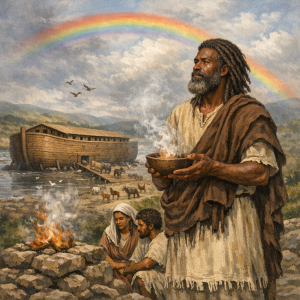
In the Genesis account, Noah is presented not merely as a survivor of a catastrophe but as a covenantal figure. He is described as righteous in his generation, receives instructions for constructing the ark, offers a sacrifice after the waters recede, and becomes the recipient of a covenant signified by the rainbow. The narrative therefore links the name with themes of preservation, judgment, renewal, obedience, family continuity, stewardship of living creatures, and the limits placed upon human violence.
The name must be distinguished from the Hebrew feminine name Noa (נועָה), borne by one of the daughters of Zelophehad in Numbers 26 and 27. Although English spelling can make the two appear nearly identical, they are different biblical names with different Hebrew forms and contexts.
Etymology and Origin
The documented source of the English name is Hebrew Noaḥ, commonly transliterated Noach when the final Hebrew consonant ḥet is represented more closely. Most lexicographical and traditional explanations connect the name with the Hebrew root nuach (נוּחַ), carrying the sense of resting, settling down, repose, or relief. Thus, “rest,” “restfulness,” or “comfort” are conventional English glosses.
Genesis itself supplies an interpretive explanation of the name. At Noah’s birth, his father Lamech says that this child will bring comfort or relief from human work and toil caused by the cursed ground. The passage creates an evident sound association between Noah’s name and the Hebrew word translated “comfort” or “relief.” That association is meaningful within the biblical literary setting, but interpreters should avoid treating it as a simple technical derivation. The name Noaḥ is usually associated with “rest,” while the verb used in Genesis 5:29 is commonly connected with another Hebrew root meaning “comfort” or “console.” The verse is therefore often understood as purposeful wordplay rather than as a strict dictionary equation.
The Greek Septuagint rendered the name as Nōe, which influenced later Greek, Latin, and Christian usage. English Noah emerged through the long transmission of biblical names into medieval and early modern English. The spelling with final -ah reflects English biblical convention; it does not indicate that the Hebrew name ends with the vowel sound found in English words such as “aha.” In Hebrew pronunciation, the final consonant is a throaty sound not normally pronounced in modern English.
Related English adjectives include Noachian and Noachic, meaning “relating to Noah,” especially the Flood, the covenant, or laws attributed in later Jewish tradition to the descendants of Noah.
Cultural and Historical Context
Noah occupies a central place in the primeval history of Genesis, the opening narrative sequence extending from creation through the tower of Babel. He is the tenth generation from Adam in the genealogy of Genesis 5 and the ancestral head of the post-flood human family through his sons Shem, Ham, and Japheth. Within the narrative’s own framework, humanity’s corruption and violence precede the Flood, while the covenant after the Flood establishes a renewed moral order for human life.
The account has had enormous cultural influence. Noah’s ark appears in Jewish, Christian, Islamic, literary, artistic, educational, and popular traditions. Images of paired animals entering a vessel have become a nearly universal symbol of rescue and preservation. At the same time, the story’s gravity is sometimes softened in children’s art and toys. The biblical text itself is more complex: it joins the preservation of life with divine judgment, sacrifice, food, blood, violence, drunkenness, family conflict, and a covenant extending to “every living creature.”
Historically, the Genesis flood narrative belongs to the wider cultural world of the ancient Near East, where flood traditions were already known. Mesopotamian literature includes accounts involving flood survivors such as Atrahasis, Ziusudra, and Utnapishtim. These narratives share motifs with Genesis, including divine warning, a vessel, survival from a flood, birds sent out after the waters diminish, sacrifice, and a post-flood divine resolution. The existence of such parallels is documented and significant; it shows that ancient peoples of the region used flood traditions to address questions of mortality, divine justice, human conduct, and survival.
There is, however, no universal agreement about the precise literary relationship between Genesis and any single Mesopotamian text. Many modern scholars conclude that the Genesis account was shaped in conversation with older Mesopotamian flood traditions. Jewish and Christian believers may instead understand the similarities as reflecting shared memory, common cultural language, independent testimony to a real cataclysm, or divine revelation expressed in an ancient setting. A responsible dictionary definition should distinguish the historical fact of literary parallels from contested conclusions about their ultimate source or theological authority.
From Patriarch to Cultural Symbol
Over time, Noah became an emblem of several distinct ideas: the faithful person who acts before the evidence is visible; the builder who prepares for danger; the guardian of animals; the survivor of collective collapse; and the father of a renewed world. These meanings arise from interpretation rather than from the bare name alone. They are influential cultural associations, not independent legal definitions.
Biblical / Torah Context
The principal Torah passages concerning Noah are Genesis 5:28–9:29. Genesis 6 introduces him as one who “found grace” or favor and as a man characterized by righteousness and integrity. God instructs him to make an ark, called a tevah in Hebrew. The word is better understood as a large container, chest, or vessel than as a warship or navigational craft. In the Hebrew Bible, tevah is used notably for Noah’s vessel and for the basket or container that carries the infant Moses in Exodus 2.
Genesis 6–8 recounts the preparation of the ark, the entry of Noah’s household and animals, the coming of the waters, the eventual recession of the Flood, and Noah’s sacrifice after leaving the ark. Genesis 8:21–22 records a divine commitment concerning the regularity of seasons and the continuance of the earth’s natural cycles. Genesis 9 then sets out the covenant with Noah, his descendants, and living creatures. The rainbow is given as the covenantal sign.
Several elements of Genesis 9 have particular interpretive importance:
- Sanctity of life: Human beings are described as made in the image of God, and wrongful shedding of human blood is treated as especially serious.
- Permission and limitation regarding food: Humanity is permitted to eat animal flesh, but blood is prohibited as food. The text thereby combines human use of animals with a limitation that acknowledges life as belonging ultimately to God.
- A universal covenant: Unlike covenants later focused specifically on Abraham’s descendants or Israel, the covenant in Genesis 9 is framed broadly around Noah, his descendants, and the living world.
- The rainbow: The sign is associated with God’s stated promise not to destroy all flesh by a flood again. In the text, the sign is first and foremost a covenantal reminder, not merely a decorative symbol of optimism.
Jewish tradition reads Genesis 6:9–11:32 as the Torah portion commonly called Parashat Noach. Rabbinic literature further develops the idea that basic commandments were given to the descendants of Noah. The often-cited Seven Noahide Laws include prohibitions against idolatry, blasphemy, murder, sexual immorality, theft, and eating flesh taken from a living animal, together with an obligation associated with establishing justice or courts.
It is important to state the historical distinction accurately: the seven-law formulation is not presented in Genesis as a numbered statutory code. It is a later rabbinic legal and ethical development based upon scriptural interpretation and recorded in classical Jewish sources, including the Talmud. Its authority is therefore a matter of Jewish religious law and interpretation, not a rule of English common law or a generally enforceable civil code.
In the New Testament, Noah is remembered as an example of faith, obedience, patience, warning, and salvation through judgment. In Islam, Noah—Nūḥ—is honored as a prophet. Qur’anic accounts emphasize his preaching to a resistant people, his perseverance, the Flood, and the deliverance of believers. Thus, Noah is an important figure throughout the Abrahamic religious world, though Jewish, Christian, and Muslim interpretations differ in detail and emphasis.
Legal Implications
Historical Religious Law and Common Law
Noah is not a technical term of English common law. English common law developed through royal courts, judicial decisions, custom, and later parliamentary legislation. It did not create a special legal status called “Noah,” “Noachian,” or “Noahide” applicable to individuals merely because of a name, ancestry claim, religious belief, or personal declaration.
The Noahide laws belong to the field of rabbinic Jewish law, ethics, and theology. They may be discussed comparatively alongside concepts such as natural law, universal morality, or the law of nations, but those comparisons do not transform them into binding common-law rules. Roman law, English common law, equity, modern statutes, and Jewish halakha are distinct legal traditions. They may influence one another historically or philosophically, but they should not be collapsed into a single system.
Claims that the Noahide laws automatically govern United States courts, create a separate political jurisdiction, negate statutory law, or establish a private exemption from civil obligations are not supported by American constitutional law. In the United States, enforceable law generally arises through constitutions, statutes, regulations, judicial decisions, treaties where applicable, and recognized legal principles—not from a person’s asserted biblical identity. Religious teachings may inform personal conscience and voluntary religious practice, but they do not by themselves displace valid civil law.
Modern Constitutional Context
United States law protects religious exercise while declining to make a particular biblical or religious code the civil law of the nation. The First Amendment addresses both governmental establishment of religion and free exercise of religion. Article VI also forbids religious tests as qualifications for federal public office. Accordingly, a person may study, accept, reject, or identify with Noahide teaching without that choice conferring special civil authority or imposing a religious test upon others.
The personal name Noah has the same ordinary legal function as other given names. It may appear in birth records, contracts, identification documents, court filings, wills, and other records. A name does not ordinarily determine citizenship, legal capacity, property rights, jurisdiction, tax obligations, or liability. In legal writing, precision is necessary: “Noah” may identify an individual party, while “Noahide” may identify a religious or philosophical concept; neither term is inherently a legal conclusion.
Spiritual Meaning
For believers, Noah commonly represents trust expressed through action. He does not merely assent to a warning; he builds, gathers, waits, and obeys. The ark is therefore often interpreted spiritually as a place of refuge, discipline, preservation, and mercy amid judgment. The post-flood covenant adds a second theme: God’s judgment is not portrayed as the final word, because the narrative proceeds toward renewal, restraint, and a continuing relationship with creation.
Jewish interpretation often emphasizes Noah’s righteousness while also debating its scope. The phrase “righteous in his generations” has prompted differing readings: some regard it as high praise because he remained righteous in a corrupt age; others ask whether his righteousness would have appeared less remarkable beside figures such as Abraham. Such debate is interpretive and should not be mistaken for a contradiction in the text. It demonstrates the tradition’s interest in moral character, responsibility toward one’s generation, and the difference between private righteousness and public influence.
Christian interpreters frequently see the Flood as a pattern of judgment and salvation, sometimes connecting the ark with baptism, the community of faith, or divine rescue. Muslim tradition commonly emphasizes Nūḥ as a prophet who persistently calls his people to worship God and turn away from wrongdoing. Across these traditions, the spiritual lesson is generally not that a person can escape consequences by possessing a sacred name. Rather, Noah’s significance is connected to faithfulness, repentance, justice, restraint from violence, and care for life.
Modern Usage
In contemporary English, Noah is widely used as a personal given name. It is generally perceived as biblical, Hebrew, traditional, and accessible across religious and secular communities. The name is often chosen because of its association with peace, rest, endurance, protection, or the ark narrative. In Jewish contexts, the spelling Noach may be preferred to preserve a closer representation of the Hebrew pronunciation.
The expression “Noah’s ark” has also become idiomatic. It may refer literally to the vessel described in Genesis, to a children’s toy or animal display, or figuratively to a collection containing pairs or representatives of many kinds. Such figurative use can be playful, but it should not obscure the religious and literary significance of the source narrative.
“Noachian” or “Noahide” is used more narrowly. It may refer to the covenant of Genesis 9, rabbinic teachings concerning the descendants of Noah, or modern movements in which non-Jews voluntarily study and observe Noahide ethical principles. The terms are not interchangeable in every context: “Noachian” is often descriptive, whereas “Noahide” may denote a religious identity, legal teaching, or movement.
Controversies / Criticisms
The Flood account remains one of the most debated narratives associated with Noah. A principal disagreement concerns historicity and scale. Some Jews, Christians, and Muslims hold that the Flood was a literal worldwide event, often as a matter of faith and scriptural interpretation. Others interpret it as a regional catastrophe described in universal language, a theological narrative rooted in collective memory, or a literary account engaging ancient Near Eastern flood traditions. Modern geology does not support the claim that a single recent global flood deposited the earth’s entire fossil-bearing geological record; that conclusion, however, does not resolve theological questions concerning miracle, revelation, or the purpose of sacred narrative.
Another controversy concerns the feasibility of the ark and animal preservation. Literalist reconstructions offer calculations concerning vessel dimensions, animal kinds, food storage, and divine providence. Critics argue that the logistics of accommodating worldwide animal populations, preserving ecosystems, and repopulating the earth are not scientifically plausible under ordinary natural processes. These are disputes about interpretation, historical claims, scientific method, and the role of miracle; they should not be resolved merely by asserting that one side has no questions to answer.
The passage commonly called the “curse of Ham” raises a serious moral and historical issue. Genesis 9 does not actually curse Ham; Noah curses Canaan, Ham’s son. Later interpreters wrongly used the episode to defend racial slavery and racial hierarchy, particularly by equating Ham or Canaan with African peoples. That use lacks support in the text’s immediate wording and historical setting. It is now widely recognized as a harmful misuse of scripture rather than a valid basis for race-based legal or social subordination.
Finally, claims connecting Noahide law to secret government control, automatic jurisdiction, or a hidden replacement of constitutional law should be treated as unsupported. The existence of a religious teaching about universal ethics does not establish a covert civil legal regime. Careful analysis requires identifying the source of a claimed rule, determining whether it is religious, moral, statutory, constitutional, judicial, or contractual, and then asking whether a court with jurisdiction has actually adopted or enforced it.
Conclusion
Noah is a Hebrew biblical name most closely associated with rest, repose, and relief, and with the patriarch whose story dominates Genesis 6–9. Its enduring importance reaches far beyond personal naming. Noah has become a central symbol of judgment and mercy, destruction and renewal, obedience and preservation, covenant and moral accountability.
In legal discussion, the necessary distinction is straightforward: Noah and the Noahide tradition may carry profound religious, ethical, and historical significance, but they are not independent sources of modern common-law jurisdiction. In biblical and spiritual interpretation, the name remains connected to the hope that, after violence and disorder, life may be preserved and a renewed order may begin.
Sources / Further Reading
- Merriam-Webster, “Noah” — https://www.merriam-webster.com/dictionary/Noah
- Online Etymology Dictionary, “Noah” — https://www.etymonline.com/word/Noah
- Sefaria, Genesis, chapters 5–9 — https://www.sefaria.org/Genesis.5?lang=bi
- Bible Gateway, “Noah,” Encyclopedia of the Bible — https://www.biblegateway.com/resources/encyclopedia-of-the-bible/Noah
- Society for Old Testament Study, “Noah” — https://www.sots.ac.uk/wiki/noah/
- The Metropolitan Museum of Art, “Cuneiform tablet: Atra-hasis, Babylonian flood myth” — https://www.metmuseum.org/art/collection/search/321999
- Oxford Academic, “The Origins of the Noahide Laws” — https://academic.oup.com/liverpool-scholarship-online/book/37931/chapter-abstract/332442496
- Cornell Legal Information Institute, “Religion and the Constitution” — https://www.law.cornell.edu/wex/religion_and_the_constitution
- Cornell Legal Information Institute, “Bar on Religious Tests” — https://www.law.cornell.edu/constitution-conan/article-6/clause-3/bar-on-religious-tests
- U.S. Geological Survey, The World’s Largest Floods, Past and Present — https://www.usgs.gov/publications/worlds-largest-floods-past-and-present-their-causes-and-magnitudes