Primary Definition
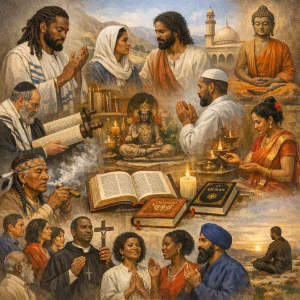
Religion is a system, way of life, or body of beliefs and practices concerning ultimate reality, the divine, sacred order, moral duty, worship, spiritual discipline, or humanity’s relation to God, gods, transcendent reality, and one another. It may include beliefs, prayers, rites, sacred texts, moral teachings, congregations, clergy, dietary practices, holy days, and forms of personal devotion. A religion may be organized through a church, synagogue, mosque, temple, tribe, school, or other community; it may also be sincerely held and practiced by an individual without formal membership in an institution.
In ordinary English, the word commonly refers both to a particular tradition—such as Judaism, Christianity, Islam, Hinduism, Buddhism, Sikhism, or an Indigenous spiritual tradition—and to the broader human activity of worship, devotion, conscience, and obedience to what is understood as sacred. The related word religious can describe a person’s faith, a practice arising from faith, or, more loosely, intense devotion to a nonreligious activity. That looser use—such as “religious devotion to exercise”—is figurative and should not be confused with religion in a legal or theological sense.
For purposes of legal analysis, “religion” is not limited to a government-approved church, a familiar denomination, a written creed, or belief in a deity. American law commonly asks whether a belief is sincerely held and religious in the believer’s own comprehensive understanding of life, rather than whether judges, employers, or officials regard it as reasonable, orthodox, popular, or logically persuasive. A mere personal preference, isolated political opinion, or lifestyle choice does not automatically become religion merely because it is deeply felt.
Etymology and Origin
The English word religion entered Middle English through Anglo-French religioun, ultimately from the Latin religio. In ancient Roman usage, religio concerned reverence, obligation, ritual care, scruple, and the proper observance of duties toward the gods. It did not originally carry every modern implication of a separate, private system of beliefs called “a religion.”
The ultimate Latin derivation is disputed. The Roman writer Cicero associated religio with relegere, often understood as to gather again, go over carefully, reread, or observe with scrupulous attention. Under that explanation, religion denotes careful attention to divine matters and rites. Later Christian writers, including Lactantius, associated the word with religare, “to bind” or “bind back,” yielding the influential spiritual interpretation that religion is a bond between human beings and God.
The “binding back to God” explanation is meaningful in later Christian theology and devotional writing, but it should not be stated as an undisputed linguistic fact. Lexicographers and classical scholars recognize that the etymology remains uncertain, and the competing explanations reflect different historical and theological interpretations of the Latin word. The dictionary’s interpretive analysis may therefore use “binding” as a spiritual image, while distinguishing that image from a settled proof of original word origin.
In English, the word gradually expanded. It could refer to a religious order, a rule of life, a profession of faith, public worship, or a particular body of believers. Modern usage commonly treats religions as distinguishable traditions, but many peoples historically did not divide “religion” from law, family, land, ancestry, ethics, medicine, government, or daily custom in the modern Western manner.
Cultural and Historical Context
Religion has been among the principal ways human communities have understood creation, death, obligation, justice, suffering, family, authority, and hope. In many ancient societies, worship and civil order were closely joined. Temples could serve religious, economic, educational, and governmental functions; rulers might claim divine sanction; and communal festivals could mark agricultural seasons, military events, covenants, or royal succession.
Ancient Roman religio especially emphasized proper observance and public duty. Roman civic religion was concerned with rites owed to particular deities and with maintaining right relations between the community and the divine order. That historical setting differs substantially from modern assumptions that religion is chiefly private belief or individual opinion.
Jewish, Christian, Islamic, Hindu, Buddhist, Sikh, Indigenous, African traditional, East Asian, and other spiritual traditions developed distinct vocabularies for divine reality, worship, moral law, community, liberation, covenant, wisdom, and salvation. It is often useful to use the word “religion” as a broad descriptive category. It is less useful when it erases real differences among traditions or imposes a modern Western classification upon communities that understand their way of life in other terms.
During the European Reformation and the subsequent development of nation-states, disputes over church authority, doctrine, taxation, public worship, and political allegiance made “religion” a major legal and governmental category. Later Enlightenment thought contributed to modern discussions of religious liberty, conscience, toleration, reason, and the distinction between civil authority and ecclesiastical authority. Those developments helped shape constitutional protections in the United States, although the American legal order did not emerge from a single religious or anti-religious source.
Biblical / Torah Context
The Torah does not present “religion” primarily as a detached category of private belief. Its central concern is covenantal faithfulness: the relationship between the God of Israel and the people of Israel, expressed through worship, obedience, justice, remembrance, prayer, Sabbath, family life, care for the vulnerable, and communal law. The foundational declaration of Deuteronomy 6:4–5 calls Israel to acknowledge the one God and to love Him with the whole heart, soul, and strength. In this setting, worship and conduct belong together.
Several Hebrew concepts illuminate matters that English speakers may call religion. Avodah can signify service, including service or worship of God. Yirah commonly conveys fear, awe, reverence, or profound regard for God. Torah means instruction or teaching and includes more than a narrow list of rules; it forms a way of covenant life. These concepts indicate that biblical faith is expressed not only by intellectual assent but also by faithful action.
The Torah repeatedly connects devotion to God with justice toward neighbors, strangers, widows, orphans, laborers, and the poor. Thus, a biblical understanding of faithful worship cannot be reduced to ceremony alone. Sacrifice, prayer, fasting, and holy observances may be meaningful, but the prophets sharply criticized ritual observance that coexisted with oppression, dishonesty, or neglect of justice.
In the New Testament, English Bibles sometimes translate the Greek threskeia as “religion” or “religious observance.” James 1:27 presents acceptable religious service in practical terms: care for vulnerable persons and moral integrity before God. Jesus likewise criticized outward displays of piety when they obscured justice, mercy, humility, and sincere love of God and neighbor. These passages do not abolish worship or communal faith; rather, they warn that external forms must be joined to truthfulness and righteous conduct.
Accordingly, within Jewish and Christian scriptural thought, religion in its sound sense is not merely institutional affiliation, verbal profession, or public identity. It concerns fidelity, worship, conscience, repentance, mercy, obedience, and the ordering of life under God. Other traditions have their own authoritative sources and should not be measured solely by biblical categories.
Legal Implications
Historical Common Law
“Common law” does not mean a universal religious law, nor does it mean that every moral teaching associated with Christianity, Judaism, or another faith automatically becomes enforceable civil law. Historically, English common law developed in a society with an established church and inherited assumptions about Christianity, public order, monarchy, and religious conformity. English common-law offenses such as blasphemy and blasphemous libel historically reflected that setting. Those offenses were not neutral definitions of religion for all peoples; they were products of particular English constitutional and ecclesiastical conditions.
It is therefore inaccurate to claim without qualification that “religion is common law” or that American common law automatically makes a particular faith the binding law of the land. The United States inherited aspects of English legal tradition, but it adopted a written federal Constitution that limits governmental power concerning religion. American states also developed their own constitutions, statutes, and judicial precedents. The content of applicable law depends on jurisdiction, constitutional text, valid statutes, and controlling judicial decisions—not merely on broad historical assertions about the common law.
United States Constitutional Law
The United States Constitution addresses religion in several important places. Article VI provides that no religious test may be required as a qualification for federal office or public trust. The First Amendment states that Congress shall make no law respecting an establishment of religion or prohibiting the free exercise thereof. Through later constitutional doctrine, the Religion Clauses generally constrain state and local governments as well as the federal government.
The Establishment Clause concerns governmental establishment, sponsorship, favoritism, coercion, or improper involvement in religion. The Free Exercise Clause protects religious belief and religiously motivated conduct, subject to legal limits that vary with the facts and governing doctrine. These clauses protect religious people and institutions, but they also protect persons who adhere to no religion from governmental compulsion in matters of conscience.
Constitutional protection does not mean that every religiously motivated act receives an automatic exemption from every neutral civil law. The Supreme Court has long distinguished belief, which government may not regulate simply as belief, from conduct, which may be regulated in some circumstances. In Employment Division v. Smith (1990), the Court held that a neutral law of general applicability ordinarily does not violate the Free Exercise Clause merely because it burdens religious practice. Subsequent statutes, including the federal Religious Freedom Restoration Act, may provide broader protection in specified settings, and other constitutional rules can apply where government action is not neutral or generally applicable.
Statutes, Employment, and Accommodation
Federal statutes may define religion more broadly or differently for their own purposes. Under Title VII of the Civil Rights Act of 1964, religion includes all aspects of religious observance, practice, and belief, unless a covered employer demonstrates undue hardship in accommodating an employee’s practice. The law protects traditional and nontraditional beliefs, including certain sincerely held non-theistic moral or ethical beliefs that occupy a place comparable to traditional religious conviction. It also protects employees from discrimination because they have no religious beliefs.
In employment matters, courts and agencies generally do not decide whether a belief is true. They may examine whether the asserted belief is religious rather than merely personal, political, economic, or social; whether it is sincerely held; whether an accommodation is reasonable; and whether the requested accommodation would create the legally required degree of hardship. Since Groff v. DeJoy (2023), the Title VII undue-hardship inquiry requires consideration of whether the burden would be substantial in the overall context of the employer’s business, rather than relying on a minimal-cost standard.
Equity, Courts, and Civil Authority
Equity is a historical body of judicial principles and remedies developed to supplement rigid common-law forms of action. Equity does not create a separate religious definition or authorize courts to decide theological truth. Courts may hear disputes involving religious organizations when they can apply neutral principles of law—such as property, contract, employment, trust, or corporate rules—without resolving doctrine, worship, or internal matters of faith that civil authorities are constitutionally barred from deciding.
Spiritual Meaning
Spiritually understood, religion may signify a disciplined response to sacred reality. It can involve remembrance of God, prayer, repentance, worship, service, moral formation, fasting, meditation, pilgrimage, study, charity, and fellowship. For many believers, religion is not primarily a label but a lived covenant: a continual ordering of the heart, mind, speech, body, possessions, and relationships toward truth and the good.
The interpretation of religion as a “binding” of the human person to God remains spiritually powerful even though its linguistic basis is disputed. In that interpretive sense, true religion binds conscience to responsibility, worship to justice, and freedom to accountability. It may call a person away from selfishness, idolatry, cruelty, falsehood, and despair, and toward reverence, mercy, humility, courage, and love.
At the same time, spiritual traditions commonly warn against reducing religion to outward performance. Ritual can become empty, institutional power can become corrupt, and a public religious identity can be used to conceal injustice. A mature spiritual understanding therefore measures religious profession not only by speech or ceremony but also by integrity and the fruits produced in human conduct.
Modern Usage
In modern public life, religion may refer to personal faith, organized institutions, protected civil status, academic study, demographic identity, or political constituency. Census surveys, schools, employers, courts, hospitals, prisons, and military institutions may use the term for administrative purposes. Such uses are practical, but they do not exhaust the meaning of spiritual life.
The word is also frequently used in discussions of religious freedom, religious discrimination, religious accommodation, interfaith dialogue, secularism, public education, charitable organizations, clergy, marriage, healthcare, and conscience. In these settings, precision matters. “Religion” is not synonymous with “church,” “Christianity,” “belief in God,” “morality,” “ethnicity,” “culture,” or “politics,” though it may overlap with each of them.
Modern law and public discourse increasingly recognize that religion can be communal or individual, theistic or non-theistic, inherited or newly embraced, formal or informal. Recognition of that diversity does not require government to endorse every belief. Rather, it requires civil authorities to avoid judging religious truth while applying lawful, neutral rules and protecting constitutional liberties.
Controversies / Criticisms
The definition of religion remains contested. Some scholars argue that the modern category of “religion” was shaped by European history and can distort traditions that do not separate sacred life from culture, law, land, kinship, or political order. Others maintain that a broad category remains useful for protecting conscience and comparing human forms of worship and meaning.
Another controversy concerns the boundary between religion and strongly held secular conviction. A legal definition that is too narrow can exclude minority and non-theistic beliefs. A definition that is too broad can make nearly any personal commitment a basis for exemption from generally applicable law. Courts therefore tend to examine sincerity, comprehensiveness, ultimate concerns, and the actual context of the claim rather than adopting a single mechanical formula.
Claims that the United States is legally governed by one religion, or that any religious text is automatically controlling civil law, are disputed and generally incompatible with the constitutional prohibition on religious tests and the First Amendment’s Religion Clauses. Historical references by judges or public officials to Christianity and national morality do not themselves amend the Constitution or override its text. Conversely, constitutional neutrality toward religion does not require hostility to religious persons or the suppression of private religious expression.
Conclusion
Religion is a broad and historically layered word. At its center are humanity’s efforts to understand and respond to ultimate reality through belief, worship, moral duty, community, and disciplined practice. Its Latin history suggests reverent care and scrupulous observance; later spiritual interpretation emphasizes a binding relationship between humanity and God. Both ideas have influenced the word’s development, though neither should be overstated as the sole unquestioned origin.
In biblical and Torah contexts, religion is best understood not as empty ceremony but as covenantal faithfulness expressed through worship, justice, mercy, and obedience. In law, religion is neither a private privilege granted by government nor an unlimited power to disregard civil law. It is a protected sphere of conscience and practice governed in the United States by constitutional guarantees, statutes, and judicial decisions. A careful use of the term recognizes its sacred importance to believers, its diverse cultural forms, and the legal necessity of protecting both religious exercise and freedom from religious coercion.
Sources / Further Reading
- Merriam-Webster Dictionary, “Religion”: https://www.merriam-webster.com/dictionary/religion
- Legal Information Institute, Cornell Law School, “Religion and the Constitution”: https://www.law.cornell.edu/wex/religion_and_the_constitution
- Constitution Annotated, Library of Congress, Article VI and the Religious Test Clause: https://constitution.congress.gov/browse/article-6/clause-3/
- Constitution Annotated, Library of Congress, “Laws Regulating Religious Belief”: https://constitution.congress.gov/browse/essay/Amdt1_4_2/ALDE_00013222/
- United States Equal Employment Opportunity Commission, “Religious Discrimination”: https://www.eeoc.gov/religious-discrimination
- United States Equal Employment Opportunity Commission, “Section 12: Religious Discrimination”: https://www.eeoc.gov/laws/guidance/section-12-religious-discrimination
- Employment Division v. Smith, 494 U.S. 872 (1990): https://www.law.cornell.edu/supremecourt/text/494/872
- UK Parliament, “Religion and Belief: Contemporary Context”: https://www.parliament.uk/about/living-heritage/transformingsociety/private-lives/religion/contremporarycontext-/