V
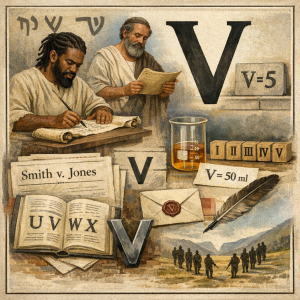
Primary Definition
V is the twenty-second letter of the modern English alphabet. In ordinary English orthography, the lowercase form is v, and its usual sound is the voiced labiodental consonant heard at the beginning of voice, value, and victory. The sound is made by placing the lower lip against the upper teeth while vibrating the vocal cords.
The character has several distinct and legitimate uses. Most prominently, capital V is the Roman numeral for five. It may also be an initial, an abbreviation, a scientific symbol, a designation in a sequence, or a visual shape. Meaning depends upon the document, field, capitalization, surrounding words, and established convention. The symbol itself does not carry one universal legal, religious, political, or spiritual meaning.
In dictionary usage, V can refer to the letter, its spoken name (“vee”), a thing shaped like the letter, the fifth item in a Roman-numeral sequence, or a person or thing designated by that letter. Lowercase v. has an especially important legal use as an abbreviation of versus, meaning “against,” in the titles of contested court cases.
Etymology and Origin
The English letter V belongs to the Latin alphabet. Its deeper ancestry is generally traced through Greek and earlier Semitic alphabetic traditions. The relevant ancient Semitic letter is commonly identified as waw, a character associated with a consonantal sound nearer to w than to the modern English v. Greek adopted a related character as upsilon. Latin then used the ancestor of the modern U, V, and Y in ways that differed from present English practice.
For much of Roman and medieval writing, U and V were not treated as fully separate letters. A single character could represent both a vowel-like sound and a consonantal sound. In inscriptions and early print, forms equivalent to V commonly appeared where a modern reader would expect U; thus Latin words now printed with u may appear in monumental capitals with V. The familiar distinction between U as a vowel letter and V as a consonant letter developed gradually in European printing and spelling practice, becoming established in English during the early modern period.
English spelling likewise preserved an older positional convention for a time. Printers often used v at the beginning of a word and u elsewhere, even when the underlying sound was the same. Older forms such as vpon for upon and haue for have illustrate that convention. The modern separation of u and v therefore represents a historical refinement of writing and typography, not the creation of an entirely new sound.
As a Roman numeral, V means five. Its precise original form remains a subject of scholarly discussion. One influential explanation connects early numeral marks with tally practices: repeated strokes marked units, while a distinctive mark identified a group of five. Other explanations describe the Roman system as developing through Etruscan and Italic numerical practices, with later standardization in Roman writing. What is well documented is that the Roman system used seven principal signs: I for one, V for five, X for ten, L for fifty, C for one hundred, D for five hundred, and M for one thousand.
Accordingly, claims that the numeral V has one certain hidden origin—for example, that it indisputably depicts a human hand, a pagan religious emblem, or a particular governmental badge—go beyond the evidence. Such explanations may be offered as theories or symbolic interpretations, but they should not be confused with settled historical fact.
Cultural and Historical Context
The letter and numeral acquired importance because alphabets and numerical systems are tools of public record. Roman numerals were used on monuments, coins, legal and administrative records, clocks, book chapters, royal and papal regnal names, military units, dates, and architectural inscriptions. Their continued use in these settings reflects tradition, visual clarity, and ceremonial style rather than an independent source of legal authority.
As a number, five has obvious practical importance in counting, grouping, and classification. Human hands, each normally having five digits, have encouraged five-based grouping in many cultures. Yet the Roman sign V is not itself proof that every use of five is derived from Rome, nor that five always possesses a special occult, religious, or governmental significance. Numerical symbols are conventional signs: they function because readers within a community recognize the convention.
The visible “V” shape has also become culturally meaningful apart from alphabetic writing. It may describe a formation of birds in flight, a fork or notch, a neckline, a chevron-like design, or an arrangement of people or vehicles. In military and aviation contexts, a V-shaped formation can have practical value: it may help participants maintain position, visibility, and coordinated movement. That practical use should be distinguished from the letter’s etymological history and from later symbolic uses.
During the twentieth century, the raised two-finger “V sign” became widely associated with victory, especially in wartime public imagery. In other places and contexts, the same hand configuration has carried meanings such as peace, celebration, or—when made with the palm turned inward in parts of the United Kingdom and elsewhere—an insulting gesture. This variation demonstrates a central interpretive rule: signs acquire meaning through social context, not merely through shape.
Biblical / Torah Context
The character V is not a letter of the biblical Hebrew alphabet and is not a letter of the classical Greek alphabet in the modern English sense. Therefore, the Torah, the Hebrew Bible, and the New Testament do not assign an original sacred meaning to the English letter V as such. The original languages of the Torah and much of the Hebrew Bible use Hebrew and Aramaic scripts; the New Testament was written in Greek.
The historical antecedent of the letter is related to the Semitic letter waw, usually written ו in Hebrew. However, waw should not simply be equated with English V. In modern Hebrew pronunciation, the letter often represents a sound closer to English v, but historically it also had functions connected with w and vowel representation. The relationship is linguistic and historical, not a basis for assuming that every English word or symbol containing V carries a Torah-derived message.
Roman numerals do appear in later editions, headings, commentaries, and reference systems connected with biblical materials. For example, editors may use Roman numerals to identify volumes, sections, kings, or chapters in older works. Such use belongs to later editorial and publishing practice, not to the original wording of Scripture. Contemporary biblical style guidance ordinarily uses Arabic numerals for chapter-and-verse citations, as in Gen. 1:1 or John 3:16.
Interpretive traditions sometimes attach significance to the number five, perhaps by observing five books of the Torah, five fingers, five offerings described in Leviticus, or other patterns. Those observations may have devotional value within a particular faith community. They do not establish that the Roman numeral V itself has a divinely fixed biblical meaning. A responsible distinction should be maintained between a text’s actual language, later numbering conventions, theological interpretation, and personal symbolism.
Legal Implications
Common-Law and Case-Name Usage
In legal writing, lowercase v. is ordinarily an abbreviation for the Latin word versus, meaning “against.” It separates opposing parties in the caption or citation of an adversarial case. For example, Smith v. Jones identifies a case between Smith and Jones; it does not, by itself, identify which party is morally right, who will prevail, or the substantive rule of decision.
In the United States, the party listed first in a civil case is commonly the plaintiff or petitioner, and the opposing party is commonly the defendant or respondent, depending on the court and procedural posture. In criminal prosecutions, the government may appear first, as in United States v. Doe or State v. Doe. Citation conventions can vary among jurisdictions, courts, reporters, and legal-writing systems. The abbreviation is a convention of legal identification, not a source of jurisdiction, authority, obligation, or consent.
Roman Numerals in Law and Government
Capital V may appear in legal and governmental documents merely as the number five. It can identify an article, section, part, count, volume, chapter, exhibit, amendment, division, or enumerated clause. Whether it has legal effect depends on the instrument in which it appears. A properly enacted statute, a constitution, a contract, a court order, or an administrative regulation may use Roman numerals for organization; the law’s force comes from valid enactment, execution, jurisdiction, and applicable legal doctrine—not from the numeral system selected by the drafter.
Historical common law developed through judicial decisions and longstanding legal custom in England and later common-law jurisdictions. Roman law was a distinct legal tradition of the ancient Roman world, although Roman legal ideas influenced parts of European civil-law development. Equity developed through separate English institutions and principles aimed historically at supplementing the rigidity of common-law forms. The fact that a modern common-law court uses Roman numerals in a caption, statute, or opinion does not transform the court into a Roman-law tribunal or establish that the governing law is Roman rather than common law, equity, constitutional law, statute, regulation, or binding precedent.
Likewise, an isolated V on a document does not inherently indicate “victory,” “voluntary,” “vessel,” “value,” “verified,” “void,” “venire,” “venue,” “versus,” or any other legal conclusion. Legal abbreviations must be read in their complete documentary setting. Where a person’s rights, duties, criminal exposure, property, or court deadlines are involved, the actual text of the controlling instrument and the law of the relevant jurisdiction govern.
Spiritual Meaning
There is no universally authoritative spiritual meaning assigned to the English letter V. In spiritual, devotional, and symbolic systems, individuals may associate it with victory, virtue, vitality, vocation, voluntary action, or the number five. Such associations can be meaningful as personal reflection or as part of a defined religious tradition, but they are interpretive rather than linguistic necessities.
A common Christian reading links “V” with victory because of words such as victory and passages concerning overcoming evil, sin, or death. That connection is understandable in English-language devotional practice. It should nevertheless be described accurately: it arises from English vocabulary and later symbolism, not from an original biblical command that the letter itself be revered, feared, or treated as a spiritual token.
Care is warranted where a single character is made to bear sweeping claims about hidden control, divine endorsement, curses, political allegiance, or legal status. Symbolic interpretation is strongest when it is openly presented as interpretation, tested against the relevant text and tradition, and kept distinct from verifiable historical or legal fact.
Modern Usage
In modern English, V remains a common alphabetic character, although words beginning with v are less numerous than words beginning with several other letters. It appears in ordinary vocabulary, initials, names, trademarks, grading systems, labels, and serial designations. In typography, the plural may be written Vs, V’s, or v’s, depending on the style guide and the need for clarity.
In science and technology, the capital or lowercase character has many field-specific meanings. V may symbolize voltage or electric potential in physics and engineering; it is also the chemical symbol for vanadium. Lowercase v often represents velocity in physics, while italic letters in mathematics may denote variables whose meaning is supplied by a definition. None of these meanings should be assumed outside the relevant discipline.
In publishing and citation, v. can mean volume, verso (the back side of a leaf), or verse, depending on the citation system. In music and media, “V” can identify a fifth installment or sequel. In commerce, software, and product naming, it may stand for version, though many technical systems instead use “ver.” or a numerical release label. Context remains decisive.
Controversies / Criticisms
The principal controversy surrounding V is not the letter itself but the tendency to overstate what a symbol proves. Internet claims sometimes assign fixed legal, religious, Masonic, pagan, Roman, governmental, or military meanings to an isolated character. Such claims often combine genuine historical fragments—such as the Roman use of V for five—with conclusions unsupported by primary documents, linguistic history, enacted law, or judicial authority.
It is also inaccurate to argue that the use of Roman numerals in a modern legal system proves that modern law is Roman law, that a statute is invalid, or that a court lacks jurisdiction. Modern legal documents often preserve older typographical practices for convenience and formality. Their validity must be assessed through the applicable constitution, statutes, rules of procedure, case law, and facts, not through symbolic speculation about a numeral.
Conversely, dismissing all symbolism as meaningless can overlook real cultural usage. A V-shaped hand gesture, a military formation, a numeral, a legal case caption, and a religious reflection can all have genuine meanings within their own contexts. The appropriate method is neither automatic suspicion nor automatic acceptance, but careful identification of the relevant language, source, audience, date, and governing convention.
Conclusion
V is a versatile alphabetic and numerical sign whose primary meanings are straightforward: it is the twenty-second letter of the English alphabet and the Roman numeral for five. Its history reflects the long development of the Latin alphabet and the gradual separation of U and V in European writing. Its legal use in v. means versus in case names, while its appearance as a Roman numeral commonly serves only to organize text or designate a number.
No universal legal, biblical, governmental, military, or spiritual doctrine follows from the character standing alone. Sound interpretation requires context and a distinction between documented historical fact, established legal convention, theological reflection, and disputed symbolic claims.
Sources / Further Reading
- Merriam-Webster Dictionary, “V.” https://www.merriam-webster.com/dictionary/v
- Cambridge Dictionary, “V, v.” https://dictionary.cambridge.org/us/dictionary/english/v
- Online Etymology Dictionary, “V.” https://www.etymonline.com/word/V
- Oxford Classical Dictionary, “Numbers, Roman.” https://academic.oup.com/edited-volume/61673/chapter-abstract/548071223
- Cornell Law School Legal Information Institute, “Versus.” https://www.law.cornell.edu/wex/versus
- Cornell Law School Legal Information Institute, Basic Legal Citation. https://www.law.cornell.edu/citation/basic-legal-citation.pdf
- Society of Biblical Literature, Student Supplement for The SBL Handbook of Style. https://www.sbl-site.org/assets/pdfs/pubs/sblhssupp2015-02.pdf