Male
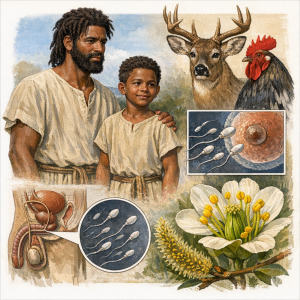
Primary Definition
In ordinary English it means an animal, the term denotes the sex that is organized, in the typical biological pattern of sexually reproducing species, toward the production of relatively small reproductive cells, commonly called sperm or pollen. It may describe a human being, a nonhuman animal, a plant, or a sexed part or function. In human contexts, it commonly refers to a boy or man; in animal breeding, zoology, medicine, and biology, it identifies one sex of an organism; and in botany it may describe a flower or plant that produces pollen-bearing stamens.
The word operates both as a noun and an adjective. As a noun, it can identify an individual of that sex: “the male of the species.” As an adjective, it can describe sex, persons, groups, anatomy, voices, clothing categories, medical data, or facilities: “male patient,” “male voter,” or “male division.” Context matters. A reference to a “male animal” ordinarily concerns biological sex; a reference to a “male identity” concerns a person’s stated gender identity; and a reference to “male grammar” concerns a linguistic category, which need not correspond to biological sex.
A careful dictionary definition should not collapse several distinct questions into one. Biological sex concerns reproductive organization and related bodily traits. Sex assigned or recorded at birth is commonly based on observed anatomy, sometimes supplemented or revised by medical information. Gender identity concerns a person’s internal and social identification. Gender roles concern cultural expectations about conduct, dress, labor, authority, and temperament. These categories often overlap in ordinary life, but they are not identical in every setting.
As an interpretive matter, the most stable biological sense is the reproductive one: the sex associated with small gametes. In humans, typical male development is associated with testes, sperm production, particular hormonal patterns, and usually an XY chromosomal pattern. None of those traits alone is a universal or complete test for every individual. Some people have differences in sex development involving chromosomes, gonads, hormones, internal reproductive structures, or external anatomy. Thus, clear general definitions remain useful without pretending that every medical case is resolved by a single visible trait.
Etymology and Origin
The English word entered through Middle English and Anglo-French forms such as masle and male, ultimately from the Latin masculus, meaning male or masculine. Masculus is related to Latin mās, meaning a male person or animal. English therefore received the word through the French-and-Latin vocabulary that entered the language after the Norman period, rather than directly from Old English.
The historical relationship between this word and masculine is genuine: both derive through Latin words connected to maleness. The word is not an acronym, a hidden legal formula, or a title conferring a special civil status. Claims that its letters secretly mean “man against legal entity,” “man as living energy,” or similar phrases are modern inventions unsupported by historical dictionaries, medieval legal sources, or Latin philology.
Over time, usage broadened. The older and continuing biological sense applies across species. English speakers also developed figurative uses, such as “male connector,” for a protruding part designed to fit into a corresponding receiving part. Such engineering terminology is analogical; it does not create a legal or biological claim about the object. Likewise, “male” in grammar refers to a masculine grammatical class in some languages, but grammatical gender is a feature of language rather than proof of biological sex.
Cultural and Historical Context
Across many societies, sex classifications have been connected with kinship, inheritance, household authority, military obligations, labor, marriage, religious office, and political participation. Those social arrangements varied widely by place and period. The biological meaning of the word did not itself prescribe a universal social role; rather, cultures attached particular expectations to persons categorized as male.
In English-speaking legal and political history, men frequently held privileges denied to women, including broader rights to vote, hold public office, control marital property, contract independently, and exercise authority within the household. These inequalities were not merely consequences of a dictionary definition. They were produced and enforced by particular customs, common-law rules, statutes, and political institutions.
English common law historically treated marriage through the doctrine commonly called coverture. As described by William Blackstone in the eighteenth century, a married woman’s separate legal position could be substantially absorbed into that of her husband for many common-law purposes. Equity sometimes recognized separate interests and trusts that tempered the rigidity of common-law rules, and later legislation substantially altered the older arrangement. The historical position of husbands under coverture should therefore not be mistaken for an eternal definition of maleness, nor should a historical legal doctrine be represented as controlling present-day American law.
Modern cultural usage is more varied. Some speakers use the word narrowly for biological sex; others use it in reference to gender identity, especially in everyday descriptions of people. Institutional documents may distinguish “sex,” “gender,” “gender identity,” and “sex assigned at birth” in order to state precisely what information is being collected or what rule is being applied. Good drafting should define its terms rather than assume that every reader uses them in exactly the same way.
Biblical / Torah Context
The Hebrew Bible uses the Hebrew word zakar for “man or English male.” It is a sex description term for animals and is used not only for adult human men, but also for boys and animals. It should not automatically be translated as “husband,” “man,” “adult,” or “patriarch,” because those English words add meanings not necessarily present in the Hebrew term.
Genesis 1:27 states that humanity was created “male and female,” placing both within the creation account and within the image-of-God language of the passage. In the immediate context, the paired terms are connected with fruitfulness and dominion over living creatures. The text supplies a theological account of human creation; it is not a modern medical taxonomy, genetic textbook, or statutory definition.
The Torah also uses sex classifications in passages concerning circumcision, lineage, ritual matters, reproduction, inheritance, and certain sexual prohibitions. Interpretation differs among Jewish communities and among later Christian traditions, particularly where ancient ritual law, moral teaching, civil regulation, and contemporary pastoral questions are concerned. A responsible reading should distinguish what the Hebrew text says, how rabbinic or Christian interpreters have understood it, and what a modern civil government may lawfully require.
Neither the Torah nor the Christian Bible provides support for the claim that an adult male is inherently a higher class of human being. Biblical texts contain patriarchal household structures and male-centered genealogies, but they also repeatedly treat men as morally accountable before God. The creation language of Genesis applies divine image-bearing to humanity as male and female, not to males alone.
Legal Implications
Historical Common Law, Equity, and Statute
At common law, the term itself did not function as a universal magical status that exempted a person from government, courts, taxation, contracts, criminal law, or civil obligations. A person’s rights and duties arose from the applicable law: common-law precedent, equitable doctrines, constitutional provisions, statutes, regulations, and valid court orders. Calling oneself a “male,” “natural man,” or “living man” does not, by itself, change legal jurisdiction or defeat a legal claim.
Historical common law did attach legal consequences to sex in areas such as marriage, inheritance, property, military service, political rights, and family relations. Those consequences were modified over generations by courts, legislatures, constitutional amendments, and civil-rights laws. Equity historically developed alongside common law and sometimes recognized separate property interests or remedies unavailable in common-law courts. Modern American courts generally administer legal and equitable remedies within unified court systems, but the distinction remains historically important.
Roman law should not be confused with English common law, although European legal traditions influenced one another over time. English common law developed through royal courts and precedent; Roman civil law developed from different sources and methods. A statement that “common law says” something must be checked against the actual jurisdiction, date, case, and statute at issue.
Current United States Law
In present United States law, sex classifications may still matter in particular contexts, including medical care, vital records, family law, prison administration, athletics, privacy accommodations, statistical reporting, and anti-discrimination law. The governing rule depends on the specific federal, state, tribal, or local authority involved. There is no single all-purpose definition that resolves every question in every jurisdiction.
Federal employment law prohibits discrimination because of sex. Title VII of the Civil Rights Act of 1964 makes it unlawful for covered employers to discriminate in hiring, discharge, compensation, and terms or conditions of employment because of an individual’s sex. The Equal Employment Opportunity Commission explains that the protection applies to everyone, including men. In Bostock v. Clayton County (2020), the United States Supreme Court held that firing an individual merely for being homosexual or transgender constitutes discrimination because of sex under Title VII.
That decision concerns Title VII employment discrimination. It did not eliminate all legal disputes involving sex-separated spaces, athletics, medical practice, family law, religious liberty, or state administrative rules. Such disputes must be analyzed under the particular statute, constitutional provision, regulation, and controlling judicial decisions involved. Broad statements that federal law either always requires sex to mean only one thing or never permits biological distinctions are both overstatements.
Military and Governmental Usage
Military and governmental records have historically used sex classifications for personnel administration, health readiness, housing, uniforms, privacy, selective-service questions, and statistical reporting. These classifications have changed as statutes, policies, medical standards, and court decisions have changed. The word itself carries no independent military rank, governmental authority, citizenship status, or exemption from public law.
Spiritual Meaning
In spiritual and religious reflection, maleness is often associated with fatherhood, sonship, stewardship, strength, protection, sacrifice, responsibility, or generative capacity. These meanings are interpretive and tradition-dependent rather than dictionary facts. They may offer a framework for moral reflection, but they should not be used to excuse domination, violence, irresponsibility, or contempt toward women or toward persons whose lives do not conform to cultural stereotypes.
Within biblical ethics, strength is frequently joined to humility, justice, fidelity, mercy, self-command, and service. A spiritual account of mature manhood therefore cannot be reduced to physical power, social control, sexual capacity, wealth, or public status. Different faith communities articulate these virtues differently, and nonreligious persons may understand similar responsibilities through ethical rather than theological language.
Modern Usage
Contemporary use commonly appears in the following settings:
- Biology and medicine: describing sex-linked anatomy, physiology, research populations, or health risks.
- Demography and records: identifying a sex category in census, health, school, or administrative data.
- Social description: referring to boys, men, or groups commonly understood as male.
- Gender identity: describing a person who identifies as a man or as male, depending on the speaker’s terminology and context.
- Botany and zoology: identifying pollen-producing plants, flowers, or sexed animals.
- Technology: describing a projecting plug, pin, or fitting designed to enter a corresponding receptacle.
Precision is especially important in medicine, law, and public policy. A clinical question may require information about anatomy, hormones, chromosomes, organs, or reproductive capacity rather than a broad demographic label. A discrimination claim may require attention to statutory language and the reason for an adverse action. A social conversation may call for respectful reference to the person’s own identity and preferred form of address.
Controversies / Criticisms
Current disagreement often arises because one word is asked to perform several jobs at once. Some people emphasize the biological, gamete-based meaning of sex and argue that sexed language should retain that meaning in law and public policy. Others emphasize that human sex traits can vary, that legal classifications must account for individual circumstances, and that gender identity has substantial social and personal significance. These are not merely dictionary disputes; they involve medicine, civil rights, language, religion, institutional policy, and competing views of fairness.
One contested issue concerns whether ordinary sex terms should be defined exclusively by reproductive role, by a cluster of biological traits, by legal documentation, by self-identified gender, or by different criteria in different contexts. Biology recognizes typical male and female reproductive organizations while medicine also recognizes variations in sex traits. The existence of such variations does not make biological categories meaningless, but it does make simplistic claims about every person’s body unreliable.
Another concern is stereotype. Terms such as “male behavior,” “male work,” or “male authority” can describe historical patterns, but they can also improperly turn cultural expectations into fixed rules. Competence, virtue, legal capacity, parental fitness, and human dignity should not be presumed from sex alone.
Finally, so-called “common-law” arguments sometimes misuse sex terminology to assert that a flesh-and-blood person is legally separate from a named legal entity or beyond governmental jurisdiction. Courts do not accept such assertions merely because they are phrased in archaic language. Legal rights are best protected by identifying the actual governing authority, preserving evidence, observing deadlines, and obtaining qualified legal advice where appropriate.
Conclusion
The term has an established biological core, a documented Latin and French linguistic history, and a broad range of ordinary, scientific, religious, technical, and legal uses. It can refer to reproductive sex, to persons categorized by sex, and, in some contexts, to gender identity or social description. Its meaning must be read in context rather than assumed from ideology, historical custom, or wordplay.
Historically, male status was often joined to legal privileges and household authority under systems such as coverture and sex-based political exclusion. Those systems were legal and cultural arrangements, not hidden meanings inside the word itself, and many have been altered or rejected by modern law. In contemporary usage, careful distinction among biology, identity, legal classification, and social role produces clearer language and more accurate analysis.
Sources / Further Reading
- Merriam-Webster, “Male” — https://www.merriam-webster.com/dictionary/male
- National Academies of Sciences, Engineering, and Medicine, Measuring Sex, Gender Identity, and Sexual Orientation — https://www.ncbi.nlm.nih.gov/books/NBK581049/
- Endocrine Society, “Considering Sex as a Biological Variable in Basic and Clinical Studies” — https://pmc.ncbi.nlm.nih.gov/articles/PMC8348944/
- Bible Gateway, Genesis 1:27 — https://www.biblegateway.com/passage/?search=Genesis%201%3A27
- The Avalon Project, Blackstone’s Commentaries, “Of Husband and Wife” — https://avalon.law.yale.edu/18th_century/blackstone_bk1ch15.asp
- United States Code, 42 U.S.C. § 2000e-2 — https://uscode.house.gov/view.xhtml?req=(title:42%20section:2000e-2%20edition:prelim)
- United States Supreme Court, Bostock v. Clayton County — https://www.supremecourt.gov/opinions/19pdf/17-1618_hfci.pdf
- U.S. Equal Employment Opportunity Commission, “Sex-Based Discrimination” — https://www.eeoc.gov/sex-based-discrimination