C
Primary Definition
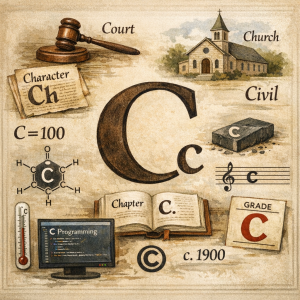
C, with the lowercase form c, is the third letter of the modern English alphabet and of the basic Latin alphabet. Its English name is pronounced “see.” Depending on the word and language in which it appears, it may represent several different consonant sounds. In English, its principal values are the “hard” sound /k/, as in court, and the “soft” sound /s/, as in civil. In the combination ch, it may represent the sound heard in church, the /k/ sound in words such as character, or the sound heard in words such as machine.
The character also functions independently as a symbol, abbreviation, label, numeral, grade, musical note, scientific notation, and technological name. Among its established uses are the Roman numeral for one hundred; the chemical symbol for carbon; a musical pitch or note; an academic grade; an abbreviation for terms such as circa, chapter, copyright, or Celsius when context establishes that meaning; and the name of the C programming language. In computing, the uppercase character is encoded as Unicode U+0043, while lowercase c is U+0063. ([unicode.org](https://www.unicode.org/charts/nameslist/n_0000.html?utm_source=openai))
Because a single letter can perform many functions, its meaning must ordinarily be determined from its setting. A letter standing alone does not carry every meaning historically or symbolically associated with it. In a contract, statute, inscription, computer program, musical score, scientific formula, or religious commentary, context remains controlling.
Etymology and Origin
The letter belongs to a long family of alphabetic signs. Its documented line of development runs through the Phoenician letter commonly called gimel, the Greek letter gamma, western Greek forms of gamma, the Etruscan alphabet, and finally the Roman or Latin alphabet. Claims that the earliest sign literally pictured a camel, camel’s neck, throwing stick, or another object are hypotheses about a remote pictographic ancestor rather than universally established facts.
The Etruscans adopted a western Greek form of gamma whose shape resembled the later Roman character. Because the Etruscan sound system did not employ the Greek distinction between voiced /g/ and voiceless /k/ in the same way, the sign was used with a /k/ value. Early Latin inherited this practice. In archaic Roman writing, C could consequently serve where later spelling distinguished C from G. The Romans eventually created G by modifying the form of C, allowing the two letters to represent separate sounds more consistently. ([academic.oup.com](https://academic.oup.com/edited-volume/61673/chapter-abstract/548068904?utm_source=openai))
Classical Latin ordinarily pronounced C as /k/, including before vowels where modern English or French may use a soft sound. The soft values arose through later sound changes, especially before front vowels such as e and i. French and other Romance developments strongly influenced English after the Norman Conquest, bringing many words in which the written letter represented /s/. English therefore preserved both the older hard value and the later soft value. ([etymonline.com](https://www.etymonline.com/word/C?utm_source=openai))
Its lowercase form developed through handwriting. Monumental Roman capitals favored the large open curve, while scribal, uncial, Carolingian, and later typographic practices produced smaller and more flowing forms. Printing standardized the familiar uppercase and lowercase pair, though calligraphy, black-letter type, mathematical alphabets, and specialized writing systems continue to use stylistic variants.
Cultural and Historical Context
The history of the letter illustrates how writing systems change through borrowing rather than through a single act of invention. Greek speakers, Etruscans, Romans, medieval scribes, printers, and modern language communities each adapted inherited forms to their own sounds and purposes. The resulting character is therefore not exclusively Greek, Roman, ecclesiastical, governmental, or commercial in origin. Its present form reflects several stages of transmission.
The spread of Latin writing through Roman administration and, later, through European education, manuscript production, missionary activity, commerce, colonization, and printing made the character part of numerous alphabets. Its pronunciation is not universal. Italian, Spanish, French, English, German, Slavic languages using Latin script, and other languages apply different rules. Diacritical forms—including Ç, Ć, Ĉ, Ċ, and Č—represent additional language-specific sounds or distinctions. Unicode treats these as defined characters or combinations rather than as merely decorative versions. ([unicode.org](https://www.unicode.org/charts/nameslist/n_0100.html?utm_source=openai))
As a Roman numeral, C represents 100. Although it was later readily associated with Latin centum, meaning “hundred,” accounts of the numeral’s earliest graphic development are more complicated, and the resemblance to the first letter of centum should not automatically be treated as its original cause. Whatever its remote origin, the value 100 became standard in Roman-numeral notation and remains recognized in governmental and editorial style guides. ([govinfo.gov](https://www.govinfo.gov/content/pkg/GPO-STYLEMANUAL-2016/pdf/GPO-STYLEMANUAL-2016-14.pdf?utm_source=openai))
The character has also acquired cultural meanings through classification. A “C grade” may indicate average, satisfactory, or intermediate performance, but grading systems differ. “Class C,” “Category C,” “Appendix C,” or “Section C” normally identifies a position within a local system rather than a universal rank. Military and governmental documents likewise use letters to organize units, schedules, annexes, security categories, equipment, and operations. Such uses are administrative conventions, not meanings inherent in the character itself.
Biblical / Torah Context
The character is not a letter of the Hebrew alphabet and does not appear as such in the Hebrew text of the Torah. Hebrew has twenty-two basic letters and does not use the Latin distinction between uppercase and lowercase. Torah scrolls are written according to Hebrew scribal forms and traditions, not in the ordinary English alphabet. ([myjewishlearning.com](https://www.myjewishlearning.com/article/how-to-read-the-hebrew-alphabet/?utm_source=openai))
There is nevertheless a remote historical relationship between C and the Semitic alphabetic tradition. The Phoenician gimel was related to the Hebrew letter gimel, and its Greek descendant gamma ultimately contributed to the Latin forms C and G. This genealogical connection does not make C equivalent to Hebrew gimel in pronunciation, numerical value, scriptural function, or religious meaning. In traditional Hebrew numeration, gimel has the value three, while the Hebrew letter associated with one hundred is qof. By contrast, C represents one hundred only in the Roman-numeral system.
English Bibles contain the character because they are English translations printed in Latin script. It appears in translated names and terms such as Canaan, Covenant, Christ, and Corinth, but those spellings reflect English, Greek, Latin, and transliteration history. They do not establish a hidden Hebrew doctrine attached to the English character. The same biblical name may begin with K, Q, C, or another letter in different languages and transliteration systems.
Chapter labels may also use the abbreviation “c.” or “ch.,” and older theological works sometimes employ C as a reference marker. Those are editorial devices added by scribes, translators, printers, or scholars. Biblical chapter divisions themselves are later systems of reference and should not be confused with the original alphabetic composition of the Hebrew text.
Legal Implications
No general doctrine of historical English common law is created merely by the standalone letter. In legal documents, C may be a defined term, an exhibit designation, a party’s initial, a subsection label, a drafting abbreviation, a classification, or part of a citation. Its legal effect comes from the document, applicable rules, surrounding language, and competent evidence of usage—not from speculative symbolism.
C Corporations
In United States federal tax law, a “C corporation” is, for the relevant taxable year, a corporation that is not an S corporation. The “C” is a conventional tax classification tied to Subchapter C of the Internal Revenue Code; it does not describe a separate natural species of corporation created by the alphabet. State law generally governs corporate formation, while federal law determines the relevant federal tax treatment. A C corporation is ordinarily recognized as a separate taxpaying entity, and corporate profits may be taxed at the corporate level and again when distributed to shareholders as dividends. ([law.cornell.edu](https://www.law.cornell.edu/definitions/uscode.php?def_id=26-USC-330235819-1404522896&height=800&term_occur=999&utm_source=openai))
Copyright and Trademark
The copyright symbol © consists visually of a letter C within a circle, although Unicode distinguishes the copyright sign from an ordinary circled capital character. Under United States copyright law, a notice for visually perceptible copies may include ©, the word “Copyright,” or the abbreviation “Copr.,” together with the year and the owner’s name. Copyright notice is no longer generally a condition of protection for works first published on or after March 1, 1989, but proper notice can still provide legal and evidentiary benefits. ([copyright.gov](https://www.copyright.gov/title17/92chap4.html?utm_source=openai))
A stylized letter may also function as a trademark if consumers understand it as identifying the source of particular goods or services. That does not ordinarily grant ownership of the letter in every context. Trademark rights are connected to source identification, commercial use, the relevant goods or services, distinctiveness, and the likelihood of confusion. A character used only as ornamentation, a grade, a model designation, or ordinary information may fail to function as a trademark. ([uspto.gov](https://www.uspto.gov/trademarks/basics/what-trademark?utm_source=openai))
Citations, Statutes, and Instruments
Legal citation depends heavily on abbreviations, but a bare “C.” has no single universal expansion. In a historical source it might signify chapter, code, court, circa, a reporter title, an author, or another expression. “C.J.” may mean Chief Justice in one setting, while “C.J.S.” commonly identifies Corpus Juris Secundum. Subsection “(c)” simply designates a structural part of a statute or rule unless the enactment provides additional meaning. Legal citation authorities expressly warn that practices and abbreviations vary among courts, manuals, jurisdictions, and databases. ([law.cornell.edu](https://www.law.cornell.edu/citation/4-100?utm_source=openai))
Historical common-law manuscripts, Roman-law texts, equity pleadings, and statutory compilations must therefore be interpreted according to their own editorial conventions. A modern reader should not silently import a contemporary abbreviation into an older record. Where a letter is ambiguous in a deed, will, statute, judgment, or contract, courts may consider the whole instrument, established definitions, trade usage, drafting history, and other admissible evidence.
Spiritual Meaning
No single spiritual meaning of the character is established across Judaism, Christianity, or other traditions. Writers have associated its curved form with an open vessel, crescent, cycle, embrace, incompleteness, receptivity, or movement. Others connect its alphabetic position—third—with theological or numerological ideas concerning witness, balance, creation, or divine fullness. These are interpretive associations, not linguistic definitions.
Christian devotional writing may emphasize words beginning with the character, such as Christ, cross, covenant, creation, conscience, or charity. Such meditation can be meaningful within a particular teaching, but it originates in the vocabulary of the language being used. The corresponding words in Hebrew, Greek, Latin, or another language may begin with entirely different letters.
Jewish mystical traditions assign great significance to Hebrew letters, their forms, names, and numerical values. Those teachings concern the Hebrew alphabet. Applying them directly to a Latin character requires an additional interpretive step and should be identified as a modern analogy rather than traditional Torah exegesis. ([myjewishlearning.com](https://www.myjewishlearning.com/article/creation-mysticism-fashioning-the-world-from-letters/?utm_source=openai))
Modern Usage
- Language: the third letter of the English and basic Latin alphabets, with hard, soft, and compound sound values.
- Science: the chemical symbol for carbon; a conventional variable in mathematics and physics; and part of the notation °C for degrees Celsius.
- Music: one of the named notes of the diatonic scale and the keynote of C major and C minor.
- Education: an academic grade whose precise value depends on the institution’s grading policy.
- Numeration: the Roman numeral for 100.
- Organization: a label for sections, exhibits, schedules, classes, categories, batteries, routes, teams, or models.
- Business law: part of the expression “C corporation.”
- Intellectual property: the visual basis of the copyright sign and a possible element of a trademark or logo.
- Computing: the name of a general-purpose programming language whose modern specification is ISO/IEC 9899:2024. ([iso.org](https://www.iso.org/standard/82075.html?utm_source=openai))
- Digital text: Unicode U+0043 for the uppercase character and U+0063 for lowercase.
Capitalization can matter. Computer languages, passwords, identifiers, database searches, and statutory definitions may treat uppercase and lowercase as distinct. Ordinary English usually does not treat capitalization as changing a word’s fundamental identity, but specialized systems may do so expressly.
Controversies / Criticisms
A longstanding spelling criticism is that the character appears redundant because its common English sounds can often be represented by K or S. Spelling reformers have therefore proposed replacing hard C with K and soft C with S. The objection is logically understandable but historically incomplete: English spelling records word origins, borrowing, morphology, and relationships among words as well as immediate pronunciation. Removing the letter would require extensive changes to familiar vocabulary and would not resolve every sound represented by ch or language-specific forms.
Another controversy involves exaggerated etymological, numerological, or legal claims. Similarity between the spoken name “see,” the noun “sea,” the Roman value 100, and words beginning with the character can inspire wordplay, but sound resemblance does not prove common origin or legal equivalence. Likewise, displaying a name in capital letters, placing a character in a circle, or assigning it a private definition does not by itself create a corporation, waive rights, establish consent, transfer property, or alter a person’s legal status.
Documented alphabetic history should also be separated from disputed claims about the earliest pictorial meaning of gimel. The chain from Semitic writing through Greek and Etruscan into Latin is well supported, but the precise object represented by the remote ancestral sign remains debated. A responsible definition should acknowledge the uncertainty rather than turning a proposed camel, weapon, or tool image into settled fact.
Conclusion
The character is fundamentally an alphabetic sign whose meanings have multiplied through more than two millennia of linguistic, administrative, scientific, legal, religious, and technological use. Its form descends through the Greek and Etruscan transmission of an older Semitic sign, while its English hard and soft pronunciations preserve different historical layers.
In law and government, it has no universal operative force apart from context. It may identify a subsection, corporation tax category, copyright notice, exhibit, classification, or citation component, but the relevant instrument or rule supplies the legal meaning. In biblical and spiritual discussion, it may support translation, symbolism, or devotional reflection, yet it is not an original Hebrew letter of the Torah and should not be assigned an ancient scriptural meaning without evidence.
The soundest interpretive principle is therefore contextual: determine whether the character is being used as a letter, sound, numeral, abbreviation, code, legal designation, or symbol before assigning significance to it.
Sources / Further Reading
- Oxford Classical Dictionary, “Alphabets of Italy”: https://academic.oup.com/edited-volume/61673/chapter-abstract/548068904
- Online Etymology Dictionary, “C”: https://www.etymonline.com/word/C
- Unicode Consortium, Basic Latin Character Names: https://www.unicode.org/charts/nameslist/n_0000.html
- U.S. Government Publishing Office, Style Manual, Roman Numerals: https://www.govinfo.gov/content/pkg/GPO-STYLEMANUAL-2016/pdf/GPO-STYLEMANUAL-2016-14.pdf
- Cornell Legal Information Institute, “C Corporation”: https://www.law.cornell.edu/wex/c_corporation
- Internal Revenue Service, “Forming a Corporation”: https://www.irs.gov/businesses/small-businesses-self-employed/forming-a-corporation
- U.S. Copyright Office, Title 17, Chapter 4: https://www.copyright.gov/title17/92chap4.html
- United States Patent and Trademark Office, “What Is a Trademark?”: https://www.uspto.gov/trademarks/basics/what-trademark
- My Jewish Learning, “How to Read the Hebrew Alphabet”: https://www.myjewishlearning.com/article/how-to-read-the-hebrew-alphabet/
- ISO, ISO/IEC 9899:2024, Programming Languages—C: https://www.iso.org/standard/82075.html