Piss (to Piss or to Piss off )
Primary Definition
Piss is a longstanding English word that functions as both a noun and a verb. As a noun, it means urine. As a verb, it means to urinate. In contemporary English, it is generally classified as vulgar, coarse, or strongly informal rather than as technical, medical, or formal language. In medical, legal, and polite public settings, speakers commonly substitute urine, urinate, void, relieve oneself, or, in gentler everyday speech, pee.
The word also appears in several idiomatic forms whose meanings cannot always be derived merely by substituting “urinate.” The two most important are:
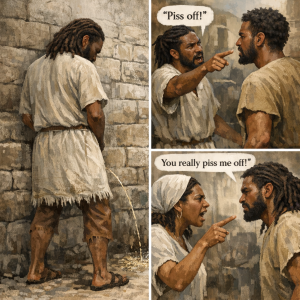
- “Piss off”, used intransitively, means “go away,” “leave,” or “depart,” often as an angry dismissal: “Piss off and leave me alone.”
- “Piss someone off”, used transitively, means to annoy, anger, exasperate, or offend someone: “That conduct really pissed her off.”
The related expression pissed off commonly means angry, irritated, or fed up in North American usage. In some British and Commonwealth usage, however, pissed without off may mean drunk. Context and region therefore matter. A statement such as “he was pissed” can mean “he was angry” in the United States but may be understood as “he was intoxicated” in the United Kingdom.
Dictionary analysis should distinguish the literal bodily meaning from the figurative meanings. The literal word concerns urination; the idiom piss off concerns dismissal or anger. Neither idiomatic meaning establishes a special legal, spiritual, or governmental definition merely because the word may appear in a dispute, a statute, testimony, or a religious translation.
Etymology and Origin
The English verb is recorded from about the beginning of the fourteenth century as pissen. It came through Old French pissier, “to urinate.” Etymological sources commonly trace the French form to a proposed Vulgar Latin form, *pissiare, and characterize the ultimate formation as imitative or sound-symbolic: that is, a word shaped in part by an expressive sound association rather than by a clearly recoverable classical Latin root. The asterisk in *pissiare is significant. It marks a reconstructed form, not a surviving word found directly in a known manuscript. ([etymonline.com](https://www.etymonline.com/word/piss%20off?utm_source=openai))
Accordingly, it is inaccurate to state as settled fact that the English word originated in Roman law, Roman government, classical religion, or a particular pagan rite. The word’s linguistic history runs through French and probable popular Latin speech; that is not the same thing as a documented origin in a Roman legal or religious institution.
For much of English history, the word was less sharply excluded from respectable print than it became in later polite usage. Like many words involving bodily functions, it gradually acquired a stronger social taboo in formal conversation and publishing. Euphemisms proliferated: make water, pass water, ease oneself, go to the toilet, and pee. This change is principally a matter of register, manners, and social convention, not a change in the biological act described.
The phrasal verb piss off developed later than the basic verb. Etymological records place the “go away” sense in the late 1950s, chiefly in British usage, and the transitive “annoy someone” sense by the late 1960s, chiefly in American usage. Pissed off in the sense of angry is recorded earlier, in the mid-twentieth century. Some accounts associate its circulation with military speech during the Second World War, but that association should be treated cautiously: it is a reported explanation of usage, not proof that the military created either the basic word or every later idiom. ([etymonline.com](https://www.etymonline.com/word/piss%20off?utm_source=openai))
Cultural and Historical Context
Words for bodily functions often reveal a tension between plain speech and social restraint. Piss is direct and vivid. For that reason, it may be used for shock, comic force, contempt, intimacy, realism, or emotional emphasis. It may also be heard as crude, hostile, or needlessly degrading depending on the speaker, listener, location, and purpose.
In ordinary speech, the word can carry widely different force. Friends may use it casually; a parent may prohibit it around children; an employer may view it as unprofessional; and a courtroom, school, church, or public meeting may treat it as inappropriate even where it is not unlawful. These are social and institutional judgments about decorum. They should not be confused with a universal rule that the utterance itself is illegal or morally identical in every setting.
English has produced many compounds and expressions built from the word. Some refer literally to urination; others are figurative. Examples include piss away, meaning to waste recklessly; pissing contest, meaning a futile rivalry or contest of ego; and take the piss, especially in British usage, meaning to mock, tease, or make contemptuous sport of someone or something. Such expressions demonstrate semantic extension: a bodily term becomes a vehicle for ideas of waste, disdain, rivalry, or rejection.
The phrase piss off is especially context-sensitive. As an imperative, it can be an insulting command to leave. As a transitive phrase, it identifies the speaker’s emotional reaction: “The delay pissed me off.” In the latter form, it does not necessarily accuse another person of a legal wrong; it ordinarily expresses irritation. The dictionary’s interpretive analysis is that the phrase often intensifies the speaker’s feeling rather than providing precise evidence of the seriousness of the underlying event.
Biblical / Torah Context
The exact modern English expression piss off does not occur in the Hebrew Bible or the New Testament. It is a much later English idiom and should not be projected backward into Scripture. Likewise, the English word piss in an older Bible translation does not establish that the original Hebrew, Aramaic, or Greek used a modern English profanity category.
The King James tradition contains the phrase “pisseth against the wall” in several passages concerning males, including 1 Samuel 25:22. The underlying Hebrew wording is commonly understood as a graphic expression identifying a male person, rather than as an instruction about urination. Modern translations often render the expression more directly as “male” or “every male.” The older English translation preserves a literal bodily image that modern readers may find startling, but the passage’s principal concern is the threatened destruction of males within a household, not toilet behavior. ([biblehub.com](https://biblehub.com/text/1_samuel/25-22.htm?utm_source=openai))
Torah material does address bodily waste and the cleanliness of Israel’s military camp. Deuteronomy 23:12–14 directs that a place be set apart outside the camp and that waste be covered. The text joins practical camp sanitation with the covenantal idea that the camp must be holy because the Lord is present among the people. This is genuinely relevant military and spiritual context, but it should not be overstated. The passage does not provide an English etymology for piss, nor does it create a modern common-law rule concerning the word. ([biblegateway.com](https://www.biblegateway.com/passage/?search=Deuteronomy+23%3A12-14&version=AKJV&utm_source=openai))
Leviticus 15 concerns ritual status connected with certain bodily discharges, including abnormal genital discharges and seminal emission. It does not simply declare ordinary urination sinful. Biblical ritual impurity is a distinct covenantal and ceremonial category; it should not casually be equated with personal guilt, dirtiness in a modern medical sense, or criminal conduct. Scholarly notes on Leviticus distinguish abnormal discharge from ordinary seminal emission and describe the chapter in terms of ritual impurity and purification. ([bible.usccb.org](https://bible.usccb.org/bible/leviticus/15?utm_source=openai))
Legal Implications
The Word as Speech
In American law, piss and piss off ordinarily have no single, free-standing technical definition. Courts interpret language according to context, ordinary usage, statutory wording, contractual terms, and the facts of a particular case. Merely using a vulgar word is not automatically a crime.
Profane expression also may receive constitutional protection. In Cohen v. California (1971), the United States Supreme Court reversed a conviction based on the public display of an expletive on a jacket, holding that general offensiveness alone did not justify punishment under the statute at issue. The decision does not create a blanket immunity for every insult in every context, but it stands against the proposition that government may punish speech simply because many listeners find its language offensive. ([supreme.justia.com](https://supreme.justia.com/cases/federal/us/403/15/?utm_source=openai))
Context remains decisive. A phrase such as “piss off” may be protected rude expression; yet speech can raise different legal questions if it is part of a genuine threat, targeted unlawful harassment, coercion, disorderly conduct as specifically defined by law, or conduct intended and likely to provoke an immediate breach of the peace. The legal issue is not the dictionary word in isolation but the entire communication and surrounding circumstances.
Urination as Conduct
The literal act of urinating is different from speaking the word. Historical common law recognized public-order concepts such as nuisance and breach of the peace, but modern enforcement in the United States normally depends on state statutes, municipal ordinances, park rules, transit regulations, or other enacted provisions. There is no single nationwide American offense called “pissing.”
Public urination may, depending on the jurisdiction and facts, be charged or regulated as a sanitation violation, public nuisance, disorderly conduct, trespass, indecent exposure, or a similar local offense. Whether a particular charge is lawful depends on the exact statute, the location, public visibility, intent, notice, and other facts. “Disorderly conduct” itself is a broad statutory category in many jurisdictions and commonly concerns conduct that unreasonably disturbs public peace, safety, or order; its application varies substantially by state and locality. ([law.cornell.edu](https://www.law.cornell.edu/wex/disorderly_conduct?utm_source=openai))
It is therefore misleading to claim that common law alone automatically makes every instance of public urination a felony, an act of indecency, or a breach of the peace. Such conclusions require the governing jurisdiction’s current statute or ordinance and the facts of the case. Roman law, equity, and modern statutory law are also separate legal traditions and should not be collapsed into a single label called “common law.”
Spiritual Meaning
The word has no inherent universal spiritual meaning. In a literal sense, urination is an ordinary bodily function. In spiritual or moral discourse, the word may be used figuratively to convey contempt, waste, humiliation, anger, or rejection. Those meanings arise from cultural associations and rhetorical force, not from a fixed spiritual definition contained in the word itself.
Within a biblical framework, the most defensible related themes are reverence, cleanliness, self-control, truthful speech, and respect for others. Deuteronomy’s instruction concerning camp sanitation joins bodily realities with communal order and holiness. That does not mean the body is evil, nor does it support treating every use of a coarse English term as a spiritual offense. A faith community may properly adopt standards of speech and modesty, but those standards are theological or communal judgments and should be stated as such.
Modern Usage
Modern usage remains common in informal conversation, entertainment, political rhetoric, sports culture, and angry exchanges. The word may be used literally, humorously, aggressively, or idiomatically. It is usually unsuitable for formal correspondence, legal drafting, medical records, classroom instruction, professional customer service, or situations in which a neutral term can communicate the same fact without unnecessary friction.
Writers should select language according to audience and purpose. Urinate is appropriate for clinical, official, and legal descriptions. Pee is generally milder and family-friendly. Piss may be appropriate when accurately reporting a quotation, representing a speaker’s voice, describing slang, or preserving the intensity of an utterance. The phrase piss off should be used with particular care because it can be either a hostile dismissal or an emphatic description of anger.
Controversies / Criticisms
The principal controversy surrounding the term is not its literal meaning but its level of offensiveness. Some speakers regard it as ordinary blunt language; others consider it vulgar and disrespectful. Neither reaction is imaginary. The social force of the word changes with age group, region, religious setting, workplace expectations, and relationship between speakers.
Claims that the word has a hidden legal, occult, Roman, religious, or governmental meaning generally require strong documentary support. The documented etymology does not establish such a special origin. Likewise, claims that every biblical appearance of an older English form proves that coarse modern speech is approved—or forbidden—go beyond what translation history can show. A responsible dictionary treatment distinguishes the text of a translation, the meaning of the ancient-language passage, and a modern reader’s moral response.
Another recurring confusion concerns law and offense. A person may be rude without committing a crime; a person may violate a workplace rule without violating criminal law; and public urination may be regulated even though saying the word is constitutionally protected in many contexts. Clear analysis keeps speech, conduct, etiquette, morality, and enforceable law separate.
Conclusion
Piss is an old English word for urine and urination, inherited through French from a probable popular Latin source. Its historical development produced a wide family of literal and figurative expressions, including piss off, which can mean either “go away” or “make someone angry.” Its force comes largely from register: it is direct, informal, and often vulgar, though its severity varies by context.
Neither the word nor its idioms carry an automatic special status in common law, Scripture, government, or military usage. Biblical passages concerning bodily waste and ritual impurity must be read in their own textual and covenantal settings. Modern legal consequences arise from particular laws and facts—especially where public urination, threats, harassment, trespass, or disorderly conduct are alleged—not from the mere existence of a coarse dictionary term.
Sources / Further Reading
- Online Etymology Dictionary, “Piss” and “Piss Off”: https://www.etymonline.com/word/piss%20off
- Legal Information Institute, Cornell Law School, “Disorderly Conduct”: https://www.law.cornell.edu/wex/disorderly_conduct
- Legal Information Institute, Cornell Law School, “Disturbance of the Peace”: https://www.law.cornell.edu/wex/disturbance_of_the_peace
- Cohen v. California, 403 U.S. 15 (1971): https://supreme.justia.com/cases/federal/us/403/15/
- Bible Gateway, Deuteronomy 23:12–14: https://www.biblegateway.com/passage/?search=Deuteronomy%2023%3A12-14&version=AKJV
- Bible Hub, 1 Samuel 25:22 Hebrew Text Analysis: https://biblehub.com/text/1_samuel/25-22.htm
- Chabad.org, Leviticus 15, Torah text and commentary: https://www.chabad.org/library/bible_cdo/aid/9916/jewish/Chapter-15.htm