Polyandry
Primary Definition
Polyandry is a form of plural marriage or marital union in which one woman has, or is socially recognized as having, more than one husband at the same time. It is the gender-specific counterpart of polygyny, in which one man has more than one wife. Both are subclasses of the broader term polygamy, meaning marriage involving more than two spouses.
The term should be used carefully. In anthropological writing, polyandry normally refers to a recognized social institution rather than to adultery, casual sexual relations, sequential remarriage, or a household in which several men have relationships with the same woman without a shared marital arrangement. It also differs from polygynandry, a broader arrangement involving multiple women and multiple men within an interconnected marriage group.
Two general forms are commonly identified:
- Fraternal polyandry: a woman marries two or more brothers. This is the form most frequently discussed in studies of Himalayan and Tibetan societies.
- Non-fraternal polyandry: a woman has multiple husbands who are not brothers or otherwise closely related.
Polyandry is historically uncommon in comparison with monogamy and polygyny, but it has been documented in particular cultural settings. It is not accurate to describe it as a universal stage through which all societies pass, nor as a practice reducible to one cause such as poverty, population control, female choice, or supposed “primitive” social development. Those older explanations are now regarded as incomplete or, in some cases, as reflecting colonial-era assumptions rather than careful local study.
Etymology and Origin
The English word polyandry entered use in the eighteenth century. It is formed from Greek elements: poly-, meaning “many,” and anēr (genitive andros), meaning “man” or “husband.” In its modern social sense, the word therefore means, literally, a condition of having many husbands.
The linguistic history requires some precision. Related Greek forms could refer to a multitude of men or to populousness; the specific modern English sense of one woman having multiple husbands is a later scholarly formation. The related word polyandria was also used in botany for flowers having many stamens before it became associated with human marriage arrangements. Etymological history explains the construction of the word, but it does not prove that any particular ancient Greek or Roman society practiced polyandry as a normal legal institution. ([etymonline.com](https://www.etymonline.com/word/polyandry?utm_source=openai))
In ordinary modern speech, polygamy is often used loosely to mean a man having several wives. Technically, however, that is polygyny. Polyandry is not merely “polygamy with the genders reversed”; the social, economic, inheritance, kinship, and legal questions created by plural husbands can be materially different from those arising in polygynous households.
Cultural and Historical Context
Documented Social Forms
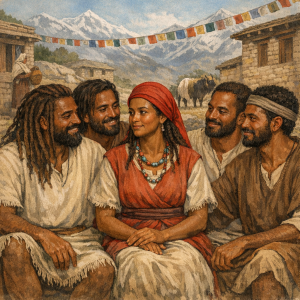
The best-known documented examples of polyandry have occurred in parts of the Himalayan region, including Tibetan cultural areas and some communities in Nepal and northern India. In many of these settings, fraternal polyandry joined brothers in marriage to one wife and maintained a single household rather than dividing a family estate into separate units.
Anthropologists have often connected this arrangement with practical household concerns: preserving family land, reducing fragmentation of inherited property, maintaining labor for farming, herding, or trade, and keeping brothers economically united. Research on Tibetan fraternal polyandry, for example, has emphasized the advantages that a larger cooperative household could have where livelihoods combined agriculture, pastoralism, and commercial activity. ([digitalcommons.unl.edu](https://digitalcommons.unl.edu/nebanthro/113/?utm_source=openai))
These explanations should not be mistaken for a universal rule. A household may preserve property through polyandry in one region, while another community may use inheritance rules, delayed marriage, migration, celibacy, or other arrangements to address similar pressures. Nor should economic explanation erase individual agency: studies report that younger brothers sometimes left plural marriages because of conflict, unequal authority, dissatisfaction, reproductive concerns, or opportunities outside the household. ([digitalcommons.unl.edu](https://digitalcommons.unl.edu/nebanthro/113/?utm_source=openai))
Older Theories and Their Limits
Nineteenth- and early-twentieth-century writers sometimes treated polyandry as evidence of a single evolutionary path from “primitive” to “civilized” marriage. Such theories commonly relied on secondhand reports and assumed that European monogamy was the natural endpoint of social progress. Modern anthropology generally rejects that unilinear model. Marriage systems are better studied in their particular historical, material, legal, religious, and kinship contexts.
Likewise, broad claims that polyandry exists simply because women are scarce, land is scarce, or populations must be controlled are inadequate when offered as total explanations. Demographic conditions, inheritance, labor needs, household authority, local custom, and state law may all matter. Scholarly debate continues over the degree to which particular forms of Tibetan polyandry should be characterized as adaptive in evolutionary, economic, or social terms. ([pubmed.ncbi.nlm.nih.gov](https://pubmed.ncbi.nlm.nih.gov/26197483/?utm_source=openai))
South Asian Literary Memory
Polyandry also has a prominent place in South Asian literary and religious memory through the Mahabharata, in which Draupadi is married to the five Pandava brothers. That narrative is culturally significant and is sometimes invoked in connection with regional polyandrous traditions. A literary or sacred narrative, however, should not automatically be treated as proof that a particular legal custom was widespread in every historical community. Literary representation, religious tradition, and lived social practice must be distinguished.
Biblical / Torah Context
The Hebrew Bible and Torah do not present a developed institution called “polyandry,” and they contain no clear narrative example of a woman simultaneously maintaining several lawful husbands. Biblical marriage language and household law generally assume a husband-wife structure in which a married woman’s sexual union with another man is treated as adultery. The Torah’s adultery provisions therefore operate within a patriarchal legal and social order in which paternity, inheritance, household authority, and marital fidelity were strongly connected.
At the same time, the Torah’s treatment of marriage should not be oversimplified. The Hebrew Bible includes examples of polygyny—men having more than one wife—and legal materials that regulate households containing more than one wife. This does not amount to an endorsement of every plural arrangement, nor does it establish polyandry. It demonstrates that ancient Israelite marital practice and biblical law cannot be described simply by importing a modern Western definition of monogamy into every text. Scholarly treatments of the Hebrew Bible discuss polygyny, concubinage, inheritance, and gendered household status as distinct but related subjects. ([academic.oup.com](https://academic.oup.com/edited-volume/34452/chapter-abstract/292321058?utm_source=openai))
Levirate marriage is sometimes confused with polyandry. Under the levirate principle described in Deuteronomy 25:5–10, a surviving brother could marry the widow of a deceased brother in specified circumstances to preserve the deceased man’s family line. This is not polyandry because the prior husband is dead; it concerns widowhood, inheritance, and lineage, rather than simultaneous husbands.
Later Jewish and Christian traditions have usually favored monogamy in their formal marital ethics, though their historical developments differ substantially. Claims that the Torah expressly establishes a modern legal doctrine against every conceivable plural relationship should be stated with care. The texts must be read in their ancient legal setting, and later religious interpretation should not be confused with the wording of the Torah itself.
Legal Implications
Common Law and the Meaning of the Offense
In common-law legal history, the terms polygamy and bigamy have often overlapped, but they are not always used with identical precision. Broadly, bigamy concerns contracting a purported second marriage while a prior lawful spouse is living and the first marriage remains valid. “Polygamy” may refer more generally to plural-spouse marriage or cohabitation. Historical legal terminology was not always gender-neutral in expression because older laws were written in sex-specific language, but the underlying prohibition could apply to a person with a living husband or a living wife who purported to marry another.
Polyandry was not ordinarily recognized as a separate common-law marriage category. Rather, where a woman with a living lawful husband purported to marry another man, the legal issue was generally addressed through the law of bigamy or polygamy. The question was not whether the second relationship was called “polyandry” in anthropology; it was whether the jurisdiction regarded the first marriage as continuing and the subsequent marriage as legally void or criminal.
Common law is not the same thing as Roman law, ecclesiastical law, equity, statute law, or modern family law. Roman legal traditions had their own rules concerning marriage status and marital capacity. English ecclesiastical courts historically exercised important authority over marriage and marital causes, while Parliament enacted criminal statutes. Equity traditionally concerned remedies and jurisdictional principles rather than creating a general right to plural marriage. Modern American marriage law is chiefly statutory and state-administered, although common-law concepts continue to influence legal vocabulary and judicial reasoning.
United States Law
In the United States, a marriage involving more than two people is not generally recognized as a valid civil marriage. Federal law provides that, for federal-law purposes involving marital status, a marriage is one “between 2 individuals,” and expressly states that the law does not require or authorize federal recognition of marriages involving more than two individuals. ([uscode.house.gov](https://uscode.house.gov/view.xhtml?edition=prelim&f=treesort&fq=true&granuleId=USC-prelim-title1-section7&hl=true&num=0&req=gender+marriage+are.&utm_source=openai))
State laws vary in wording, procedure, and penalties, but states generally prohibit a person from entering another marriage while a prior marriage remains legally in force. Massachusetts, for example, provides that a person with a former husband or wife living who marries another person, or continues cohabitation with a second husband or wife in the Commonwealth, may be guilty of polygamy, subject to stated exceptions. ([malegislature.gov](https://malegislature.gov/Laws/GeneralLaws/PartIV/TitleI/Chapter272/Section15?utm_source=openai))
The leading historical United States Supreme Court decision commonly associated with plural marriage is Reynolds v. United States, 98 U.S. 145 (1879). The case upheld the application of a federal anti-bigamy statute in the Utah Territory against a religious-freedom defense. It concerned polygyny, not polyandry specifically, but it remains important in the constitutional history of marriage regulation and the distinction between religious belief and conduct regulated by law. ([govinfo.gov](https://www.govinfo.gov/app/details/USREPORTS-98/USREPORTS-98-145?utm_source=openai))
Legal consequences may extend beyond criminal liability. A purported additional spouse may lack automatic rights concerning inheritance, divorce, support, immigration, taxation, health-insurance coverage, survivor benefits, child custody presumptions, or medical decision-making. Particular outcomes depend on the jurisdiction, the facts, parentage law, contract law, and the best interests of children. This discussion is general educational material, not legal advice.
Spiritual Meaning
Polyandry has no single inherent spiritual meaning. Its spiritual significance depends on the beliefs and practices of the community concerned. In some traditional settings, marriage may be understood as a sacred bond joining households, ancestors, land, labor, and future generations. In other settings, plural marriage is evaluated principally through religious teachings that define marriage as exclusive union between two persons.
From an interpretive perspective, discussions of polyandry often raise broader spiritual questions about fidelity, covenant, responsibility, consent, jealousy, kinship, sacrifice, justice, and the relation between personal desire and household duty. Those questions are not answered merely by the dictionary definition. A religious community may judge polyandry permissible, forbidden, spiritually unwise, culturally necessary, or morally neutral according to its own authoritative texts and traditions.
It is therefore inaccurate to label polyandry inherently sacred, inherently immoral, “pagan,” or spiritually corrupt merely from the word’s Greek construction or from the fact that it differs from modern civil marriage norms. Such judgments are theological or ethical conclusions, not etymological facts.
Modern Usage
In contemporary English, polyandry is used most often in anthropology, sociology, history, comparative religion, and discussions of non-monogamous relationships. It may describe a historically recognized marital system, especially fraternal polyandry, or it may be used more loosely in popular media for any arrangement in which a woman has multiple male partners.
That looser use can cause confusion. A person who has several romantic partners is not necessarily in a polyandrous marriage. Likewise, consensual non-monogamy, polyamory, open relationships, and group relationships are not automatically polyandry. Polyamory generally refers to consensual multiple intimate relationships and need not involve marriage, co-residence, shared husbands, or a formal kinship system.
In legal writing, “polyandry” is less common than “bigamy,” “polygamy,” “plural marriage,” or “multiple-spouse marriage,” because statutes usually regulate marital status without needing an anthropological label for the sex of each spouse.
Controversies / Criticisms
One controversy concerns representation. Polyandry has often been portrayed in sensational or exotic terms by outsiders. Such portrayals can reduce real communities to unusual sexual customs while ignoring economics, labor, inheritance, religion, family affection, conflict, and changing political conditions.
A second controversy concerns gender and consent. The fact that a marriage system is culturally established does not by itself establish that every participant freely chose it or experienced it equally. Critics may question whether women, younger brothers, children, or other household members possessed meaningful freedom to enter or leave the arrangement. Conversely, it is also misleading to assume, without evidence, that all participants lacked agency. Responsible analysis considers the actual social circumstances and voices of people within the community.
A third controversy concerns legal recognition. Advocates of adult autonomy may argue for greater recognition of consensual multi-adult households. Opponents raise concerns about coercion, unequal bargaining power, inheritance complexity, exploitation, child welfare, and the administrative structure of marriage law. These are modern policy debates; they should not be resolved by treating ancient custom, common-law terminology, or religious assertion as automatically decisive.
Conclusion
Polyandry is the social institution or marital arrangement in which one woman has more than one husband at the same time. Its most studied form is fraternal polyandry, historically associated with certain Himalayan and Tibetan communities, where it could serve household, labor, and inheritance purposes. The word’s Greek-derived form describes “many husbands,” but the term’s modern social meaning developed in later scholarly usage.
In biblical and Torah study, polyandry should be distinguished from polygyny, adultery, widow remarriage, and levirate marriage. In common-law and modern legal contexts, it has generally been addressed not as a recognized marital form but through rules against bigamy or plural marriage. Accurate use of the term requires attention to context: anthropology describes social institutions, religion makes theological judgments, and law determines civil recognition and legal consequences.
Sources / Further Reading
- Etymonline, “Polyandry” — https://www.etymonline.com/word/polyandry
- University of Nebraska–Lincoln Digital Commons, Jeff Willett, “Tibetan Fraternal Polyandry: A Review of Its Advantages and Breakdown” — https://digitalcommons.unl.edu/nebanthro/113/
- PubMed, Eric Alden Smith, “Is Tibetan Polyandry Adaptive? Methodological and Metatheoretical Analyses” — https://pubmed.ncbi.nlm.nih.gov/26197483/
- University Press Library Open, The Return of Polyandry — https://uplopen.com/books/m/10.1515/9781800738645
- Oxford Academic, “Marriage and Sexual Relations in the World of the Hebrew Bible” — https://academic.oup.com/edited-volume/34452/chapter-abstract/292321058
- U.S. House of Representatives, United States Code, 1 U.S.C. § 7 — https://uscode.house.gov/view.xhtml?edition=prelim&f=treesort&fq=true&granuleId=USC-prelim-title1-section7
- Massachusetts General Laws, Chapter 272, Section 15 — https://malegislature.gov/Laws/GeneralLaws/PartIV/TitleI/Chapter272/Section15
- U.S. Government Publishing Office, Reynolds v. United States, 98 U.S. 145 (1879) — https://www.govinfo.gov/app/details/USREPORTS-98/USREPORTS-98-145
- Cornell Legal Information Institute, “Polygamy” — https://www.law.cornell.edu/wex/polygamy