Eternal
Primary Definition
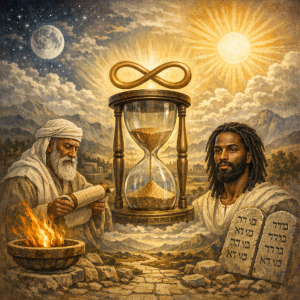
Eternal is an adjective describing that which has no end, endures without interruption, belongs to eternity, or is understood as independent of ordinary temporal limitation. In its strictest philosophical and theological sense, the word may describe existence without beginning or end. In ordinary English, however, it frequently has a less exact meaning: continuing indefinitely, lasting for a very long time, recurring constantly, or seeming never to end.
The distinction between those senses matters. A being described as eternal may be said to exist without beginning, without end, or outside succession of time altogether. A thing described as eternal in ordinary speech—a flame, a covenant, a monument, a complaint, or a delay—usually is not claimed literally to be infinite. Context determines whether the word is being used with metaphysical precision, religious devotion, legal aspiration, poetic emphasis, or rhetorical exaggeration.
- Strict sense: without beginning or end; timeless; not subject to temporal succession.
- Enduring sense: continuing without end or interruption; perpetual; everlasting.
- Religious sense: pertaining to God, divine life, ultimate judgment, salvation, or the life to come.
- Figurative sense: seemingly endless or constantly repeated, as in “eternal waiting” or “an eternal argument.”
Modern dictionaries recognize both the strict and extended senses. Merriam-Webster, for example, includes “having infinite duration,” “continued without end or interruption,” “seemingly endless,” and “timeless.” Thus, the word does not always carry a single fixed claim about literal infinity. The object described, the speaker’s purpose, and the surrounding language must be considered.
Etymology and Origin
Eternal entered English in the late fourteenth century through Middle French eternel and Late Latin aeternalis. Those forms derive from Latin aeternus, meaning lasting, enduring, permanent, everlasting, or belonging to an age. The Latin word is connected with aevum, meaning age, lifetime, era, or eternity.
This history is important because the earliest linguistic idea was not necessarily a technical philosophical formula for “outside time.” It involved enduring duration, an age, and existence extending through time. Over centuries, theological and philosophical writing developed more specialized meanings. English inherited both the broad duration-based sense and the stricter sense associated with divine eternity.
The related English noun eternity denotes the condition or state of being eternal, and eternally means forever, without end, or in a figurative sense, continually. Other related words include eternalize, coeternal, and sempiternal. Although eternal, everlasting, perpetual, and sempiternal overlap, they are not always interchangeable:
- Everlasting commonly emphasizes continuing forever from a beginning.
- Perpetual often means continuously recurring or indefinite in duration, especially in legal and institutional language.
- Sempiternal traditionally means everlasting or unending in duration, sometimes distinguished from timeless eternity by implying duration through time.
- Eternal can carry either an everlasting sense or the stronger theological and philosophical sense of timeless, uncreated being.
The noun phrase the Eternal became an English designation for God. This usage reflects a theological claim rather than an independent legal title or a universal definition shared by all religions and philosophies.
Cultural and Historical Context
Human beings have long used language of eternity to address mortality, memory, cosmic order, justice, and the limits of human power. Ancient peoples observed recurring seasons, generations, stars, death, and the survival of social customs. These experiences produced concepts of enduring time, recurring ages, ancestral continuity, and divine permanence. Yet the English word eternal itself is a later Latin-derived word; it should not be projected backward as though every ancient culture used precisely the same concept.
In classical philosophy, discussions of eternity often concerned whether the cosmos had a beginning, whether the soul survives death, and whether divine reality changes. Later Jewish, Christian, Islamic, and philosophical traditions further developed distinctions between temporal life and divine permanence. A major classical theological formulation, associated with Boethius, describes eternity as the complete and simultaneous possession of endless life. Under that account, eternity is not merely very long time; it is a mode of being not divided into past, present, and future.
That philosophical meaning differs from popular speech. When a person says a school day lasted “an eternity,” the statement ordinarily conveys frustration or perceived duration, not a metaphysical assertion. Likewise, phrases such as “eternal love,” “eternal city,” and “eternal truth” may express loyalty, aspiration, cultural memory, or a claim that a truth is not dependent on changing fashion.
Historically, rulers, institutions, and movements have sometimes invoked eternal language to strengthen legitimacy. A constitution, empire, creed, dynasty, or monument may be called eternal in ceremony or propaganda. Such language does not establish literal permanence. Human institutions remain subject to historical change, legal amendment, political defeat, natural events, and the mortality of their members. The dictionary distinction between aspiration and fact is therefore essential.
Biblical / Torah Context
The English word eternal does not appear as a single original Hebrew or Greek word throughout the Bible. English translations use it to render several expressions whose meanings depend on grammar, genre, and context. Care is required before treating any English occurrence of “eternal” as a complete lexical answer to a doctrinal question.
Hebrew Bible and Torah
A principal Hebrew term often translated “everlasting,” “forever,” “of old,” or sometimes “eternal” is olam (עוֹלָם). Its range includes a distant or concealed time, remote antiquity, a continuing future, an age, or enduring duration. In some settings it describes God’s everlasting nature; in others it describes statutes, covenants, priestly offices, landmarks, or conditions that plainly operate within history. Therefore, olam cannot mechanically be assigned one English equivalent in every passage.
For example, Genesis 21:33 refers to the “everlasting God,” using language traditionally understood to confess God’s enduring and incomparable existence. Deuteronomy and Exodus also use enduring-language for covenantal commands, memorial observances, and priestly arrangements. The interpretive question is not whether the Hebrew term is meaningful, but whether a particular passage emphasizes unlimited duration, continuing validity within an appointed order, remote antiquity, or covenantal permanence.
Jewish liturgical and theological tradition commonly speaks of God as sovereign beyond human generations. The familiar title Adon Olam, often translated “Lord of the World” or “Master of the Universe,” expresses God’s sovereignty and enduring reality. Jewish thought also uses olam ha-ba, “the world to come,” in discussions of the future world or hereafter. These are related concepts, but they should not be collapsed into a simplistic assertion that every biblical use of olam means “infinite duration without qualification.”
New Testament Usage
The principal Greek adjective commonly translated “eternal” or “everlasting” in the New Testament is aiōnios (αἰώνιος), related to aiōn (αἰών), “age” or “world-age.” It is used in phrases including “eternal life,” “eternal fire,” “eternal judgment,” and descriptions of God’s glory or kingdom. Traditional Christian translations commonly render aiōnios as “eternal” where the context concerns divine life, final judgment, or God’s kingdom.
There is a real interpretive controversy concerning the semantic range of aiōnios. Some interpreters argue that it must always mean endless duration. Others emphasize its relation to “age” and argue that it can mean “age-related,” “belonging to the age to come,” or duration determined by context. Neither side should settle the matter merely by appealing to an English gloss. Responsible interpretation examines the sentence, parallel passages, Jewish and Greek linguistic background, literary genre, and the theological framework used by the interpreter.
Within mainstream Christian doctrine, “eternal life” ordinarily means more than endless post-mortem existence. It is understood as participation in the life of God, received through divine grace and expressed in communion with God. John 17:3, for example, connects eternal life with knowing the Father and Jesus Christ. This is a theological interpretation of Scripture, not a definition imposed by secular English usage.
Legal Implications
Eternal is not, by itself, a general technical term of art in Anglo-American common law. Legal documents more often employ terms such as perpetual, in perpetuity, forever, permanent, irrevocable, or during the life of. Whether “eternal” in a document creates an enforceable legal duration depends on the instrument, the jurisdiction, applicable statutes, the nature of the right, and rules of contract or property interpretation.
At historical common law, the law was wary of attempts to control property indefinitely through remote future interests. The Rule Against Perpetuities developed to prevent certain contingent future interests from vesting too remotely. The traditional formulation asks whether an interest must vest, if at all, no later than twenty-one years after a life in being at the creation of the interest. The rule concerns particular future interests; it does not mean that every long-lasting ownership interest or every use of the word “forever” is void.
A fee simple estate, for example, has historically been described as an estate potentially of indefinite duration. By contrast, a contingent future interest may fail under the Rule Against Perpetuities if it could vest too remotely. Many American jurisdictions have modified, reformed, or abolished the traditional common-law rule by statute. Consequently, one cannot determine present legal effect simply by repeating an old common-law maxim.
“In perpetuity” is common legal language for an interest or obligation intended to continue indefinitely. Yet even that phrase is not self-executing. It may be limited by public policy, statutory law, constitutional limits, changing circumstances, the terms of a trust, consumer-protection rules, property law, or judicial doctrines governing interpretation and enforceability.
For instance, modern United States copyright law generally grants rights for specified statutory terms rather than literal eternity. For many works created on or after January 1, 1978, the ordinary term is the author’s life plus seventy years; works made for hire and certain anonymous or pseudonymous works have different stated terms. A party cannot make copyright eternal merely by using that word in a private declaration.
Likewise, a private contract saying that an obligation lasts “eternally” may be construed according to ordinary interpretive principles. A court may treat the phrase as ambiguous, as rhetorical, as meaning indefinite duration subject to termination rights, or as limited by governing law. The result turns on the whole agreement and jurisdiction-specific law. This entry is descriptive and is not legal advice.
Governmental and Military Usage
No generally recognized governmental or military legal definition gives eternal a special status separate from ordinary language. Governments may use phrases such as “eternal vigilance,” “eternal memory,” or “eternal flame” in public ceremony, memorials, and commemorative speech. Such expressions are symbolic unless incorporated into a specific statute, regulation, order, or binding instrument that supplies a defined legal consequence.
Spiritual Meaning
Spiritually, eternal commonly points beyond temporary conditions and invites reflection on what does not perish: God, truth, the soul, moral accountability, divine love, ultimate justice, or life beyond death. The precise content varies significantly among religious and philosophical traditions.
In Jewish and Christian settings, divine eternity often functions as a contrast to creaturely transience. Human beings are born, age, change, and die; God is confessed as faithful through generations. That contrast can encourage humility, repentance, courage, and a long view of moral responsibility. It can also be misused if someone employs “eternal” language to evade practical duties in the present. Authentic spiritual reflection should not treat temporal life, neighborly obligations, or justice as unimportant merely because they are not permanent.
For Christians, eternal life is frequently understood both as future hope and present communion with God. For Jews, reflection on God’s enduring sovereignty and the world to come has taken diverse forms across biblical, rabbinic, medieval, and modern thought. Other traditions may speak of the deathless, the unconditioned, liberation from temporal bondage, or cycles of time. Similar English translations should not obscure genuine differences among those beliefs.
Modern Usage
In modern writing, eternal remains powerful because it joins emotional force with temporal depth. It appears in religion, philosophy, literature, music, memorial culture, advertising, science fiction, and everyday complaint.
- Religious: “eternal life,” “the Eternal,” “eternal glory,” and “eternal judgment.”
- Memorial: “eternal remembrance,” “eternal flame,” and “eternal rest.”
- Philosophical: “eternal truths,” “the eternal and the temporal,” and “eternal recurrence.”
- Figurative: “an eternal struggle,” “eternal traffic,” or “the eternal question.”
- Commercial or promotional: “eternal beauty,” “eternal value,” or “an eternal classic.”
In careful formal writing, a writer should avoid using eternal where a measurable term is available. A contract, scientific report, or policy statement may require “permanent,” “indefinite,” “for the life of the agreement,” “non-expiring,” or a stated date rather than evocative language. Precision protects against misunderstanding.
Controversies / Criticisms
The principal controversy surrounding eternal language concerns whether it means strictly endless duration, timelessness, duration through successive ages, or enduring significance. This controversy is especially visible in biblical translation and doctrines of final judgment, salvation, the immortality of the soul, and universal reconciliation. The disagreement is substantive and cannot responsibly be resolved by claiming that one English word automatically decides all theological questions.
A second criticism is rhetorical inflation. Words such as “eternal,” “forever,” and “timeless” are often used in advertising, politics, and romantic language to create emotional certainty. The listener should distinguish a poetic promise from a verifiable fact. No human product, officeholder, government, private corporation, or legal arrangement becomes literally eternal merely because it is described that way.
A third issue concerns philosophical coherence. Some thinkers maintain that a timeless being cannot act in time, respond to prayer, know changing events, or enter a temporal relationship. Others argue that divine eternity is compatible with divine action because God’s knowledge and purpose are not limited as human knowledge is. These are enduring philosophical disputes, not questions settled by ordinary dictionary definition.
Conclusion
Eternal is a word of duration, permanence, and ultimate significance. Its ordinary meaning ranges from “lasting without end” to “seemingly endless,” while its strongest theological and philosophical meaning refers to existence not bounded by time. Its Latin history points to age and enduring duration; its religious use developed in relation to divine permanence, the world to come, salvation, judgment, and hope.
In biblical interpretation, legal drafting, and spiritual discussion, the word requires context. Hebrew olam, Greek aiōnios, Latin aeternus, and modern English eternal overlap but are not identical. In law, the word has no independent power to override statutes, public policy, or established rules concerning property and contractual duration. In ordinary speech, it is often figurative. In religious confession, it may bear profound claims about God and human destiny. A sound dictionary use therefore distinguishes literal from figurative, theological from legal, and settled linguistic fact from contested interpretation.
Sources / Further Reading
- Merriam-Webster, “Eternal”: https://www.merriam-webster.com/dictionary/eternal
- Online Etymology Dictionary, “Eternal”: https://www.etymonline.com/word/eternal
- Cornell Legal Information Institute, “Perpetuity”: https://www.law.cornell.edu/wex/perpetuity
- Cornell Legal Information Institute, “Rule Against Perpetuities”: https://www.law.cornell.edu/wex/rule_against_perpetuities
- Cornell Legal Information Institute, “In Perpetuity”: https://www.law.cornell.edu/wex/in_perpetuity
- United States Code, 17 U.S.C. § 302, “Duration of Copyright”: https://www.law.cornell.edu/uscode/text/17/302
- Bible Gateway, Genesis 21:33: https://www.biblegateway.com/passage/?search=Genesis%2021%3A33&version=KJV
- Bible Gateway, John 17:3: https://www.biblegateway.com/passage/?search=John%2017%3A3&version=KJV
- Encyclopaedia Britannica, “Boethius”: https://www.britannica.com/biography/Boethius