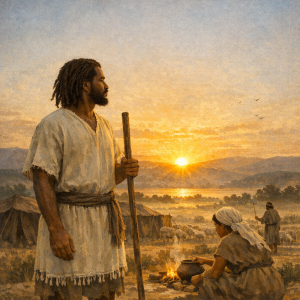
Primary Definition
Morning in the English construct is the beginning portion of the day: the period of dawn or the coming of daylight, and in ordinary modern English, the time from daybreak until noon. It may also refer more broadly to the early or first stage of something: the morning of life, the morning of a nation, or the morning of a new season. Or the true Origins of Sorrow or grief which is missed in the most common definitions here in the construct the U was removed from the etymology of the word to make a new word vic versa
In the Ancient Israelite and Biblical Hebrew setting, the usual word translated morning is boqer (בֹּקֶר), meaning dawn, daybreak, or the morning. In the creation account, the Hebrew text repeatedly speaks of evening and morning as markers of the ordered movement of a day. Genesis 1 does not use the English word morning; it uses Hebrew terms later translated into English. Thus, the Biblical Hebrew setting is important to the meaning of the time of day, but it is not the historical source of the English word morning.
In modern dictionary’s ordinary usage, morning is a natural human word for the time when men, women, sons, daughters, fathers, mothers, households, laborers, and communities awaken and begin the day. It is not primarily a legal term, a governmental classification, a Roman institution, or a religious title.
The word in common dictionary try to distinguish from the word mourning, which means grief, lamentation, or the outward and inward expression of sorrow, especially after death, separation, disaster, or grave loss. In visible spelling, the distinction is simple but important: mourning contains the letter U; morning does not.
Spelling: Morning vs. Mourning
Morning is spelled M-O-R-N-I-N-G. Mourning is spelled M-O-U-R-N-I-N-G. The visible spelling difference is the letter U after the letter O.
- Morning: the beginning of the day; dawn; early daytime.
- Mourning: grief, lamentation, sorrow, or observance of loss.
In many English accents, morning and mourning are pronounced alike or nearly alike. They are therefore commonly treated as homophones. Their similarity in sound has made them available for poetry, sermons, music, wordplay, cultural reflection, and alternative interpretations. Sound similarity, however, does not by itself establish that two words have the same origin.
The statement that “mourning became morning when the U was removed” is visually understandable as a symbolic observation: remove the U from mourning and the remaining letters form morning. But conventional historical linguistics does not treat that spelling change as the documented origin of the English word morning. The two words developed through different Old English word families.
Etymology and Origin
Documented English Word History: Morning
The documented English history of morning reaches back to Old English morgen, meaning morning, dawn, or the early part of the day. Related forms appeared across Germanic languages: Old Saxon morgan, Old High German morgan, Old Norse morgunn, Gothic maurgins, Dutch morgen, and modern German Morgen.
In Middle English, related forms included morwen, morwe, morwenyng, and moregeninge. The modern word morning developed as a form built from morn or morwen with the ending -ing, apparently following the pattern of evening. In its earlier sense, it referred especially to the coming of sunrise or the dawning of the day. Over time, English usage extended it to cover the larger portion of the day before noon.
The related English words morn, morrow, and tomorrow preserve older connections between morning and the day that follows. In earlier English, morrow could mean morning as well as the next day. The conventional etymological record therefore connects morning with dawn, light, the beginning of the day, and the Germanic word family represented by Old English morgen.
Documented English Word History: Mourning
Mourning has a different documented history. It comes from Old English murnung, meaning grief, complaint, sorrow, or lamentation, and from the verb murnan, meaning to grieve, lament, feel sorrow, regret, yearn, or be troubled. Middle English forms included mornen and related spellings.
Conventional etymological sources trace mourn to a Germanic word family associated with grief, sorrowful remembrance, regret, or pining. The word later developed specialized associations with lamenting the dead and with outward customs of grief. By the early modern period, mourning could refer not only to sorrow itself but also to mourning clothes, funeral observances, and other public signs of bereavement.
Accordingly, conventional linguistic scholarship treats morning and mourning as historically distinct words. One is connected to dawn and the beginning of the day; the other is connected to grief and lamentation. Their similarity in current pronunciation is real, but the words are not conventionally regarded as descendants of one another.
Slavery-Era Interpretation and Historical Context Before English interpretation
A cultural interpretation circulated in modern oral teaching, social-media discussion, sermons, and community conversation connects morning with mourning in the history of chattel slavery. In this account, enslaved men and women could awaken after a night in which another man or woman had been beaten, severely punished, sold away, separated from a husband, wife, father, mother, son, daughter, brother, sister, or otherwise subjected to brutal control. The beginning of the day could therefore be a time of grief rather than relief.
Some versions of the account state that an enslaver, slave master, overseer, or other authority figure would ask an enslaved man or woman words to the effect of, “How was your morning?” or “Did you have a good morning?” The interpretation draws attention to the bitter possibility that a seemingly ordinary greeting could be heard against a background of death, punishment, sale, family separation, forced labor, and mourning. It is presented as a reflection upon the lived conditions of slavery and the emotional reality that mornings could begin with loss.
The underlying history of brutality, separation, and grief is thoroughly documented. Enslaved fathers, mothers, husbands, wives, sons, daughters, and children were bought, sold, hired out, transferred, punished, and separated at the will of enslavers. The domestic slave trade frequently broke families apart. Men and women who survived enslavement described the fear of sale, the grief of separation, physical violence, and the loss of family members. Such experiences make it historically understandable that mornings could be emotionally joined with mourning in the memory, speech, music, and cultural interpretation of oppressed people.
Yet a careful dictionary must distinguish that documented historical suffering from a separate claim about the origin of an English word. No reliable documentary evidence presently establishes that morning was created by slaveholders from mourning, that the word’s spelling was deliberately changed by removing the letter U, or that “good morning” originated as a slave-era taunt. The English word morning and greetings such as good morning are attested long before the development of hereditary racial slavery in the English colonies of North America.
The slavery-era interpretation should therefore not be dismissed as meaningless merely because it is not the documented etymology. It can function as cultural criticism, memorial reflection, moral teaching, or wordplay that names the grief carried into a new day by enslaved men and women. But it should not be represented as settled linguistic fact without primary historical evidence.
Cultural and Historical Context
Morning has long carried meanings beyond a clock-defined period. In agricultural communities, morning was the time to rise, tend animals, draw water, prepare food, travel, labor, pray, gather a household, or begin work. In military settings, morning could mark watch changes, marching, inspection, drill, prayer, rations, or the resumption of conflict. These are contextual uses of the ordinary time word, not proof that morning began as a military term.
In literature, morning is often associated with awakening, renewal, hope, youth, clarity, revelation, and the return of light after darkness. Yet it can also carry uncertainty. A man or woman may wake into debt, illness, grief, labor, danger, war, bereavement, or oppression. Thus morning may symbolize both promise and burden.
The contrast between morning and mourning has been used particularly powerfully in Black spiritual, musical, poetic, and preaching traditions. Such use may hold together two truths: dawn may represent survival and renewed possibility, while grief remains present because violence, death, separation, and injustice have not been forgotten. This is interpretive and cultural meaning, not a substitute for documented word history.
Biblical / Torah Context
In the Torah and the wider Hebrew Scriptures, morning is regularly associated with dawn, ordering of time, worship, labor, watchfulness, deliverance, and renewed encounter with Yah. The Biblical Hebrew word boqer (בֹּקֶר) commonly means morning or dawn. Genesis 1 repeatedly states that there was evening and there was morning in the ordering of creation.
Within this Ancient Israelite setting, morning is not etymologically related to the English words morning or mourning. The English translations use morning to convey the Hebrew meaning, but the Hebrew word belongs to a separate language family and textual history.
Morning offerings were part of Israelite worship. Exodus 29:38–42 describes a continual offering, including one lamb in the morning and another at evening. Psalm 5:3 speaks of directing prayer toward Yah in the morning. Psalm 30:5 uses the movement from weeping at night to joy in the morning as a powerful image of restoration. Lamentations 3:22–23 likewise speaks of mercies renewed in the morning.
These passages should not be forced into a simplistic claim that every morning is happy or painless. Scripture also recognizes mourning, lamentation, affliction, death, exile, and injustice. Biblical hope is not denial of grief. Rather, the movement from darkness toward morning can symbolize Yah’s faithfulness amid suffering.
Later English translations often use the title Lord for the Hebrew titles and names of the Creator. In ordinary English, lord means master or ruler. In this dictionary’s Ancient Israelite heritage context, Master is the preferred English sense when discussing Adon or Adonai, while Yah or Yahuah may be used for the Creator where appropriate. The Hebrew Scriptures themselves should be read in their own historical and linguistic setting before later rabbinic, Christian, Catholic, or modern institutional interpretations are imposed upon them.
Common-Law or Legal Significance
Morning is not, by itself, a technical doctrine of English common law. It ordinarily serves as a factual time reference. In legal instruments, statutes, contracts, police reports, court testimony, notices, and affidavits, phrases such as “in the morning” may be too indefinite when precision matters. A stated hour, date, time zone, and location are generally clearer.
Historically, common-law courts often dealt with time in practical terms: before sunrise, after sunset, by daylight, at night, on a named day, or within a stated period. Whether “morning” is sufficiently definite in a particular legal dispute depends on the document, surrounding facts, accepted local usage, and controlling law. It does not carry a fixed universal legal definition across all jurisdictions.
The word mourning has sometimes appeared in legal and social contexts concerning funeral observances, bereavement leave, inheritance customs, family obligations, military casualties, or ceremonial dress. Such uses do not make mourning the origin of morning, nor do they create a common-law rule from the similarity of the words.
The laws that upheld slavery were statutory, colonial, state, federal, commercial, and judicial in various places and periods; they were not merely expressions of timeless common law. Enslaved men and women were often treated by legal systems as property or as legally controlled laborers, despite their humanity. A responsible historical account must distinguish the human reality of fathers, mothers, sons, daughters, husbands, wives, and households from the degrading classifications imposed by slave codes and slaveholding institutions.
Spiritual Meaning
Spiritually, morning may represent waking, breath, renewed responsibility, gratitude, prayer, work, repentance, and another opportunity to walk uprightly. For a grieving man or woman, morning may also expose the pain that was temporarily quieted by sleep. The dawn does not erase mourning; it may reveal it more clearly.
The comparison of morning and mourning can therefore carry a legitimate spiritual lesson without making an unsupported etymological claim. A new day may arrive while grief remains. A household may rise after loss. A mother may awaken missing her son; a father may awaken missing his daughter; a man or woman may begin the day carrying the memory of violence, separation, or death. To acknowledge this is not weakness. It is truthfulness about human life.
At the same time, the Biblical image of morning can speak of endurance and restoration: darkness is real, mourning is real, and yet the coming of light may still call a man or woman toward faithful action, mercy, justice, repair, and hope.
Modern Usage
In present-day English, morning is used in several ordinary ways:
- The time from dawn until noon: “I will see you in the morning.”
- The early part of a particular day: “The storm passed by morning.”
- A greeting: “Good morning.”
- The beginning stage of life, history, or development: “the morning of her career.”
- A cultural or spiritual metaphor for renewal, awakening, or hope.
Good morning is an ordinary English greeting. The phrase does not inherently mean “good mourning,” nor does its ordinary use require a man or woman to accept the slavery-era interpretation described above. Nevertheless, some people choose different greetings, such as “grand rising,” “peace,” “blessings,” or “rise in strength,” because they wish to avoid the sound association with mourning or because they attach personal spiritual meaning to their words.
Such choices are matters of conscience, culture, personal practice, and community expression. They should not be confused with a universally established rule of English etymology.
Competing Etymological Interpretations
Documented linguistic interpretation: Morning derives through Middle English from Old English morgen and related Germanic words for dawn or the beginning of the day. Mourning derives through Old English murnung and murnan, words associated with grief and lamentation. The words are historically distinct.
Cultural and interpretive position: The visible removal of the U from mourning produces morning. This has been interpreted in relation to slavery, grief, family separation, and the experience of awakening after loss or violence. As cultural reflection, the comparison can communicate a serious moral truth about how enslaved men and women experienced the beginning of a day.
Disputed or unsupported proposition: The claim that slaveholders invented the word morning, deliberately removed the U from mourning, or originated “good morning” as a fixed slaveholding taunt is not established by reliable linguistic evidence currently available. The historical suffering of enslaved people is documented; the proposed etymology is not.
A sound dictionary entry can recognize all three levels. It may preserve the cultural teaching, honor the historical grief behind it, and still state plainly that documented etymology does not support a direct derivation of morning from mourning.
Conclusion
Morning means the beginning of the day, especially dawn and the hours before noon. Its documented English ancestry comes from Old English morgen and a wider Germanic word family concerned with dawn and daybreak. Mourning means grief and lamentation and comes from a different Old English word family associated with sorrow.
The two words are closely connected in modern sound but not in documented historical origin. Their spelling difference is the letter U: mourning contains it; morning does not. The claim that morning developed from mourning in connection with slavery should be treated as a cultural, interpretive, and disputed account rather than as settled linguistic history.
Still, the interpretation speaks to a grave historical reality. Enslaved men and women often woke into a world where fathers, mothers, sons, daughters, husbands, wives, and whole households could be separated, punished, sold, or killed. In that context, a morning could indeed be a time of mourning. The dictionary should preserve that moral and historical insight while distinguishing it from the established etymology of the English word.
Sources / Further Reading
- Online Etymology Dictionary, “Morning”: https://www.etymonline.com/word/morning
- Online Etymology Dictionary, “Mourning”: https://www.etymonline.com/word/mourning
- Oxford Learner’s Dictionaries, “Morn”: https://www.oxfordlearnersdictionaries.com/us/definition/english/morn
- Bosworth-Toller Anglo-Saxon Dictionary, “morgen”: https://bosworthtoller.com/23129
- University of Michigan, Middle English Dictionary, entries associated with morgen: https://quod.lib.umich.edu/m/middle-english-dictionary/dictionary?q=morgen&search_field=etyma&utf8=%E2%9C%93
- National Park Service, “The Dent Family and the Domestic Slave Trade”: https://www.nps.gov/articles/000/the-dent-family-and-the-domestic-slave-trade.htm
- National Park Service, “Ulysses S. Grant, Slavery, and the Hiring Out System in St. Louis”: https://www.nps.gov/articles/000/ulysses-s-grant-slavery-and-the-hiring-out-system-in-st-louis.htm
- Library of Congress, Born in Slavery: Slave Narratives from the Federal Writers’ Project, 1936–1938: https://www.loc.gov/collections/slave-narratives-from-the-federal-writers-project-1936-to-1938/
- Bible Hub, Genesis 1:13 and Hebrew lexical material for boqer: https://biblehub.com/lexicon/genesis/1-13.htm
- Bible Hub, Hebrew lexicon entry for boqer (בֹּקֶר): https://biblehub.com/hebrew/1242.htm
- Australian Associated Press FactCheck, “‘Good morning’ link to slavery a modern fabrication”: https://prod-ss.aap.com.au/factcheck/good-morning-link-to-slavery-a-modern-fabrication/
"Morning" is the period of time from sunrise to noon. It is the first part of the day, typically understood to begin when one wakes up or when the sun rises, and ends around midday. Activities during this time often include breakfast, going to work or school, and other daily routines.