Primary Definition
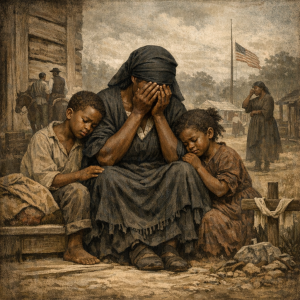
Mourning is and English interpretive construct known as grief, sorrow, lamentation, or the inward and outward response to death, separation, loss, suffering, or another profound deprivation. It may describe a man’s or woman’s private grief; the shared sorrow of a father, mother, son, daughter, husband, woman/wife, family, or community; a period of bereavement; spoken lament; funeral observance; or visible signs of grief, such as dark clothing, a veil, an armband, lowered flags, or a public memorial. In proper Slave origins this word Morning/Mourning was use as Morning or Good Mourning or How was your Morning/Mourning when Slaves and their families had been killed, sold away, separated, severely punished, Whipped, imprisoned, raped, driven from the plantation slave owners, or otherwise subjected to brutality. Under those conditions, “morning” could be experienced as “mourning”: on the start of a new or beginning day which fear, grief, pain, was a tool to use on the slave during that era of cruelty.
MOURNING — M-O-U-R-N-I-N-G and MORNING — M-O-R-N-I-N-G are distinct words in modern English spelling, although in many English accents they are pronounced alike or nearly alike. The conspicuous written distinction is the letter U in mourning. Mourning concerns grief, lamentation, and sorrow. Morning ordinarily identifies the beginning portion of the day: the time from dawn, waking, or sunrise through the earlier hours of daylight.
This dictionary also examines a cultural and historical interpretation associated with the experience of chattel slavery in America. In that interpretation, the beginning of a new day could bring no assurance of peace. An enslaved man or woman might awaken grieving because another man, woman, son, daughter, father, mother, husband, wife, family member, or community member had been killed, sold away, separated, severely punished, imprisoned, raped, driven from the plantation, or otherwise subjected to brutality. Under those conditions, “morning” could be experienced as “mourning”: the arrival of another day marked by unresolved grief, fear, and deprivation.
A historical interpretive accounts says that an enslaver, slave master, or overseer might ask words to the effect of, “How was your morning?” The account draws attention to the possibility that the enslaved hearer’s actual condition was one of mourning, not ease or cheerful renewal. The point of the account is moral and cultural: a customary greeting about the new day may sound radically different when heard against the violence, family separation, and uncertainty of slavery.
That interpretation deserves serious attention as an expression of historical memory and as a reflection on the emotional world imposed by slavery. It should not, however, be confused with a proven linguistic derivation. The surviving English documentary record places forms of both mourning and morning in Old English and Middle English centuries before the Atlantic slave trade. No reliable historical evidence presently establishes that enslavers created the English spelling morning by removing the U from mourning.
Mourning and Morning: The Letter U
The visual relation between the words is immediate:
- mourning = grief, lamentation, bereavement;
- morning = the early part of the day.
Removing the U from the modern spelling mourning produces morning. This visible fact has encouraged an interpretive connection between the two words. It can be rhetorically powerful, particularly in reflections on slavery, bereavement, trauma, and the reality that a new day does not erase an earlier loss.
Yet resemblance in modern spelling is not, by itself, proof that one word historically came from the other. English contains many words that sound alike, look alike, or differ by a single letter while having separate histories. Historical etymology asks what forms appear in dated manuscripts, dictionaries, and related languages—not merely whether a modern word can be changed into another by adding or removing a letter.
The distinction is therefore important: the mourning/morning comparison may function as cultural interpretation, poetic language, moral witness, or a lesson about the enslaved experience; conventional historical linguistics treats the two English words as separate in origin.
Etymology and Origin
Documented English Word History
Mourning is the noun formed from mourn. Etymological sources trace it to Old English murnung, meaning complaint, grief, or the act of lamenting, and to the Old English verb murnan, “to feel or express sorrow, grief, or regret.” Related Germanic forms occur in Old Saxon, Old High German, Old Norse, and Gothic. The word therefore belongs to an old Germanic family of terms concerning sorrow, remembrance, regret, pining, and lament.
In Middle English, forms such as mornen, mournen, and related spellings developed toward the modern verb mourn. The noun mourning was in English by about the thirteenth century in the sense of grief or the expression of grief. A later specialized sense developed for customary bereavement dress and visible observances. Thus, “to wear mourning” means not merely to feel sorrow but to display recognized signs of bereavement.
The documented history of morning is different. It is related to morn and descends from Old English morgen, a Germanic word for the early day or dawn. Cognate forms appear in other Germanic languages, including forms represented by modern German Morgen and Dutch morgen. The literary English noun morn preserves this older family of day-beginning language.
Accordingly, the conventional record does not show a sequence in which mourning was first written and then altered into morning. Rather, it records older forms for grief and older forms for dawn or the beginning of the day. Their modern closeness is real, but the histories conventionally given for them are separate.
Changes in Meaning
The central sense of mourning has remained relatively stable: sorrow over loss, especially death. Its range has broadened in ordinary use. A man or woman may mourn a deceased father or mother, but may also mourn a marriage, homeland, community, health, freedom, safety, lost childhood, destroyed language, unjust imprisonment, or a future that has been taken away. Public mourning may follow war, disaster, political violence, mass killing, or the death of a respected community member.
In contrast, morning has retained its ordinary temporal meaning. It may refer to the period after midnight, the hours after waking, the time before noon, or—more poetically—the beginning of a new phase. Phrases such as “the morning of life” use the day’s beginning as a metaphor for youth or renewal. That metaphorical use should not be confused with the separate word mourning.
Slavery-Era Interpretation and Historical Context
The slavery-era interpretation does not depend upon proving a new English etymology in order to carry historical force. The condition of enslaved people in the United States made mourning a recurring and concrete reality. Enslaved men and women lived under a system that treated human beings as saleable property in statutes, wills, estate divisions, account books, advertisements, court records, and commercial transactions. Families could be divided by sale, inheritance, debt, relocation, punishment, or the death of an enslaver.
The Library of Congress preserves accounts describing the anguish of forced separation. One antislavery account included in its teaching materials explains that an enslaved husband and wife might be sold apart while parents remained elsewhere and sons, daughters, brothers, and sisters were scattered across distant states. The record describes the resulting grief as more hopeless than ordinary separation by death because the separated family could be placed in the hands of the slave trade without any expectation of reunion.
Government and archival records likewise show that enslaved people were bought, sold, conveyed, inherited, and divided among heirs. A 1754 division of enslaved people associated with the Washington family, for example, lists named enslaved men, women, and children as property to be apportioned among claimants. Such records are not merely abstract evidence of an economic system; they reveal the legal machinery through which homes and family relationships could be broken apart.
Against that history, the proposed association of morning with mourning becomes understandable as a cultural reading. For an enslaved family, the morning could bring news that a husband had been sent away, a daughter had been sold, a son had been hired out, a mother had been punished, or a loved one had not survived violence, illness, confinement, or flight. The new day could therefore be a time of dread as well as labor.
Documentary Limits
Research into historical dictionaries, Old English records, digitized slave narratives, archival collections, and major historical sources confirms both the antiquity of the English words and the severe realities of slavery. It does not, on the evidence presently located, confirm a documented slavery-era convention in which enslavers systematically used “morning” as an altered spelling of “mourning,” or deliberately coined morning by removing the letter U.
Nor does the surviving record establish that dictionaries intentionally omitted such an etymology during slavery. Dictionaries may be criticized for many historical limitations, including whose speech, suffering, and cultural memory they preserved or ignored. But a responsible dictionary entry must distinguish that broader criticism from a specific assertion of deliberate suppression. The available documentary evidence establishes older, separate English histories for the two words; it does not establish a concealed enslaver-created origin for morning.
This conclusion does not erase the interpretive account. It identifies its proper category: cultural, moral, and historical interpretation rather than settled linguistic fact.
Family Separation, Death, Punishment, and Mourning Under Slavery
Mourning under slavery was not limited to funeral rites. It included grief caused by forced separation while loved ones remained alive. A father could lose a daughter through sale; a mother could lose a son through inheritance or a creditor’s claim; husbands and wives could be separated by relocation; brothers and sisters could be dispersed to different plantations; and grandparents could remain behind without knowing whether they would see their family again.
The harm was intensified by uncertainty. Enslaved people generally lacked secure legal authority to keep their households together, control their place of residence, refuse sale, protect their children from an enslaver’s decisions, or seek ordinary legal remedies on equal terms. The law of slaveholding jurisdictions frequently treated human beings as property for commercial and estate purposes, notwithstanding their human relationships, marriages, parenthood, worship, memory, and grief.
Violence and punishment also produced mourning. Enslaved men and women could be whipped, confined, hunted, sexually abused, sold as punishment, or threatened with separation. The National Archives and Library of Congress preserve narratives and records that document these conditions. The exact experience differed by place, period, enslaver, labor system, and individual circumstance, but the power to divide families and impose violence was central to the institution.
For that reason, the interpretive phrase “mourning in the morning” should not be dismissed as trivial wordplay. Even where it is not a historical etymology, it can name a truthful condition: the beginning of another day under a system that made grief, fear, and family loss ordinary possibilities.
Cultural and Historical Context
Across cultures, mourning commonly joins inward grief with outward practice. Families may gather, prepare a body for burial, speak the name of the deceased, refrain from celebration, wear particular clothing, sit in silence, sing, pray, weep, provide food, erect a memorial, or observe a designated period of lament. None of these acts makes grief artificial. Rather, they give communal form to a loss that may otherwise be difficult to bear alone.
English-language usage often distinguishes grief, mourning, and bereavement. Grief commonly refers to the emotional pain of loss. Mourning often includes the expression, practice, and social recognition of grief. Bereavement ordinarily identifies the condition of having lost someone through death. In ordinary speech these terms overlap, and no rigid division should be imposed where a family uses them differently.
Public mourning may also express collective memory. A community may mourn those killed in war, racial terror, disaster, violence, or governmental wrongdoing. Such mourning can include solemnity and protest at the same time. To mourn publicly may be to insist that a life, a family, and a people must not be forgotten.
Common-Law and Legal Significance
Mourning is not, by itself, a major technical term of English common law. Historical common law did not create a general legal right to recover money merely because a man or woman suffered grief after a death. The common-law treatment of loss was often narrower than ordinary human experience, concentrating on recognized injuries, property interests, contractual duties, dependency, or financial loss rather than sorrow alone.
Modern statutes and wrongful-death laws vary by jurisdiction. Some allow specified family members to seek damages after a wrongful death, but the categories of claimants, recoverable losses, proof requirements, and available damages differ widely. A statute may use terms such as “child,” “parent,” “spouse,” “heir,” “dependent,” or “person.” Those are statutory classifications and should not be silently substituted for ordinary family language. In this dictionary’s house usage, a daughter is a woman in relation to her father and/or mother, and a son is a man in relation to his father and/or mother; statutory definitions may be narrower, broader, or differently framed.
Legal rules also distinguish between historical common law, equity, statutes, administrative regulations, and court decisions interpreting them. No general conclusion about a current wrongful-death claim can be drawn from the word mourning alone. The governing jurisdiction, statute, relationship, facts, and current case law matter. This entry provides historical and linguistic information, not legal advice.
In governmental practice, a “day of mourning” may be proclaimed after the death of a public official, military service members, or victims of catastrophe. Flags may be ordered lowered and public ceremonies adjusted. Such observances are governmental acts or customs; they do not alter the ordinary meaning of mourning as grief and lamentation.
Biblical / Torah Context
In the Ancient Israelite and Biblical Hebrew setting, mourning is a serious human and communal response to death, disaster, captivity, devastation, and separation. The Hebrew Scriptures contain several words and practices connected with grief and lament. One important verb is ʾābal (אָבַל), “to mourn.” Another is qûnen (קוֹנֵן), “to raise a lament” or chant a dirge. The noun qînâh (קִינָה) refers to a lament or funeral song.
The Torah records Jacob mourning the reported death of his son Joseph. Genesis 37:34 describes Jacob mourning for his son many days. Genesis 50:10 records a great and grievous mourning connected with Jacob’s death. These passages show mourning as more than a private feeling: it involves family, time, visible conduct, and communal acknowledgment of loss.
Later biblical writings deepen the language of lament. The book commonly called Lamentations opens with the Hebrew cry ʾêkhâh (אֵיכָה), “How?”—a word that can function as a question and as an exclamation of shock before catastrophe. The book grieves the destruction of Jerusalem, the loss of safety, and the suffering of the people. Its poetry does not deny pain or rush prematurely to consolation.
Within this dictionary’s Ancient Israelite heritage perspective, the Creator may be referred to as Yah or Yahuah. The biblical material presents mourning as something brought before the Creator rather than hidden behind empty speech. The English title “Lord,” where used in later translations, generally carries the sense of master or ruler; that translation issue is not central to the English word mourning, but it should not obscure the Hebrew setting of the passages.
Later Jewish, Christian, Catholic, and other religious traditions developed particular mourning prayers, burial customs, periods of observance, and theological interpretations. Those later practices may be historically important, but they are chronologically distinct from the Ancient Israelite and Biblical Hebrew texts themselves.
Modern Usage
Modern English uses mourning both literally and figuratively. A woman may be “in mourning” after the death of her mother. A town may observe mourning after a killing or disaster. A people may mourn those lost to slavery, war, colonization, forced displacement, or racial violence. A man may mourn a destroyed home, a lost marriage, diminished health, or a way of life.
The word remains especially connected with death, but it is not limited to death. Mental-health, pastoral, and community settings often recognize forms of grief arising from separation, disappearance, estrangement, infertility, disability, displacement, and other profound losses. Such use does not diminish mourning for the dead; it acknowledges that loss can take several forms.
In ordinary greeting, “Good morning” remains a conventional expression directed to the early part of the day. It does not ordinarily mean “good mourning.” Nevertheless, writers, speakers, teachers, and families may deliberately use the homophonic relation to invite reflection on trauma, history, and the difference between outward politeness and inward suffering.
Competing Etymological Interpretations
Documented linguistic interpretation: mourning comes through Old English and Middle English forms connected with sorrow and lament; morning comes through Old English and Germanic forms connected with dawn and the beginning of the day. The words have separate documented histories.
Cultural slavery-era interpretation: the removal of the U from mourning to form morning is used to express the reality that enslaved men and women could awaken each day in grief over violence, forced sale, family separation, and uncertainty. Some versions include a reported overseer or enslaver greeting about “morning” that is heard as a painful contrast to mourning.
Dictionary assessment: the cultural interpretation is meaningful as an account of historical suffering and as a moral reading of language. It should not be stated as a demonstrated etymology without dated primary-source evidence showing that the word morning was created from mourning in slavery-era English. The available record does not establish that proposition.
Conclusion
Mourning is grief, sorrow, lamentation, and the human response to profound loss. It may be inward, public, spiritual, familial, cultural, or ceremonial. The word carries particular weight when considering slavery, because enslaved families endured death, forced sale, violent punishment, displacement, and the breaking apart of fathers, mothers, sons, daughters, husbands, wives, and communities.
Mourning and morning are plainly different in modern spelling and standard meaning. The letter U visually distinguishes grief from the beginning of the day. Conventional historical linguistics documents separate older histories for the two words. At the same time, the slavery-related interpretation examined here remains a serious cultural observation: for people made vulnerable to daily violence and family separation, a new morning could indeed be a time of mourning.
Sources / Further Reading
- Merriam-Webster, “Mourning”
- Online Etymology Dictionary, “Mourning”
- Bosworth-Toller Anglo-Saxon Dictionary, entries and textual examples for Old English mourning vocabulary
- Oxford Learner’s Dictionaries, “Morn”
- Library of Congress, “Slavery in the United States: Primary Sources and the Historical Record”
- Library of Congress, “Born in Slavery: Slave Narratives from the Federal Writers’ Project, 1936 to 1938”
- National Archives, “Slave Narratives Compiled by the Federal Writers’ Project, 1936–1938”
- National Archives, “Race, Slavery, and Free Blacks Petitions”
- Founders Online, “Division of Slaves, 10 December 1754”
- Yale Bible Study, “Lamentations, Part 1”
"Mourning" refers to the process of expressing grief, sorrow, or sadness due to the loss or death of someone or something significant. It typically involves rituals, customs, or symbolic behaviors that vary across different cultures and societies. Mourning can also refer to a period of time during which these expressions of grief are carried out.