Monday – (Moon) or Dies Lunae (Latin for “day of the Moon”)
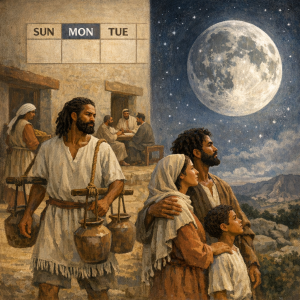
Primary Definition
In ordinary modern English, Monday is the weekday that follows Sunday and precedes Tuesday. In the common Sunday-first arrangement used in much of the United States, it is the second day of the week. In the international week-date convention associated with ISO 8601, however, Monday is treated as the first day of the week. Thus, whether Monday is called the “first” or “second” day depends upon the calendrical convention being used, not upon a difference in the day itself.
The word has two related senses. First, it is a practical calendrical designation: a recurring civil day used to schedule work, commerce, government activity, court deadlines, travel, education, worship, and private obligations. Second, its linguistic form preserves an older celestial association with the moon. That association is etymological and historical. It does not mean that every modern use of the word invokes, endorses, or participates in religious observance connected with the moon.
For common-law and legal interpretation, “Monday” ordinarily means the civil calendar day identified as Monday in the relevant jurisdiction and time zone. Its legal effect does not arise from the name’s ancient derivation. Rather, legal consequences arise only when a constitution, statute, court rule, contract, regulation, order, or recognized rule of procedure makes a deadline, duty, holiday, meeting, payment, or event dependent upon that day.
Etymology and Origin
The English word developed through Old English forms including mōnandæg, commonly understood as “moon’s day.” It passed through Middle English forms such as monedai before reaching its modern spelling. The first element is related to moon; the second is day. The word therefore belongs to a group of English weekday names that preserve early Germanic renderings of older planetary-day terminology.
English Monday is not simply a direct borrowing of a Latin word. It is more accurately described as a translation or calque: a native-language rendering of the sense of Latin dies Lunae, “day of the Moon.” Comparable forms remain visible in Germanic languages, including German Montag, Dutch maandag, Danish mandag, Norwegian mandag, Swedish måndag, and Icelandic mánudagur. Romance-language equivalents, such as French lundi, Spanish lunes, and Italian lunedì, descend more directly from the Latin expression.
The deeper connection between moon and timekeeping is unsurprising. The apparent phases of the moon supplied ancient societies with a highly visible recurring measure of time. English moon, Latin mensis (“month”), and related words in other Indo-European languages reflect a broad historical association between lunar cycles, months, and measurement. This linguistic relationship should not be overstated: a month in a modern Gregorian calendar is not determined by the moon’s actual phase. Nevertheless, the vocabulary preserves the older human practice of observing lunar cycles as a means of reckoning time.
The weekday-name system itself was shaped by a long cultural transmission. Classical Mediterranean societies associated the seven-day cycle with the sun, moon, and five visible planets. In Latin usage, the moon’s day was identified with Luna. Germanic-speaking peoples translated several Roman weekday names through culturally corresponding terms; in English, the moon and sun days remained celestial in form, while several other weekday names came to reflect Germanic divine names. The historical process is linguistic and cultural, not proof that every later English speaker adhered to Roman or Germanic religious beliefs.
Cultural and Historical Context
Monday’s place in social life has changed significantly. In agricultural and preindustrial communities, the rhythm of labor was often shaped by daylight, seasons, religious observances, local markets, and household needs rather than by a standardized Monday-through-Friday workweek. The widespread modern association of Monday with returning to work or school is therefore comparatively recent and is closely connected with industrial employment, office schedules, public administration, and standardized education.
In many English-speaking settings, Monday became culturally associated with beginnings, obligation, and transition after a weekend. Expressions such as “Monday morning,” “Monday blues,” “Mondayitis,” and “Monday morning quarterback” reflect this social role. A “Monday morning quarterback” is a person who criticizes decisions after knowing the outcome, especially decisions made in a sporting contest or other completed event. Such expressions are figurative and culturally contingent; they are not definitions with legal force.
The idea of Monday as the beginning of the workweek is also not universal. In the United States, calendars commonly display Sunday first, while many businesses nevertheless regard Monday as the opening day of the ordinary workweek. International business, computing systems, and European calendrical practice frequently treat Monday as the first weekday. Care is therefore appropriate when a document says “the first day of the week.” A contract, employment policy, software specification, or court rule should be read for its own definitions rather than presumed to use one universal convention.
Monday also appears in historical observances and popular labels. “Black Monday” has been used for several unrelated events, including particular financial-market crashes, periods of public distress, and the Monday following Easter in some older English usage. The phrase does not identify one single legal or historical event unless the surrounding context supplies a date and jurisdiction.
Biblical / Torah Context
The English name Monday does not appear in the Hebrew Bible or the Torah. Biblical Hebrew does not ordinarily name the weekdays after the moon, sun, or other celestial bodies. Instead, the days are commonly identified in relation to the Sabbath. In modern Hebrew, Monday is Yom Sheni, meaning “second day.” This numerical usage is consistent with a Jewish weekly pattern in which the days lead toward the seventh-day Sabbath.
The Torah establishes the significance of a seven-day cycle, most prominently in the creation account and in the command to remember or keep the Sabbath. Genesis describes heavenly lights as serving signs, seasons, days, and years, but it does not prescribe the English weekday name or establish a sacred “Moon day.” Exodus grounds Sabbath observance in the pattern of six days of labor followed by the seventh day of rest. Accordingly, the theological emphasis in the Torah is on the sanctity of the Sabbath and on the orderly reckoning of time, rather than on devotional observance of Monday.
It is important to distinguish the moon’s legitimate calendrical significance from worship. The biblical world recognized the moon as part of creation and as relevant to times and seasons. At the same time, biblical law and prophetic teaching repeatedly reject worship directed toward created heavenly bodies. Therefore, it is historically inaccurate to infer that use of the English civil word Monday, without more, amounts to lunar worship, idolatry, or rejection of Torah principles.
Christian communities inherited the seven-day week from the Jewish and Roman worlds, but Christian Scripture likewise does not command English speakers to use the name Monday. The New Testament’s primary weekly emphasis concerns the first day of the week and the Lord’s Day in particular contexts, not a mandate to rename all civil weekdays. A believer may choose to use “Monday,” “second day,” or another descriptive form according to conscience and community practice, provided no false claim is made that ordinary language alone determines religious allegiance.
Legal Implications
Common Law and Historical Practice
At historical common law, weekdays could matter because courts, markets, writs, contracts, and public offices operated according to recognized days and terms. Yet Monday was not, by its name alone, a separate source of common-law authority. The common law generally treated days as units for counting time, identifying return dates, and fixing performance. Legal consequences followed from the relevant rule or instrument, not from moon-related etymology.
Older English legal traditions sometimes gave special treatment to Sunday as a non-juridical day, and statutes later regulated Sunday transactions, labor, and court activity in various places. That historical treatment should not be transferred to Monday by analogy. Monday was ordinarily a regular secular day for legal and commercial business unless a specific law, local custom, or holiday rule provided otherwise.
Statutes, Rules, and Modern Deadlines
Under modern American law, Monday may be legally important in several ways. Federal law designates certain public holidays to occur on Mondays, including the third Monday in January for the Birthday of Martin Luther King, Jr.; the third Monday in February for Washington’s Birthday; the last Monday in May for Memorial Day; the first Monday in September for Labor Day; and the second Monday in October for Columbus Day. These are statutory holiday designations, not rules of ancient common law.
A “Monday holiday” does not mean every Monday is a legal holiday. Most Mondays remain ordinary business days. Furthermore, federal holiday law chiefly governs federal employees and federal governmental operations; state law, local law, court rules, collective-bargaining agreements, and private employment policies may differ. A state court may be open when a federal office is closed, or vice versa.
Procedural rules commonly provide that when a filing deadline falls on a Saturday, Sunday, or legal holiday, the deadline moves to the next day that is not one of those days. If the next available day is Monday, Monday becomes the deadline. But the result depends on the governing rule. In some contexts, electronic filing systems, time-zone provisions, emergency orders, or jurisdiction-specific definitions of “legal holiday” can alter the analysis. One should never assume that a deadline automatically extends merely because Monday follows a weekend; the applicable statute, court rule, or contract must be consulted.
Likewise, “next Monday,” “this Monday,” and “Monday next” can be ambiguous in informal speech and occasionally in legal drafting. The safest practice is to state an exact date, such as “Monday, August 10, 2026,” and, where material, to identify the governing time zone. This is especially important in notices, payment demands, contracts, court pleadings, election documents, and interstate transactions.
Governmental and Military Context
Government agencies frequently use Monday as the beginning of an administrative workweek, but schedules vary according to agency mission, collective-bargaining agreements, shift work, and emergency operations. Federal statutes recognize a standard Monday-through-Friday workweek in some employment provisions while also accommodating employees with nonstandard tours of duty.
There is no general military-law meaning by which Monday becomes a special jurisdictional, ceremonial, or spiritual category. Military organizations may use Monday for training cycles, reporting periods, pay administration, formations, or command schedules, but those uses arise from regulations and orders. They should not be confused with the word’s etymology.
Spiritual Meaning
At the literal linguistic level, the term retains a historical connection to the moon. Some modern spiritual, astrological, neopagan, or symbolic systems accordingly associate Monday with lunar qualities such as reflection, change, receptivity, emotion, rhythm, or renewal. Those associations are matters of religious or symbolic interpretation. They are not part of the ordinary legal definition of Monday, and they are not universally accepted.
From a Torah-centered or biblical perspective, a more restrained interpretation is appropriate. The moon may be understood as a created heavenly body that assists in marking appointed times and seasons, while worship belongs to the Creator rather than the created object. Under that view, the civil use of the word can be treated as a conventional inherited label, much like other calendar vocabulary whose historical roots do not necessarily determine the present speaker’s religious intention.
The dictionary’s interpretive analysis is that names can preserve cultural memory without imposing spiritual consent. A person may reasonably choose alternative terminology for reasons of conscience. However, it is a disputed and generally unsupported proposition that speaking or writing the ordinary name of a weekday, without ritual intent or worshipful conduct, automatically creates a religious covenant, legal disability, or spiritual obligation.
Modern Usage
Modern usage of Monday is predominantly secular and administrative. It appears in calendars, workplace schedules, school announcements, airline reservations, banking notices, software interfaces, legislative calendars, court orders, and personal communications. The normal meaning is simply a particular recurring civil day.
In international date systems, Monday may be represented as day 1 of a week. In ordinary American calendars, Sunday is often printed first, producing a different visual order. Digital systems may allow either preference. When software uses week numbers, the governing standard or configuration matters because a “week” may begin on Sunday or Monday.
In commercial language, “Monday delivery,” “Monday close,” “Monday settlement,” or “Monday morning” normally refers to the relevant local business day. Such wording may require clarification where parties operate across time zones, observe different holidays, or use overnight processing systems. Precision is more valuable than etymological argument when rights or money are at stake.
Controversies / Criticisms
A recurring controversy concerns claims that weekday names prove present-day adherence to ancient pagan religion. The documented etymology supports the narrower statement that the English name has a historical moon-related origin and is linked to the Latin planetary-week vocabulary. It does not support the broader conclusion that all users of the word worship the moon or practice an ancient religion. Etymology describes a word’s history; it does not automatically prescribe a speaker’s present belief, intent, or legal status.
Another error is to treat Latin terminology as automatically “Roman law” or to assume that the phrase dies Lunae creates a rule of law in the United States. Latin was influential in legal, ecclesiastical, scientific, and scholarly writing for centuries, but a Latin phrase becomes legally operative only when adopted by an authoritative legal source or used in a legally relevant instrument. The historical name of a weekday is not itself a statute, contract, judicial holding, or rule of equity.
Finally, claims that Monday has a fixed universal status as either the first or second day of the week should be qualified. Both usages exist. The proper answer depends on the cultural, religious, technical, or legal framework under examination.
Conclusion
Monday is an ordinary English name for a recurring weekday, with a documented historical connection to the moon through Old English and Latin calendrical language. Its ancient linguistic background is real, but its current everyday use is mainly civil, practical, and secular. In biblical and Torah contexts, Monday is better compared with the “second day” of the weekly sequence than treated as a divinely established lunar observance. In law, its significance depends upon the governing text: common-law practice, statute, court rule, contract, regulation, or official calendar.
Careful interpretation therefore separates three questions: what the word historically meant, how speakers commonly use it now, and what legal or spiritual consequence—if any—a particular authority assigns to it. Keeping those questions distinct prevents both historical oversimplification and unsupported legal conclusions.
Sources / Further Reading
- Online Etymology Dictionary, “Monday”: https://www.etymonline.com/word/Monday
- United States Code, 5 U.S.C. § 6103, “Holidays”: https://uscode.house.gov/view.xhtml?req=%28title%3A5+section%3A6103+edition%3Aprelim%29
- U.S. Government Publishing Office, Public Law 90-363, Uniform Monday Holiday Act: https://www.govinfo.gov/app/details/STATUTE-82/STATUTE-82-Pg250-3/summary
- International Organization for Standardization, ISO 8601 date and time information: https://www.iso.org/iso-8601-date-and-time-format.html
- Bible Gateway, Exodus 20:8–11: https://www.biblegateway.com/passage/?search=Exodus%2020%3A8-11&version=GNT
- JewishGen, “Introduction to the Jewish Calendar”: https://www.jewishgen.org/InfoFiles/m_calint.htm