O
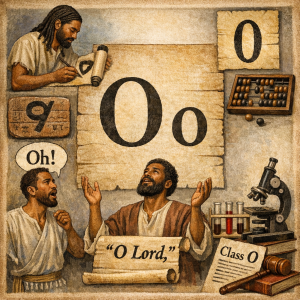
Primary Definition
O is the fifteenth letter of the modern English alphabet and, in its ordinary uppercase form, a rounded Latin character written O; its lowercase form is o. In English, it principally represents vowel sounds, though the precise sound varies by word, dialect, spelling pattern, and historical development. It may represent a short vowel, as in not; a long vowel or diphthong, as in go; a reduced vowel in some unstressed positions; or may be silent, as in certain inherited spellings.
The letter must be distinguished from several related but different things:
- 0 (zero): the numeral zero, which is visually similar but is not the letter O.
- Oh: an interjection expressing surprise, recognition, pain, hesitation, admiration, or other feeling.
- O: a literary or formal vocative particle, used to address a person, deity, or abstract quality directly, as in “O Lord,” “O friend,” or “O death.”
- O: an abbreviation, symbol, or classification in specialized fields, where its meaning depends entirely on the governing context.
In dictionary analysis, therefore, O is not one word with one fixed meaning. It is first a letter; second, a sound-symbol within writing; and third, a character that may acquire specialized meanings through grammar, science, government, military communication, typography, and ordinary custom.
Etymology and Origin
The Latin letter O belongs to a long alphabetic lineage. Its remote ancestor is generally identified with the Phoenician letter ayin or ʿayin, whose name literally meant “eye.” In Semitic writing, that sign represented a guttural consonant rather than the vowel sound now associated with English O. When Greek writers adopted and adapted the Phoenician alphabet, they reassigned certain Semitic consonant signs that Greek did not need to represent vowel sounds. The ancestor of O consequently became Greek omicron, a vowel letter.
The Greek name omicron literally means “small o,” distinguishing it from omega, “great o.” The distinction developed because Greek came to use separate written letters for short and long o-type sounds. The Latin alphabet inherited O through Greek and Etruscan transmission, and English later inherited it through the Roman alphabet.
The rounded shape of O has encouraged many popular explanations. A familiar claim says that O was deliberately drawn as a human mouth opened to pronounce “oh.” That explanation is attractive but historically unreliable. The documented ancestral connection is to the Semitic letter called “eye,” and the Greek reassignment of that inherited sign as a vowel was a linguistic adaptation, not evidence that its circular form was originally designed as a mouth.
In English orthography, O has acquired an unusually broad range of functions. The development of English pronunciation changed more rapidly than spelling conventions. As a result, the same letter may be pronounced differently in son, so, love, move, women, do, and colonel. This is not proof that O has no sound; rather, it reflects the layered history of English, including Germanic inheritance, French influence, Latin and Greek learning, the Great Vowel Shift, regional pronunciation, and conservative spelling.
The letter also appears in the connective form -o- in many learned compounds, especially words formed from Greek elements, such as biology, geology, and microscope. In such terms, the O may function more as a combining vowel than as an independent lexical unit.
Cultural and Historical Context
O has long been culturally important because its simple circular form is easy to recognize, reproduce, decorate, and mistake for other symbols. A circle may suggest completeness, enclosure, unity, a ring, an eye, an opening, a wheel, or the numeral zero. Those associations are visually understandable, but they should not automatically be treated as the original linguistic meaning of the letter.
In printing and handwriting, O is often paired with zero as a classic example of character ambiguity. Typefaces may distinguish zero by making it narrower, more oval, dotted, slashed, or otherwise marked. Such distinctions are practical safeguards in accounting, serial numbers, computer systems, engineering drawings, inventory records, and other contexts in which a single mistaken character can cause error.
In older literary English, capitalized O commonly appears before a direct address: “O king,” “O God,” or “O liberty.” This use is more formal and elevated than ordinary spoken English. Modern writers often omit it, use an exclamation point, or simply address the person directly. Yet it remains familiar in poetry, hymns, prayers, historical documents, and ceremonial language.
The exclamation oh is related in sound and often in writing practice, but it should not be confused with the vocative O. The former is generally an emotional or conversational utterance: “Oh, I understand.” The latter marks an address: “O Justice, where are you?” Modern informal writing frequently uses “oh” for both, but formal editing traditionally preserves the distinction.
In Irish surnames, the prefix O’ has a separate history. It derives from Irish Ó, meaning “descendant” or “grandson,” and is not a use of the English alphabetic letter O as an independent word. Thus names such as O’Neill and O’Brien preserve a patronymic element of Irish language and family history.
Biblical / Torah Context
The English letter O is not itself a letter of the Hebrew Torah text, nor was it part of the original Hebrew, Aramaic, or Greek biblical manuscripts. Biblical references to O in English Bibles are therefore generally matters of translation, transliteration, typography, or English literary style rather than an original-script doctrine concerning the Latin character.
Its historical ancestor, however, is relevant to Semitic writing. Hebrew ayin (ע), like Phoenician ayin, is traditionally named for the “eye” and is the sixteenth letter of the Hebrew alphabet. In Biblical Hebrew it historically represented a guttural consonant. In many later Jewish and Israeli pronunciations, that ancient guttural quality is weakened or absent, though it remains more distinctly preserved in some Jewish linguistic traditions and in related Semitic languages.
It is important not to collapse these facts into a false identity. Hebrew ayin is not English O, even though the Latin letter belongs to the same broad historical family of alphabetic development. The two characters have different shapes, different positions in their alphabets, different phonetic histories, and different present-day functions.
In the King James Version and other traditional English translations, “O” often introduces prayer, lament, worship, prophecy, or direct appeal: “O Lord,” “O God,” and similar expressions. Psalm 8, for example, begins with the English address “O LORD, our Lord.” This use conveys direct invocation and solemnity in English. It should not be mistaken for an extra Hebrew word automatically present in every underlying passage; translators and editors may use it to render the force of direct address in a dignified English register.
Jewish interpretive traditions sometimes attach symbolic reflections to Hebrew letters, including ayin and its association with sight or the eye. Such reflections may be spiritually meaningful within particular schools of teaching, but they are interpretive traditions rather than a universal rule of biblical grammar. A responsible dictionary distinction is necessary: the historical name “eye” is documented; every later symbolic teaching built upon “eye,” perception, watchfulness, or inward vision is not thereby established as the original legal or theological meaning of every biblical occurrence of the letter.
Legal Implications
The letter O has no general, independent definition in historical English common law. Common law developed through judicial decisions and customary legal principles; it does not make a single alphabetic character a universal legal term. The legal significance of O arises only when a document, statute, regulation, form, contract, court record, code, trademark, or established professional usage gives the character a defined role.
Accordingly, the meaning of O in a legal instrument depends on context. It might be a party initial, exhibit designation, subsection label, form field, agency code, corporate mark, serial-number character, or shorthand adopted by the drafter. A court construing an ambiguous use would ordinarily look to the text as a whole, the defined terms, surrounding circumstances where admissible, applicable statutes or regulations, and ordinary rules of interpretation. The letter alone does not create jurisdiction, obligation, property rights, governmental authority, or legal status.
A practical legal issue concerns confusion between O and 0. In regulated transportation communication, federal materials expressly distinguish the figure zero from the letter O and recommend the phonetic word “Oscar” for O. This illustrates a sound administrative principle: where characters can be confused, the record should use formatting, standardized spelling, or phonetic confirmation to reduce error.
Neither common law nor modern statutory law supports a general proposition that all-capital letters, unusual punctuation, or an isolated alphabetic character automatically changes a person’s legal capacity, citizenship, court jurisdiction, or the validity of a document. Such assertions periodically appear in “sovereign citizen” or redemption-style theories, but they are not accepted principles of American law. Legal consequences arise from lawfully enacted rules, valid agreements, admissible evidence, and judicial determinations—not from unsupported symbolic readings of typography.
The courtroom cry “Oyez, oyez, oyez” is sometimes mentioned in connection with O. It should be distinguished from the letter itself. Oyez is a traditional legal ceremonial expression, pronounced approximately “oh-yez,” and derives through Anglo-French from an imperative meaning “hear.” The sound “O” at its beginning does not make it a legal definition of the letter O. In the United States Supreme Court, the Marshal’s cry of “Oyez, oyez, oyez” opens sessions of the Court.
Spiritual Meaning
As a circle, O has often been used in religious art, meditation, poetry, and spiritual reflection to suggest wholeness, eternity, unity, the divine, the created order, or the cycle of life. Such meanings are understandable symbolic interpretations of its shape. They are not, however, fixed by English grammar or proven by the historical origin of the Latin letter.
From a biblical and Torah-conscious perspective, care is especially appropriate. The historical relationship between O and the Semitic letter ayin permits discussion of alphabetic development and, in some traditions, reflection on sight, attention, and perception. It does not establish that the English letter O possesses an inherent spiritual power, hidden legal authority, or universally binding sacred meaning.
The dictionary’s interpretive analysis is that O can serve as a useful visual symbol of completeness or attentive vision when a writer clearly presents it as metaphor. The documented fact is more modest: it is an alphabetic character with an ancient ancestry connected to a letter named “eye.” Spiritual claims beyond that point should be identified as devotional, poetic, mystical, or denominational interpretation rather than as settled linguistic fact.
Modern Usage
In modern English and international practice, O appears in many specialized settings:
- Alphabet and spelling: O is the fifteenth English letter.
- Phonetic communication: the standard spelling word is commonly Oscar, particularly in military, maritime, aviation-related, emergency, and other clarity-sensitive communications.
- Computing: uppercase O is encoded in Unicode as U+004F, “LATIN CAPITAL LETTER O”; lowercase o is U+006F.
- Science: O is the chemical symbol for oxygen. This is a convention of chemical notation, not a meaning carried by the letter in ordinary language.
- Grades and classifications: O may have local meanings in school systems, blood-group notation, manufacturing labels, military classifications, or administrative forms. The relevant system must define the term.
- Time: o’clock preserves an older contraction of “of the clock.”
- Typography: O may be confused with zero, Q, D, and certain non-Latin letters or symbols, especially in poorly designed fonts.
Because O is a common letter and a simple shape, modern readers should resist assigning a specialized meaning without evidence. A laboratory report, court filing, government form, software interface, military message, and religious text may all use O differently. Accurate interpretation begins with the governing document, field, and defined vocabulary.
Controversies / Criticisms
The principal controversy surrounding O is not the letter itself but the tendency to overread it. Symbolic systems often claim that its form proves hidden meanings involving the sun, a mouth, an eye, zero, infinity, deity, legal personhood, or secret governmental authority. Some of these associations may be valid as artistic or spiritual metaphors; they are not automatically valid as historical etymology, statutory interpretation, or common-law doctrine.
A second source of confusion is the relationship between O, zero, and the spoken word “oh.” They are often interchangeable in casual speech but should be separated in precise writing. In identifiers, account numbers, legal records, and technical systems, confusing O with 0 can have material consequences. Good drafting avoids the ambiguity rather than treating it as a mystery.
A third issue concerns ancestral letters. It is correct to say that Latin O descends through Greek from a Semitic letter traditionally called ayin. It is inaccurate to say that every English O therefore means “eye,” carries Hebrew legal force, or imports the religious interpretation of every later tradition concerning ayin. Historical descent does not make distinct languages and writing systems legally or theologically identical.
Conclusion
O is a foundational Latin alphabetic letter whose history reaches from Semitic ayin, through Greek omicron, to the Roman and English alphabets. Its primary function is linguistic: it represents vowel values within written language. Its rounded form has produced rich cultural, poetic, and spiritual associations, but those associations must be distinguished from documented etymology.
In legal and governmental settings, O has no universal common-law power or standalone legal definition. Its force, if any, depends on a specific and properly established context. In biblical English, O often marks reverent or elevated direct address, while the letter’s historical relationship to Hebrew ayin is a matter of alphabetic ancestry rather than proof of a concealed doctrine. The soundest reading is therefore contextual, historically informed, and cautious about claims that assign independent legal or spiritual authority to a single character.
Sources / Further Reading
- Online Etymology Dictionary, “O” — https://www.etymonline.com/word/O
- Unicode Consortium, “C0 Controls and Basic Latin” — https://www.unicode.org/charts/PDF/U0000.pdf
- Sefaria Library, Klein Dictionary, “ע ‘Ayin’” — https://www.sefaria.org/Klein_Dictionary%2C_%D7%A2
- Bible Gateway, Psalm 8, King James Version — https://www.biblegateway.com/passage/?search=Psalm%208&version=KJV
- Oyez, “About Oyez” — https://www.oyez.org/about
- U.S. Government Publishing Office, 49 CFR Part 220, Appendix A, Recommended Phonetic Alphabet — https://www.govinfo.gov/content/pkg/CFR-2012-title49-vol4/pdf/CFR-2012-title49-vol4-part220-appA.pdf
- U.S. Government Publishing Office, International Code of Signals, Phonetic Tables — https://www.govinfo.gov/content/pkg/GOVPUB-D5_300-PURL-LPS73101/pdf/GOVPUB-D5_300-PURL-LPS73101.pdf