African
Primary Definition
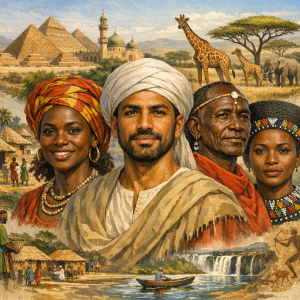
African is both an adjective and a noun. As an adjective, it means belonging to, originating in, associated with, or characteristic of Africa, its peoples, its states, or its many cultures. As a noun, it ordinarily means a native or inhabitant of Africa, a citizen of an African state, or a person whose ancestry or cultural heritage is connected to the continent.
The word is geographic before it is racial. It may properly describe people from North, West, Central, East, and Southern Africa, regardless of complexion, language, religion, ethnicity, or ancestry. An Egyptian, Algerian, Nigerian, Ethiopian, Kenyan, Congolese, Malagasy, or South African may all be African, although their nationalities, communities, and personal identities differ greatly. Accordingly, African is not an exact synonym for Black, Black American, or African American.
The term also applies to nonhuman subjects connected with the continent, as in African geography, African states, African languages, African wildlife, African art, or African legal systems. These expressions identify a broad field or relationship; they do not imply that Africa possesses one uniform culture, language, government, religion, or legal tradition.
Etymology and Origin
The English word descends through Latin and European usage from Africa and the Latin adjective Africanus, meaning “of Africa.” The securely documented historical point is that Roman writers and administrators used Africa for territory around Carthage, especially an area corresponding largely to modern Tunisia and adjoining parts of North Africa. It did not initially designate the whole continent.
After Rome defeated Carthage, the name became attached to Roman provincial administration, including the province commonly known as Africa Proconsularis. Over many centuries, European geographers and mapmakers extended the regional name until it became the conventional name for the entire continent. Earlier Greek and Mediterranean sources often used Libya for extensive lands west of Egypt, while Arabic geographical writing employed several regional names rather than treating all of Africa as a single cultural unit.
Disputed Etymologies
The source of the Roman name itself remains uncertain. One longstanding theory connects it with the Afri or Afer, names applied to people living near Carthage. Other proposals derive it from a Berber or Amazigh word related to ifri, “cave”; a Phoenician root interpreted as “dust”; the Latin aprica, “sunny”; or a Greek expression later interpreted as “without cold.” These proposals are not equally supported, and no single explanation has achieved universal scholarly acceptance.
Claims that Alkebulan was the single ancient indigenous name for the whole continent are popular in some modern cultural and spiritual literature but are not firmly established by surviving ancient evidence. Africa contained many peoples and languages, and there is no demonstrated reason to expect one prehistoric name to have been used universally for the entire landmass. Such a claim should therefore be identified as disputed rather than stated as settled etymology.
Cultural and Historical Context
For most of human history, the inhabitants of the continent primarily identified through kingdoms, cities, clans, peoples, languages, religious communities, and regions rather than through one continent-wide identity. Identities such as Akan, Amazigh, Amhara, Arab, Bakongo, Dinka, Fulani, Hausa, Igbo, Kikuyu, Kongo, Luo, Mandinka, Oromo, Shona, Somali, Tuareg, Wolof, Xhosa, Yoruba, and Zulu are examples of the specificity concealed when every person is described only as African.
European exploration, commercial expansion, the Atlantic and Indian Ocean slave trades, colonial conquest, missionary activity, and modern mapmaking gave the continental term increasing political significance. Colonial governments frequently treated diverse communities as broadly “African” in contrast to Europeans or settlers. Military administrations likewise used expressions such as “African troops” or “African regiments,” even when the soldiers came from distinct nations, ethnic communities, and legal jurisdictions. Such usage was often administratively convenient but culturally imprecise.
The forced transportation of millions of people created African-descended populations throughout the Americas, Caribbean, Europe, Middle East, and Indian Ocean world. In diaspora communities, a continental identity could preserve a relationship to an ancestral homeland even when slavery had destroyed records of a person’s particular nation, language, or family. The adjective consequently acquired meanings involving heritage, survival, cultural continuity, and resistance as well as geography.
Pan-African movements of the nineteenth and twentieth centuries transformed the word into a political expression of solidarity. Pan-African thinkers and organizers emphasized common interests among colonized African peoples and African-descended communities abroad. This solidarity contributed to anticolonial movements, independence campaigns, civil-rights activism, and the formation of the Organization of African Unity and its successor, the African Union. The African Union expressly recognizes a role for the African diaspora, while distinguishing diaspora affiliation from citizenship in an African state.
Biblical / Torah Context
The modern continental name does not appear as such in the Hebrew Torah. Biblical texts instead identify particular lands and peoples known to their authors. These include Mitzrayim, ordinarily translated as Egypt; Kush or Cush, commonly associated with regions south of Egypt, especially Nubia and the upper Nile; and Put, often connected by scholars with a North African region. The exact boundaries attached to ancient names can vary by period and passage and should not automatically be equated with modern national borders.
Genesis 10:6 lists Cush, Mizraim, Put, and Canaan among the descendants of Ham. This genealogical geography influenced later Jewish, Christian, and Islamic mapmaking, but it is not a scientific classification of modern races. Nor does it make every inhabitant of Africa a literal member of one biological lineage.
A particularly harmful later interpretation associated Africans and enslavement with the so-called “curse of Ham.” The text of Genesis 9:25, however, pronounces the curse upon Canaan, not upon Ham, Cush, or all African peoples. It neither identifies Black skin as a curse nor creates a perpetual law authorizing the enslavement of Africans. Racialized readings were developed and amplified in later societies, especially where religious arguments were recruited to defend slavery and colonial domination. Presenting that interpretation as the plain teaching of the Torah disregards the actual wording and historical setting of the passage.
The broader Bible contains substantial connections with African places and persons, including Egypt, Cush, and Ethiopia as understood in ancient usage. These references include rulers, soldiers, merchants, refugees, converts, and communities of faith. They cannot fairly be reduced to one story of slavery or judgment. Modern African Jews, Christians, Muslims, and practitioners of indigenous religions likewise belong to complex traditions that cannot be inferred merely from biblical geography.
Legal Implications
Historical Common Law and Statutory Classification
At historical common law, African was principally a description of origin and was not, by itself, a complete legal status. The severe disabilities imposed on Africans and their descendants in Britain’s colonies and the United States were created and enforced through slave codes, colonial enactments, constitutional provisions, judicial decisions, and racial customs. These rules should not be inaccurately described as the inevitable meaning of the word or as a universal doctrine of common law.
American colonial and state statutes converted perceived African ancestry into a basis for enslavement, exclusion, segregation, restrictions on testimony and property, and denial of political rights. Courts sometimes enforced these enactments through presumptions concerning color, maternal descent, or enslaved status. Equity did not consistently cure those injustices and often operated within the same slaveholding legal order.
In Dred Scott v. Sandford in 1857, the United States Supreme Court notoriously held that African Americans descended from enslaved people were not citizens of the United States for purposes of federal jurisdiction. That decision was repudiated by the Civil War Amendments, particularly the Thirteenth Amendment abolishing slavery and the Fourteenth Amendment establishing birthright citizenship and equal protection. It has no present validity.
Later segregation laws imposed disabilities under labels such as “Negro,” “colored,” and “African descent.” In Brown v. Board of Education in 1954, the Supreme Court held that state-mandated racial segregation in public education violated the Equal Protection Clause. Modern civil-rights law developed through constitutional amendments, federal and state statutes, regulations, and judicial decisions rather than through a freestanding dictionary meaning of African.
Current Legal Usage
In present law, describing a person as African does not establish citizenship, immigration status, or domicile. Africa is a continent, not a sovereign state capable of issuing one continental nationality. Legal nationality must ordinarily be identified through a particular country, while a person may also possess multiple citizenships, stateless status, refugee status, or a diaspora identity.
Discrimination against a person because the person is from Africa may implicate protections concerning national origin, race, color, ethnicity, or ancestry, depending on the facts and governing law. Title VII of the Civil Rights Act of 1964 prohibits covered employment discrimination on grounds that include race, color, and national origin. The Equal Employment Opportunity Commission explains that national-origin discrimination includes unfavorable treatment because a person comes from a particular country or part of the world, has a related ethnicity or accent, or is perceived to have such a background.
Under 42 U.S.C. § 1981, intentional discrimination based upon ancestry or ethnic characteristics may constitute racial discrimination even where modern popular classifications are uncertain. In Saint Francis College v. Al-Khazraji, the Supreme Court recognized that nineteenth-century legal understandings of race were broader and less consistent than many current classifications. Thus, a court examines the actual basis of discrimination rather than assuming that one administrative racial box resolves every case.
Federal statistical terminology must also be distinguished from personal, historical, and legal identity. The United States has used “Black or African American” as a federal data category. The Office of Management and Budget’s 2024 revision of Statistical Policy Directive No. 15 describes federal race and ethnicity categories as sociopolitical constructs, not biological or genetic definitions. It also establishes Middle Eastern or North African as a separate minimum reporting category and emphasizes detailed responses and self-identification. These standards support statistics and civil-rights administration; they do not determine an individual’s worth, culture, or entire legal identity.
Spiritual Meaning
The word has no single inherent spiritual definition. There is no one “African religion” shared by all inhabitants of the continent. Africa includes indigenous religious systems, Judaism, Christianity, Islam, and numerous blended or newer movements. Even traditions grouped as indigenous differ in their understandings of God, divinities, ancestors, moral duty, healing, initiation, community, land, and the afterlife.
In diaspora spirituality, African identity may symbolize ancestral remembrance, restoration of a history disrupted by enslavement, reverence for elders, and resistance to cultural erasure. Traditions including Vodou, Candomblé, Santería or Regla de Ocha, and related practices preserve or transform elements associated with particular West and Central African peoples. They should not be treated as interchangeable, primitive, or reducible to stereotypes about magic.
From an interpretive perspective, the word may carry a spiritual call toward dignity, kinship, responsibility, and remembrance. That meaning arises from communities and believers, not from the etymology alone. Claims that every African person possesses one spirituality, or that African identity proves membership in a particular biblical lineage, exceed the available historical evidence.
Modern Usage
In careful contemporary writing, the term should be used at the level of precision the subject permits. African is appropriate when the continent-wide relationship is relevant or when a person chooses that identity. A specific nationality, people, language, or region is preferable when known and material. “African government” may be misleading where “government of Ghana” is intended, just as “African language” is less informative than naming Swahili, Amharic, Yoruba, Arabic, or another language.
African American generally refers to an American identity and is not automatically applicable to every African immigrant, Black person, Afro-Caribbean person, or person of African ancestry in another country. Conversely, not every African identifies as Black. Respectful usage therefore gives substantial weight to self-identification and context.
Controversies / Criticisms
- Overgeneralization: Treating Africa as one culture erases national, ethnic, linguistic, religious, and political differences.
- Racial substitution: Using the term as a polite substitute for “Black” can create inaccuracies, particularly concerning North Africans, diaspora populations, and multiracial persons.
- Colonial framing: Some critics note that continent-wide terminology was standardized through European mapping and administration. Others respond that Africans and diaspora communities have since adopted and transformed the name into a powerful identity of their own.
- North African inclusion: Social and governmental systems have sometimes separated “North African” from “African,” although North Africa is geographically part of the continent. The dispute demonstrates the difference between geography and socially constructed racial categories.
- Questionable origin stories: Confident claims about a single literal meaning of the name, or a universally accepted earlier name, often go beyond the evidence.
- Administrative categories: Census and equal-opportunity classifications are useful for measuring inequality but may compress distinct communities into categories that do not match every person’s identity.
Conclusion
The term is fundamentally a broad designation of geographic origin, relationship, residence, ancestry, or heritage. Its earliest documented use was regional and connected with Roman North Africa; its later continental, racial, political, and spiritual meanings developed gradually. It may express citizenship in an African state, continental solidarity, diaspora ancestry, or cultural belonging, but it does not by itself identify a particular nationality, race, language, religion, or legal status.
A sound common-law dictionary treatment must therefore resist both racial reduction and romantic invention. Historical statutes and cases often used African ancestry to impose grave injustice, but those disabilities arose from positive enactments, governmental practices, and judicial choices—not from the natural meaning of the word. Modern usage is most accurate when it respects self-identification, distinguishes geography from race, and recognizes the extraordinary diversity of African peoples and their descendants.
Sources / Further Reading
- South African History Online, “Africa: What’s in a Name?” — https://sahistory.org.za/article/africa-whats-name
- African Union, “Constitutive Act” — https://au.int/en/constitutive-act
- African Union, “Diaspora & Civil Society Engagement” — https://au.int/en/programs/diaspora-civil-society-engagement
- Sefaria, Genesis 10 — https://www.sefaria.org/Genesis.10
- Library of Congress, “Dred Scott v. Sandford: Primary Documents in American History” — https://guides.loc.gov/dred-scott
- National Archives, “Brown v. Board of Education” — https://www.archives.gov/milestone-documents/brown-v-board-of-education
- U.S. Supreme Court, Saint Francis College v. Al-Khazraji, via Cornell Legal Information Institute — https://www.law.cornell.edu/supremecourt/text/481/604
- U.S. Department of Justice, “Federal Protections Against National Origin Discrimination” — https://www.justice.gov/crt/federal-protections-against-national-origin-discrimination-2
- U.S. Equal Employment Opportunity Commission, “National Origin Discrimination” — https://www.eeoc.gov/national-origin-discrimination
- Office of Management and Budget, 2024 Statistical Policy Directive No. 15 — https://spd15revision.gov/
- U.S. Census Bureau, “2020 Census Frequently Asked Questions About Race and Ethnicity” — https://www.census.gov/programs-surveys/decennial-census/decade/2020/planning-management/release/faqs-race-ethnicity.html
- Smithsonian Institution, “Race: Are We So Different?” — https://www.si.edu/exhibitions/race-are-we-so-different-event-exhib-509
- Library of Congress, Joseph M. Murphy, Working the Spirit: Ceremonies of the African Diaspora — https://www.loc.gov/item/hlas-bi95024461/