Semitic
Primary Definition
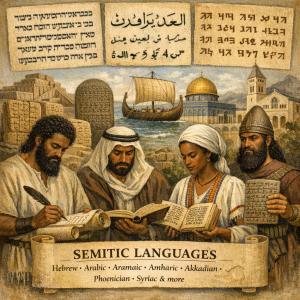
Semitic is principally a linguistic term. It describes the Semitic branch of the Afroasiatic language family, which includes Arabic, Hebrew, Aramaic, Amharic, Tigrinya, Akkadian, Ugaritic, Phoenician, Syriac, and related languages, both living and extinct. In careful modern usage, Semitic refers first to languages, their historical development, their grammatical features, their written traditions, and, where context requires, the peoples and cultures historically associated with those languages.
The term should not be treated as a precise biological, racial, national, or religious classification. A person may speak a Semitic language without belonging to any single ethnicity, religion, nation, or ancestry group. Likewise, Jews, Arabs, Assyrians, Ethiopians, Maltese people, Aramaic-speaking communities, and many others cannot accurately be reduced to one supposed “Semitic race.” The modern scholarly use of the term is linguistic and historical rather than biological.
Semitic languages are often recognized by related vocabulary, patterns of word formation, and shared grammatical structures. Many, though not all in identical form, use roots built largely around consonants. For example, related words concerning writing, peace, kingship, or divinity may reveal historical relationships between languages even when pronunciation, spelling, and grammar have changed over centuries. Such relationships are established through comparative linguistics, not merely by resemblance or traditional genealogy.
Etymology and Origin
The English word Semitic derives from Shem, rendered Sem in Greek and Latin traditions. Shem is one of the sons of Noah in the book of Genesis. In Hebrew, shem (שֵׁם) means “name.” The designation was adopted by European scholars in the late eighteenth century, who used the biblical Table of Nations as a framework for classifying languages then understood to be related, especially Hebrew, Aramaic, Arabic, and Syriac.
August Ludwig von Schlözer is commonly credited with introducing the designation in 1781, although Johann Gottfried Eichhorn also played an important role in disseminating it. The historical attribution is not entirely free from dispute because intellectual classifications often develop through several writers rather than one inventor. What is clear is that the word arose during an era in which European philologists and historians frequently used biblical genealogies to organize their understanding of nations, languages, and ancient history.
The original terminology reflected both genuine linguistic observation and an inherited biblical scheme. Scholars correctly recognized that Hebrew, Arabic, Aramaic, and related languages shared substantial structural and lexical connections. Yet the name chosen for the family came from Genesis rather than from a neutral linguistic label. Modern comparative linguistics preserves the term because it is established and useful, while recognizing that a language family is not the same thing as a literal descent group from a single biblical ancestor.
The older expression Hamito-Semitic, once used for the broader family now generally called Afroasiatic, has largely been abandoned in professional linguistic classification. “Hamite” was associated with outdated racial and biblical-geographical theories and did not describe a valid linguistic branch comparable to Semitic. The Library of Congress and modern language classification systems place Semitic within Afroasiatic, alongside such branches as Berber, Cushitic, Chadic, Egyptian, and Omotic.
Cultural and Historical Context
Semitic languages have been central to the history of the ancient Near East, North Africa, the Horn of Africa, and the Mediterranean world. Akkadian, written in cuneiform, was used in ancient Mesopotamia and survives in extensive records from Assyria and Babylonia. Aramaic became a major language of administration, commerce, and literature across large parts of the Near East. Hebrew became the language of much of the Hebrew Bible and of later Jewish religious, legal, and literary tradition. Phoenician and Punic were influential in maritime trade and colonial settlement around the Mediterranean. Arabic later became a language of the Qur’an, Islamic civilization, scholarship, government, poetry, law, and international exchange.
Other Semitic languages remain vital today. Arabic exists in a wide range of regional spoken forms as well as in Modern Standard Arabic. Hebrew was revived as a widespread modern spoken language while retaining its longstanding liturgical and literary importance. Amharic and Tigrinya are major languages of Ethiopia and Eritrea. Neo-Aramaic varieties continue to be spoken by diverse Assyrian, Chaldean, Syriac, Jewish, and other communities, although many are endangered.
The historical scope of Semitic languages demonstrates why the term cannot properly mean “Jewish” alone. Hebrew is Semitic, but so are Arabic and Aramaic. Jews are not the only people historically connected with Semitic languages, and Arabs are not outside the category. Furthermore, language, ethnicity, religion, citizenship, and ancestry do not always coincide. An Arabic-speaking Christian, a Hebrew-speaking secular Israeli, an Amharic-speaking Ethiopian Jew, and an Aramaic-speaking Assyrian may each have different identities while sharing participation in Semitic-language traditions.
In nineteenth- and early twentieth-century European writing, “Semite” and “Semitic” were sometimes used broadly for Jews, Arabs, Aramaeans, Assyrians, and other peoples of Western Asia and North Africa. Such usage often blurred language, culture, religion, and supposed race. It became especially problematic when racial theorists claimed that humanity could be divided into fixed, hereditary “Semitic,” “Aryan,” “Hamitic,” or similar races. Those schemes are historically important because they influenced politics and discrimination, but they are not reliable scientific classifications of human beings.
Biblical / Torah Context
The biblical background of the word lies in Genesis 10 and 11, often called the Table of Nations. These chapters present Shem, Ham, and Japheth as sons of Noah and trace lines of descent from them after the Flood. Genesis 10 identifies Shem with descendants including Elam, Asshur, Arpachshad, Lud, and Aram. Genesis 11 continues Shem’s genealogy toward Abraham.
Within Jewish and Christian interpretive traditions, these genealogies have often been understood as a theological account of the shared human family after the Flood. They express relationship, descent, blessing, dispersion, and the development of peoples and lands. The text is not a modern linguistic manual, a genetic study, or a racial taxonomy. It should therefore not be used as though it supplied a scientific population map.
Indeed, the biblical categories and the modern linguistic category do not perfectly align. Some peoples placed in the biblical line of Shem did not speak languages classified by modern linguists as Semitic, while some languages classified as Semitic are associated in Genesis with lines outside Shem. For example, the Canaanite languages, including Hebrew and Phoenician, are linguistically Semitic, though Canaan is placed in the line of Ham in Genesis 10. This difference is significant: the eighteenth-century name “Semitic” was inspired by Scripture, but the modern language family is determined by comparative linguistic evidence.
In Torah-centered interpretation, Shem is also associated with the preservation of sacred lineage and, through Abraham, the covenantal history of Israel. That theological association may be meaningful within faith traditions. It does not establish that every speaker of a Semitic language is a descendant of Shem in a provable genealogical sense, nor does it establish superiority, inferiority, political entitlement, or spiritual status for any modern people.
Legal Implications
Semitic is not generally a stand-alone term of art in the Anglo-American common law. Traditional common law developed through judicial decisions concerning private rights, property, contracts, torts, crimes, and procedure; it did not create a stable legal status called “Semitic.” Modern legal issues involving persons who may be described historically or linguistically as Semitic ordinarily arise under constitutional principles, statutes, civil-rights laws, immigration law, anti-discrimination law, hate-crime law, or international human-rights standards—not through a separate common-law definition of the word.
In United States employment law, Title VII of the Civil Rights Act of 1964 prohibits covered employment discrimination based on race, color, religion, sex, and national origin. The law does not require a claimant to prove membership in a “Semitic race.” Discrimination may instead be based on actual or perceived Jewish identity, Arab ethnicity, Middle Eastern ancestry, religion, language, national origin, dress, accent, or association with a protected group. The Equal Employment Opportunity Commission recognizes that national-origin discrimination may overlap with race and religion, including discrimination directed at persons perceived to be Arab, Middle Eastern, Muslim, or otherwise associated with a particular ethnic or religious community.
A historically important federal case is Shaare Tefila Congregation v. Cobb, 481 U.S. 615 (1987). The United States Supreme Court held that Jewish plaintiffs could state a racial-discrimination claim under 42 U.S.C. § 1982 because Jews were among groups regarded as distinct races when the statute was enacted. The decision did not declare that Jews constitute a biologically separate race under present-day science. Rather, it interpreted a Reconstruction-era civil-rights statute in light of the historical understanding of the groups Congress intended to protect. The distinction matters: legal interpretation may employ historical concepts of “race” for statutory coverage without endorsing obsolete racial science.
Accordingly, references to “Semitic” in legal argument should be used with care. It may describe a language family or historical classification, but it is usually less precise than the legally relevant facts: the person’s religion, ethnicity, ancestry, national origin, citizenship, language, or the discriminator’s perception and motive. Legal claims should be evaluated under the governing jurisdiction, statute, facts, and case law rather than through generalized assertions about “Semitic” identity.
Spiritual Meaning
The word Semitic itself has no single universal spiritual meaning. Its spiritual associations arise from the religious traditions expressed through Semitic languages. Hebrew is foundational to Judaism and central to the text and interpretation of the Tanakh. Aramaic is prominent in portions of the Hebrew Bible, the Talmud, Jewish prayer, and several Christian traditions. Arabic is the language of the Qur’an and holds unique sacred importance in Islam. Ge’ez remains a major liturgical language in Ethiopian and Eritrean Christian traditions.
For believers, the languages themselves may carry reverence because they preserve scripture, prayer, legal commentary, sacred poetry, and inherited ritual. That reverence should not be converted into ethnic essentialism. Sacred language can unite a worshiping community while remaining distinct from claims that one modern people is spiritually superior by blood, race, or language.
From an interpretive perspective, the term can remind readers that the biblical world emerged amid a network of related languages and neighboring cultures. Hebrew scripture, Jewish tradition, Christianity, and Islam all developed in historical settings where related Semitic languages were spoken, translated, borrowed from one another, and used in public life. This is a cultural and linguistic observation, not proof that the traditions are identical or that their theological claims are interchangeable.
Modern Usage
In contemporary academic writing, the preferred use of Semitic is as an adjective: “Semitic languages,” “Semitic philology,” “Semitic inscriptions,” “Semitic roots,” or “Semitic studies.” It is generally clearer to name the particular language, community, people, or historical period at issue whenever possible. “Arabic-speaking,” “Hebrew-language,” “Jewish,” “Arab,” “Aramaic-speaking,” “Assyrian,” “Ethiopian,” or “Middle Eastern” will often convey more accurate information than the broad label “Semitic.”
The noun Semite remains in dictionaries and historical works but is less favored in ordinary modern speech because it can imply a racial category rather than a linguistic or cultural relationship. Careful writers should avoid using it as a substitute for “Jew,” “Arab,” or “Middle Easterner.” Those words are not synonymous.
The related term antisemitism has a specialized and firmly established meaning: prejudice, hostility, discrimination, or hatred directed at Jews. Although the word’s literal components might suggest opposition to all “Semitic” peoples, its historical use has referred specifically to anti-Jewish hatred. It was coined in German in the late nineteenth century as Antisemitismus and was associated with efforts to recast older anti-Jewish prejudice in racial and pseudo-scientific language. The United States Holocaust Memorial Museum defines antisemitism as prejudice against or hatred of Jews and notes its central role in the Nazi persecution and genocide of European Jews.
Controversies / Criticisms
The most serious controversy surrounding the term is its misuse as a racial category. Nineteenth-century racial theories often contrasted “Semitic” and “Aryan” peoples as though each were fixed biological types with permanent moral, intellectual, and political traits. Such claims are discredited. Language relationship does not establish racial purity, common genetics, moral character, or collective political interest.
A common rhetorical claim states that an Arab or other non-Jewish speaker of a Semitic language “cannot be antisemitic” because that person is also “Semitic.” This argument relies on a literal but historically inaccurate reading of antisemitism. In established English usage, antisemitism means anti-Jewish prejudice; it does not mean hostility toward every person linguistically classified as Semitic. A person’s own ancestry, language, or ethnic background does not logically prevent that person from holding prejudiced views about Jews, just as membership in any broad category does not prevent prejudice against a subgroup within or associated with it.
Another error is to use “Semitic” as proof of an unbroken, exclusive, or legally decisive ancestry claim. Historical populations mixed, migrated, converted, adopted languages, lost languages, and formed new communities. Linguistics can identify relationships among languages; it cannot by itself establish modern individual genealogy, land title, religious truth, or political authority.
Finally, some critics object to retaining the term because of its biblical and nineteenth-century origins. Others support retaining it because it remains a practical and internationally recognized name for a well-established language branch. The prevailing scholarly approach is generally to retain Semitic in its narrow linguistic sense while rejecting racialized and essentialist uses.
Conclusion
Semitic is best understood as a historical and linguistic designation for a major branch of the Afroasiatic languages. Its name was drawn from Shem in the biblical Table of Nations, but its modern scholarly use rests on comparative linguistic study rather than on a claim of literal racial descent. The term has genuine importance in the study of Hebrew, Arabic, Aramaic, Akkadian, Ethiopic languages, ancient Near Eastern history, Jewish tradition, Christianity, Islam, and world civilization.
At the same time, precision is essential. “Semitic” should not be used as a vague racial label, a substitute for Jewish or Arab identity, or a basis for claims about biology, character, legal rights, or spiritual rank. In law and public discourse, specific descriptions of religion, national origin, ethnicity, language, ancestry, or discriminatory conduct are usually more accurate. Properly used, the term identifies a family of languages and the vast human record carried through them.
Sources / Further Reading
- Library of Congress, ISO 639-5 Language Coding Agency, “Hierarchy: Codes for the Representation of Names of Languages”: https://www.loc.gov/standards/iso639-5/hier.php
- Sefaria, Genesis 10, Revised JPS translation and traditional commentary: https://www.sefaria.org/Genesis.10?with=Rashi
- United States Holocaust Memorial Museum, “Antisemitism”: https://encyclopedia.ushmm.org/content/en/article/antisemitism
- United States Equal Employment Opportunity Commission, “Enforcement Guidance on National Origin Discrimination”: https://www.eeoc.gov/laws/guidance/eeoc-enforcement-guidance-national-origin-discrimination
- Shaare Tefila Congregation v. Cobb, 481 U.S. 615 (1987), Legal Information Institute: https://www.law.cornell.edu/supremecourt/text/481/615
- Online Etymology Dictionary, “Semite”: https://www.etymonline.com/word/Semite