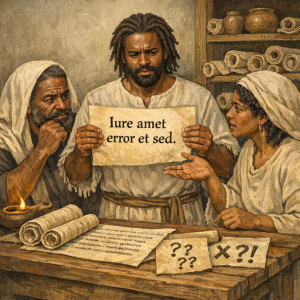
Iure amet error et sed.
Primary Definition
This expression is not an established English common-law term, legal maxim, Latin canon, governmental formula, military phrase, or recognized theological expression. It does not appear to form a complete, idiomatic sentence in classical or legal Latin. Rather, it has the appearance of generated or placeholder-style text assembled from individual Latin words or Latin-looking forms.
For dictionary purposes, the proper definition is therefore limited and cautionary: a nonstandard Latin-like word sequence with no settled independent legal, religious, or historical meaning. It should not be quoted as authority, translated as a fixed maxim, or treated as creating a right, duty, jurisdiction, contract term, spiritual doctrine, or rule of law.
Several of its component forms can be identified in Latin, but identification of individual words does not establish a coherent meaning for the whole sequence. Latin, like English, depends on grammar, inflection, context, and accepted usage. A row of recognizable words can still fail to communicate a complete proposition.
Component Words
- iure may be an ablative form of ius, meaning “law,” “right,” “justice,” or “legal principle.” In context, it can mean “by right,” “rightly,” “lawfully,” or “according to law.”
- amet is ordinarily a third-person singular present subjunctive form of amare, “to love.” Depending on context, it may suggest “may he, she, or it love.”
- error is a Latin noun associated with wandering, mistake, misconception, delusion, or error.
- et means “and.”
- sed means “but.”
Placed together without surrounding context, however, these forms do not produce a stable grammatical statement. The final pairing of “and” and “but,” in particular, signals an unfinished or mechanically assembled fragment rather than a conventional maxim. Any confident English rendering of the entire expression would therefore be speculative rather than a translation of an accepted source.
Etymology and Origin
The expression has no documented etymology as a unit because there is no reliable evidence that it originated as a named phrase, legal formula, proverb, liturgical line, or quotation from a historical text. Its individual words do have Latin roots, but their roots should not be mistaken for the origin of the phrase itself.
The most legally significant component is iure, from ius. Roman writers used ius broadly for that which is binding or right: law, justice, legal entitlement, a legal order, or a rule governing relations between persons. The term survives in many later legal formations, including jurisprudence, jurisdiction, juris, de jure, and sui juris. The English spelling “jur-” reflects later spelling and linguistic development; classical Latin commonly used i where later languages often use j.
Amet derives from amo, “I love,” and belongs to the ordinary Latin vocabulary of affection, desire, preference, and attachment. Its subjunctive form generally requires a grammatical setting: for example, a wish, command, purpose, condition, indirect question, or dependent clause. Without that setting, assigning a precise sense is unsafe.
Error is related to the Latin verb errare, “to wander” or “go astray.” The basic image of straying from a path became a figurative description of intellectual mistake, false belief, or misjudgment. English inherited related words such as “error,” “err,” “errant,” and “erroneous.” The English legal word “error” can have technical meanings in particular settings, such as judicial error, error of law, or historical writs of error, but those meanings do not transform this entire expression into a legal term.
The sequence is most plausibly understood as resembling the pseudo-Latin frequently found in design templates, test databases, auto-generated web content, sample forms, and unfinished website entries. Such material may contain real Latin words, distorted Latin, or words selected solely because they create the visual appearance of prose. That appearance is not proof of linguistic coherence or historical authority.
Cultural and Historical Context
Latin held an important place in the history of European law, scholarship, diplomacy, religion, medicine, science, and government. Roman legal vocabulary influenced later civil-law traditions, while medieval and early modern legal records in England often used Latin alongside Law French and English. The historical use of Latin in legal institutions explains why a Latin-looking expression may appear authoritative to modern readers.
But a crucial distinction must be maintained: Latin language is not the same thing as Roman law, and Roman law is not the same thing as English common law. Roman law developed through Roman institutions, juristic writings, imperial enactments, and later codifications. English common law developed through English courts, precedent, writ practice, custom, and later statutory enactment. The two traditions influenced one another at various points, especially through legal education and scholarly vocabulary, but neither is reducible to the other.
Historically, English legal records remained substantially Latinized for centuries. Formulaic Latin was used in pleadings, writs, judicial records, university education, ecclesiastical administration, and legal treatises. Many recognizable maxims entered English legal culture in Latin, including nemo judex in causa sua (“no one should judge in his own cause”), ubi jus ibi remedium (“where there is a right, there is a remedy”), and res judicata (“a matter adjudged”). Their legal importance, however, comes from their established use in authoritative sources and legal reasoning—not merely from being written in Latin.
There is no comparable historical record establishing this expression as a maxim. It should not be placed beside authentic maxims merely because one of its words, iure, concerns law or right.
Biblical / Torah Context
No recognized Biblical, Torah, rabbinic, New Testament, or Vulgate context attaches to this expression as a complete phrase. It is not Hebrew, Biblical Aramaic, or Koine Greek, and it should not be represented as a quotation from the Torah, the Psalms, the Prophets, the Gospels, the Epistles, or the Latin Vulgate.
Individual ideas suggested by its separate words—law, love, error, and contrast—are certainly important in Biblical and Torah-based teaching. The Torah addresses justice, righteous judgment, covenant obligation, testimony, mercy, and faithful conduct. Biblical literature repeatedly distinguishes truth from falsehood, wisdom from error, and love from injustice. Christian Scripture likewise contains extensive teaching concerning love, law, sin, repentance, truth, and mercy.
Yet those broad themes cannot properly be used to supply an invented meaning for a phrase that has no documented Scriptural source. Sound interpretation begins with an actual text in its language, literary setting, translation history, and established context. A spiritual lesson may be drawn from a reader’s reflection on law, love, or error, but such a reflection should be identified as interpretation rather than presented as the phrase’s original or literal meaning.
Legal Implications
This expression has no known independent legal force. It is not, by itself, a common-law cause of action, defense, remedy, jurisdictional doctrine, rule of evidence, constitutional principle, commercial term, military order, governmental designation, or statutory command.
In the United States, common law generally refers to law developed through judicial decisions rather than enacted legislation. Courts apply binding and persuasive authority according to jurisdiction, constitutional limits, statutes, procedural rules, and precedent. A phrase acquires legal significance through adoption in a constitution, statute, regulation, contract, judicial opinion, recognized legal instrument, or established doctrine. A disconnected Latin-like sequence does not become law merely because it contains a word related to ius or resembles traditional legal language.
Historical Common Law and Roman Law
Historically, common-law courts used Latin terminology and sometimes relied on inherited maxims. That use does not mean that every Latin statement was binding. A maxim may summarize a doctrine, but the underlying doctrine must still be found in authoritative legal sources. Likewise, a Roman-law word such as ius may be historically important without controlling a modern common-law court.
Roman-law concepts should also be distinguished from equity. Equity developed in England as a body of principles and remedies administered historically through the Court of Chancery. Although equitable ideas sometimes overlap with general ideas of fairness and conscience, equity is not a free-standing license to assign legal effect to unfamiliar language. Modern courts ordinarily apply equity through settled doctrines, statutes, procedural rules, and case law.
Current Legal Use
In current law, the expression may have significance only in a factual and limited sense. For example, it could appear in a website draft, a form template, a software test record, an exhibit, a contract attachment, a communication, or a disputed document. In those circumstances, a court might examine what the parties intended, whether the text was incorporated into an agreement, whether it was a clerical or drafting error, and whether the document as a whole remains enforceable under applicable law.
That is not the same as treating the phrase as a legal doctrine. If a document contains unintelligible language, the legal effect may depend on the governing jurisdiction, the nature of the transaction, surrounding circumstances, rules of interpretation, severability provisions, and evidence of mutual assent. Parties should not assume that untranslated or artificial Latin strengthens a legal claim. Where rights, property, criminal exposure, court filings, or contractual obligations are involved, qualified legal counsel should review the actual document and applicable jurisdiction.
Spiritual Meaning
No inherent spiritual meaning can be established for the expression. It is not a recognized prayer, invocation, sacred name, ritual formula, creed, or doctrinal statement. Claims that it carries hidden spiritual, occult, ecclesiastical, governmental, or legal power are unsupported unless a claimant can identify a reliable primary source and show the phrase in its original context.
An interpretive reader might notice a contrast among the component ideas of right, love, and error. From that perspective, one could reflect on the proposition that justice should be joined with mercy, or that affection without truth can lead to error. Such reflection may be morally meaningful, but it remains a modern interpretive exercise. It should not be confused with a translation, a revelation, or a historically transmitted teaching.
Modern Usage
In modern digital settings, expressions of this kind commonly occur as placeholder text, generated copy, incomplete content, sample records, development data, or automated text. The practical meaning is usually functional rather than linguistic: the text marks a field that still requires genuine content.
Editors, website owners, legal researchers, and document preparers should treat such language as a prompt for verification. Before publishing, filing, signing, or relying upon a document containing unfamiliar Latin, they should identify the source, verify the grammar, determine whether the text is complete, and replace filler text with the intended language where appropriate.
A useful editorial rule is simple: do not infer legal, governmental, military, religious, or historical significance from an unfamiliar phrase merely because it looks ancient or contains Latin vocabulary. Traceable authority matters more than appearance.
Controversies / Criticisms
The principal controversy surrounding Latin-like expressions is not a dispute over this phrase’s established meaning; rather, it is the recurring tendency to attribute authority to words that sound formal, ancient, or obscure. This tendency can produce several errors.
- Etymological overreach: deriving a fixed modern meaning from isolated word roots while ignoring grammar and context.
- False legal authority: assuming that Latin automatically overrides statutes, judicial decisions, contracts, or procedural rules.
- Conflation of legal systems: treating Roman law, canon law, common law, equity, and modern statutory law as though they were one undifferentiated body of rules.
- Invented religious attribution: assigning Biblical or spiritual authority without locating the phrase in an actual sacred text or recognized tradition.
- Template contamination: allowing placeholder text to remain in published articles, legal documents, websites, forms, or databases.
Dictionary analysis should resist both extremes: it should neither invent a grand meaning nor deny that the component Latin words have real histories. The responsible conclusion is narrower. The words may be individually analyzable, but the sequence has no demonstrated status as a coherent and authoritative term.
Conclusion
This expression should be classified as an unestablished Latin-like fragment, not as a common-law term or recognized legal maxim. Its component words touch themes of law, love, error, conjunction, and contrast, but their combination does not yield a settled grammatical or legal proposition.
Its use in legal, governmental, military, Biblical, spiritual, or contractual discussion should therefore be avoided unless a verifiable original source provides a particular context. Where it appears in a record or publication, the most prudent course is to identify whether it is placeholder material, a transcription mistake, generated text, or an incomplete draft, and then replace or clarify it with language that accurately states the intended meaning.
Sources / Further Reading
- Legal Information Institute, Cornell Law School, “Common Law”: https://www.law.cornell.edu/wex/common_law
- Legal Information Institute, Cornell Law School, “Law”: https://www.law.cornell.edu/wex/law
- Latin-English Dictionary, entry for iure: https://www.latin-english.com/latin/iure/
- Latin-English Dictionary, entry for amet: https://www.latin-english.com/latin/amet/
- The National Archives (United Kingdom), material concerning historical English legal records in Latin: https://cdn.nationalarchives.gov.uk/documents/education/spotlight-on-gordon-riots.pdf