Shit (Pooh/Poop)
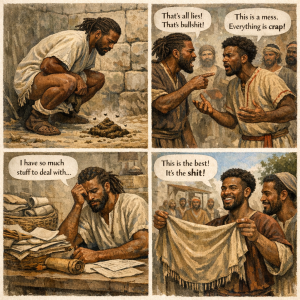
Primary Definition
Shit is a longstanding English noun and verb that is now commonly marked as vulgar. In its literal sense, the noun means feces or excrement; the verb means to defecate. In ordinary speech, however, the word has developed many figurative uses. It can refer to nonsense, deception, an unpleasant matter, trouble, contemptible conduct, an undesirable thing, or—depending heavily on tone and context—something impressive or important.
The literal meaning should be kept distinct from its broad slang meanings. A person who says, “There is shit on the ground,” ordinarily means excrement. A person who says, “That is shit,” may mean that an assertion is false, a product is poor, or a situation is bad. “I have a lot of shit to do” commonly means tasks, problems, or obligations. “The shit” can, by contrast, be used approvingly in some informal dialects to mean something excellent. Context, speaker relationship, setting, and tone determine which sense is intended.
The related words poop and pooh are generally milder alternatives. Poop commonly denotes feces, especially in family, child-care, veterinary, and informal health contexts. Pooh may be a spelling used for the same subject, but it also appears in the expression “pooh-pooh,” meaning to dismiss or ridicule. Neither euphemism has precisely the same social force as shit. The latter ordinarily carries greater intensity, bluntness, anger, humor, or defiance.
As a dictionary matter, the word is not inherently a legal term, a religious title, a governmental office, or a military rank. It is an inherited Germanic English word for bodily elimination that became a powerful taboo and slang term. Any legal, spiritual, military, or cultural significance arises from the setting in which it is used, rather than from a separate technical meaning built into the word itself.
Etymology and Origin
The word is very old. Modern English shit descends from Old English forms associated with scītan, “to defecate,” and related noun forms for diarrhea or excrement. Merriam-Webster identifies the verb as an alteration of earlier shite, from Middle English shiten, itself from Old English scītan. Related Germanic words include Dutch schijten and German scheißen, both meaning “to defecate.”
Etymologists commonly connect this Germanic family with a reconstructed Indo-European root conveying cutting, splitting, or separation. That proposed older connection is a linguistic reconstruction rather than a surviving written sentence from a prehistoric speaker. The semantic idea is straightforward: excretion is a separation or discharge from the body. This does not make the word related in ordinary modern meaning to every other word that may descend from a similar ancient root; etymological relationship is not a claim that words remain interchangeable.
Historical spellings varied. Medieval English used forms such as shiten, schyt, and shite. The noun appears to have had early associations with purging or diarrhea before its general modern sense of feces became widespread. The spelling shite remains current, particularly in British and Irish usage, while shit is the dominant standard spelling in American English.
A frequently repeated story claims that shit began as an acronym for “Ship High in Transit” or “Store High in Transit,” supposedly stamped on manure cargoes transported by sea. That story is false. The word existed in English centuries before the alleged shipping practice, and its documented Old English and Middle English ancestry rules out a modern acronym origin. Acronym stories of this type are often attractive because they provide a memorable explanation, but memorability is not evidence.
Cultural and Historical Context
Bodily waste has always required practical management, yet societies often surround words for it with embarrassment, ritual concerns, humor, or rules of politeness. The history of shit reflects that tension. It is an old native English word, but for long periods it was avoided in polite print and replaced by terms such as excrement, feces, stool, dung, waste, or euphemisms such as poop.
Its later history is therefore not simply one of a “bad word” becoming common. Rather, the word moved between restricted and public uses. It remained alive in speech, working language, insult, comedy, and private writing even when editors and publishers excluded it from formal publications. Modern dictionaries commonly label it “vulgar,” which describes social register and likely audience reaction, not an inherent moral quality possessed by the sound or letters.
The word’s force also made it useful as an exclamation. Used alone, it can signal surprise, pain, frustration, alarm, disappointment, or recognition of a serious problem. Used as an intensifier, it can heighten an adjective or noun phrase. Compound forms such as shitstorm, shitshow, shitlist, and bullshit illustrate the word’s productivity in modern slang. These compounds are often vivid but may be unsuitable in professional, educational, religious, judicial, or family settings.
Historically, vulgarity has not been fixed. A term deemed unprintable in one generation may appear in newspapers, film, novels, and political speech in another. Yet increased public use does not mean universal acceptance. Many speakers still regard the word as crude, hostile, immature, or unnecessarily aggressive, especially where children are present or where a respectful institutional tone is expected.
Biblical / Torah Context
The English word shit is not a biblical Hebrew term and should not be projected backward into the Torah or Bible as though Scripture used that English vocabulary. English translations vary widely in their rendering of words for dung, excrement, refuse, filth, and human waste. Older translations commonly employ terms such as dung; contemporary translations may say excrement or use a less direct expression such as “relieve yourself.”
A relevant Torah passage is Deuteronomy 23:12–15. In the context of an Israelite military camp, the passage directs the people to designate a place outside the camp, use a digging implement, and cover their excrement. The stated rationale combines camp order, cleanliness, and the holiness of a community understood to be in God’s presence. This is a concrete sanitation instruction within the covenantal and military setting described by the text; it should not be reduced either to a modern public-health code or merely to symbolic ritual.
Elsewhere, biblical references to dung or excrement may serve literal agricultural, sanitary, humiliating, or prophetic purposes. In siege narratives and prophetic rhetoric, imagery involving waste can express desperation, disgrace, corruption, or judgment. Such imagery is deliberately severe. It does not mean that all references to bodily waste have the same theological significance, nor does it establish that a particular modern English profanity is spiritually prohibited in every circumstance.
In Jewish and Christian moral reflection, speech is often evaluated by truthfulness, reverence, intent, self-control, and effect upon others. That broader framework permits different conclusions about casual profanity. Some believers avoid the word entirely as coarse speech; others distinguish a literal, candid use from speech intended to degrade, deceive, curse, or provoke. Those are interpretive and pastoral judgments, not a hidden lexical meaning of the word itself.
Legal Implications
Common Law and Historical Legal Usage
At historical common law, shit was not generally a technical word with a self-contained legal definition. Courts and legal writers more often used formal expressions such as filth, nuisance, offal, sewage, excrement, or human waste. Legal consequences historically arose from conduct involving waste—such as fouling land or water, maintaining a nuisance, violating sanitation rules, or creating an offensive condition—not from the mere existence of the slang word.
Common-law nuisance doctrine addressed unreasonable interference with the use and enjoyment of land, and public-nuisance principles could concern conditions affecting the public’s health, safety, comfort, or convenience. Those doctrines are distinct from modern statutory sanitation, environmental, zoning, and public-health regulation. A dictionary entry should not imply that all laws concerning feces are “common law,” because contemporary rules are frequently created by statutes, regulations, local ordinances, or administrative codes.
Roman law and equity do not supply a special origin or controlling definition for this English word. Roman legal systems addressed sanitation, property, and nuisance-like harms in their own legal vocabulary; equity developed remedies and principles within English legal history. Neither fact converts shit into a Roman-law or equity term.
Speech, Obscenity, and Profanity in United States Law
In United States constitutional law, profanity is not automatically obscenity. Obscenity is a narrow legal category, generally assessed under the three-part test stated in Miller v. California. The test concerns material appealing to prurient sexual interest, depicting or describing sexual conduct in a patently offensive manner as specifically defined by applicable law, and lacking serious literary, artistic, political, or scientific value when viewed as a whole. A nonsexual expletive about excrement ordinarily does not become legally obscene merely because it is vulgar.
The Supreme Court’s decision in Cohen v. California is important to the broader principle. The Court held that, absent a more particularized and compelling justification, the state could not make the public display of a single offensive four-letter expletive a criminal offense. The Court recognized that words may convey emotion as well as a detached idea. The decision does not create an unlimited right to use abusive language in every place or circumstance; threats, harassment, disorderly conduct under properly drawn laws, workplace rules, school rules, and context-specific restrictions may raise different issues.
Broadcast law also differs from ordinary private conversation or most internet speech. Federal regulations restrict broadcast licensees from airing obscene material and prohibit indecent material between 6 a.m. and 10 p.m. For broadcast purposes, the Federal Communications Commission has treated language describing sexual or excretory activities or organs in patently offensive terms as potentially indecent, depending on context. Thus, the word may be lawful in many settings while still producing regulatory or employment consequences in a regulated medium.
In contracts, employment disputes, defamation cases, disciplinary proceedings, and criminal cases, the word may be evidence of tone, intent, hostility, or the surrounding facts. It does not automatically prove harassment, defamation, incitement, or criminal conduct. Courts examine the whole statement, audience, relationship, repetition, setting, governing statute or rule, and applicable constitutional protections.
Spiritual Meaning
There is no universally settled spiritual meaning attached to the word itself. Its literal referent naturally evokes themes of bodily mortality, cleansing, humility, disgust, waste, and the boundary between what a community treats as private and public. Those associations are human and cultural before they are doctrinal.
In interpretive analysis, the word can function spiritually as a reminder that human beings are embodied rather than self-sufficient or purely abstract. Sacred texts and religious practices frequently distinguish cleanliness from uncleanness, ordinary life from sacred space, and reverence from contempt. But it is important not to confuse physical waste with personal worth. A person’s bodily functions do not make that person spiritually worthless, and sanitation rules should not be used to demean persons who are ill, disabled, poor, elderly, or dependent on care.
When used figuratively, the word may communicate moral disgust toward fraud, cruelty, hypocrisy, or corruption. That usage can be rhetorically forceful, but it can also become a substitute for careful judgment. A spiritual ethic of truthful speech may call for naming evil clearly while resisting needless contempt toward other people.
Modern Usage
Modern English uses the word in at least five major ways:
- Literal noun: feces or excrement.
- Literal verb: to defecate.
- Exclamation: a response to surprise, frustration, fear, or pain.
- Figurative noun: nonsense, dishonesty, trouble, possessions, events, or an undesirable situation.
- Intensifier or evaluative term: an expression of unusually strong approval or disapproval.
Its acceptability is highly situational. Medical, caregiving, veterinary, and sanitation communications often favor stool, feces, bowel movement, or excrement for clarity and professionalism. Parents may choose poop. In informal conversation among consenting adults, shit may be routine. In a courtroom, classroom, workplace, worship service, customer-facing setting, or communication with an unfamiliar audience, a more precise and less abrasive word will often be wiser.
Digital culture has expanded the word’s use in memes, usernames, comments, and compound labels. Its frequent appearance online can create the mistaken impression that it has no social cost. In fact, employers, platforms, schools, and communities may apply their own standards, and written profanity can be read as more hostile than the speaker intended because tone is absent.
Controversies / Criticisms
The principal controversy is not whether the word has an ancient English origin; that is well supported. The controversy concerns propriety, censorship, and social effect. One view treats the word as an ordinary, expressive part of living English whose force can communicate emotion more honestly than sanitized alternatives. Another regards it as unnecessarily coarse and as contributing to a decline in civility, particularly in public discourse and around children.
Both views can overstate their case. It is inaccurate to claim that the word is inherently unlawful, magical, spiritually contaminating, or uniquely incapable of serious literary use. It is equally inaccurate to claim that listeners’ objections are always irrational or that context never matters. Speech is both individual expression and social action. Responsible use requires attention to audience, purpose, and foreseeable effect.
Claims that the word originated in a secret maritime acronym should be rejected as false etymology. Claims that it is inherently a Roman, pagan, governmental, military, Catholic, Christian, or common-law term are likewise unsupported. The documented history is simpler: it is an old Germanic-derived English word whose literal bodily meaning acquired extensive slang, emotional, and taboo uses over time.
Conclusion
Shit is an ancient English-derived word for excrement and defecation that has become one of the language’s most flexible vulgar terms. Its modern meanings range from literal bodily waste to trouble, nonsense, deception, contempt, surprise, and even emphatic praise. Its power comes less from a technical definition than from its history as a socially restricted, emotionally charged word.
For legal purposes, the word is not automatically obscenity and has no singular common-law definition; consequences depend upon context, governing law, and conduct. In biblical and Torah contexts, related concepts concern sanitation, holiness, humiliation, and human embodiment, but modern English profanity should not be falsely inserted into ancient texts. Clear writing therefore requires distinguishing documented word history from cultural interpretation, and literal definition from moral or legal judgment.
Sources / Further Reading
- Merriam-Webster Dictionary, “Shit” — https://www.merriam-webster.com/dictionary/shit
- Online Etymology Dictionary, “Shit” — https://www.etymonline.com/word/shit
- Legal Information Institute, Cornell Law School, Cohen v. California, 403 U.S. 15 (1971) — https://www.law.cornell.edu/supremecourt/text/403/15
- Legal Information Institute, Cornell Law School, “Obscenity” — https://www.law.cornell.edu/wex/obscenity
- Electronic Code of Federal Regulations, 47 C.F.R. § 73.3999 — https://www.law.cornell.edu/cfr/text/47/73.3999
- Sefaria, Deuteronomy 23 — https://www.sefaria.org/Deuteronomy.23