Slavery (enslaved)
Primary Definition
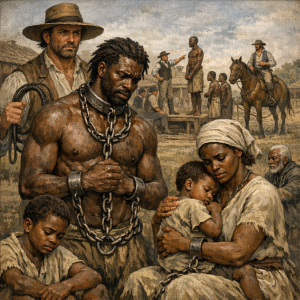
Slavery is a condition or system in which one human being is subjected to another’s dominion in a manner that strips, or substantially strips, the subjected person of liberty, self-direction, and the practical ability to refuse labor or leave. In its strongest historical and legal form, commonly called chattel slavery, a person is treated as property: bought, sold, inherited, transferred, compelled to labor, and often subjected to violence or legal disabilities by an owner or governing system.
The word enslaved, as in “enslaved person,” is increasingly preferred in historical writing because it identifies slavery as something imposed upon a person rather than as that person’s natural identity. A person was not inherently a “slave”; he or she was enslaved by another person, institution, law, market, or state. This wording does not change the historical reality of legal status where law classified people as slaves, but it does preserve the humanity and agency of those subjected to the institution.
Slavery must be distinguished from every difficult, low-paid, dependent, or unwanted form of work. The distinctions can be morally important and legally decisive. A harsh job, poverty, debt, military discipline, imprisonment, apprenticeship, or a freely accepted employment contract is not automatically slavery. Slavery involves coercive control over the person. Forced labor, debt bondage, servitude, trafficking, and slavery may overlap, but international law treats them as related rather than perfectly identical concepts. ([ilo.org](https://www.ilo.org/topics/forced-labour-modern-slavery-and-trafficking-persons/what-forced-labour?utm_source=openai))
Etymology and Origin
The English noun slave entered Middle English through Anglo-French esclave and Medieval Latin sclavus. The Medieval Latin term was connected with Sclavus, meaning a Slav or Slavic person. During the early Middle Ages, the frequent capture and sale of Slavic peoples in parts of Europe caused the ethnic designation to be used more generally for a person held in bondage. English records use slave in this sense from the fourteenth century. ([merriam-webster.com](https://www.merriam-webster.com/dictionary/slave?utm_source=openai))
This etymology is a historical explanation of the English word, not a claim that slavery began with Slavic peoples, Europe, Rome, Christianity, or any one civilization. Systems of human bondage are much older than the English language and appeared in many societies under different names and legal arrangements. The history of slavery therefore cannot responsibly be reduced to the origin of one English word.
Slavery names the institution or condition; enslavement emphasizes the act or process of imposing it. The verb to enslave means to reduce a person to slavery or servitude. Figurative phrases such as “enslaved by addiction,” “a slave to fashion,” or “wage slavery” use the moral force of the literal term to describe domination, compulsion, dependency, or loss of self-command. Such metaphors may express a genuine concern about coercion, but they should not casually erase the distinctive violence and hereditary legal subjugation of historical chattel slavery.
Cultural and Historical Context
Slavery has taken many forms across history. Ancient systems could arise through war captivity, debt, birth, punishment, piracy, conquest, or sale. Some enslaved people performed agricultural labor, domestic service, mining, military support, skilled work, administration, or sexual labor. Their conditions varied, but variation in treatment does not make a system non-coercive where one person was legally subordinated to another’s will.
Historically, slavery was often supported by positive law: enacted rules, local customs enforced by courts, colonial codes, commercial rules, or governmental power. It was not merely a private wrong committed by isolated individuals. In many places, law defined who could be held, how status passed to children, how persons could be transferred, and which testimony, property rights, marriage rights, mobility, education, or legal remedies were denied to enslaved people.
The transatlantic slave trade and racialized chattel slavery in the Americas are especially significant to the modern English-speaking meaning of the term. From the fifteenth through the late nineteenth centuries, millions of African women, men, and children were trafficked principally from West Africa to the Americas. This system created extraordinary wealth for imperial and commercial powers and was justified by ideologies of racial hierarchy whose effects continue to shape social life and public memory. ([unesco.org](https://www.unesco.org/en/query-list/t/transatlantic-slave-trade?utm_source=openai))
In what became the United States, colonial and state laws developed a system in which African ancestry was made central to a hereditary, racialized form of bondage. Enslaved persons could be sold, separated from family, compelled to work, punished, and denied ordinary civil standing. The United States Supreme Court’s decision in Dred Scott v. Sandford (1857) notoriously held that Congress lacked authority to prohibit slavery in the territories and intensified the national constitutional crisis preceding the Civil War. ([guides.loc.gov](https://guides.loc.gov/dred-scott?utm_source=openai))
Abolition was neither automatic nor solely the achievement of governments. Enslaved people resisted through survival, family and community formation, religious life, work slowdowns, litigation, escape, revolt, military service, writing, and organized political action. Abolitionists, free Black communities, religious reformers, and political movements also worked to end the trade and the institution. The Haitian Revolution, which began with the Saint-Domingue uprising of August 1791, was a decisive event in the wider history of anti-slavery and abolition. ([unesco.org](https://www.unesco.org/en/days/slave-trade-remembrance?hub=66746&utm_source=openai))
Biblical / Torah Context
The Bible and Torah contain laws and narratives concerning bondage, debt service, captives, household servants, and liberation. They should not be read as if every ancient category exactly matched either modern employment or the racial chattel slavery of the Atlantic world. At the same time, historical difference must not be used to deny that some biblical texts regulate real forms of human ownership and coercive service.
The Hebrew term eved can be translated “servant,” “slave,” or “bondservant,” depending on context. It can refer broadly to a subordinate, official, worshipper, or person in service, so translation requires care. Torah passages distinguish among situations. Exodus 21 provides for the release of a Hebrew male servant after six years of service; Deuteronomy 15 similarly commands release and instructs the master not to send the person away empty-handed. Leviticus 25 directs that an impoverished Israelite who becomes dependent be treated as a hired worker rather than ruled with harshness, with restoration connected to the Jubilee structure. ([sefaria.org](https://www.sefaria.org/Exodus.21.10?utm_source=openai))
Other passages are morally difficult to modern readers. Leviticus 25:44–46 permits Israelites to acquire male and female slaves from surrounding nations and speaks of their inheritance. Exodus 21 also includes provisions concerning physical injury to servants and enslaved persons. Thus, it is inaccurate to say that the Torah simply abolishes all slavery in the modern sense. It is also inaccurate to claim that its limited protections for some Israelite debt servants make every form of bondage described in the text voluntary or benign.
Several Torah principles nonetheless stand in tension with systems of kidnapping and race-based chattel slavery. Exodus 21:16 condemns kidnapping a person for sale or possession. Deuteronomy 23:15–16 directs that an escaped slave not be handed back to a master and that the person be allowed to live where he chooses. Israel’s own deliverance from Egypt repeatedly supplies a moral memory against oppression: “you were slaves in Egypt” becomes a reason to remember the vulnerable and act justly.
Jewish interpretation developed detailed rules concerning Hebrew servants and obligations of masters. Later rabbinic tradition often treated such service as limited and regulated, while still preserving distinctions that are not equivalent to contemporary equality before the law. Christians have historically disagreed sharply about the biblical witness. Some used selected texts to defend slavery; abolitionists and later anti-slavery thinkers emphasized the Exodus, the unity of human beings before God, the condemnation of man-stealing, and the ethical command to love one’s neighbor. Neither a proof-texting defense nor a proof-texting denial adequately accounts for the full historical record.
Legal Implications
Common Law, Statute, Equity, and Historical Practice
In common-law discussion, it is important not to assume that “common law” itself created a universal rule either authorizing or prohibiting slavery. English legal history was complicated. Colonial slavery was extensively created and maintained by colonial legislation, local courts, imperial commerce, and governmental power. In England, Somerset v. Stewart (1772) became a landmark case concerning the inability to forcibly remove James Somerset from England for sale overseas. It is commonly summarized as holding slavery unlawful in England, but its precise scope and consequences have been debated. The decision did not by itself abolish slavery throughout the British Empire. ([parliament.uk](https://www.parliament.uk/about/living-heritage/transformingsociety/tradeindustry/slavetrade/overview/abolition-campaign-the-arguements/?utm_source=openai))
The case is nevertheless associated with an enduring legal principle: slavery, because it is so severe, cannot simply be presumed from vague custom or judicial implication. It requires clear legal authority—often described in historical legal language as “positive law.” That proposition should not be overstated. It did not mean slavery was absent wherever English common law had influence; colonial statutes and imperial systems were used to enforce it. Nor did it make equity or natural-rights language automatically effective without political and legal change.
United States Constitutional Law
In the United States, the Thirteenth Amendment was passed by Congress on January 31, 1865, ratified on December 6, 1865, and formally abolished slavery and involuntary servitude within U.S. jurisdiction, except as punishment for crime after due conviction. Section 2 gives Congress power to enforce the amendment through appropriate legislation. ([archives.gov](https://www.archives.gov/milestone-documents/13th-amendment?utm_source=openai))
The amendment is self-executing as to its prohibition, but enforcement statutes and judicial interpretation remain significant. The Supreme Court has held that Congress may legislate against the “badges and incidents” of slavery, an idea recognized in Jones v. Alfred H. Mayer Co. (1968), which upheld federal authority to bar racial discrimination in property transactions. ([oyez.org](https://www.oyez.org/cases/1967/645?utm_source=openai))
The constitutional exception for punishment after criminal conviction remains controversial. Critics argue that the text enabled exploitative penal labor systems, including post-Civil War convict leasing and continuing coercive practices. Others stress that the exception does not authorize private enslavement, trafficking, debt bondage, or arbitrary compelled labor. As a matter of current federal law, the scope of any prison-work requirement depends on constitutional doctrine, statutes, institutional rules, and the facts of a particular case; the exception should not be misrepresented as a general license to enslave people.
Federal criminal law separately prohibits peonage, slavery, involuntary servitude, forced labor, and trafficking-related conduct. For example, 18 U.S.C. § 1589 addresses forced labor obtained through force, threats, restraint, serious harm, abuse of legal process, or certain coercive schemes. The Supreme Court’s decision in Bailey v. Alabama (1911) rejected a state system that used criminal sanctions to compel labor in payment of a debt, affirming that peonage could not be maintained indirectly. ([law.cornell.edu](https://www.law.cornell.edu/uscode/text/18/1589?utm_source=openai))
International Law
International law defines slavery in terms of powers attaching to ownership exercised over a person. The 1926 Slavery Convention definition was carried forward in substance by the 1956 Supplementary Convention and influenced later international legal instruments. The Supplementary Convention also addressed practices similar to slavery, including debt bondage, serfdom, certain servile marriage practices, and exploitative child transfer. ([legal.un.org](https://legal.un.org/avl/ha/sc/sc.html?utm_source=openai))
Forced labor has a related but distinct legal definition: work or service exacted under menace of a penalty and not offered voluntarily. “Modern slavery” is a widely used umbrella expression, but it is not itself a single universally defined legal category. Precision matters when identifying victims’ rights, criminal conduct, labor violations, and governmental responsibilities. ([ilo.org](https://www.ilo.org/topics/forced-labour-modern-slavery-and-trafficking-persons/what-forced-labour?utm_source=openai))
Spiritual Meaning
In spiritual and moral language, slavery often symbolizes captivity to sin, fear, violence, greed, false worship, addiction, or unjust worldly power. Such language can express the conviction that human freedom is not merely the ability to choose, but the ability to live truthfully, responsibly, and without domination by destructive desires or tyrannical persons.
That metaphor requires care. Spiritual bondage is not identical to the legal and physical captivity endured by enslaved people. A responsible spiritual use of the term should deepen, rather than divert attention from, the actual wrong of treating persons made in the image of God as objects, commodities, instruments, or disposable labor. Religious teaching that speaks of liberation has moral credibility only when it rejects coercion, racial domination, kidnapping, trafficking, and the abuse of vulnerable persons in practice.
Modern Usage
Modern historical writing often uses enslaved people, enslaver, and enslavement to keep attention on human agency and responsibility. The older words slave and slaveholder remain historically intelligible and appear in original documents, statutes, court opinions, and scholarship. The choice should be governed by clarity, historical context, and respect for persons.
In contemporary policy discussions, “modern slavery” may include forced labor, human trafficking, debt bondage, forced marriage, child exploitation, and slavery-like practices. The phrase draws attention to serious ongoing abuses, but responsible usage requires identifying the specific conduct involved. Not every case of trafficking is legal slavery; not every labor-law violation is forced labor; and not every economic dependency is slavery in the legal sense.
Controversies / Criticisms
- Person-first language: Some writers prefer “enslaved person” because it resists defining a human being by imposed status. Others retain “slave” when quoting documents or describing a legal category. Both usages require historical seriousness.
- Metaphorical overuse: Calling ordinary employment, taxation, inconvenience, or disagreement “slavery” may trivialize the experiences of people subjected to ownership, forced labor, family separation, and violence.
- Biblical interpretation: Debate persists over whether biblical regulations mitigated an existing ancient institution, authorized it, or contain principles ultimately incompatible with slavery. Honest interpretation must acknowledge both protective provisions and texts that permit enduring servitude.
- Common-law claims: Claims that slavery was “always illegal under common law” are too broad. Claims that common law universally endorsed slavery are likewise too broad. The historical record includes conflicting jurisdictions, statutes, judicial decisions, and imperial practices.
- Present-day terminology: “Modern slavery” is useful for public education but can blur legal categories. Victim protection and accountability improve when the precise conduct—forced labor, trafficking, servitude, debt bondage, or unlawful confinement—is accurately named.
Conclusion
Slavery is not simply hard labor or economic hardship. It is a grave condition of domination in which persons are controlled as if they were property or compelled to serve without meaningful freedom to refuse or leave. Its forms have varied across cultures and centuries, but its central injury is consistent: the denial of human dignity, liberty, family integrity, and moral personhood.
The term carries legal, historical, biblical, and spiritual significance. Those meanings should be carefully distinguished rather than blended into slogans. Historical chattel slavery, ancient servitude, debt bondage, peonage, forced labor, human trafficking, and metaphorical bondage may be connected, but they are not interchangeable. Clear language helps preserve the truth of past injustice while identifying and resisting coercive practices that continue in the present.
Sources / Further Reading
- Merriam-Webster, “Slave: Definition & Meaning” — https://www.merriam-webster.com/dictionary/slave
- National Archives, “13th Amendment to the U.S. Constitution: Abolition of Slavery (1865)” — https://www.archives.gov/milestone-documents/13th-amendment
- Legal Information Institute, Cornell Law School, “Slavery” — https://www.law.cornell.edu/wex/slavery
- Legal Information Institute, Cornell Law School, “18 U.S. Code § 1589: Forced Labor” — https://www.law.cornell.edu/uscode/text/18/1589
- Library of Congress, Constitution Annotated, “Thirteenth Amendment” — https://constitution.congress.gov/browse/amendment-13/
- Oyez, “Jones v. Alfred H. Mayer Company” — https://www.oyez.org/cases/1967/645
- United Nations, “Supplementary Convention on the Abolition of Slavery, the Slave Trade, and Institutions and Practices Similar to Slavery” — https://www.un.org/en/genocideprevention/documents/atrocity-crimes/Doc.15_supplementary%20slaverytrade.pdf
- International Labour Organization, “What Is Forced Labour?” — https://www.ilo.org/topics/forced-labour-modern-slavery-and-trafficking-persons/what-forced-labour
- UNESCO, “Transatlantic Slave Trade” — https://www.unesco.org/en/query-list/t/transatlantic-slave-trade
- Sefaria, “Exodus 21” — https://www.sefaria.org/Exodus.21
- UK Parliament, “Abolition: The Argument” — https://www.parliament.uk/about/living-heritage/transformingsociety/tradeindustry/slavetrade/overview/abolition-campaign-the-arguements/