the Messiah
Primary Definition
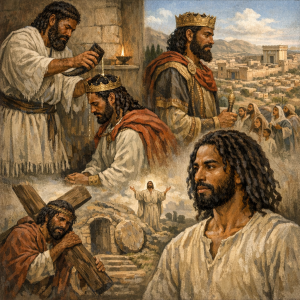
Messiah is an English form of the Hebrew title mashiach (מָשִׁיחַ), meaning “anointed one.” In its earliest biblical usage, the word described a person consecrated or set apart for a particular office by anointing with oil—especially a king or high priest. It was not originally a personal surname, a general synonym for “God,” or an automatic reference to one future divine redeemer.
With the definite article, the Messiah, the phrase ordinarily identifies the expected anointed deliverer or ruler in Jewish and Christian religious thought. The precise identity, nature, mission, and time of that figure differ substantially among traditions. In much of Judaism, the Messiah is expected to be a future human king in the line of David who will help bring about national restoration, justice, peace, knowledge of God, and the redemption or ingathering of Israel. In Christianity, Jesus of Nazareth is confessed as the Messiah—Greek Christos, “anointed one”—whose life, death, resurrection, present reign, and promised return fulfill God’s redemptive purpose.
Accordingly, “Messiah” is a religious and historical title whose meaning must be read in context. A biblical reference to “an anointed one” does not necessarily mean the future Messiah in the later Jewish or Christian sense. Conversely, later messianic interpretation often reads earlier biblical passages as promises, patterns, or prophecies pointing toward a final anointed king.
Etymology and Origin
The English word Messiah came through Greek and Latin forms of the Hebrew mashiach, derived from the Hebrew verb mashach, “to anoint.” Anointing involved applying oil to a person or object as a sign of consecration, appointment, sanctification, or authority. The Greek translation of the Hebrew Scriptures commonly rendered the underlying Hebrew concept with christos, meaning “anointed.” Thus, the title Christ is not originally a family name; it is the Greek counterpart of “Messiah.”
The foundational image is therefore not merely emotional salvation but public appointment. An anointed king was understood to hold office under divine authority; an anointed priest was set apart for sacred service. The title carries ideas of calling, commission, responsibility, accountability, and divine favor. It does not mean that every anointed person was morally perfect, beyond criticism, or personally divine.
In the Hebrew Bible, the term is applied in more than one way. Israelite kings may be called “the LORD’s anointed.” The high priest may be called “the anointed priest.” Isaiah 45:1 famously applies the term to Cyrus, the Persian king who was not an Israelite but whom the text portrays as an instrument used by God to permit the Judean return from Babylonian exile. These usages demonstrate that the word’s basic lexical meaning is broader than a single end-times figure.
Over time, especially as the Davidic monarchy ended and Jewish communities endured exile, foreign rule, and political upheaval, the title acquired stronger expectations of future restoration. The older language of anointed kingship became a vehicle for hope that God would raise up a faithful ruler, restore justice, defeat oppression, and vindicate the covenant people. This historical development is one reason why the later phrase “the Messiah” bears a more concentrated meaning than many earlier biblical instances of “anointed.”
Cultural and Historical Context
Messianic expectation arose within the history of Israel’s kingship, covenant, temple worship, exile, return, and continued subjection to powerful empires. The promises associated with David’s royal house—particularly the hope for enduring righteous rule—provided a central setting for later expectations of a Davidic Messiah. Prophetic passages concerning righteous government, restoration, peace, return from exile, and the nations’ recognition of the God of Israel were subsequently gathered into diverse pictures of the messianic age.
There was not, however, one uniform messianic doctrine in ancient Judaism. Second Temple Jewish writings exhibit several expectations: a royal Davidic deliverer, a priestly figure, a heavenly agent, a prophet-like leader, or an age in which God acts decisively without every source using the precise title messiah. Some Qumran texts are often understood as anticipating more than one anointed figure, including priestly and royal roles. Historical claims that all Jews at the time of Jesus expected exactly the same military-political Messiah are therefore oversimplified.
The Roman occupation of Judea sharpened hopes for liberation and righteous rule, but it also made messianic claims politically dangerous. A claimant to kingship could be viewed by imperial authorities as a threat to public order. This background helps explain why the title could carry both religious and governmental implications in the first century. A messiah was not necessarily imagined only as a private spiritual teacher; the title could concern the restoration of Israel, the rule of God, and the ordering of public life.
After the destruction of the Second Temple in 70 CE and later Jewish revolts against Rome, messianic hope continued but developed in different directions within rabbinic Judaism, Christianity, and later Jewish movements. Rabbinic literature preserved vigorous discussion concerning the Messiah, the messianic age, repentance, suffering, redemption, and the proper limits of calculating the end. Christianity proclaimed that Jesus was already the Messiah while also maintaining hope for a future consummation of his reign.
Biblical / Torah Context
Anointing in the Torah
The Torah establishes anointing as a sacred act. Priests and certain holy objects were consecrated for service by anointing oil. Leviticus refers to the “anointed priest,” showing that the Hebrew term could denote an office-holder serving in the sanctuary. The Torah’s concern is not merely ceremony: anointing marks separation for God’s service and imposes heightened responsibility on the one appointed.
The Torah itself does not provide a fully developed later doctrine of “the Messiah” as a future Davidic king. Rather, it supplies categories later used in messianic thought: covenant, blessing, kingship, priesthood, redemption, obedience, judgment, and the hope that God will dwell among and restore His people. Interpretations connecting particular Torah passages directly to the Messiah vary among Jewish, Christian, and other readers and should be identified as interpretive rather than treated as uncontested lexical fact.
Hebrew Bible and Prophetic Development
The historical books call Saul and David the LORD’s anointed, reflecting the royal use of the title. Psalms associated with kingship, including Psalm 2, later became important in Jewish and Christian messianic interpretation. Prophetic texts such as Isaiah 9, Isaiah 11, Jeremiah 23, Jeremiah 33, Ezekiel 34, Ezekiel 37, Micah 5, Zechariah 9, and Daniel 7 or 9 are frequently discussed in relation to messianic expectation. Yet the immediate historical setting and literary meaning of each passage remain subjects of substantial scholarly and theological debate.
For example, Jews and Christians may agree that Isaiah, Jeremiah, Ezekiel, and the Psalms speak powerfully of divine justice, kingship, restoration, and hope, while disagreeing about whether specific passages predict Jesus, describe a future Messiah not yet revealed, refer first to historical figures or events, or operate on more than one level of meaning. Responsible dictionary use should not erase these differences.
New Testament Context
The New Testament uses the Greek title Christos repeatedly for Jesus. Its central confession is that Jesus is the Christ, or Messiah. The Gospels portray debate over what kind of Messiah Jesus was expected to be: a Davidic king, liberator, prophet, teacher, suffering servant, or heavenly judge. The early Christian proclamation joined messianic kingship to Jesus’s crucifixion and resurrection, a combination that many contemporaries found unexpected or difficult.
Christian theology commonly understands Jesus as fulfilling the offices of prophet, priest, and king. This “threefold office” is a later theological framework rather than a single phrase stated in that form throughout the Bible. It expresses a Christian interpretive conclusion: Jesus reveals God’s word, offers reconciliation, and reigns as the promised king. Judaism does not generally accept the Christian claim that Jesus fulfilled the messianic requirements in the final and complete sense.
Legal Implications
“The Messiah” is not a technical term of Anglo-American common law. Historical common law developed through judicial decisions, customs, and precedents concerning civil rights, property, contracts, crimes, procedure, and governmental authority. It did not create a legal office called “the Messiah,” nor does it grant legal immunity, sovereign power, special citizenship, exemption from court jurisdiction, or ownership rights merely because a person claims or is called the Messiah.
The title may appear in legal disputes only indirectly, such as cases involving religious liberty, defamation, fraud, employment, child custody, institutional governance, public safety, religious accommodation, or the use of religious names in commerce. In such cases, a civil court generally does not decide whether a claimant is genuinely the Messiah as a matter of religious truth. Courts may evaluate evidence relevant to conduct, contracts, sincerity where legally relevant, property, harm, or statutory requirements, while avoiding theological adjudication where the First Amendment forbids it.
United States constitutional law protects religious belief and religious exercise, but those protections do not ordinarily excuse neutral and generally applicable laws, nor do they authorize coercion, violence, fraud, abuse, or deprivation of another person’s rights. Article VI of the United States Constitution also prohibits religious tests for federal office. The First Amendment’s Religion Clauses protect both against governmental establishment of religion and against improper governmental interference with religious exercise.
There is an important distinction between religious language and legal authority. A believer may use “Messiah” as a confession of faith; a church may teach that Jesus is the Messiah; and an individual may profess a messianic belief. None of those facts alone changes civil legal status. Claims that a religious title automatically overrides statutes, court orders, taxation, criminal law, contracts, or constitutional limits are unsupported by ordinary American legal doctrine.
Spiritual Meaning
Spiritually, the Messiah represents hope that human corruption, injustice, exile, sin, violence, and death do not have the final word. In Jewish thought, messianic hope is commonly connected with the repair of the world, the restoration of Israel, peace, justice, faithful worship, and wider recognition of the one God. The emphasis is often not escape from the material world, but its righteous renewal under God.
In Christian thought, the Messiah is the center of redemption. Jesus is understood as the anointed king who reconciles humanity to God, defeats the powers of sin and death, establishes a people under a new covenant, and will bring history to its rightful completion. Christian spiritual language therefore links Messiah with salvation, forgiveness, resurrection, discipleship, judgment, humility, sacrificial love, and divine kingship.
Interpretively, the title warns against reducing spiritual authority to worldly domination. Anointing in Scripture signifies service under God, not self-exaltation. Both Jewish and Christian traditions contain strong ethical teaching that genuine hope in redemption should lead to justice, mercy, repentance, humility, and care for neighbors rather than speculation, coercion, or contempt for others.
Modern Usage
In modern English, messiah is often used figuratively for a person portrayed as a rescuer, reformer, genius, or hoped-for leader. Such use can be complimentary, ironic, or critical: a political candidate may be described as being treated “like a messiah,” meaning supporters place unrealistic hope in that person. Lowercase figurative use should be distinguished from the religious title.
Within Judaism, beliefs range from traditional expectation of a personal Davidic Messiah to emphasis on a future messianic age, ethical redemption, or nonliteral interpretations. Within Christianity, “Jesus Christ” is ordinarily a confessional identification of Jesus as the Messiah. Messianic Jewish groups typically affirm Jesus as Messiah while retaining varying degrees of Jewish practice and identity; their theological status is contested within wider Judaism.
The word also appears in literature, music, political rhetoric, and popular culture. Because it carries profound commitments for Jews and Christians, casual use can communicate either admiration or disrespect depending on context. Precision is therefore preferable: identify whether the intended meaning is the Hebrew biblical term, the Jewish future redeemer, the Christian confession concerning Jesus, a claimant, or a metaphorical “savior.”
Controversies / Criticisms
The principal controversy concerns identity and fulfillment. Christianity holds that Jesus is the promised Messiah; Judaism generally maintains that the Messiah has not yet come and that the world has not experienced the definitive peace, restoration, and knowledge of God associated with messianic fulfillment. This is a genuine theological disagreement, not a question settled by English dictionary usage alone.
Another controversy concerns proof-texting—the practice of treating isolated biblical verses as conclusive without considering language, historical setting, genre, and the broader scriptural context. Christian readers may understand passages such as Isaiah 53, Psalm 22, Daniel 9, or Zechariah 12 as messianic prophecies fulfilled in Jesus. Jewish readers may interpret the same texts differently, including in relation to Israel, a historical person, a prophet, priestly history, or another contextual referent. Academic scholars likewise debate how ancient audiences first understood particular texts and how later communities reread them.
Messianic claims can also become socially harmful when a leader demands unquestioning obedience, isolates followers, seeks sexual or financial control, incites violence, or claims exemption from moral and civil accountability. Such conduct should be evaluated by ordinary ethical and legal standards, regardless of spiritual language. The title itself proves neither truth nor falsehood; claims require discernment, evidence, and attention to their fruits.
Finally, it is inaccurate to claim that “Messiah” has a hidden origin in Roman law, maritime law, secret governmental systems, or a universal pagan title. The documented linguistic origin is Hebrew mashiach, “anointed one,” with Greek christos serving as the principal translation in early Christian usage. Later cultural influences may shape how communities understand messianism, but they do not erase that documented Hebrew origin.
Conclusion
The Messiah is, at root, the anointed one: a person consecrated and commissioned under God’s authority. From that concrete biblical practice grew enduring hopes for righteous kingship, restoration, deliverance, peace, and divine judgment. Jewish and Christian traditions share the word’s Hebrew foundation while differing decisively about the Messiah’s identity, mission, and fulfillment.
In legal settings, the term is a religious title rather than a source of independent civil authority. In spiritual settings, it is a title of hope and accountability, pointing beyond human rulers toward justice under God. Careful use requires distinguishing the ancient lexical meaning, later theological interpretations, figurative modern speech, and unsupported claims of special legal status.
Sources / Further Reading
- Jewish Encyclopedia, “Messiah” — https://www.jewishencyclopedia.com/articles/10729-messiah
- Jewish Encyclopedia, “Anointing” — https://www.jewishencyclopedia.com/articles/1559-anointing
- Sefaria, Leviticus 4:3 — https://www.sefaria.org/Leviticus.4.3?lang=bi
- Sefaria, Isaiah 45:1 — https://www.sefaria.org/Isaiah.45.1?lang=bi
- My Jewish Learning, “Jewish Messianism” — https://www.myjewishlearning.com/article/jewish-messianism/
- My Jewish Learning, “Who Is the Messiah?” — https://www.myjewishlearning.com/article/who-is-the-messiah/
- Bible Gateway, Encyclopedia of the Bible, “Messiah” — https://www.biblegateway.com/resources/encyclopedia-of-the-bible/Messiah
- Legal Information Institute, Cornell Law School, “Religion and the Constitution” — https://www.law.cornell.edu/wex/religion_and_the_constitution
- Legal Information Institute, Cornell Law School, “Establishment Clause” — https://www.law.cornell.edu/wex/establishment_clause