Shem
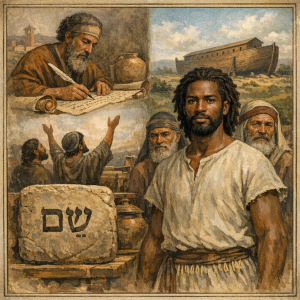
Primary Definition
Shem is a Hebrew word and personal name, written שֵׁם (shem or shem). As a common Hebrew noun, it principally means name. Depending on context, it may also carry the associated senses of reputation, renown, fame, authority, memorial, or an identified person. In the Hebrew Scriptures, it is also the name of one of Noah’s sons and the ancestor through whom the Genesis genealogy proceeds to Abraham.
The term therefore has two connected but distinct uses:
- Common noun: a name, designation, reputation, or renown.
- Proper name: Shem, son of Noah, brother of Ham and Japheth, and forefather in the biblical line leading through Arphaxad, Shelah, Eber, Peleg, and ultimately Abram (Abraham).
The connection between the noun and the personal name is direct in Hebrew: the patriarch’s name is the ordinary word for “name.” This does not prove that every biblical use is a wordplay, nor does it authorize speculative doctrines based solely on the English spelling. It does mean that Hebrew-speaking readers would naturally recognize the ordinary meaning carried by the name.
In biblical thought, a “name” is often more substantial than a label used for administrative convenience. A name may represent public standing, remembered deeds, family continuity, authority, reputation, or the character by which a person is known. Thus, when Scripture speaks of making a “name,” it can concern enduring renown; when it speaks of profaning, honoring, calling upon, or bearing a name, the subject may involve reputation, allegiance, worship, and covenantal identity rather than mere pronunciation.
Etymology and Origin
Shem comes from the Hebrew noun שֵׁם (shem), “name.” Biblical Hebrew uses the word in ordinary naming contexts, but also in broader expressions involving fame, reputation, and memorial significance. Lexical resources commonly identify its semantic range as including name, fame, report, renown, authority, and reputation.
The English form Shem comes through ancient translations and later English Bible tradition. The Greek Septuagint renders the patriarch’s name as Sēm (Σήμ), and Latin biblical tradition commonly uses Sem. English translations generally retained the familiar form “Shem.” Other transliterations may appear in academic, Jewish, Christian, and Islamic literature, but they ordinarily refer to the same biblical figure.
The Hebrew noun belongs to a very old family of related words found across Semitic languages. Such linguistic relationship is a matter of comparative language study, not proof that all peoples who speak related languages descend biologically from one historical individual. It is appropriate to say that “Semitic” as a linguistic label was named after biblical Shem; it is not appropriate to use that modern linguistic label as a scientific racial classification.
The modern term Semitic was introduced in eighteenth-century European scholarship for a family of related languages that includes Hebrew, Aramaic, Arabic, Akkadian, and others. The designation was derived from the Genesis genealogy of Shem. The label remains useful in linguistics, although its biblical genealogy does not align perfectly with modern linguistic classifications. For example, the Table of Nations places Canaan among Ham’s descendants, while Canaanite languages, including Phoenician and Hebrew’s closest ancient relatives, are linguistically classified as Northwest Semitic.
Cultural and Historical Context
Shem appears in the post-Flood narrative of Genesis as one of Noah’s three named sons: Shem, Ham, and Japheth. The biblical account presents the three as ancestral heads of nations after the Flood. Genesis 10, conventionally called the “Table of Nations,” organizes numerous peoples and regions in a genealogy. Its purpose is not identical to that of a modern census, genetic study, or ethnographic map. It is a theological and historical ordering of the known world from the perspective of the biblical writers.
Within that structure, Shem’s descendants include Elam, Asshur, Arphaxad, Lud, and Aram. Later branches include Eber, from whom come Peleg and Joktan. The genealogy in Genesis 11 narrows from Shem through Arphaxad and Eber to Terah and Abram. In this literary sense, Shem is pivotal: the universal human story after the Flood proceeds through all nations, while the covenant narrative subsequently focuses on the family through which Abraham emerges.
Genesis gives Shem special narrative prominence in the account of Noah’s drunkenness. When Ham sees Noah’s nakedness and reports it to his brothers, Shem and Japheth walk backward and cover their father without looking upon him. Noah’s ensuing speech blesses the LORD, “the God of Shem,” while Canaan, Ham’s son, is cursed. The text’s exact historical and moral questions have been debated for centuries, but the immediate narrative contrast is plain: Shem and Japheth act with restraint and filial regard, whereas Ham’s conduct initiates a crisis within the family.
The statement concerning “the God of Shem” is especially important. It does not make Shem divine, nor does it make a bloodline itself an object of worship. Rather, the formulation identifies the LORD with a covenantally meaningful line in the unfolding biblical narrative. The blessing belongs first to God; Shem’s family is significant because the biblical account locates the Abrahamic and Israelite line within it.
Ancient and medieval readers often attempted to correlate each descendant named in Genesis 10 with a particular people, kingdom, or territory. Some identifications have historical plausibility, while others remain uncertain or reflect later interpretive traditions. A careful dictionary definition should not treat every later ethnic identification as settled fact. Biblical genealogies can preserve memories of peoples, places, political relationships, and shared origins, but they are not a substitute for archaeological, linguistic, or historical analysis.
Biblical / Torah Context
Shem in Genesis
The Torah identifies Shem as Noah’s son in Genesis 5:32 and returns to him repeatedly in Genesis 6–11. He enters the ark with Noah and the family, survives the Flood, participates in the renewed human history after the Flood, and becomes the ancestor of the line traced to Abraham.
Genesis 10:21 describes Shem as the father of “all the children of Eber.” This matters because Eber is traditionally associated with the designation “Hebrew,” though the precise linguistic and historical relationship is debated. At minimum, the text gives Eber a prominent place within Shem’s lineage and prepares the reader for the later Abraham narrative.
Genesis 11:10–26 gives a focused genealogy from Shem to Abram. This genealogy functions as a bridge between the Flood account and the call of Abraham in Genesis 12. In Torah context, Shem is therefore not merely an ancestor of vaguely defined “eastern” peoples. He is a named link in the narrative movement from creation, judgment, preservation, dispersion, and finally covenant.
The Meaning of “Name” in Scripture
The ordinary word shem occurs throughout the Hebrew Bible with meanings that extend beyond a personal identifier. A person may have a good name or a bad name; a name may be remembered, cut off, exalted, or made great. In such passages, “name” concerns social and moral standing. A person’s name may stand for that person’s public character and continuing memory.
The theological use of the word is also significant. The “name” of God refers to God as known, proclaimed, worshiped, and honored among human beings. Biblical language about God placing His name in a place, acting for His name’s sake, or commanding that His name not be taken in vain concerns divine holiness and covenant fidelity. It should not be reduced to a claim that the physical sound of a particular pronunciation has independent magical force.
Genesis 11 provides a meaningful contrast. The builders of Babel say that they will make a “name” for themselves. In the following chapter, God promises Abram, “I will make your name great.” The literary contrast is often understood as opposing self-exalting human ambition with renown granted under divine promise. This is interpretive analysis grounded in the placement and wording of the narratives; it should not be confused with a separate legal rule or historical proof that every human aspiration for recognition is unlawful or sinful.
Later Jewish and Christian Interpretation
Rabbinic literature contains traditions that identify Shem with Melchizedek, the king-priest of Salem who blesses Abram in Genesis 14. This identification appears in later Jewish interpretive sources, including the Babylonian Talmud. It is a respected traditional interpretation within parts of rabbinic literature, but Genesis itself never expressly says that Melchizedek was Shem. The two figures should therefore not be treated as unquestionably identical on the basis of the Torah text alone.
Christian interpreters have also given Shem significance because the genealogy in Luke traces Jesus’ ancestry through Shem and Abraham. The New Testament book of Hebrews discusses Melchizedek’s priesthood, but it does not identify Melchizedek as Shem. Christian theological claims about Melchizedek must be distinguished from the explicit biblical facts concerning Shem.
Legal Implications
Shem is not a technical term of English common law, American constitutional law, equity, Roman law, admiralty, military law, or statutory law. The biblical name does not itself create a legal status, national jurisdiction, private right, exemption from law, title to property, or special political authority. Nor does the Hebrew meaning “name” alter the ordinary legal principles governing identification, contracts, records, estates, citizenship, or criminal liability.
In common-law and modern legal systems, a person’s name can be legally important because it identifies a party to a case, deed, contract, will, business record, or government filing. Names may also be protected against fraud, impersonation, defamation, trademark infringement, or misuse in particular circumstances. Those legal consequences arise from applicable statutes, judicial decisions, administrative rules, and common-law doctrines—not from the biblical etymology of the word shem.
A distinction is particularly necessary where religious, political, or “sovereign citizen” materials claim that names written in capital letters, particular spellings, punctuation, or asserted separation between a natural person and a legal person create immunity from government authority. Such propositions are not established rules of common law. Courts generally recognize that a name may be styled in different ways without creating a separate legal being or defeating jurisdiction. A person’s religious interpretation of a biblical name may be meaningful as an exercise of conscience, but it is not by itself a legal defense.
Historically, biblical genealogy has sometimes been misused to construct racial hierarchies, claims of inherited dominion, or theories that particular populations are permanently cursed or divinely inferior. Those uses are not required by the meaning of Shem, and they are incompatible with the actual complexity of the Genesis text. The curse in Genesis 9 is directed at Canaan, not at Shem, Ham as a whole, or all later populations arbitrarily assigned to one of Noah’s sons. It creates no valid legal justification for slavery, discrimination, conquest, or unequal civil status.
Spiritual Meaning
Spiritually, Shem may be understood as a name associated with remembrance, identity, reputation, and the transmission of covenant history. The word’s ordinary meaning invites reflection on the relationship between a person’s name and the life by which that name is remembered. In this sense, Shem can symbolize the importance of honor, truthful testimony, family responsibility, and the preservation of faith across generations.
The Genesis account does not teach salvation by ancestry. Shem’s significance is genealogical and narrative: his line leads to Abraham in the Torah’s account. The broader biblical witness consistently places moral responsibility, worship, covenant faithfulness, justice, and mercy above mere descent. Therefore, an appeal to Shem as an ancestor, cultural symbol, or spiritual example should not become an assertion of ethnic superiority.
For Jewish readers, Shem may be considered within the sacred genealogy that leads toward Abraham and Israel. For Christians, he may be read within the ancestral line that eventually leads to Christ. For readers outside either tradition, Shem remains a major figure in one of the world’s foundational origin narratives. These readings may differ in theology, but all should distinguish the biblical text from later doctrinal elaboration.
Modern Usage
In modern English, Shem is used primarily as a masculine given name of Hebrew and biblical origin. It may be chosen because of its concise form, its literal meaning of “name,” its association with Noah’s family, or its place in Jewish and Christian biblical tradition.
The related adjective Semitic is most properly used for languages and linguistic features. “Semitic languages” is an established scholarly classification. It includes, among others, Hebrew, Aramaic, Arabic, Amharic, and the ancient language Akkadian. Use of “Semitic” as a broad racial category is outdated and imprecise. Human populations have complex histories that cannot be reliably reduced to the biblical genealogy of Noah’s sons.
The word antisemitism deserves separate treatment. Although it is etymologically connected to “Semitic,” modern usage refers specifically to hostility, prejudice, discrimination, or violence directed toward Jews. It does not ordinarily mean prejudice against every speaker of a Semitic language. The term arose in modern Europe and has a specific historical and political meaning that should not be obscured by a merely literal reading of its components.
Controversies / Criticisms
Several issues require caution. First, the order in which Shem, Ham, and Japheth are named does not conclusively resolve their birth order. Genesis 10:21 is translated differently by various versions because the Hebrew construction can be read in more than one way. Some traditional chronologies treat Shem as the eldest; other readings regard Japheth as the elder brother. The text gives Shem theological prominence, but prominence in a genealogy is not always a simple statement of age.
Second, identifying modern nations, races, or ethnic groups with Shem, Ham, or Japheth is highly contested and often historically unsound. The biblical Table of Nations reflects an ancient worldview, and its categories do not map neatly onto contemporary national borders, genetic populations, or linguistic families.
Third, claims that Shem was certainly Melchizedek belong to later interpretation rather than express Torah language. Such traditions may be studied respectfully, but they should be labeled as rabbinic or theological tradition. The same principle applies to legends concerning Shem’s priesthood, knowledge, longevity, residence, or role in later sacred history.
Finally, the literal meaning “name” should not be used to support theories that a person can control legal reality through capitalization, pronunciation, private declarations, or symbolic separation from a government-recognized name. Scripture’s rich treatment of names concerns identity, reputation, covenant, remembrance, and worship; it does not establish a hidden commercial-law code.
Conclusion
Shem is both an ordinary Hebrew word for “name” and a central biblical personal name. In Genesis, Shem stands at the beginning of the post-Flood genealogy that leads to Abraham, giving him lasting importance in Jewish, Christian, and wider biblical tradition. The noun shem also carries a larger biblical sense of reputation, renown, remembered identity, and honored standing.
A sound understanding keeps several levels distinct: the documented Hebrew meaning of the word; the explicit Genesis narrative; later Jewish and Christian interpretations; modern linguistic terminology; and unsupported legal or racial claims. Shem may properly be studied as a biblical ancestor, a Hebrew name, and a concept related to identity and renown. It should not be converted into a basis for ethnic hierarchy, invented legal immunity, or claims that later tradition is identical with the plain text of Scripture.
Sources / Further Reading
- University of Iowa, Bible & Archaeology, “RTL Words: SHEM (שם)” — https://bam.sites.uiowa.edu/RTL/shem
- Sefaria Library, Genesis 10–11 (JPS translation and Hebrew text) — https://www.sefaria.org/Genesis.10-11
- Sefaria Library, Genesis 9 — https://www.sefaria.org/Genesis.9
- Jewish Encyclopedia, “Shem” — https://www.jewishencyclopedia.com/articles/13541-shem/
- Jewish Encyclopedia, “Melchizedek” — https://www.jewishencyclopedia.com/articles/10602-melchizedek/
- Semantic Dictionary of Biblical Hebrew, entry for שֵׁם — https://hiperbiblia.com/lexicons/H8034?dict=sdbh
- Encyclopaedia Britannica, 1911 edition, “Semitic Languages” — https://en.wikisource.org/wiki/1911_Encyclop%C3%A6dia_Britannica/Semitic_Languages