Saturday – (Saturn) or Dies Saturni (Latin for “day of Saturn”)
Primary Definition
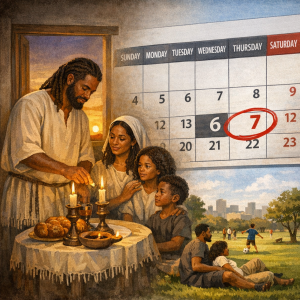
Saturday is the civil-calendar day that follows Friday and precedes Sunday. In ordinary modern English, it is commonly understood as one of the two weekend days. Its numerical position depends upon the convention being used: calendars that begin the week on Sunday commonly treat it as the seventh day, while the international Monday-first convention treats it as the sixth day.
The name is an English day-name of planetary and Roman derivation. It is not, by its ordinary dictionary meaning, a command to honor Saturn, an assertion that Saturn exists, or a religious observance. A word may retain an ancient historical component after speakers have ceased to use it religiously. Thus, a person may use the ordinary name of the day without adopting the religious ideas associated with its linguistic ancestry.
In Torah-centered and Jewish usage, the period commonly called Saturday overlaps with Shabbat, the seventh-day Sabbath. The two terms should not simply be treated as identical. “Saturday” is a civil and linguistic designation whose boundaries ordinarily run from midnight to midnight in local civil time. Shabbat is a sacred time in Jewish law and practice, traditionally beginning before sunset on Friday and ending after nightfall on Saturday. The distinction matters in religious observance, legal accommodation, and careful historical discussion.
Etymology and Origin
The English word developed from Old English forms such as sæterndæg and sæternesdæg. Those forms mean, in substance, “Saturn’s day” and reflect the Latin planetary day-name. Merriam-Webster identifies the word as deriving from Old English and ultimately from Latin Saturnus, the Roman name Saturn. Etymological sources likewise describe the Old English form as a partial translation or borrowing based on the Latin weekday name. Merriam-Webster, “Saturday”; Online Etymology Dictionary, “Saturday”.
The seven-day planetary week was widely transmitted through the Roman world. In Latin, each day could be described through a celestial body and its associated deity. The English name is notable because English substituted Germanic divine names for several Roman planetary names—compare Tuesday, Wednesday, Thursday, and Friday—yet retained the Saturn-based form for this day. The usual linguistic explanation is not that English people continued a distinct Saturn cult, but that no settled Germanic equivalent displaced the Roman name in Old English.
Other languages demonstrate that weekday naming is not a single universal theological system. Dutch zaterdag preserves a related Saturn-based form. By contrast, German Samstag, French samedi, Polish sobota, and Russian subbota reflect forms connected with “Sabbath.” Scandinavian terms such as Swedish lördag and Danish lørdag historically reflect “washing” or “bathing day.” These variations show that a calendar day can acquire different names through distinct cultural histories without becoming a different day in civil reckoning.
The word therefore has a documented Roman linguistic association, but its present English use is chiefly conventional. Etymology explains where a word came from; it does not automatically dictate its present legal, religious, or moral meaning.
Cultural and Historical Context
Roman and planetary context
Saturn was an important figure in Roman religion, traditionally associated with agriculture, sowing, abundance, and an imagined ancient age of prosperity. The Roman festival Saturnalia was celebrated in Saturn’s honor and became known for feasting, gift-giving, and temporary reversals of ordinary social customs. These facts help explain the cultural background of the name, but they do not establish that the modern weekly day carries Saturnalia’s practices or religious obligations.
It is useful to distinguish three separate historical matters:
- Roman religion: Saturn was a Roman deity and had religious associations in antiquity.
- Roman calendar language: a planetary-day naming system associated a weekday with Saturn.
- Modern English usage: the English word functions as an ordinary civil name for a day of the week.
Confusing these categories produces exaggerated claims. The historical origin of a name is real; the conclusion that every use of the name is an act of pagan worship is interpretive and is not established by ordinary linguistic evidence.
Jewish, Christian, and civil-calendar development
For Jewish communities, the seventh-day Sabbath is central to religious life and is not derived from Roman planetary naming. In English-speaking settings, Jewish people may say “Saturday” when referring to the civil date while also observing Shabbat according to Torah and halakhic practice. In this respect, the civil name and sacred observance coexist but are not interchangeable.
Many Christian communities came to give special prominence to Sunday as the Lord’s Day in remembrance of the resurrection of Jesus Christ. The Catholic Catechism, for example, describes Sunday as the Christian weekly celebration inherited through apostolic tradition and identifies it with the Lord’s Day rather than merely with the Jewish Sabbath. Catechism of the Catholic Church, “The Lord’s Day”. Other Christians, including Seventh-day Adventists and certain Sabbath-observing churches, maintain Saturday observance as the biblical seventh-day Sabbath. These are theological positions, not competing dictionary definitions of the English word.
In modern commercial culture, Saturday is frequently associated with markets, sporting events, recreation, travel, household activity, and weekend employment. That cultural pattern is neither ancient nor universal. Many occupations—including health care, transportation, emergency services, hospitality, retail, agriculture, manufacturing, and military operations—regularly function on Saturdays.
Biblical / Torah Context
The Torah does not use the English word “Saturday.” Its foundational term is Hebrew Shabbat (שַׁבָּת), generally associated with ceasing or resting. The Sabbath command appears in the Decalogue. Exodus connects the seventh-day rest with creation: God created in six days and rested on the seventh; therefore the day is set apart. Deuteronomy also connects Sabbath observance with Israel’s deliverance from bondage in Egypt. Sefaria, Exodus 20:8–11; Sefaria, Deuteronomy 5.
In this Torah context, Sabbath is more than personal relaxation. It establishes a rhythm of worship, rest, remembrance, family life, and relief from ordinary labor. The command extends rest beyond the household head to children, servants, resident strangers, and working animals. Its social dimension is therefore significant: rest is not reserved only for those with wealth or authority.
Traditional Jewish observance treats Shabbat as commencing before sundown on the sixth day and ending after nightfall on the seventh. Consequently, a work shift on Friday evening may create a Shabbat conflict even though it occurs before the civil date called Saturday. Conversely, the final portion of civil Saturday after Shabbat ends may not present the same religious issue. Courts, employers, schools, and institutions should avoid assuming that “Saturday off” precisely describes every Sabbath-observance need.
From a Torah-oriented interpretive perspective, the Saturn-derived English label may be viewed as a foreign civil designation imposed upon a day that Scripture identifies by its place in the creation week and by its covenantal significance. That is a coherent religious concern for some believers. It remains important, however, to distinguish that concern from the historical claim that the Torah’s Sabbath originated in Saturn worship. The Torah’s Sabbath command is presented within the biblical text on its own grounds—creation, covenant, holiness, and liberation—not as an adoption of Roman religion.
Legal Implications
The name of the day does not itself create legal status. At historical common law, there was no general rule that the linguistic term “Saturday” carried a special religious or commercial disability merely because of its Roman etymology. Legal effects arise from particular constitutions, statutes, regulations, contracts, court rules, collective-bargaining agreements, and institutional policies—not from word origin alone.
Common law, statutes, and Sunday laws
English and early American law did contain Sabbath- and Sunday-related restrictions, often called “blue laws” or Sunday closing laws. These were statutory enactments, sometimes informed by Christian Sabbath understandings; they should not be inaccurately described as a universal rule of common law. In McGowan v. Maryland (1961), the United States Supreme Court considered Maryland’s Sunday closing statutes and upheld them against the constitutional challenge before it, emphasizing the laws’ then-existing secular rest and welfare purposes. The Court’s constitutional analysis concerned Sunday laws, not a legal prohibition or special status attached to Saturday as such. McGowan v. Maryland, 366 U.S. 420 (1961); Constitution Annotated, “Sunday Closing Laws”.
Current U.S. employment law
Under Title VII of the Civil Rights Act of 1964, “religion” includes religious observance, practice, and belief. Covered employers generally must reasonably accommodate an employee’s sincerely held religious observance when it conflicts with work requirements unless the employer establishes undue hardship on the conduct of its business. This protection can apply to Jewish Shabbat observance, Saturday Sabbath observance by Christians, and comparable practices of other faiths. 42 U.S.C. § 2000e(j).
In Groff v. DeJoy (2023), the Supreme Court clarified that an employer cannot establish Title VII undue hardship merely by showing a de minimis cost. The burden must be substantial in the overall context of the employer’s business. The result does not guarantee every requested day off, and each case remains fact-specific; it does require a more serious inquiry than the earlier minimal-cost formulation. Groff v. DeJoy, U.S. Supreme Court opinion.
Common accommodations may include voluntary shift swaps, flexible scheduling, leave, reassignment, or changes in work schedules. The Equal Employment Opportunity Commission specifically uses the example of an employee seeking relief from Friday-night and Saturday work to observe the Jewish Sabbath. EEOC, “Section 12: Religious Discrimination”. This is general information, not legal advice; state and local law, union agreements, and the particular facts may provide additional rights or rules.
Government, court, and military scheduling
Saturday is not itself a federal legal public holiday in the United States. Federal law does provide that when a listed public holiday falls on a Saturday, the preceding Friday ordinarily becomes the legal public holiday for many federal employees. 5 U.S.C. § 6103. Federal procedural rules also commonly extend a filing deadline that expires on a Saturday, Sunday, or legal holiday to the next non-weekend, non-holiday day. Federal Rules of Civil Procedure.
Military organizations use standardized calendars and duty rosters, but Saturday has no universal military exemption. Service members may be scheduled for duty, training, watch, deployment, or operations on any day. Religious accommodation in military contexts is governed by separate statutes, regulations, readiness needs, and command considerations; civilian Title VII rules should not be assumed to apply identically to military service.
Spiritual Meaning
Spiritually, Saturday may signify different things depending upon the community and believer. For Jewish worshippers, Shabbat can represent sanctification of time, covenant faithfulness, delight, rest, creation, liberation, and trust that human worth is not measured solely by production. For Saturday-Sabbath Christians, it may represent obedience to the fourth commandment, remembrance of creation, and a weekly setting apart of time for God.
For others, the day has no spiritual significance beyond ordinary rest or recreation. The dictionary’s interpretive analysis is that a civil word can be used responsibly in ordinary communication while a person remains free to reject the theology, mythology, or spiritual symbolism historically connected with its etymology. A believer who chooses alternative language—such as “the seventh day” or “Sabbath”—may do so as a matter of conscience. That conscientious choice deserves accurate representation, but it should not be converted into a universal linguistic rule unsupported by law or history.
Modern Usage
Modern English uses “Saturday” in dates, schedules, transportation timetables, contracts, news reporting, court notices, retail advertising, and everyday speech. The standard abbreviation is “Sat.” In legal and business writing, precision may require specifying a calendar date, local time zone, and deadline time rather than relying solely on a weekday name.
Religious and practical usage often requires further clarification. “Saturday morning,” “Friday sundown through Saturday night,” “the Jewish Sabbath,” and “the seventh-day Sabbath” are not equivalent phrases. Where employment, school attendance, examinations, travel, or public events are involved, organizations should ask what hours of observance are actually implicated rather than assume that a request concerns only the civil midnight-to-midnight period.
Controversies / Criticisms
A recurring controversy concerns whether the Saturn-based name makes use of the term spiritually improper. The documented linguistic premise is sound: the English name has a Saturn-related historical origin. The stronger conclusion—that speaking or writing the ordinary word necessarily honors a Roman deity—is a disputed theological inference, not a conclusion compelled by lexicography, historical linguistics, or civil law.
A second confusion is the claim that the biblical Sabbath is simply “Saturday.” In contemporary civil practice, Saturday substantially overlaps with the Sabbath, but the Torah-based observance begins before the civil day begins and concludes before civil Saturday necessarily ends. The terms can be convenient practical approximations, but they are not exact synonyms.
A third criticism concerns the tendency to label all weekend custom or religious-day regulation as “common law.” Historically, religious-rest restrictions have often been enacted through statutes and local ordinances. Present-day legal questions usually turn on constitutional doctrine, civil-rights statutes, administrative regulations, and case law. Careful analysis should identify the actual source of law rather than use “common law” as a general label for all longstanding practice.
Conclusion
Saturday is the ordinary English civil name for the day between Friday and Sunday, with a documented route through Old English and Latin planetary nomenclature. Its association with Saturn explains its linguistic history, not an unavoidable modern religious commitment. In Torah and Jewish life, the day overlaps with Shabbat, whose meaning arises from biblical creation, liberation, covenant, and rest rather than from Roman naming conventions.
Legally, Saturday has significance when a statute, court rule, contract, schedule, or religious-accommodation claim makes it relevant. It is not inherently a federal holiday, a universal day of legal rest, or a category created by common law. Respectful and accurate usage requires keeping etymology, civil timekeeping, religious observance, and enforceable law distinct.
Sources / Further Reading
- Merriam-Webster, “Saturday”: https://www.merriam-webster.com/dictionary/Saturday
- Online Etymology Dictionary, “Saturday”: https://www.etymonline.com/word/Saturday
- Sefaria, Exodus 20:8–11: https://www.sefaria.org/Exodus.20.8-11
- Sefaria, Deuteronomy 5: https://www.sefaria.org/Deuteronomy.5.1-30
- U.S. Supreme Court, Groff v. DeJoy: https://www.supremecourt.gov/opinions/22pdf/22-174_k536.pdf
- U.S. Equal Employment Opportunity Commission, “Religious Discrimination”: https://www.eeoc.gov/laws/guidance/section-12-religious-discrimination
- Legal Information Institute, 42 U.S.C. § 2000e(j): https://www.law.cornell.edu/definitions/uscode.php
- Legal Information Institute, McGowan v. Maryland: https://www.law.cornell.edu/supremecourt/text/366/420
- Legal Information Institute, 5 U.S.C. § 6103: https://www.law.cornell.edu/uscode/text/5/6103