Ruach
Primary Definition
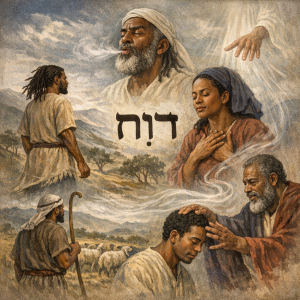
The Hebrew noun רוּחַ (ruaḥ, commonly transliterated ruach) has a broad but coherent range of meanings centered on invisible movement and animating power. Depending on context, it may mean wind, breath, spirit, disposition, courage, will, or the life-giving vitality of a person or creature. No single English word adequately covers every occurrence.
Its literal physical senses are wind and breath: moving air outside the body and moving air associated with life within the body. From those concrete senses arise figurative uses. A person may have a troubled, willing, steadfast, broken, or proud ruach; a people may possess a collective spirit; and God’s ruach may describe divine power, presence, communication, empowerment, or life-giving activity. Biblical Hebrew commonly uses the same word family where modern English divides “weather,” “respiration,” “mind,” “morale,” and “spirit” into separate categories.
The proper translation must therefore be determined by grammar, nearby words, literary setting, and the subject under discussion. In a weather account, ruach normally means “wind.” In a passage about physical life, it may mean “breath” or “life-force.” In a statement concerning character, resolve, emotion, prophecy, or divine action, “spirit” may be the most fitting English equivalent. Treating every instance as a reference to an immaterial being, or treating every instance as merely air in motion, flattens the word’s documented semantic range.
In Biblical Hebrew, ruach is ordinarily grammatically feminine, though masculine agreement appears in some passages. Its plural forms include ruchot, which may refer to winds, directions, spirits, or dispositions according to context. The classical Brown-Driver-Briggs lexicon summarizes its principal range as “breath, wind, spirit.”
Etymology and Origin
Ruach belongs to an ancient Northwest Semitic word family. Related forms occur in Aramaic and Syriac, while Arabic preserves related words such as rīḥ, “wind,” and rūḥ, “spirit” or “soul.” Ugaritic also contains a related term associated with wind. These cognates support the conclusion that the word’s primary field was ancient and widely shared among Semitic-speaking peoples: breath, moving air, odor, vitality, and spirit.
The word should not be reduced to a simplistic modern etymology such as “energy,” “vibration,” or “invisible force.” Such phrases may be devotional or interpretive descriptions, but they are not dictionary definitions. The documented lexical evidence begins with breath and wind, then extends naturally to spirit and inward disposition. The connection is intelligible: breath is a visible sign of life, wind is a real but unseen force, and a person’s inward resolve is likewise unseen but revealed by effects.
English pronunciation varies. The final consonant is the Hebrew letter ח (ḥet), a guttural sound not identical to English k or h. In ordinary English use, “roo-ahkh,” “roo-akh,” and “roo-ah” are heard. Academic transliteration often writes rûaḥ or ruaḥ to preserve the final consonant more accurately.
Cultural and Historical Context
In the ancient Near Eastern environment, wind was not an abstract meteorological category. It could nourish, cool, carry rain, drive ships, scatter seed, bring locusts, dry land, or destroy crops and buildings. Scripture accordingly speaks of east winds, sea winds, storm winds, and the “four winds” or four directions. The word’s physical sense is neither primitive nor incidental; it is a major part of its biblical use.
Breath also carried immediate significance in an age without modern medical vocabulary. A living person breathes; at death breath ceases. This made breath a natural image for life, frailty, and dependence upon God. A mere human utterance could be called “windy” or empty speech, while divine breath could be portrayed as powerful, creative, judging, or renewing. The same semantic movement appears in other languages, including Greek pneuma and Latin spiritus, both of which can refer to breath or spirit.
Over time, Hebrew usage developed rich idioms built on ruach. Expressions involving a “high spirit,” “low spirit,” “short spirit,” “broad spirit,” or “broken spirit” describe temperament, patience, humility, discouragement, magnanimity, or inward strength. These uses show that the word is not limited to theology. It can name human morale, emotional condition, intellectual inclination, or the prevailing character of a community.
Later Jewish literature and religious reflection gave increasingly developed attention to distinctions among nefesh, neshamah, and ruach. Those distinctions can be important in rabbinic, philosophical, mystical, and Hasidic teachings, but they should not be read back mechanically into every verse of the Torah. In the Hebrew Bible, the terms overlap at points and must be interpreted in their immediate literary settings rather than assigned rigid, universal definitions.
Biblical / Torah Context
Wind and Creation
Genesis 1:2 contains one of the best-known uses: ruach Elohim, literally “spirit/wind of God,” moving or hovering over the waters. Many English Bibles translate the expression “the Spirit of God.” Other Jewish and academic interpreters argue that the grammar can support “a wind from God” or “a mighty divine wind.” The difference is significant because the first rendering readily supports later theological readings about God’s Spirit, while the second emphasizes wind within the creation scene.
The lexical ambiguity is real, not a defect in the text. Hebrew permits a deliberate resonance between wind and divine activity. A careful reader should acknowledge both the longstanding traditional translation “Spirit of God” and the scholarly alternative “divine wind,” rather than insist that the verse settles every later doctrinal question by itself.
Life, Breath, and Mortality
The Torah uses ruach in expressions concerning the breath or spirit of life. Genesis 6:17 and 7:15 speak of creatures possessing the “breath/spirit of life.” This usage includes animals and therefore cautions against automatically equating ruach with a later philosophical concept of an exclusively human, immortal soul. The immediate point is living animation: creatures live by a life-principle dependent upon God.
Other passages associate the withdrawal of breath or spirit with death and its return with renewed life. Psalm 104:29–30 describes creatures dying when God takes away their breath and being created or renewed when God sends forth His spirit. The poetry joins biological dependence, creation, and divine providence without presenting a modern scientific account of respiration.
Human Character and Moral Disposition
In biblical usage, ruach can describe the inward orientation of a person. A “broken spirit” conveys contrition or crushed inward strength; a “steadfast spirit” conveys constancy; a “willing spirit” conveys readiness; a “haughty spirit” conveys pride. Proverbs 16:18 memorably links pride of spirit with downfall. Psalm 51 asks for a clean heart and a steadfast spirit, illustrating the close relation—but not strict identity—between lev (heart) and ruach (spirit).
This use is important for legal and moral interpretation. Biblical language frequently addresses outward conduct and inward disposition together. Yet the word itself does not create an independent legal test for judging hidden motives. It is a descriptive and theological term whose legal relevance, where any exists, depends upon the particular commandment, narrative, or judicial text.
Divine Empowerment and Prophecy
The “Spirit of YHWH” or “Spirit of God” is associated with divine empowerment in several biblical narratives. Judges such as Othniel, Gideon, Jephthah, and Samson are described as acted upon or empowered by the Spirit of YHWH. Saul and David likewise appear in narratives involving the divine spirit, kingship, prophecy, and authority. These passages portray divine enablement for particular purposes; they should not be assumed to describe one identical experience in every case.
Isaiah 11:2 speaks of the spirit of YHWH resting upon the anticipated Davidic ruler, characterized by wisdom, understanding, counsel, might, knowledge, and reverence for YHWH. Ezekiel 36:26–27 promises a new heart and new spirit, followed by God’s Spirit enabling obedience. Ezekiel 37 uses deliberate wordplay: the same ruach can be translated breath, wind, and spirit as dry bones receive life. The literary force depends precisely on the word’s multiple meanings.
Ruach HaKodesh
Ruach ha-kodesh means “holy spirit” or, more literally, “spirit of holiness.” The exact phrase occurs in passages such as Psalm 51:11 and Isaiah 63:10–11. In later Jewish usage, it commonly refers to divine inspiration, prophetic communication, or the holy influence of God. It should not automatically be treated as a direct equivalent of every later Christian doctrinal formulation, even though Christianity drew heavily upon the Hebrew Scriptures and their Greek translations when developing its language about the Holy Spirit.
Legal Implications
Ruach is not a technical term of English common law. It does not identify a court, legal person, jurisdiction, sovereign authority, contract doctrine, property right, or rule of evidence. Assertions that the Hebrew word itself establishes a special legal status, defeats civil jurisdiction, or creates a private exemption from statutes have no basis in the ordinary historical meaning of the word.
Historical common law developed in medieval England through royal courts, judicial decisions, custom, and later legislation. Roman law, equity, canon law, Jewish law, and modern statutory law are distinct legal traditions, although they have sometimes influenced one another. A Hebrew biblical term may be relevant to religious interpretation, the history of law, or the meaning of a text cited in litigation, but it does not become a rule of American or English common law merely because it appears in Scripture.
Within Jewish legal tradition, questions involving intention, repentance, prophecy, vows, testimony, ritual fitness, and moral character may involve concepts translated as heart, mind, soul, or spirit. Nevertheless, halakhic conclusions are ordinarily drawn from the Torah, rabbinic interpretation, precedent, and accepted legal methods; they cannot responsibly be derived from an isolated lexical claim about ruach.
In contemporary civil law, the word may appear incidentally in religious names, translations, charitable organizations, literary works, expert testimony, or disputes involving religious expression. Its legal significance would then arise from the governing constitution, statute, contract, organizational document, or case law—not from an independent legal force carried by the word itself.
Spiritual Meaning
Spiritually, ruach expresses a powerful biblical insight: life is received, sustained, and renewed rather than self-created. Breath is intimate and continual; wind is free, mobile, and beyond human control. Together, those images make ruach an apt word for God’s life-giving action and for the inward reality of human beings.
Jewish interpretation often emphasizes the holiness of embodied life rather than treating the body as a disposable prison for a superior spirit. Breath, body, moral action, and divine service belong together. A person’s ruach can be humbled, strengthened, embittered, or made willing, which makes spiritual life inseparable from character and conduct.
Christian readers often connect Hebrew ruach with Greek pneuma in the Septuagint and New Testament. This connection is historically important, but the terms belong to different languages and literary settings. Responsible interpretation recognizes continuity in the breath-wind-spirit imagery while allowing Jewish and Christian traditions to articulate their own theological conclusions.
Modern Usage
In Modern Hebrew, ruach remains an ordinary word for wind and a common word for spirit, mood, morale, and atmosphere. It appears in expressions concerning patience, humility, mood, public spirit, creativity, and group morale. The Academy of the Hebrew Language records ruach as a Hebrew equivalent used for “morale” in administrative and psychological terminology.
The word also appears in government and military language. Ruach Tzahal, usually rendered “The Spirit of the Israel Defense Forces,” is the IDF’s stated ethical code and framework of values. Here the term means institutional ethos or moral character, not a supernatural entity. This modern usage illustrates the continuing range from individual disposition to collective identity.
In English-speaking religious communities, “Ruach” is frequently used as a personal name, organizational name, title for worship music, or shorthand for the Holy Spirit. Such uses may be meaningful within a faith community, but they do not eliminate the word’s ordinary Hebrew meanings of wind and breath. Context remains controlling.
Controversies / Criticisms
The chief controversy concerns over-translation. Some readers insist that ruach always means “spirit,” while others insist that it always means “wind,” “breath,” or an impersonal force. Both positions disregard the lexical evidence. The word has several related senses, and biblical authors sometimes appear to use that very flexibility for poetic and theological effect.
Genesis 1:2 is a principal example. “Spirit of God,” “wind from God,” and “divine wind” represent different translation decisions with theological implications. The existence of alternatives does not mean that all translations are equally likely in every context; it means the Hebrew phrase must be evaluated with grammar, ancient usage, reception history, and the wider literary setting in view.
A second problem is anachronism. Later mystical systems may distinguish nefesh, ruach, and neshamah in detailed spiritual hierarchies. Those systems can be legitimate subjects of religious study, but they should be identified as later interpretive traditions rather than presented as the only meaning of every biblical occurrence.
Finally, modern popular teaching sometimes uses “Hebrew word studies” to claim hidden meanings unavailable through ordinary translation, or to attach political and legal conclusions to sacred vocabulary. A sound dictionary approach does the opposite: it honors the word’s depth while distinguishing documented linguistic fact from theological reflection and personal application.
Conclusion
Ruach is a foundational Hebrew word joining the natural and the inward: wind in the world, breath in the creature, spirit in the person, and divine activity in Scripture. Its meanings are related but not interchangeable. The best translation is always contextual.
For biblical and spiritual study, the word invites attention to life, dependence, moral disposition, divine power, and renewal. For legal study, it has historical and religious importance but no independent status as a technical rule of common law. Careful use requires resisting both reductionism and exaggerated claims, allowing the Hebrew text, its grammar, and its literary setting to guide interpretation.
Sources / Further Reading
- Sefaria Library: Brown-Driver-Briggs, רוּחַ
- Sefaria Library: Ernest Klein Dictionary, רוּחַ
- Sefaria Library: Genesis 1:2 with Traditional Commentaries
- TheTorah.com: “The Genesis of Creation”
- My Jewish Learning: “Body and Soul”
- Academy of the Hebrew Language: רוּחַ in Modern Hebrew Terminology
- Israel Defense Forces: “The Spirit of the IDF”