Fasting
Primary Definition
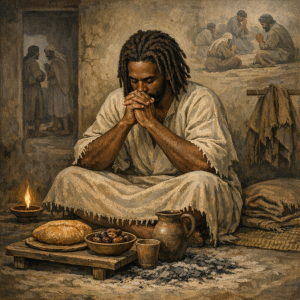
Fasting is the deliberate abstention, for a defined period, from food, from food and drink, or from specified foods or bodily comforts. The word may describe both the act of refraining and the period during which one refrains: a person fasts; a community observes a fast; a fast may last from part of a day to many days.
In its ordinary English sense, fasting principally concerns eating. Its exact practice, however, depends upon the governing context. A “water fast” ordinarily excludes food but permits water. A religious fast may restrict food, drink, sexual activity, entertainment, work, luxury, or other ordinary pleasures. A medical fast may require no food for a specified interval before testing or surgery, while permitting or prohibiting water and medicines under clinical instructions. Thus, the word identifies a disciplined withholding, but does not itself settle what is withheld, for how long, or for what purpose.
Fasting differs from involuntary hunger, famine, food insecurity, and starvation. Those conditions involve deprivation imposed by circumstance or coercion; fasting, in its central meaning, involves intentional restraint. It also differs from simple dieting. Dieting generally regulates what or how much one eats for nutrition, weight, health, economics, or preference. Fasting may have health-related uses, but historically it has also served as a religious observance, a form of penitence, a response to grief or danger, a preparation for prayer, and a public expression of communal humility.
The dictionary’s interpretive analysis is that fasting is best understood not merely as “not eating,” but as a temporary, purposeful act of self-restraint. The purpose matters: a fast undertaken for prayer, repentance, solidarity, medical preparation, political witness, or metabolic scheduling may involve similar outward conduct while carrying substantially different moral, legal, and spiritual meanings.
Etymology and Origin
The English verb fast, meaning to abstain from food, comes through Middle English from Old English fæstan, meaning to fast or go without eating. It belongs to a Germanic family of related words, including German fasten and Dutch vasten. Historical etymology also connects the word with an older sense of holding firmly, observing, or keeping steadfastly. That background helps explain why fasting has long been associated with disciplined observance rather than accidental lack of food. ([ahdictionary.com](https://ahdictionary.com/word/search.html?q=fasted&utm_source=openai))
English contains several words spelled fast. The religious verb is historically related to ideas of firmness and observance, but it should not be confused in practical definition with fast meaning rapid, nor with every use of fast meaning fixed or secure, as in “hold fast.” The shared spelling has produced many popular wordplays, but fasting does not mean that food is “fastened,” nor does it inherently mean moving quickly.
The noun fast developed naturally from the verb: it denotes an instance or season of fasting. Expressions such as “break the fast” and “breakfast” preserve the older and ordinary idea that the first meal after sleep ends the nightly interval without food. In modern speech, “fasting” often functions as a general label for a practice, while “a fast” usually denotes a particular observance or period.
Cultural and Historical Context
Fasting is found across many cultures and religious traditions. It has commonly been used to mark grief, mourning, impending danger, seasonal devotion, initiation, purification, repentance, and collective appeal to divine mercy. Because eating is both necessary and socially meaningful, voluntarily setting food aside can make an otherwise inward intention visible. A communal fast may also create a shared experience of dependence, discipline, and mutual obligation.
In Jewish life, fasts have been connected with repentance, mourning, remembrance, and sacred calendar observances. In Christianity, fasting became closely associated with penitence, prayer, almsgiving, Lent, and preparation for holy days. In Islam, fasting in Ramadan is a central religious observance, joining bodily restraint with prayer, charity, moral discipline, and communal life. Other religious and philosophical traditions have also developed forms of food restraint, though their rules, theology, and purposes differ. It is therefore inaccurate to assign fasting exclusively to any one religion, civilization, or later ecclesiastical system.
Historically, public fasts were sometimes proclaimed in English-speaking communities during war, disease, drought, political uncertainty, or perceived national crisis. In the American colonial and revolutionary periods, civil authorities and assemblies issued calls for days of humiliation, fasting, and prayer. The Continental Congress, for example, designated May 17, 1776, as a day of “Humiliation, Fasting and Prayer,” and later recommended a general fast during the Revolutionary War. ([loc.gov](https://www.loc.gov/exhibits/religion/rel04.html?utm_source=openai))
Such proclamations should be described carefully. They show a historical practice in which civil authorities publicly called people to religious observance; they do not establish that fasting itself became a permanent rule of American common law. During the Civil War, President Abraham Lincoln proclaimed a national day of humiliation, fasting, and prayer for April 30, 1863, and Massachusetts separately publicized the observance. The historical record demonstrates the governmental use of proclamations and recommendations in a religious culture; it does not create a general modern legal duty to fast. ([loc.gov](https://www.loc.gov/resource/lprbscsm.scsm0265/?st=text&utm_source=openai))
Biblical / Torah Context
In the Hebrew Bible, fasting appears in contexts of grief, danger, repentance, mourning, petition, and communal return to God. The Torah’s most prominent annual context is the Day of Atonement, Yom Kippur. Leviticus 16:29 directs Israel to “practice self-denial” or “afflict” themselves on the tenth day of the seventh month while doing no work. Leviticus 23 contains related directions. The Hebrew wording is broader than a bare dietary instruction; later Jewish interpretation understands fasting as a principal form of the commanded self-denial. ([sefaria.org](https://www.sefaria.org/Leviticus.16?utm_source=openai))
This distinction is important. The Torah text does not reduce Yom Kippur to a private wellness practice or a mere ritual of going hungry. It places self-denial within a solemn day involving rest, atonement, priestly service, cleansing, and the covenantal life of the people. In that setting, fasting is related to humility before God and serious moral reflection, not a method of earning salvation by physical suffering.
The prophetic writings also place limits on outward fasting. Isaiah 58 criticizes fasting that leaves oppression, injustice, quarrelling, and indifference untouched. The chapter presents a fast acceptable to God as one joined to loosening injustice, feeding the hungry, sheltering the vulnerable, and refusing exploitation. The interpretive lesson is plain: bodily abstinence cannot substitute for righteousness, mercy, and repair of one’s conduct. A fast that enlarges pride, controls others, or excuses wrongdoing contradicts the ethical purpose attributed to it in the prophetic tradition.
Other biblical accounts portray individuals and communities fasting in response to grave circumstances. Moses is associated with forty days on Sinai; David fasts in grief and prayer; Esther calls for a communal fast before approaching the king; and Ezra, Nehemiah, Joel, and Jonah connect fasting with confession, lamentation, danger, or collective repentance. These examples are descriptive and contextual. They do not automatically make every biblical fast a universal command, nor do they establish one uniform duration or method for all persons in all times.
Within the New Testament, Jesus is portrayed as fasting in the wilderness, and he teaches that fasting should not be performed for public display or personal praise. Early Christian practice continued fasting, while Christian traditions developed different calendars and rules. In the Roman Catholic Church, current canon law distinguishes fasting from abstinence, identifies Fridays and Lent as penitential times, and provides that fasting and abstinence are observed on Ash Wednesday and Good Friday, subject to the Church’s stated rules and local application. This is canon law for the Church’s faithful, not civil common law and not a rule binding all persons. ([vatican.va](https://www.vatican.va/archive/cod-iuris-canonici/eng/documents/cic_lib4-cann1244-1253_en.html?utm_source=openai))
Legal Implications
Common Law, Statutes, and Religious Rules
Fasting is not, in itself, a technical doctrine of the English or American common law. Traditional common law developed through judicial decisions and legal custom concerning matters such as property, contracts, crimes, torts, and procedure. Historical proclamations for public fasts were governmental acts or political-religious observances; they should not be confused with judge-made common law rules. Likewise, religious requirements concerning fasting arise from the laws, scriptures, traditions, or internal governance of particular faith communities, rather than from common law merely because they are old.
Roman law, equity, and modern statutory law must also be kept distinct. There is no general principle of Roman law or equity that makes fasting a universal legal obligation. Modern civil law may become relevant when fasting intersects with religious accommodation, employment conditions, medical care, prison administration, education, contracts, or public health. The legal question in such cases is ordinarily not whether fasting is spiritually valid, but what rights, duties, safety interests, or accommodations apply under a particular constitution, statute, regulation, or case.
United States Law
In the United States, no general federal statute commands citizens to fast. Federal holiday law lists legal public holidays, but it does not establish a national fasting day. Public calls to prayer or fasting, when made historically, are different from creating a generally enforceable obligation. The distinction matters because an official proclamation, a religious exhortation, a church rule, and a binding civil statute are different kinds of authority. ([uscode.house.gov](https://uscode.house.gov/view.xhtml?req=%28title%3A5+section%3A6103+edition%3Aprelim&utm_source=openai))
Religious fasting can be legally relevant in employment. Title VII of the Civil Rights Act of 1964 generally requires covered employers to reasonably accommodate an employee’s sincere religious observance or practice unless doing so would impose an undue hardship on the conduct of the employer’s business. In Groff v. DeJoy (June 29, 2023), the United States Supreme Court explained that an employer denying a religious accommodation must show a burden involving substantial increased costs in relation to its particular business; mere coworker dislike of a religious practice cannot itself establish undue hardship. The result remains fact-specific and does not mean every requested fasting-related schedule, meal, break, uniform, or leave arrangement must be granted in every workplace. ([law.cornell.edu](https://www.law.cornell.edu/supremecourt/text/22-174?utm_source=openai))
In institutional settings, a fast may raise additional questions. A prisoner’s religious diet, a student’s schedule, a patient’s informed consent, or a service member’s observance may require an institution to consider reasonable accommodation alongside genuine operational and safety needs. No special “military origin” of fasting is established by these modern issues; military relevance arises only where religious practice intersects with service requirements, readiness, health, or discipline.
Spiritual Meaning
Spiritually understood, fasting is often a voluntary emptying of ordinary appetite in order to give greater attention to God, conscience, prayer, repentance, gratitude, or service. It can remind the person fasting that life, strength, food, and time are received rather than self-created. The physical sensation of hunger may become a recurring prompt to pray, to remember the poor, or to examine one’s desires.
Fasting is not inherently holy merely because it is difficult. Its meaning depends on truthfulness, humility, mercy, and the direction of the heart. A person may fast while acting unjustly, seeking praise, manipulating another person, or damaging his or her health. For that reason, many religious teachers connect fasting with prayer, charity, reconciliation, and care for neighbors. The discipline is meant to order desire, not to glorify deprivation.
Some spiritual communities also speak of fasting from speech, anger, media, luxury, entertainment, or other habits that distract from prayer and moral responsibility. This is an extended or analogical use of the term. It may be spiritually useful, but it should not erase the word’s primary historical meaning of abstaining from food, whether fully or in part.
Modern Usage
Modern usage includes religious, medical, athletic, and commercial contexts. “Intermittent fasting” commonly refers to eating patterns that alternate periods of eating with periods of reduced or no caloric intake. “Time-restricted eating” generally refers to confining meals to a daily time window. “Fasting blood work” may require a person to avoid food before a laboratory test. “Preoperative fasting” concerns instructions before anesthesia or surgery. These uses are practical and should not be casually treated as equivalent to a religious fast.
Health claims require caution. Federal health sources note that intermittent and periodic fasting are being studied, but they also state that firm conclusions about many claimed health effects have not been reached. Fasting may cause weakness, headache, fainting, or dehydration, and “detox” marketing often overstates evidence. Persons who are pregnant or breastfeeding, underweight, diabetic, taking medicines affected by meals, living with an eating disorder, managing chronic illness, or preparing for a procedure should seek individualized advice from a qualified clinician rather than rely on generalized fasting claims. ([nccih.nih.gov](https://www.nccih.nih.gov/health/detoxes-cleanses?utm_source=openai))
Controversies / Criticisms
Fasting is sometimes criticized when it becomes performative, coercive, medically unsafe, or disconnected from ethical conduct. The criticism is strongest where authorities pressure vulnerable people to fast, where religious discipline is used to shame others, or where a person’s physical condition makes abstention dangerous. A voluntary practice of self-restraint becomes morally different when consent is absent or when it is imposed without reasonable regard for health.
Commercial fasting culture has also drawn criticism. Some programs present fasting as a universal cure, a guaranteed means of “detoxification,” or a shortcut to moral superiority and bodily perfection. Those claims exceed the evidence and may encourage unsafe behavior. In addition, broad fasting advice can be harmful to people with eating disorders or a history of disordered eating. Responsible discussion should avoid treating hunger as proof of virtue or presenting prolonged abstinence as appropriate for everyone.
There are also religious disputes concerning which fasts are obligatory, who is exempt, whether water or medication breaks a fast, how days are counted, and whether fasting should be public or private. Such questions are ordinarily resolved within the relevant religious community. A general dictionary definition should identify those disagreements without pretending that one tradition’s detailed rule is the universal meaning of the word.
Conclusion
Fasting is the intentional practice of abstaining from food, or from defined forms of nourishment and comfort, for a limited time and a stated or understood purpose. Its English roots emphasize disciplined observance; its historical uses range from personal devotion to communal mourning and public calls for humility. In Torah and biblical contexts, fasting is closely connected with self-denial, repentance, prayer, justice, and dependence upon God. In modern civil law, it is not a general common-law duty, though it may implicate religious-accommodation and health-related questions.
Properly understood, fasting is neither automatically virtuous nor inherently harmful. Its sound meaning depends upon voluntary choice, truthful purpose, ethical conduct, and appropriate care for human health. The outward act of abstaining gains its deepest significance not from deprivation alone, but from the repentance, prayer, justice, charity, discipline, or lawful purpose to which it is joined.
Sources / Further Reading
- Merriam-Webster Dictionary, “Fast”: https://www.merriam-webster.com/dictionary/fast
- American Heritage Dictionary, “Fast”: https://ahdictionary.com/word/search.html?q=fasted
- Sefaria Library, Leviticus 16:29–30: https://www.sefaria.org/Leviticus.16.29-30
- Library of Congress, “Religion and the Congress of the Confederation”: https://www.loc.gov/exhibits/religion/rel04.html
- Library of Congress, 1863 Proclamation for a Day of National Humiliation, Fasting and Prayer: https://www.loc.gov/item/scsm000265/
- United States Supreme Court, Groff v. DeJoy, June 29, 2023: https://www.law.cornell.edu/supremecourt/text/22-174
- Code of Canon Law, Cann. 1244–1253, Vatican: https://www.vatican.va/archive/cod-iuris-canonici/eng/documents/cic_lib4-cann1244-1253_en.html
- National Center for Complementary and Integrative Health, “Detoxes and Cleanses”: https://www.nccih.nih.gov/health/detoxes-cleanses
- National Institute on Aging, “Calorie Restriction and Fasting Diets: What Do We Know?”: https://www.nia.nih.gov/news/calorie-restriction-and-fasting-diets-what-do-we-know