Word Bandit
Primary Definition
Word bandit is not an established term of art in the historic common law, in modern statutory law, the Bible, or standard general dictionaries. It is best understood as a transparent English compound: a contextual expression made by joining word with bandit. Its meaning therefore depends materially on the speaker, setting, and intended object.
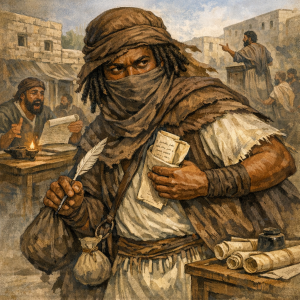
In ordinary figurative use, the expression may describe a person who appears to “take,” manipulate, appropriate, withhold, distort, or deploy words for an advantage. Depending on context, it can be playful, admiring, critical, or accusatory. A speaker may call a quick-witted writer, lyricist, debater, copywriter, comedian, or rhetorical strategist a word bandit in a humorous sense: someone who “steals the show” through language, takes a memorable phrase, or makes off with attention by verbal skill. In a more critical sense, it may refer to a person accused of taking another person’s words, ideas, expression, quotations, authorship, or credit without permission or fair acknowledgment.
The expression should not, however, be treated as automatically alleging a literal crime. In law, theft, fraud, plagiarism, copyright infringement, defamation, trademark infringement, and breach of confidence are separate concepts with different elements and remedies. Calling someone a word bandit is ordinarily figurative rhetoric unless the surrounding words identify specific wrongful conduct and satisfy the legal requirements of a recognized claim.
As an interpretive dictionary entry, the phrase may be summarized as follows:
- Literal-compositional sense: a supposed taker or raider of words, language, phrases, or verbal credit.
- Figurative positive sense: a person who uses words with daring, speed, originality, charm, or persuasive force.
- Figurative negative sense: a person believed to appropriate, twist, suppress, imitate, or exploit the language of another.
- Commercial/proper-name sense: a name used for particular goods or entertainment products, rather than a universal dictionary definition.
Etymology and Origin
The first element, word, comes through Old English word, meaning speech, utterance, statement, news, or a verbal expression. It has long carried both a narrow sense—an individual unit of language—and a broader moral and social sense, as in one’s word, keeping one’s word, or giving one’s word.
The second element, bandit, entered English in the late sixteenth century from Italian bandito, “an outlaw.” The Italian term was associated with bandire, meaning to proclaim, proscribe, or banish. The deeper history is significant: the word did not begin merely with private stealing. It referred to one who had been publicly proclaimed outside lawful protection or otherwise outlawed. Etymological sources connect the development with the Germanic root behind ban, involving public proclamation, command, prohibition, and exclusion. Thus, a bandit historically was a person placed outside the peace or order proclaimed by authority, and only later did the word settle into its familiar English sense of robber, brigand, or lawless marauder. ([etymonline.com](https://www.etymonline.com/word/bandit?utm_source=openai))
The compound itself does not appear to have a single documented historical point of origin comparable to a long-standing legal maxim or biblical phrase. English readily forms temporary and imaginative compounds: bank bandit, burglar bandit, one-armed bandit, time bandit, and similar expressions. In that productive pattern, bandit supplies an image of taking, raiding, evading, or operating outside accepted bounds, while the first word identifies what is allegedly taken or controlled.
Accordingly, it would be inaccurate to claim that the expression has a known Roman, Greek, pagan, military, ecclesiastical, common-law, or governmental etymology. The documented origin belongs to the component word bandit; the combined expression is principally modern, contextual English.
Cultural and Historical Context
Bandits occupy an enduring place in history, folklore, journalism, and popular entertainment. The image ranges from the violent highway robber to the romanticized outlaw who resists corrupt authority. Such portrayals often blur essential distinctions. A person may be called an outlaw by a ruling power, but that label alone does not establish whether the person acted unjustly, whether the law itself was legitimate, or whether the accusation was proven. Conversely, popular admiration for a supposed rebel does not erase violence, coercion, theft, or injury.
This tension matters when bandit is carried into the realm of language. A “word bandit” can evoke someone who defies conventional speech, takes verbal risks, exposes deception, or refuses to submit to empty official language. Yet the same phrase can suggest a person who uses language opportunistically: someone who raids another’s work, strips statements of context, captures public attention with misleading slogans, or takes credit for the labor of others.
The image is especially useful in a culture where words are economically and politically valuable. Names, slogans, lyrics, headlines, quotations, speeches, articles, software text, campaign messages, and online posts can generate money, reputation, votes, influence, and social standing. As a result, disputes over “who said it first,” “who owns the phrase,” “who was quoted accurately,” and “who received credit” are not trivial merely because they concern language. Nevertheless, the moral wrong and the legal wrong may differ. A person can behave discourteously or dishonestly without committing an actionable offense; conversely, a legally actionable use may occur even where the user believes the borrowing was harmless.
The phrase also bears a playful cultural dimension. The official rules for a board game titled The Cheeky Word Bandit describe a game mechanism in which the “Word Bandit” appears in place of a letter and leaves a team with fewer letters from which to make words. There the name is not a charge of wrongdoing; it personifies a mischievous obstacle that “steals” possible word choices from players. ([drumondpark.com](https://www.drumondpark.com/rules/wordbandit.pdf?utm_source=openai))
Biblical / Torah Context
The exact English compound is not a recognized biblical or Torah term. Neither should a modern English phrase be projected backward as if it were a technical Hebrew, Aramaic, or Greek expression. Biblical translations sometimes use bandit where other translations use robber, thief, or raider; those English choices translate particular ancient-language terms in particular passages.
For example, some modern translations of John 10:1 say that the person entering the sheepfold by another way is “a thief and a bandit,” while others render the second term as “robber.” The point of the passage is not a linguistic theory about words. It uses the image of unauthorized entry and predation to contrast illegitimate conduct with rightful care and access. ([biblegateway.com](https://www.biblegateway.com/verse/en/John%2010%3A1?utm_source=openai))
Likewise, Proverbs 23:28 is rendered in some translations as describing one who lies in wait “like a robber” or “like a bandit.” Translation notes identify genuine lexical uncertainty in the rare Hebrew noun involved: it may be understood in an active sense as a robber or bandit, or in a passive sense related to prey or something seized. That uncertainty cautions against building expansive doctrine upon an English translation choice alone. ([biblegateway.com](https://www.biblegateway.com/passage/?search=Prov.23.28&version=NET&utm_source=openai))
The Torah and the wider Hebrew Bible repeatedly condemn false witness, deceit, theft, dishonest weights, oppression, and unjust gain. Those principles may provide a moral framework for evaluating wrongful appropriation of another’s speech or authorship, but they do not create a biblical definition of the present expression. The most responsible application is analogical: words should not be used to deceive, bear false witness, exploit another’s labor, or conceal injustice.
Legal Implications
Historic Common Law
Historic common law did not recognize “word bandit” as a named cause of action, status, office, crime, or jurisdictional classification. Common law dealt with concrete wrongs such as larceny, fraud, libel and slander, passing off, breach of confidence, and interference with contractual or property rights. The label itself does not establish any of those wrongs.
At common law, larceny traditionally concerned the wrongful taking and carrying away of another’s personal property with the required criminal intent. Spoken or written language is not automatically “stolen” in that technical sense merely because another person repeats it, quotes it, remembers it, or uses a similar idea. Modern intellectual-property law, contract law, privacy law, and defamation law address certain word-related disputes more directly, but each depends on its own facts.
Modern Civil and Criminal Law
Several legally distinct situations may be loosely described in everyday speech as “stealing words”:
- Copyright infringement: may arise from unauthorized copying of protected original expression fixed in a tangible medium. Copyright generally does not protect facts, ideas, systems, methods, titles, short phrases, or ordinary words as such.
- Plagiarism: is commonly an ethical, academic, professional, or reputational wrong involving uncredited use of another’s work. It is not automatically a crime and is not identical to copyright infringement.
- Defamation: may arise where false statements of fact harm a person’s reputation. Whether calling someone a “word bandit” is actionable depends heavily on context, audience, implication, provable factual content, and applicable constitutional and state-law standards.
- Fraud or false advertising: may arise when words are used knowingly and materially to induce reliance, transactions, or consumer confusion.
- Breach of confidence or contract: may arise where confidential text, unpublished work, trade secrets, or agreed-upon attribution obligations are improperly used.
- Trademark or unfair competition: may arise when language is used as a source identifier in commerce and the use is likely to confuse consumers about the origin, sponsorship, or affiliation of goods or services.
Trademark law is particularly relevant because the expression has been used as a registered mark in connection with a board game. The registration record reported for “WORD BANDIT” identifies games and playthings, specifically a board game involving a mechanical device that generates and displays letter combinations. Registration does not convert the two ordinary English words into property in every context. Trademark rights are tied to use as a mark, particular goods or services, territorial and procedural considerations, and the likelihood of consumer confusion. ([trademarks.justia.com](https://trademarks.justia.com/878/20/word-87820759.html?utm_source=openai))
Under United States trademark law, use of a reproduction or colorable imitation of a registered mark can create civil liability when used in commerce in connection with relevant goods or services in a way likely to cause confusion, mistake, or deception. The governing question is not whether another person has merely uttered or written the same words. It is whether the challenged commercial use functions in a confusing source-identifying manner. ([law.cornell.edu](https://www.law.cornell.edu/uscode/text/15/1114?utm_source=openai))
No special rule of Roman law, equity, military law, admiralty law, or constitutional law attaches to the expression merely because it contains the word bandit. Equitable remedies, such as injunctions, may be available in actual intellectual-property, contract, or unfair-competition disputes, but equity does not create an independent “word bandit” claim.
Spiritual Meaning
Spiritually understood, the expression can serve as a cautionary metaphor about stewardship of speech. Words can bless, warn, teach, reconcile, testify, comfort, accuse, deceive, and divide. A person becomes “bandit-like” in speech—not by a mystical status but by conduct—when language is used to take what is not rightfully theirs: another person’s reputation, peace, authorship, dignity, consent, or opportunity to be heard.
The constructive opposite is not silence. It is truthful and responsible speech: giving credit where credit is due; distinguishing quotation from paraphrase; admitting uncertainty; refusing to twist another’s statement; correcting error; and speaking with courage without pretending ownership of another person’s work or voice. In this interpretive sense, the phrase may warn against verbal exploitation while also affirming that language can be used boldly for truth and justice.
Modern Usage
Modern use is likely to remain unstable because the phrase has no single controlling dictionary meaning. Readers should ask what the speaker means in the immediate setting. In a writing workshop, it may praise a person who finds irresistible phrasing. In a political discussion, it may criticize slogan-making, selective quotation, or rhetorical manipulation. In a publishing dispute, it may be an imprecise accusation of plagiarism or copyright violation. In a game context, it may be a fictional character or branded product name.
Careful writers should avoid using the phrase as a substitute for facts. If the allegation is that a person copied protected text, say what text was copied, who created it, when it was published, what permission was or was not given, and how the copying occurred. If the concern is false attribution, identify the statement and the evidence. If the issue is ordinary imitation, inspiration, parody, quotation, or criticism, those distinctions should be stated plainly rather than concealed beneath an emotionally forceful label.
Controversies / Criticisms
The principal difficulty with the expression is vagueness. “Bandit” is morally charged, and attaching it to words may imply dishonesty, theft, or illegality without identifying a specific act. Used carelessly, it can turn an ordinary disagreement about interpretation, influence, borrowing, or style into a personal accusation.
Another difficulty is the tendency to confuse ideas with expression. People frequently believe they “own” every phrase, concept, argument, or verbal resemblance associated with them. The law recognizes narrower interests. A person may own copyright in qualifying original expression, may possess contractual or confidential rights in particular materials, or may hold trademark rights in a commercial source identifier; none of this ordinarily gives ownership of language in the abstract.
There is also a legitimate criticism of romanticizing bandit imagery. The historical bandit was not merely a clever rebel; banditry could involve ambush, coercion, violence, and dispossession. In harmless games and creative writing, the metaphor may be innocuous. In accusations directed toward real persons, it should be used with proportion, evidence, and awareness of its potentially defamatory force.
Conclusion
The expression is a modern, flexible compound rather than a settled term of common law or scripture. Its power comes from the history and imagery of bandit: public outlawry, unlawful taking, evasion of accepted boundaries, and—at times—romanticized rebellion. Applied to speech, writing, and ideas, it can describe either verbal ingenuity or verbal appropriation.
Its sound legal and moral use requires precision. The phrase alone proves nothing. Where a real dispute exists, the underlying conduct should be identified and evaluated under the proper category—copyright, trademark, defamation, fraud, contract, confidentiality, academic ethics, or ordinary interpersonal responsibility. Where the phrase is used creatively, it may simply celebrate someone whose command of language is daring, memorable, and difficult to contain.
Sources / Further Reading
- Online Etymology Dictionary, “bandit” — https://www.etymonline.com/word/bandit
- Noah Webster’s 1828 American Dictionary, “bandit” — https://1828.mshaffer.com/d/word/bandit
- Drumond Park, The Cheeky Word Bandit game rules — https://www.drumondpark.com/rules/wordbandit.pdf
- United States Patent and Trademark Office, Trademark Status and Document Retrieval, Serial No. 87820759 — https://tsdr.uspto.gov/#caseNumber=87820759&caseType=SERIAL_NO&searchType=statusSearch
- Legal Information Institute, 15 U.S.C. § 1114 — https://www.law.cornell.edu/uscode/text/15/1114
- Legal Information Institute, “Trademark Infringement” — https://www.law.cornell.edu/wex/trademark_infringement
- Bible Gateway, John 10:1 translation comparison — https://www.biblegateway.com/verse/en/John%2010%3A1
- Bible Gateway, Proverbs 23:28 and translation note — https://www.biblegateway.com/passage/?search=Prov.23.28&version=NET