The Christ
Primary Definition
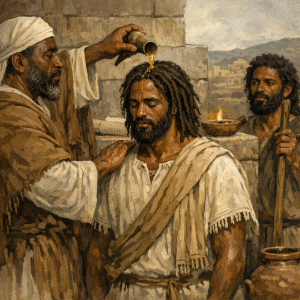
The Christ is a title, not a surname. In its primary historical and linguistic sense, it means “the Anointed One.” It is the English form of the Greek Christos (Χριστός), a word used in Greek biblical tradition to translate the Hebrew mashiach (מָשִׁיחַ), commonly rendered in English as “Messiah.” Thus, “Jesus the Christ” means “Jesus the Messiah” or “Jesus, the Anointed One.” ([oxfordlearnersdictionaries.com](https://www.oxfordlearnersdictionaries.com/us/definition/english/christ_1?utm_source=openai))
The definite article in “the Christ” is significant. It presents the expression as an office, identity, or claimed fulfillment rather than merely a personal designation. A person may be named Jesus; “the Christ” identifies the person as the one believed to bear the messianic anointing and mission. In Christian usage, the expression ordinarily refers to Jesus of Nazareth as the promised Messiah, king, redeemer, and unique mediator between God and humanity. The precise theological content of that claim differs among Christian traditions.
Dictionary usage should distinguish three levels of meaning:
- Linguistic meaning: “anointed one.”
- Jewish-scriptural meaning: a person consecrated or set apart by anointing, especially a priest or king, and in later Jewish expectation a hoped-for messianic deliverer.
- Christian confessional meaning: Jesus is “the Christ,” understood as the Messiah promised in Scripture and, in most historic Christian traditions, as the incarnate Son and Word of God.
Accordingly, “Christ” should not be treated as a generic synonym for “Christian,” a mere last name, or a civil, governmental, military, or common-law office. It is principally a religious title whose meaning comes from the Hebrew Bible, Second Temple Jewish messianic expectation, the Greek-speaking early Christian movement, and later Christian theological development.
Etymology and Origin
The English word Christ entered English through Old English Crīst, from Latin Christus, from Greek Christos. Greek christos is related to the verb chríein, “to anoint” or “to rub with oil.” In the Greek Septuagint—the ancient Greek translation of Hebrew Scripture—the term was used to translate Hebrew mashiach. ([oxfordlearnersdictionaries.com](https://www.oxfordlearnersdictionaries.com/us/definition/english/christ_1?utm_source=openai))
Hebrew mashiach derives from a root concerning anointing with oil. In the ancient Near Eastern and biblical setting, anointing could mark a person as consecrated for a particular office or service. The semantic core is therefore not originally “divine being,” “religious institution,” or “legal authority,” but consecration: being set apart for a divinely recognized role.
In ordinary biblical Hebrew usage, an “anointed one” could be a priest, a king, or another person appointed for a particular purpose. This is important because the word itself did not, at first, refer only to one future savior figure. Biblical texts use the language of anointing in more than one setting. For example, Israelite priests were consecrated by anointing, and Israelite kings could be described as the Lord’s anointed. Isaiah 45:1 remarkably applies the Hebrew term to Cyrus, the Persian ruler, in connection with Cyrus’s role in permitting Judean restoration. ([biblegateway.com](https://www.biblegateway.com/passage/?search=Isaiah+45%3A1&version=NIV&utm_source=openai))
Over time, expectations associated with Davidic kingship, restoration, justice, deliverance, and God’s reign contributed to more focused messianic hopes within some Jewish communities. The historical development was not uniform. Ancient Judaism contained diverse views about whether a messiah would come, what such a figure would be like, whether there might be priestly and royal messianic figures, and how redemption would occur. It is therefore inaccurate to say that all Jews of the first century held one fixed doctrine of “the Messiah.”
Cultural and Historical Context
The title must be understood within Jewish life under foreign empires. The kingdoms of Israel and Judah had experienced monarchy, conquest, exile, restoration, and later rule by Persian, Hellenistic, and Roman powers. In that setting, scriptural promises concerning David’s house, Israel’s restoration, righteous rule, and the defeat of oppression acquired renewed force. Messianic language could carry religious, political, national, ethical, and eschatological significance.
The earliest followers of Jesus were Jews who proclaimed that Jesus was the Messiah. Their proclamation did not arise because “Christ” was a Roman title or because it was borrowed from a supposed pagan office. The documented linguistic path is Hebrew mashiach to Greek christos, transmitted through the Jewish Scriptures in Greek and then through early Christian writings composed largely in Koine Greek. ([academic.oup.com](https://academic.oup.com/book/50143/chapter-abstract/422781651?utm_source=openai))
The New Testament demonstrates that “Christ” began as a meaningful title. Phrases such as “Jesus the Christ,” “Christ Jesus,” and “the Christ” preserve that titular force. Yet frequent Christian use eventually caused “Jesus Christ” to function in ordinary speech much like a personal name. That modern grammatical habit should not obscure the older meaning: the claim being made is that Jesus is the Messiah.
Christian proclamation also transformed the scope of the title. Many first-century messianic hopes centered on Israel’s restoration and righteous rule. The earliest Christian writings proclaimed Jesus’s death, resurrection, lordship, and coming judgment, and carried the message to non-Jews as well as Jews. The title “Christ” consequently became central to a transnational faith rather than remaining only a term of Jewish royal expectation.
By the second through fourth centuries, Christian communities increasingly articulated their belief in Christ through creeds, liturgy, theological debate, and church councils. Historic Nicene Christianity identifies Jesus Christ as fully divine and fully human, eternally related to the Father, incarnate for human salvation, crucified, risen, and expected to return. Those doctrinal conclusions are confessional Christian propositions, not merely lexical consequences of the Greek word christos.
Biblical / Torah Context
Torah and Hebrew Scripture
The Torah supplies the foundational pattern of consecration by anointing. Priests were anointed for service, and the phrase “anointed priest” appears in priestly law. The anointing signified dedication to sacred duty, not private sovereignty or exemption from the ordinary obligations of the community. In the broader Hebrew Bible, kings such as Saul and David are associated with anointing, which links the term to royal appointment and covenantal responsibility.
The Hebrew Scriptures also attach serious moral obligations to rulers. The biblical ideal of kingship is not autonomous power; it is accountable rule under God’s justice. Prophets criticize kings, priests, and people alike for violence, corruption, idolatry, and neglect of the poor. Therefore, interpreting “anointed” as an unlimited grant of personal authority reverses the ethical direction of the biblical material.
Several passages became especially important in later messianic interpretation. These include the covenantal promises regarding David’s house, royal psalms, Isaiah’s visions of righteous rule and suffering, Jeremiah’s “righteous Branch,” Ezekiel’s shepherd imagery, Daniel’s visions, and Zechariah’s kingly imagery. Jewish and Christian readers do not always agree on the original reference, prophetic scope, or ultimate fulfillment of these texts. A responsible dictionary entry should identify that disagreement rather than assume one interpretation is shared by all readers.
New Testament Context
The New Testament repeatedly identifies Jesus as the Christ. John 1:41 explicitly explains the title by stating that “Messiah” is translated “Christ.” The Gospels present public questions concerning whether Jesus is the Messiah; Peter’s confession identifies Jesus as “the Christ”; and Jesus’s trial narratives show that messianic language could be politically sensitive under Roman rule. ([academic.oup.com](https://academic.oup.com/book/50143/chapter-abstract/422781651?utm_source=openai))
For Christians, the title is inseparable from the resurrection proclamation. Jesus is not called Christ merely because he taught morality or claimed authority. The apostolic message declares that God vindicated Jesus after crucifixion and made known his messianic identity. Paul’s letters, among the earliest surviving Christian texts, use “Christ” extensively, often in ways that show how closely the title had become joined to Jesus’s name and identity.
Christian interpreters commonly describe Christ as fulfilling three offices: prophet, who reveals God’s will; priest, who mediates and offers himself sacrificially; and king, who reigns in righteousness. This “threefold office” is a later theological framework for organizing biblical themes. It is not a phrase stated as such in the Torah, nor should it be confused with a civil division of governmental powers.
Jewish and Christian Distinctions
Judaism and Christianity share the Hebrew Scriptures but differ profoundly concerning Jesus and the Messiah. Christianity confesses Jesus as the Christ. Judaism does not accept Jesus as the Messiah in the Christian sense, and Jewish messianic expectation has developed within its own scriptural, rabbinic, legal, and communal traditions. Respectful accuracy requires preserving both statements. “Messiah” is a Jewish term with a history independent of Christian use, while “Christ” is the Greek and English form most closely associated with Christian proclamation. ([academic.oup.com](https://academic.oup.com/reference/62341/reference-article-abstract/554103653?utm_source=openai))
Legal Implications
“The Christ” is not a technical term of the Anglo-American common law. Historic common law developed through judicial decisions and customary legal principles; it did not create a civil office named “the Christ,” confer legal immunity through that title, or recognize a theological claim as a personal status that defeats otherwise applicable law. Roman law, canon law, equity, statutes, and modern constitutional law each have their own histories and rules, but none converts the religious title “the Christ” into a private legal capacity.
In the United States, the legal relevance of the term ordinarily arises through religious liberty, free speech, religious organizations, contracts, property, charitable entities, education, employment, and disputes involving church governance. The Constitution prohibits religious tests for federal office, and the First Amendment protects religious exercise while also limiting governmental establishment or preferential treatment of religion. ([constitution.congress.gov](https://constitution.congress.gov/browse/article-6/clause-3/?utm_source=openai))
Civil courts generally do not decide whether Jesus is the Christ, whether a theological doctrine is true, or which interpretation of Scripture is spiritually correct. Such questions are theological rather than judicial. Courts may, however, decide civil disputes involving religious bodies when they can apply neutral legal principles—such as deeds, trusts, corporate charters, contracts, or statutes—without resolving doctrine. The United States Supreme Court has recognized this neutral-principles approach in church-property cases while warning against civil adjudication of ecclesiastical controversies. ([supreme.justia.com](https://supreme.justia.com/cases/federal/us/442/595/?utm_source=openai))
Historic cases such as Watson v. Jones (1871) addressed property disputes involving religious organizations under common-law principles. Later constitutional decisions developed restrictions on judicial intrusion into church doctrine and governance. These cases do not make church rules identical to state law, nor do they give a religious organization unrestricted authority over civil rights, property, criminal law, taxation, or contractual duties. The applicable outcome depends upon jurisdiction, facts, governing instruments, statutory law, and constitutional limits.
Claims occasionally appear that saying “Christ,” asserting a “Christ consciousness,” declaring oneself “anointed,” or invoking biblical language creates sovereign status, removes a person from statutory jurisdiction, cancels debts, voids contracts, or defeats criminal charges. Such claims are not supported by American common law or constitutional doctrine. Religious belief may be sincerely held and constitutionally protected; it does not automatically excuse conduct prohibited by valid, generally applicable law. This distinction protects both religious liberty and the rule of law. ([law.cornell.edu](https://www.law.cornell.edu/wex/religion_and_the_constitution?utm_source=openai))
Spiritual Meaning
In Christian spiritual language, “the Christ” signifies more than ceremonial anointing. It identifies Jesus as the one through whom believers understand reconciliation with God, forgiveness, healing, truth, sacrificial love, resurrection, and the hope of a restored creation. Christians commonly speak of Christ as Savior, Lord, King, Good Shepherd, Lamb of God, Son of Man, and Word of God. Each title emphasizes a different aspect of Christian devotion and theology.
The spiritual meaning is often personal as well as doctrinal. To confess Jesus as the Christ is traditionally understood as an act of faith, allegiance, and repentance—not merely acceptance of a historical proposition. In many churches, baptism is associated with entry into life “in Christ,” and communion is associated with remembrance of Christ’s death and participation in the community formed around him.
Some modern spiritual movements use “Christ” or “Christ consciousness” in a broad, non-creedal way to mean awakened compassion, divine awareness, enlightened humanity, or an inner spiritual principle. That usage is interpretive and differs materially from historic Christian teaching, which ordinarily identifies the Christ with the particular person Jesus of Nazareth rather than with an impersonal state of consciousness available apart from him.
Modern Usage
In contemporary English, “Christ” is most often used in “Jesus Christ,” “Jesus the Christ,” “Christ Jesus,” “the Christ,” “Christendom,” “Christlike,” and “Christian.” In formal theological writing, “the Christ” often emphasizes messianic office and identity. In ordinary conversation, “Jesus Christ” may function as a conventional personal designation, though many Christians prefer forms that preserve the title’s theological force.
The term also appears in art, music, literature, church names, academic study, legal descriptions of religious organizations, and public debates over religion. Care is appropriate because “Christ” is sacred language for many believers and may be experienced as reverent, confessional, cultural, casual, or offensive depending on the context and manner of use.
Controversies / Criticisms
The principal controversies surrounding “the Christ” concern interpretation rather than the word’s basic etymology. There is broad linguistic agreement that Greek Christos corresponds to “anointed” and translates Hebrew mashiach. Disagreement arises over who, if anyone, fulfills messianic expectations; how particular biblical passages should be read; whether Jesus claimed the title in the forms reported by the Gospels; and how early Christian beliefs about Jesus developed.
Jewish readers may object when Christian interpreters treat every Hebrew-scriptural use of “anointed” as a direct prediction of Jesus. Historically, the word could apply to priests, kings, and even Cyrus. Christian readers, meanwhile, often understand the varied scriptural patterns of priesthood, kingship, suffering, deliverance, and restoration as converging in Jesus. These are competing interpretive frameworks and should be described fairly.
Another criticism concerns anachronism. It is misleading to project later creedal formulations, medieval church structures, modern denominational disputes, or contemporary political ideologies directly back into every first-century use of “Christ.” Conversely, it is also inadequate to reduce the title to a bare political label, because the earliest Christian sources use it within claims about God, salvation, worship, resurrection, and eschatological judgment.
Finally, assertions of a hidden pagan origin for the title are often overstated or unsupported. Greek language and Greco-Roman culture unquestionably shaped the setting in which Christianity spread, but the documented linguistic and scriptural background of “Christ” is the Greek rendering of the Hebrew term for “anointed one.” The word’s later use in Christian theology reflects historical development; it does not require inventing a pagan source for its primary meaning. ([oxfordlearnersdictionaries.com](https://www.oxfordlearnersdictionaries.com/us/definition/english/christ_1?utm_source=openai))
Conclusion
“The Christ” means “the Anointed One” and is the English expression of a title rooted in Hebrew mashiach and Greek Christos. Its earliest biblical background concerns consecration for sacred service, priesthood, kingship, and divine appointment. Within Christianity, the title became the central confession that Jesus is the promised Messiah and the one through whom God brings redemption.
The term has substantial religious, historical, cultural, and legal relevance, but its legal relevance must be stated carefully. It is not a common-law status, a governmental office, or a formula for personal immunity. Civil law protects religious belief and religious exercise within constitutional limits, while ordinarily leaving theological truth claims to faith communities and individual conscience. A sound use of the term therefore preserves both its ancient scriptural depth and the distinction between spiritual confession and civil legal authority.
Sources / Further Reading
- Oxford Advanced Learner’s Dictionary, “Christ” — https://www.oxfordlearnersdictionaries.com/us/definition/english/christ_1
- Oxford Bibliographies, “Messianism” — https://academic.oup.com/reference/62341/reference-article-abstract/554103653
- Oxford Academic, The Origins of Christianity: A Historical Introduction to the New Testament, “Lord and Spirit” — https://academic.oup.com/book/50143/chapter-abstract/422781651
- Bible Gateway, Isaiah 45:1 — https://www.biblegateway.com/passage/?search=Isaiah%2045%3A1&version=NIV
- Library of Congress, materials on the Septuagint and Greek-Hebrew scriptural transmission — https://www.loc.gov/
- Constitution Annotated, Article VI Religious Test Clause — https://constitution.congress.gov/browse/article-6/clause-3/
- Cornell Legal Information Institute, “Religion and the Constitution” — https://www.law.cornell.edu/wex/religion_and_the_constitution
- Watson v. Jones, 80 U.S. 679 (1871) — https://supreme.justia.com/cases/federal/us/80/679/
- Serbian Eastern Orthodox Diocese v. Milivojevich, 426 U.S. 696 (1976) — https://supreme.justia.com/cases/federal/us/426/696/
- Jones v. Wolf, 443 U.S. 595 (1979) — https://supreme.justia.com/cases/federal/us/442/595/