Statutory Jurisdiction
Primary Definition
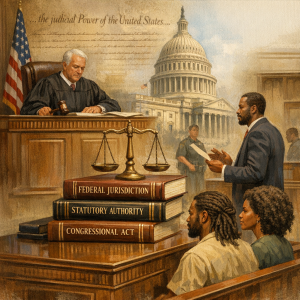
Statutory jurisdiction is the authority of a court, tribunal, agency, or other governmental decision-maker that is granted, defined, limited, or withheld by a statute enacted by a legislature. In ordinary legal usage, the phrase most often concerns a court’s authority to hear a particular class of cases, grant a specified remedy, review an agency action, issue a particular order, or exercise authority over a particular person, place, subject, or proceeding.
Statutory jurisdiction must be distinguished from jurisdiction derived directly from a constitution and from jurisdiction developed through common-law doctrine. In the United States federal system, a court ordinarily needs both a constitutional foundation and a statutory grant before it may decide a case. Article III of the United States Constitution defines the outer categories of federal “judicial Power,” but Congress establishes the lower federal courts and generally determines the scope of their jurisdiction. Thus, federal district courts are commonly described as courts of limited jurisdiction: they may act only where the Constitution permits and Congress has authorized them to act.
The phrase does not mean that every jurisdictional issue is resolved solely by reading a statute. A valid exercise of judicial power may also require such matters as a real case or controversy, proper service, due process, personal jurisdiction, venue, ripeness, standing, and compliance with procedural rules. Nor does a statute override constitutional limits. A legislature may confer authority only within the limits imposed by the governing constitution and other superior law.
In a broader sense, statutory jurisdiction also includes authority assigned by state law to state courts of limited jurisdiction, such as probate, family, juvenile, municipal, traffic, small-claims, tax, and administrative courts. A state trial court of general jurisdiction may possess broad authority under a state constitution, while statutes and court rules define its procedures, allocate specialized matters, and establish exceptions or exclusive forums.
Etymology and Origin
Jurisdiction comes through Anglo-French and Latin legal language. Its principal Latin components are ius or juris, meaning “law” or “right,” and dicere, meaning “to say” or “to declare.” In its classical legal sense, jurisdictio referred to the authority to declare or administer the law. The word therefore concerns lawful authority to make a binding legal determination, not merely the physical location of a courthouse.
Statutory derives from “statute,” a formal enactment of a legislative authority. English law used statutes to mean written enactments of Parliament, in contrast with rules identified through custom, precedent, and the common law. The combined expression “statutory jurisdiction” accordingly identifies jurisdiction that depends upon legislative text.
The terminology became especially important in legal systems that distinguish sharply between courts of general jurisdiction and courts whose powers are specifically enumerated. It is central to American federal law because the United States Constitution created the Supreme Court but gave Congress authority to establish inferior federal courts. Congress has consequently enacted jurisdictional statutes that specify what federal district courts, courts of appeals, bankruptcy courts, the Court of Federal Claims, and other federal tribunals may hear.
Cultural and Historical Context
Historically, jurisdiction has been a practical expression of political sovereignty. A king’s court, a local manorial court, an ecclesiastical court, an admiralty court, a colonial court, or a modern civil court could act only within a recognized field of authority. English common law developed through multiple overlapping institutions, each with contested boundaries. Questions about whether a matter belonged in a common-law court, chancery, ecclesiastical forum, admiralty court, or local court were not merely technical; they could determine available remedies, procedures, juries, appeal rights, and the applicable body of law.
English common law and equity are relevant background, but statutory jurisdiction is not simply a synonym for either. Common-law courts historically derived important aspects of their authority from royal institutions, writ practice, custom, and judicial precedent. Courts of equity developed through the Chancellor and were later integrated with common-law courts in many jurisdictions. Statutes could enlarge, restrict, reorganize, or clarify the authority of both. Modern American courts generally administer legal and equitable remedies in a unified judicial system, although the historical distinction can still matter in particular contexts.
In the United States, the constitutional division of power between national and state governments made jurisdiction a central feature of federalism. State courts generally possess broad authority to decide ordinary civil and criminal disputes unless federal law places a matter within exclusive federal jurisdiction. Federal courts, by contrast, do not have a general power to decide every dispute. Their authority must be traced to a constitutional category and an enacted jurisdictional statute. This allocation protects the states’ retained judicial role while allowing Congress to provide federal forums for federal questions, interstate controversies, claims involving the United States, bankruptcy, admiralty, and other designated matters.
Biblical / Torah Context
“Statutory jurisdiction” is not a biblical or Torah legal term, and no sound historical basis exists for claiming that the modern American doctrine arose directly from Torah law, canon law, or a religious system. The term belongs principally to the development of Roman, English, and later Anglo-American legal vocabulary concerning governmental authority and enacted law.
There are, however, general biblical themes that may be compared at a high level without confusing them with modern doctrine. Torah contains commands concerning judges, witnesses, impartial judgment, local governance, and the administration of justice. For example, Deuteronomy 16:18–20 directs the appointment of judges and officers and emphasizes just judgment. Such passages express moral and religious obligations concerning lawful judgment; they do not establish the jurisdiction of United States courts or supply a rule for interpreting federal or state jurisdictional statutes.
A careful dictionary treatment should therefore separate religious ethical principles from positive law. A person may find spiritual significance in justice, truthfulness, due process, or the limits of official power, but the legal validity of a court’s jurisdiction is determined by the applicable constitution, statutes, procedural rules, and binding judicial decisions.
Legal Implications
Constitutional and statutory foundations
Federal statutory jurisdiction begins with the Constitution but is ordinarily implemented through legislation. Article III, Section 2 identifies categories of cases and controversies to which federal judicial power may extend. Congress then enacts statutes conferring jurisdiction on particular federal courts. A familiar example is 28 U.S.C. § 1331, which grants district courts original jurisdiction over civil actions “arising under” the Constitution, laws, or treaties of the United States. Another is 28 U.S.C. § 1332, which grants diversity jurisdiction when the statutory requirements concerning citizenship and amount in controversy are satisfied.
Other statutes grant specialized authority. Bankruptcy jurisdiction is addressed in 28 U.S.C. §§ 1334 and 157. Admiralty and maritime jurisdiction is addressed in 28 U.S.C. § 1333. Removal statutes determine when a defendant may transfer certain qualifying actions from state court to federal court. Statutes also govern appellate jurisdiction, supplemental jurisdiction, exclusive jurisdiction, judicial review of administrative agencies, and claims against the United States.
For the United States Supreme Court, the analysis is more nuanced. The Constitution itself grants the Court original jurisdiction in a limited class of cases. Congress may regulate much of the Court’s appellate jurisdiction, but it may not enlarge the Court’s constitutionally specified original jurisdiction. This illustrates an important rule: statutory jurisdiction is real and often decisive, yet statutes operate within constitutional boundaries.
Subject-matter jurisdiction, personal jurisdiction, and venue
Statutory jurisdiction is frequently discussed as part of subject-matter jurisdiction: the court’s power to decide the kind of dispute presented. A federal court considering a contract claim between citizens of the same state, for example, does not receive subject-matter jurisdiction simply because one party prefers a federal forum. The complaint must fit a valid jurisdictional grant, such as a federal question or diversity of citizenship under the relevant statute.
Subject-matter jurisdiction differs from personal jurisdiction, which concerns a court’s authority to bind a particular defendant. Personal jurisdiction commonly involves constitutional due-process principles and state long-arm statutes. It also differs from venue, which concerns the proper geographic location for litigation among courts that otherwise have jurisdiction. Venue objections may often be waived; lack of subject-matter jurisdiction ordinarily cannot be created by agreement, consent, silence, or waiver.
These distinctions matter because parties sometimes use “jurisdiction” loosely. A defective summons, an inconvenient forum, a failure to state a claim, a limitation period, or an alleged statutory violation may be serious, but it does not automatically follow that the court lacks subject-matter jurisdiction. Courts examine the specific statute, rule, and precedent to determine the legal consequence.
Jurisdictional statutes and elements of a claim
Not every requirement written in a statute is jurisdictional. The United States Supreme Court has repeatedly instructed courts not to treat procedural or claim-processing requirements as limits on subject-matter jurisdiction unless Congress clearly indicates that result. In Arbaugh v. Y & H Corp. (2006), the Court explained that when Congress does not clearly state that a threshold limitation is jurisdictional, courts should generally treat it as an element of the plaintiff’s claim for relief rather than a bar to subject-matter jurisdiction.
This distinction can affect when an objection must be raised, whether it may be forfeited, who bears a burden of proof, whether a court must raise the issue on its own, and whether a judgment can later be attacked as void. The label “jurisdictional” therefore should not be used casually. A statute may define prohibited conduct, establish a prerequisite to suit, impose a deadline, or limit a remedy without stripping a court of adjudicatory power.
State courts and statutory allocation
State law varies substantially. Many state trial courts are courts of general jurisdiction, receiving broad authority from a state constitution or statute. Yet legislatures often establish specialized courts and define their subject-matter limits by statute. A small-claims court may have a monetary ceiling; a probate court may be assigned estate matters; a family court may receive particular domestic-relations cases; and a municipal court may be confined to ordinance or misdemeanor matters. Whether a defect deprives a state court of jurisdiction, requires transfer, or merely calls for a procedural correction depends on the governing state constitution, statutes, rules, and appellate decisions.
Administrative, military, and governmental contexts
Statutory jurisdiction is also relevant outside ordinary civil litigation. Administrative agencies have only the authority delegated by the legislature or Congress. An agency may investigate, regulate, adjudicate, or impose sanctions only to the extent authorized by its organic statute and related laws. Courts reviewing agency action commonly ask whether the agency acted within its statutory authority, followed required procedures, and remained within constitutional limits.
Military jurisdiction provides a separate but related example. Courts-martial operate under the Uniform Code of Military Justice, enacted by Congress pursuant to its constitutional powers concerning the armed forces. Jurisdiction in that setting may depend upon the status of the accused, the nature of the proceeding, and statutory provisions of military law. It should not be assumed that rules governing civilian federal jurisdiction apply identically to military justice.
Spiritual Meaning
In a spiritual or moral sense, statutory jurisdiction can be understood as a reminder that legitimate authority has limits. The concept rejects the idea that an official may act merely because the official possesses power in a practical sense. Lawful authority requires an identifiable source, defined boundaries, fair procedures, and accountability. Those ideas can harmonize with broad religious and ethical teachings about justice, humility in the exercise of power, truthful testimony, and impartial judgment.
This is interpretive analysis rather than a rule of law. Spiritual convictions may motivate a person to scrutinize governmental action or seek justice, but they do not substitute for legal research, evidence, timely objections, or compliance with lawful court orders.
Modern Usage
Modern lawyers use the phrase when drafting complaints, motions to dismiss, removal papers, appellate briefs, and judicial opinions. A pleading in federal court commonly contains a section titled “Jurisdiction and Venue,” identifying the statute that authorizes the court to hear the action. A party challenging jurisdiction may argue that the cited statute does not cover the claim, that a statutory prerequisite is absent, that Congress made jurisdiction exclusive elsewhere, or that the constitutional case-or-controversy requirement is not met.
The phrase is also used in legislative drafting. When Congress creates a right, program, agency, or judicial remedy, it may specify which court has original jurisdiction, whether jurisdiction is exclusive or concurrent, what review is available, and whether claims may be removed from state court. Careful statutory language is essential because jurisdiction determines both the availability of a forum and the separation of authority among governmental institutions.
Controversies / Criticisms
A recurring controversy concerns the overuse of the word “jurisdiction.” Courts and commentators have criticized arguments that label every statutory defect as jurisdictional. The consequence of a true jurisdictional defect is unusually serious, so modern doctrine seeks a clearer distinction between limits on judicial power and ordinary requirements governing a claim or procedure.
Another disputed area arises in self-represented litigation, including arguments sometimes associated with “sovereign citizen” or “common-law court” theories. Such arguments may assert that a court lacks jurisdiction because a person does not consent, identifies as a “natural person” rather than a legal person, rejects a particular citizenship status, uses special punctuation or name formats, declines to contract with the government, or invokes an undefined “common-law jurisdiction.” These propositions are not accepted rules of American law. Personal jurisdiction, subject-matter jurisdiction, and criminal jurisdiction arise from applicable law and facts, not from unilateral declarations or a litigant’s refusal to consent.
This does not mean jurisdictional objections are frivolous. Courts must possess lawful authority, and valid objections may be decisive. The sound method is to identify the precise constitutional provision, statute, procedural rule, factual record, and binding precedent that supports the objection. General assertions that statutes are inherently invalid, that all courts are commercial corporations, or that jurisdiction depends solely upon consent do not replace that analysis.
Conclusion
Statutory jurisdiction is the legislatively defined portion of lawful governmental authority to hear, decide, review, or remedy a particular matter. It is especially important in federal courts, whose jurisdiction depends on both constitutional authorization and congressional enactment. The term also applies to specialized state courts, administrative bodies, military tribunals, and other decision-makers whose powers are assigned by statute.
A proper jurisdictional analysis is specific rather than rhetorical. It asks: What court or agency is involved? What constitution and statute govern? What kind of claim, offense, remedy, party, territory, or proceeding is at issue? Does the statute actually make the disputed requirement jurisdictional? And do constitutional limits independently permit the proposed exercise of power? Answering those questions preserves both individual rights and the rule that governmental authority must remain within lawful bounds.
Sources / Further Reading
- Legal Information Institute, Cornell Law School, “Jurisdiction”: https://www.law.cornell.edu/wex/jurisdiction
- Legal Information Institute, Cornell Law School, “Subject Matter Jurisdiction”: https://www.law.cornell.edu/wex/subject_matter_jurisdiction
- United States Courts, “About Federal Courts”: https://www.uscourts.gov/about-federal-courts
- United States Courts, “Comparing Federal & State Courts”: https://www.uscourts.gov/about-federal-courts/court-role-and-structure/comparing-federal-state-courts
- U.S. House of Representatives, Office of the Law Revision Counsel, United States Code, Title 28: https://uscode.house.gov/browse/prelim@title28/part4
- National Archives, Constitution of the United States, Article III: https://www.archives.gov/founding-docs/constitution-transcript
- Arbaugh v. Y & H Corp., 546 U.S. 500 (2006): https://supreme.justia.com/cases/federal/us/546/500/