Primary Definition
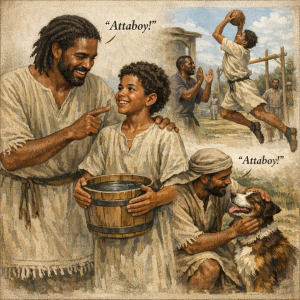
Attaboy, also written atta boy, at-a-boy, that-a-boy, and in other informal variants, is an exclamation of praise, encouragement, approval, or congratulation. It ordinarily means “well done,” “good job,” “keep going,” or “that is the right thing to do.” It is most often directed to a male person, a boy, a man, or a male animal, though speakers sometimes use it more generally and without intending a literal statement about sex or age.
The expression is generally spoken as a quick, warm, emphatic response rather than as a complete grammatical sentence. A parent may say it when a child masters a task; a coach may call it out after a good play; a friend may use it after someone makes a wise choice; and an animal handler may say it to a dog after successful obedience. Its meaning depends substantially upon tone. Said sincerely, it conveys approval and encouragement. Said with exaggerated emphasis, it may be playful. Said after conduct the speaker regards as foolish, selfish, or improper, it may be sarcastic.
In ordinary modern English, attaboy is the most common consolidated spelling. The spaced form is closer to the phrase as heard by many speakers, but it is less standardized. The supplied form may therefore be understood as a phonetic or informal rendering of the familiar exclamation rather than as a separate technical term.
- Approval: “You finished the work ahead of schedule—attaboy.”
- Encouragement: “Attaboy; stay focused and finish strong.”
- Congratulation: “Attaboy! That was an excellent catch.”
- Affectionate praise toward an animal: “Attaboy—good dog.”
- Irony or sarcasm: “You deleted the whole file? Attaboy.”
The word can also function as a noun. A supervisor who gives an employee an attaboy gives a brief verbal commendation. In that noun sense, it means praise itself rather than the exact spoken exclamation: “The report earned him an attaboy from the manager.”
Etymology and Origin
The prevailing dictionary explanation is that attaboy represents a casual, compressed pronunciation of an earlier approving expression such as “that’s the boy” or “that’s a boy.” Merriam-Webster identifies the word as probably an alteration of “that’s the boy,” while Oxford’s learner’s dictionary likewise describes it as probably representing a casual pronunciation of that expression. The contraction illustrates a common feature of spoken English: words used repeatedly in quick emotional speech may run together, lose sounds, and eventually become treated as a single written word.
The phrase should not be parsed too literally as though it were a formal declaration identifying a particular male child. In use, the older underlying expression worked as an approving recognition: the person addressed had done what the speaker hoped, expected, or encouraged him to do. “That is the one,” “that is the spirit,” and “that is the way” express a similar approving pattern. Over time, the sound and emotional force of the expression mattered more than its original grammatical structure.
Major dictionaries date the established written form to the early twentieth century. Merriam-Webster gives 1909 as its first known use. Etymonline also dates it to 1909 and characterizes the early usage as baseball slang. Dictionary.com gives an origin range of approximately 1905–1910. These dates should be understood carefully: a first known printed use is not necessarily the day an expression was invented. Informal cheers often circulate in speech, family life, workplaces, sporting culture, and local communities before editors find them in print.
The spelling has never been wholly uniform. Attaboy is now the dominant dictionary headword, but atta boy remains common because it visibly suggests the phrase’s spoken parts. Variants such as ataboy, thatta boy, and that-a-boy have appeared in informal writing. Such variation is unsurprising for an interjection primarily learned by hearing. The standard spelling is useful in edited prose, but nonstandard spellings do not ordinarily create a different legal, theological, or linguistic meaning.
There are alternative etymological suggestions. Linguist Anatoly Liberman, writing for Oxford University Press’s OUPblog, questioned whether the usual derivation fully explains the expression and considered possible connections with older hunting calls and terms. That discussion is useful as a reminder that etymology sometimes remains uncertain. It should not, however, be presented as a settled replacement for the mainstream dictionary account. The careful conclusion is that the derivation from “that’s the boy” is widely accepted as probable, while some scholars have explored less conventional possibilities.
Cultural and Historical Context
The expression developed in a setting where short spoken praise had practical value. Athletic contests, manual work, hunting, training, military-style drills, child-rearing, and animal handling all reward quick signals of approval. A coach or parent does not need a formal speech in the instant after a successful action. A compact exclamation can recognize achievement, reinforce behavior, and sustain morale.
Its association with American speech is strong. Cambridge labels it informal and mainly U.S., while Oxford identifies it as especially North American. That does not mean every American uses it or that it is unknown elsewhere. Rather, its sound, register, and cultural associations commonly evoke American conversational English, particularly the language of sports, fathers and sons, coaches, old films, television dialogue, and informal workplace banter.
Historically, the phrase often carried a paternal or mentor-like voice. An older man might say it to a younger man, a parent to a child, a coach to a player, or an owner to a dog. That pattern reflects social relationships in which praise moved downward through a hierarchy. Yet actual usage has never been limited to those relationships. Peers use it with one another; women use it; and it may be said jokingly to a person of any age.
The term also illustrates the cultural power of small acknowledgments. An attaboy may be only one word, but it can signal belonging, competence, recognition, or permission to continue. In teamwork settings, it can strengthen solidarity when it is specific and sincere. A player who hears approval after a good effort may understand that the group saw the effort, not merely the final result.
At the same time, the expression can appear dated. Some speakers associate it with older generations or with stylized mid-twentieth-century American dialogue. That quality can be used deliberately in fiction, advertising, comedy, or character writing. A writer may choose it to create a folksy, paternal, athletic, old-fashioned, or deliberately exaggerated voice.
Biblical / Torah Context
There is no documented biblical, Torah, Hebrew, Greek, Roman, or ecclesiastical origin for this English exclamation. It is not a term of art from the Torah, the Hebrew Bible, the New Testament, rabbinic literature, canon law, or church liturgy. Claims that it secretly derives from an ancient religious formula would require evidence beyond the sound of the modern phrase; no such accepted evidence appears in the standard dictionary accounts of the word.
Nevertheless, the general act expressed by the term—encouraging a person who does what is good, faithful, skillful, or courageous—has broad biblical parallels. Biblical texts frequently contain exhortation, blessing, commendation, and encouragement. For example, encouragement to be strong and courageous appears in the Book of Joshua, and the New Testament contains repeated instructions to build one another up. Those passages concern moral and spiritual encouragement, but they do not define, create, or authorize this particular English idiom.
In a Jewish or Christian teaching context, the expression may be used informally to praise conduct believed to be honorable. That use is conversational rather than doctrinal. A teacher may say it after a child tells the truth, helps another person, learns a passage, or acts responsibly. The spiritual principle is not contained in the word itself; it arises, if at all, from the values attached to the conduct being praised.
Legal Implications
Attaboy has no established technical meaning in common law, equity, Roman law, constitutional law, statutory law, military law, commercial law, or modern legal drafting. It does not create a contract, transfer a right, establish jurisdiction, confer governmental authority, waive liability, or function as a formal legal certification merely because it is spoken or written.
In ordinary legal analysis, the phrase would usually be treated as informal praise or conversational context. A workplace message stating “attaboy” may be evidence that a supervisor expressed approval, but the word alone ordinarily does not establish a promotion, a binding performance evaluation, a bonus, or a legal promise. The surrounding facts, the employer’s policies, the complete communication, and applicable law would control.
Its possible relevance is therefore evidentiary and contextual, not doctrinal. In a dispute, a court or fact-finder might consider the phrase as one part of a larger record showing an atmosphere of praise, sarcasm, favoritism, retaliatory conduct, or informal supervision. But no sound legal conclusion follows from the word in isolation. The ordinary meaning of the expression should not be confused with a legally operative statement.
The phrase also has no special military command meaning. Although it may be heard in settings involving discipline, training, sports, or group effort, it is not an official command equivalent to an order, rank, award, commendation, or lawful directive. A military or governmental institution may use informal praise in daily speech, but institutional usage does not convert the expression into a source of legal authority.
Spiritual Meaning
On a spiritual or personal level, the expression may be interpreted as a small verbal sign of affirmation. It recognizes effort and can encourage a person to persevere. Used with humility and truthfulness, praise can support healthy relationships by acknowledging diligence, courage, repentance, service, craftsmanship, or kindness.
This is interpretive analysis, not a claim about the word’s historical origin. The expression has no inherent sacred force, ritual status, or supernatural effect. Its spiritual significance, where a speaker gives it one, depends on intention, setting, and the moral character of what is being praised.
There is also a caution. Praise can become manipulative if it is used merely to control people, to reward unquestioning obedience, or to avoid honest correction. Meaningful encouragement is most constructive when it is connected to specific good conduct: “You showed patience,” “You kept your word,” or “You worked carefully.” In that sense, an affectionate exclamation may be valuable, but it is strongest when accompanied by sincerity and discernment.
Modern Usage
Modern speakers use attaboy in several overlapping ways. In sports, it commonly follows a good play, a determined effort, or recovery from a mistake. In family life, it may praise a child for learning, helping, trying, or behaving responsibly. In workplaces, it can serve as an informal compliment among colleagues. With dogs and other animals, it often accompanies a command successfully performed.
Because the expression is traditionally male-coded, many speakers use alternatives when addressing women, girls, mixed groups, or persons whose gender is unknown. Attagirl developed as a parallel expression, though some consider it equally dated. More inclusive alternatives include “way to go,” “nice work,” “well done,” “great job,” “good thinking,” “you handled that well,” and “keep it up.” These alternatives can also be more precise because they identify what the speaker is approving.
The phrase can be used with a name: “Attaboy, Marcus!” It can stand alone: “Attaboy!” It can appear after a statement: “You made the right call—attaboy.” As a noun, it may take an article and plural form: “She gave the team an attaboy,” or “The project earned several attaboys.” The noun usage is informal and is most natural in conversational writing rather than formal reports.
Digital communication has preserved the term but changed its tone. In a text message, comment thread, or social-media post, punctuation and surrounding words help establish whether it is sincere: “Attaboy! Proud of you.” Without context, it may read as teasing or sarcastic. A speaker should therefore consider the relationship and medium before using it in sensitive communications.
Controversies / Criticisms
The principal criticism of the expression concerns gender and condescension. Because it literally contains boy, it may sound patronizing when directed to an adult man, especially by someone in a position of authority. It may also exclude or awkwardly misidentify people who are not male. In some contexts, calling an adult male “boy” has a serious history of racial degradation and unequal treatment. The phrase is not automatically intended in that sense, but speakers should recognize that words acquire meaning from history, relationship, power, and circumstance.
For these reasons, a manager, teacher, public official, or professional may prefer clear, respectful praise over a potentially familiar expression. “Excellent work on the analysis” is usually more specific and less open to misunderstanding than “attaboy.” The latter may be welcome among close friends or teammates, but it is not equally suitable in every workplace or public setting.
A second issue is sarcasm. The same phrase that warmly applauds a success can become a cutting rebuke when delivered after a mistake. This flexibility is common to praise expressions, but it means that the words alone cannot determine intent. Tone, timing, punctuation, facial expression, and prior relationship remain essential.
Finally, etymological certainty should not be overstated. The mainstream explanation connects the term with a compressed form of “that’s the boy,” and that explanation is supported by major dictionaries. Alternative theories exist, but they remain disputed. Neither the conventional account nor the alternatives support elaborate claims that the expression is an ancient legal formula, a hidden religious term, or a word carrying independent governmental authority.
Conclusion
Attaboy is an informal North American-style exclamation of approval, encouragement, or admiration. Its most likely origin is a spoken reduction of “that’s the boy,” with the established written form appearing in the early twentieth century. It has long been at home in sports, family life, animal training, and informal peer conversation because it provides immediate, emotionally direct recognition.
The expression has no special common-law, statutory, military, governmental, biblical, or ritual meaning. Any legal relevance depends on the larger facts of a communication, and any spiritual meaning is personal or interpretive rather than inherent in the word. Modern users should be attentive to tone, gendered language, age, race, hierarchy, and the possibility of sarcasm. Where it is welcome and sincerely meant, it remains a compact way of saying: well done; keep going; your effort has been seen.
Sources / Further Reading
- Merriam-Webster, “Attaboy”: https://www.merriam-webster.com/dictionary/attaboy
- Oxford Advanced Learner’s Dictionary, “Attaboy”: https://www.oxfordlearnersdictionaries.com/us/definition/english/attaboy
- Cambridge Dictionary, “Attaboy”: https://dictionary.cambridge.org/us/dictionary/english/attaboy
- Online Etymology Dictionary, “Attaboy”: https://www.etymonline.com/word/attaboy
- Dictionary.com, “Attaboy”: https://www.dictionary.com/browse/attaboy
- Oxford University Press OUPblog, Anatoly Liberman, “Attaboy! Or, The Male-Intimate Affectionate Overtones Questions”: https://blog.oup.com/2006/12/attaboy_or_the/