Racism
Primary Definition
Racism is, in its primary and historically established sense, a belief, attitude, practice, or system that treats human beings as naturally divided into racial groups and assigns unequal worth, ability, rights, status, or opportunity to those groups. It commonly includes claims of racial superiority or inferiority, racial prejudice, hostility, exclusion, segregation, or discrimination.
The word is used in more than one related sense. In an individual sense, it may describe a person’s expressed belief that people of one race are inherently better or worse than people of another race, or conduct motivated by such a belief. In an institutional or systemic sense, it may describe policies, practices, customs, or social arrangements that produce or preserve unequal racial outcomes, whether or not every individual involved consciously holds racial animus. These senses overlap but are not identical. A person may engage in direct racial discrimination; an institution may maintain a practice with racially unequal effects; and a society may contain inherited inequalities without every member personally intending discrimination.
Dictionary definitions generally include both an ideology of racial superiority and conduct based on racial prejudice or discrimination. Modern definitions also commonly recognize racism as a political or social system that creates advantage for one racial group over another. The exact scope of the term remains debated in ordinary speech, academic writing, political discussion, and legal argument. That debate should not obscure the core meaning: racism concerns the improper evaluation or treatment of persons on the basis of perceived race or racialized ancestry rather than their individual character, conduct, and lawful rights.
Etymology and Origin
Racism is formed from race plus the suffix -ism, which often denotes a doctrine, system, movement, or characteristic practice. Merriam-Webster identifies the word as perhaps influenced by the French racisme and records an English use in 1886. The related word racialism was once more common in some contexts, particularly in earlier twentieth-century writing, but racism became the usual modern term.
The word’s relatively recent appearance should not be confused with the age of the conduct it describes. Human communities have long distinguished between peoples, tribes, nations, religions, languages, and lineages. Yet the modern concept of race—especially the claim that humanity can be divided into fixed biological classes arranged in a hierarchy of inherited mental, moral, or civilizational capacity—developed through particular historical processes. European colonial expansion, chattel slavery, imperial administration, nineteenth-century racial classification, and theories sometimes called “scientific racism” all contributed to the development of racial ideologies in their modern form.
Accordingly, it is important to distinguish ethnocentrism, xenophobia, religious persecution, and racism. These can coexist, and each can be gravely unjust, but they are not interchangeable. Ethnocentrism judges other cultures by one’s own culture; xenophobia concerns fear or hostility toward foreigners; religious persecution targets belief or worship; racism centers on presumed racial difference, ancestry, physical traits, or racial classification. In actual life, a single act may involve more than one of these categories.
Cultural and Historical Context
Racism has taken different forms in different places and periods. It has been used to rationalize conquest, enslavement, forced labor, exclusion from citizenship, residential separation, denial of voting rights, unequal schooling, immigration restrictions, discriminatory employment practices, and violence. Its historical forms should be studied in their own settings rather than reduced to a single formula.
In the United States, race-based chattel slavery became deeply embedded in colonial and state legal systems. After the Civil War, the Thirteenth Amendment abolished slavery and involuntary servitude except as punishment for crime; the Fourteenth Amendment, ratified on July 9, 1868, established national birthright citizenship and prohibited states from denying any person equal protection of the laws. These constitutional changes were directed in substantial part toward securing civil and legal rights for formerly enslaved people. Their promise, however, was repeatedly undermined in practice by violence, discriminatory enforcement, disenfranchisement, segregation, and judicial limitations during and after Reconstruction.
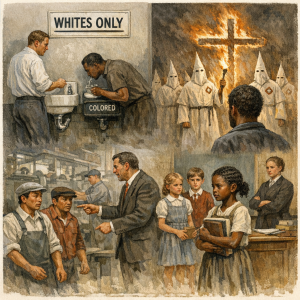
“Jim Crow” describes a broad system of legally imposed and socially enforced racial segregation that developed especially in the southern United States after Reconstruction. Segregation affected schools, transportation, housing, voting, public accommodations, and access to public institutions. The mid-twentieth-century civil-rights movement challenged these systems through litigation, organizing, public witness, legislation, and political action. Landmark legal developments included Brown v. Board of Education (1954), which rejected state-imposed racial segregation in public education, the Civil Rights Act of 1964, and the Voting Rights Act of 1965.
Governmental and Military Context
Government institutions have at times created, enforced, or dismantled race-based systems. This does not mean every governmental distinction involving demographic data is racist, nor does it mean that all present inequalities necessarily prove unlawful discrimination. It does mean that historical facts, legal authority, purpose, implementation, and actual effects must be examined carefully when evaluating a governmental practice.
Military history is relevant because the United States armed forces were once segregated. On July 26, 1948, President Harry S. Truman issued Executive Order 9981, declaring a policy of equality of treatment and opportunity in the armed services without regard to race, color, religion, or national origin. The order marked a major federal commitment to ending military segregation. Its significance illustrates that racial discrimination was not merely a private social attitude; it could be established and maintained through official policy.
Biblical / Torah Context
The Bible and Torah do not use the modern English word racism, and their ancient categories of nation, tribe, people, foreigner, lineage, and covenant should not be carelessly equated with modern racial classifications. Therefore, claims that Scripture supplies a technical modern definition of racism go beyond the text.
Nevertheless, biblical principles are frequently brought to bear on the subject. Genesis presents humanity as made in the image of God (Genesis 1:26–27), a teaching commonly understood to ground the inherent dignity of every human being. The Torah repeatedly commands just treatment of the ger, often translated “sojourner,” “stranger,” or resident foreigner: “You shall love him as yourself” because Israel had been strangers in Egypt (Leviticus 19:33–34). Deuteronomy likewise warns against partiality and commands care for the vulnerable and the stranger (Deuteronomy 10:17–19).
In the New Testament, Acts 17:26 describes God as having made humanity from one origin or “one blood,” depending on translation tradition. James 2 condemns partiality in the assembly, particularly favoritism based on worldly status. Galatians 3:28 is frequently cited by Christians for the proposition that ethnic, social, and sex-based distinctions do not determine a person’s standing in Christ. These passages have inspired religious opposition to racial hierarchy and racial exclusion.
At the same time, Scripture has been misused historically to defend slavery, segregation, ethnic domination, and false theories of inherited racial curse. Such uses are contested by Jewish and Christian scholars and are not warranted merely by citing ancient genealogies, national judgments, or covenantal distinctions. A sound reading must distinguish descriptive passages about ancient peoples from a universal authorization to demean persons because of ancestry or appearance.
Legal Implications
Common Law, Equity, and Constitutional Law
Racism is not, by itself, a single freestanding offense with one universal “common-law definition.” Traditional English common law did not develop a modern, comprehensive cause of action labeled “racism.” Common law addressed particular wrongs—such as assault, battery, false imprisonment, defamation, trespass, breach of contract, and certain public wrongs—rather than a general modern civil-rights claim under that name. Courts of equity historically supplied remedies such as injunctions in appropriate cases, but equity did not create a general racial-equality code equivalent to modern civil-rights statutes.
In the United States, legal protection against race discrimination comes principally from constitutional provisions, federal and state statutes, administrative law, and judicial decisions interpreting them. The Fourteenth Amendment’s Equal Protection Clause restricts discriminatory action by states and state actors. It does not ordinarily regulate purely private conduct without a sufficient governmental connection. Federal governmental action is subject to equal-protection principles through the Fifth Amendment’s Due Process Clause as interpreted by the Supreme Court.
Federal statutes also provide important protections. Title VII of the Civil Rights Act of 1964 prohibits covered employers from discriminating because of race, color, religion, sex, or national origin. It can address intentional disparate treatment and, in defined circumstances, facially neutral employment practices that create an unlawful disparate impact. Section 1981 of Title 42 protects the equal right to make and enforce contracts and to receive the equal benefit of laws and proceedings. Other statutes apply in areas including housing, voting, education, public accommodations, and federally funded programs.
A legal claim requires more than a moral accusation. The applicable statute or constitutional provision, jurisdiction, facts, evidence, deadlines, available remedies, defenses, and procedural requirements all matter. A rude remark, an unfair outcome, a historical disparity, and a legally actionable discrimination claim are not automatically identical categories, even though they may be morally or socially related. Conversely, discrimination can be unlawful even when it is expressed through coded language, selective standards, or ostensibly neutral practices rather than open racial insults.
Race, Color, National Origin, and Ancestry
Legal categories overlap but differ. Under Title VII, race and color are distinct protected bases; color concerns pigmentation, complexion, or skin shade. National-origin discrimination concerns ancestry, place of origin, or characteristics associated with a national-origin group. Religion is separately protected. A fact pattern may implicate several categories at once, such as discrimination directed toward a person because of perceived ethnicity, racial appearance, national origin, and religion.
Internationally, the International Convention on the Elimination of All Forms of Racial Discrimination defines racial discrimination broadly as distinctions, exclusions, restrictions, or preferences based on race, color, descent, or national or ethnic origin that have the purpose or effect of impairing equal enjoyment of human rights. That treaty definition is useful for international human-rights discussion, but it should not be assumed to create the same private cause of action or remedy available under the law of every jurisdiction.
Spiritual Meaning
In spiritual and ethical discussion, racism is often understood as a disorder of judgment and relationship: the elevation of group identity above the equal moral worth of persons. From this perspective, it may involve pride, contempt, partiality, fear, unjust judgment, collective blame, refusal of neighborly love, or indifference to another person’s suffering.
This is an interpretive moral analysis, not a separate legal definition. Religious traditions differ in vocabulary and doctrine, but many teach that persons must not be reduced to ancestry, appearance, nationality, or inherited stereotypes. A spiritual response to racism may include repentance for personal prejudice, truthful examination of history, reconciliation where possible, restitution where a duty is established, protection of the vulnerable, and commitment to impartial justice. Such terms should not be used to erase individual responsibility: reconciliation does not require denying wrongdoing, and forgiveness language should never be used to coerce silence from persons who have suffered injustice.
Modern Usage
In current usage, racism may refer to explicit racial hatred, racial slurs, discriminatory decisions, unequal access to institutions, cultural stereotypes, or systems producing durable racial inequality. Context is essential. A speaker using the term may be describing personal animus, a discriminatory policy, a social pattern, or a historical structure. Before agreeing or disagreeing, it is useful to ask: What conduct is alleged? Who made the decision? What racial classification or stereotype is involved? Is the claim moral, historical, sociological, or legal? What evidence supports it?
The phrase systemic racism is especially contested. Supporters use it to describe interlocking institutional practices and inherited conditions that can perpetuate racial disadvantage even without overtly racist intent by each decision-maker. Critics argue that the phrase is sometimes used too broadly, treats unequal outcomes as conclusive proof of discrimination, or assigns collective guilt without proving individual fault. A careful approach avoids both errors: unequal outcomes alone do not automatically establish a legal violation or personal guilt, but neither does the absence of openly expressed hatred establish that a policy is fair or nondiscriminatory.
Modern debate also includes disagreement over race-conscious remedies, admissions policies, employment programs, demographic preferences, and the proper relationship between equality of opportunity and equality of outcome. In Students for Fair Admissions, Inc. v. President and Fellows of Harvard College (June 29, 2023), the Supreme Court held that the challenged race-conscious college-admissions programs violated the Equal Protection Clause. That decision concerns the constitutional limits on particular admissions programs; it does not eliminate all anti-discrimination law, nor does it settle every moral, historical, or policy dispute concerning race.
Controversies / Criticisms
The term racism can be used precisely or imprecisely. It is sometimes applied as a serious description of documented ideology or conduct; at other times it is used as a generalized political accusation. Because the charge bears moral weight, fairness requires attention to words, actions, patterns, authority, evidence, and context. Calling every disagreement about culture, immigration, criminal justice, religion, history, or public policy “racist” without showing a racial premise or discriminatory mechanism can weaken public understanding and inhibit honest discussion.
Another controversy concerns whether racism must involve power. Some writers define racism broadly as racial prejudice or discrimination by any person against any racial group. Others reserve the word for prejudice combined with institutional or social power. Both usages appear in modern discourse. The broader definition is closer to ordinary dictionary usage; the narrower definition is an analytical framework used in some academic and activist settings. Neither usage should be silently assumed in a serious discussion. The speaker should state which meaning is intended.
There is also a recurring risk of racial essentialism in efforts meant to oppose racism. Treating people as spokesmen for an entire race, assuming identical views within a racial group, assigning moral blame or innocence by ancestry, or judging an individual’s legitimacy by racial identity can reproduce the very group-based reasoning that anti-racist principles reject. Equal justice requires holding persons accountable for their own conduct while recognizing real historical and institutional conditions.
Conclusion
Racism is best understood as a family of related beliefs, practices, and systems that improperly rank, exclude, burden, or stereotype people on the basis of race or racialized ancestry. Its modern name is comparatively recent, but the historical harms associated with racial hierarchy, exclusion, and legally enforced segregation are well documented. In law, the term has no single self-executing common-law remedy; rights and liabilities depend on constitutional provisions, statutes, judicial doctrine, evidence, and jurisdiction. In moral and spiritual reflection, racism raises questions of truth, dignity, impartiality, responsibility, and justice.
A careful use of the word should reject both racial contempt and careless accusation. It should distinguish historical fact from interpretation, legal liability from moral criticism, intentional discrimination from disparate effect, and individual guilt from collective history. The enduring principle is that no person’s inherent worth, civil rights, or claim to equal justice should depend upon race, color, ancestry, or ethnic origin.
Sources / Further Reading
- Merriam-Webster, “Racism.” https://www.merriam-webster.com/dictionary/racism
- National Archives, “14th Amendment to the U.S. Constitution: Civil Rights (1868).” https://www.archives.gov/milestone-documents/14th-amendment
- National Archives, “Executive Order 9981: Desegregation of the Armed Forces (1948).” https://www.archives.gov/milestone-documents/executive-order-9981
- Library of Congress, “The Civil Rights Act of 1964: A Long Struggle for Freedom.” https://www.loc.gov/exhibits/civil-rights-act/prologue.html
- U.S. Equal Employment Opportunity Commission, “Race/Color Discrimination.” https://www.eeoc.gov/racecolor-discrimination
- U.S. Equal Employment Opportunity Commission, “Section 15: Race and Color Discrimination.” https://www.eeoc.gov/laws/guidance/section-15-race-and-color-discrimination
- U.S. House of Representatives, Office of the Law Revision Counsel, 42 U.S.C. § 1981, “Equal Rights Under the Law.” https://uscode.house.gov/view.xhtml?edition=prelim&f=treesort&jumpTo=true&num=0&req=%28title%3A42+section%3A1981+edition%3Aprelim%29+OR+%28granuleid%3AUSC-prelim-title42-section1981%29
- Office of the United Nations High Commissioner for Human Rights, “International Convention on the Elimination of All Forms of Racial Discrimination.” https://www.ohchr.org/Documents/ProfessionalInterest/cerd.pdf
- Supreme Court of the United States, Students for Fair Admissions, Inc. v. President and Fellows of Harvard College (2023). https://www.supremecourt.gov/opinions/22pdf/20-1199_hgdj.pdf