Caucasian
Primary Definition
Caucasian has several distinct meanings, and its meaning must be determined from context:
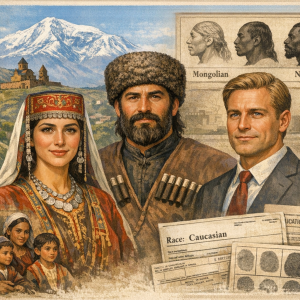
- Geographic meaning: of, relating to, or originating in the Caucasus, the mountainous region between the Black Sea and the Caspian Sea. In this sense, the word may refer to the peoples, cultures, languages, geography, or history of Armenia, Azerbaijan, Georgia, the Russian North Caucasus, and neighboring territories.
- Historical anthropological meaning: a person assigned to the so-called “Caucasian race” under obsolete systems that divided humanity into a small number of large racial types.
- American social meaning: a conventional synonym for White, particularly for a person understood to be of European ancestry. This usage remains familiar in the United States but is increasingly regarded as dated, imprecise, or misleading.
- Institutional meaning: a legacy category appearing in older legal opinions, medical records, police descriptions, demographic forms, and scientific literature. Such usage may document a historical classification without establishing that the classification is scientifically valid.
The geographic sense remains legitimate, although it can still be ambiguous because the Caucasus contains many different nations, ethnic communities, religions, and language families. The racial sense is not accepted in modern genetics as the name of a discrete biological division of humanity. The National Human Genome Research Institute describes race as a social and political construct and cautions that race and ethnicity are not reliable substitutes for genetic ancestry. ([genome.gov](https://www.genome.gov/genetics-glossary/Race?utm_source=openai))
Accordingly, careful usage distinguishes among White identity, European ancestry, genetic ancestry, national origin, and actual origin in the Caucasus. These concepts may overlap in particular cases, but they are not interchangeable.
Etymology and Origin
The word is formed from Caucasus and the suffix -ian, meaning “of or pertaining to.” Caucasus entered European languages through Latin and Greek forms of the ancient geographical name. In its literal construction, therefore, the adjective means “of the Caucasus.” English geographical use is recorded from the early nineteenth century, while the expanded racial meaning developed from late eighteenth-century European classification systems. ([etymonline.com](https://www.etymonline.com/word/Caucasian?utm_source=openai))
The German writer Christoph Meiners used a version of the designation in a broad racial sense before Johann Friedrich Blumenbach adopted it. Blumenbach, a physician and natural historian at the University of Göttingen, gave the term lasting scientific prestige through the 1795 edition of De Generis Humani Varietate Nativa, commonly translated as On the Natural Variety of Mankind. It is therefore more accurate to say that Blumenbach popularized and systematized the classification than to say without qualification that he invented the word. ([uni-goettingen.de](https://www.uni-goettingen.de/en/650077.html))
Blumenbach divided humanity into five principal varieties while maintaining that all human beings belonged to one species and shared a common origin. He selected the Caucasian designation partly because he regarded a Georgian woman’s skull in his collection as exceptionally symmetrical and partly because he believed the region near the Caucasus represented humanity’s original homeland. His reasoning joined anatomical observation with subjective aesthetics, environmental theory, and assumptions influenced by the biblical geography of Noah and Mount Ararat. ([uni-goettingen.de](https://www.uni-goettingen.de/en/650077.html))
This history requires nuance. Blumenbach opposed polygenist theories that treated human groups as separate species, objected to slavery, and defended the intellectual capacities of African peoples. Nevertheless, his placement of a supposedly original Caucasian form near the center or ideal of human variation was Eurocentric. Later writers separated his terminology from his doctrine of one human species and used racial taxonomies to support hierarchy, colonial domination, segregation, and eugenics. Thus, the consequences of the classification extended beyond Blumenbach’s stated intentions. ([uni-goettingen.de](https://www.uni-goettingen.de/en/650077.html))
Cultural and Historical Context
During the nineteenth and early twentieth centuries, European and American scholars attempted to classify humanity by skin color, skull measurements, facial form, hair texture, language, geography, and presumed ancestry. The resulting systems did not agree with one another. Depending on the author, the Caucasian category could include Europeans, North Africans, West Asians, many Central Asians, and peoples of the Indian subcontinent. It was therefore much broader than the ordinary modern American meaning of “White person of European ancestry.”
These classifications were often presented as objective science, but their boundaries reflected political and cultural judgments. Traits varied gradually across populations, people migrated and intermarried, and different authorities assigned the same communities to different categories. The categories nevertheless gained institutional power because governments, courts, universities, immigration officials, physicians, and military or police administrators repeated them.
The literal geography also creates an important contradiction. Indigenous peoples of the Caucasus include Georgians, Armenians, Azerbaijanis, Circassians, Chechens, Avars, Ossetians, and numerous other communities. They do not constitute one uniform ethnicity, language, religion, appearance, or political identity. The Library of Congress has described the region as exceptionally diverse, historically known for the extraordinary number of languages spoken there. Using the region’s name as a general label for all White people obscures that diversity while implying a Caucasus origin that most Europeans do not possess in any immediate genealogical sense. ([loc.gov](https://www.loc.gov/resource/gdc.a22000912/?st=brief&utm_source=openai))
By the twentieth century, anthropology and genetics increasingly rejected the old typological model in which humanity was divided into a few fixed races. Human biological variation is real, and some genetic variants occur at different frequencies in populations with different ancestral histories. That fact, however, does not restore the old Caucasian type as a clear biological unit. Modern genomic research emphasizes that most variation occurs within populations, that boundaries are overlapping and gradual, and that a broad social label cannot substitute for an individual’s ancestry or medical information. ([genome.gov](https://www.genome.gov/about-genomics/policy-issues/population-descriptors-in-genomics))
Biblical / Torah Context
The term is not found in the Torah or other biblical writings and did not arise in the ancient Hebrew world. The biblical texts speak of families, tribes, peoples, kingdoms, languages, lands, strangers, and nations, but they do not employ Blumenbach’s five-part racial taxonomy. Applying the modern label retrospectively to Israelites, Egyptians, Canaanites, Persians, Greeks, Romans, or other biblical peoples risks imposing a comparatively recent European classification on ancient identities.
Genesis presents humanity as a connected creation. Genesis 1:27 places human beings under a common divine image, while Genesis 10 organizes remembered peoples through a genealogical “Table of Nations.” These passages concern sacred anthropology, kinship, territory, and the relationship of nations; they do not set out modern biological races. Likewise, the Torah’s legal distinctions ordinarily concern such matters as covenant membership, household status, tribal inheritance, resident aliens, foreigners, and neighboring nations rather than “Caucasian” status.
Blumenbach’s own association of the Caucasus with human origins was partly influenced by an older tradition locating the landing of Noah’s ark near Mount Ararat. That influence documents how biblical geography entered an eighteenth-century theory; it does not make his racial classification a teaching of Scripture. The inference from “Ararat is near the Caucasus” to “the Caucasian type is humanity’s original racial form” belongs to Blumenbach’s historical framework, not to the text of Genesis. ([uni-goettingen.de](https://www.uni-goettingen.de/en/650077.html))
Later interpreters sometimes tried to map the descendants of Shem, Ham, and Japheth onto modern racial categories. Such schemes have varied widely and have frequently been used to justify ethnic hierarchy, slavery, or claims of national superiority. They should be identified as post-biblical interpretations rather than presented as definitions supplied by the Torah itself.
Legal Implications
Not an Original Common-Law Classification
The racial meaning was not a traditional category of medieval English common law, Roman law, or classical equity. It developed in modern anthropology and entered law through statutes, administrative practice, and judicial interpretation. A legal dictionary should therefore avoid treating it as an immemorial common-law status.
The relevant historical distinction is between common-law institutions and legislatively created racial qualifications. The United States Naturalization Act of 1790 limited naturalization to a “free white person.” The statute did not use the word Caucasian, but later courts tried to determine who qualified as White and sometimes adopted anthropological terminology in doing so. ([loc.gov](https://www.loc.gov/resource/rbpe.21301100/?sp=1&st=list&utm_source=openai))
Ozawa and Thind
In Ozawa v. United States, 260 U.S. 178 (1922), the Supreme Court considered the naturalization petition of Takao Ozawa, a Japanese immigrant who had lived in the United States for many years. The Court rejected skin color as an individual test and held that “white person” referred to someone belonging to what was then popularly called the Caucasian race. It concluded that Ozawa fell outside that category and was ineligible under the racial restriction then in force. ([supreme.justia.com](https://supreme.justia.com/cases/federal/us/260/178/?utm_source=openai))
Only months later, United States v. Bhagat Singh Thind, 261 U.S. 204 (1923), exposed the instability of that reasoning. Thind, an immigrant from Punjab and a veteran of the United States Army, argued that contemporary anthropologists classified Asian Indians as Caucasian or Aryan. The Court nevertheless denied his claim, holding that “free white persons” was to be interpreted according to the presumed understanding of the “common man,” not technical ethnology. Thus, scientific classification controlled when it excluded Ozawa but did not control when it might have included Thind. ([supreme.justia.com](https://supreme.justia.com/cases/federal/us/261/204/?utm_source=openai))
These cases demonstrate that legal whiteness was not merely a neutral discovery of biological fact. It was constructed through statutes and judicial choices concerning citizenship and social membership. The decisions belong to the history of federal naturalization law; they do not supply a scientifically valid definition for present use. Racial barriers to naturalization were ultimately removed by twentieth-century federal legislation, including the Immigration and Nationality Act of 1952, although that enactment retained other restrictive immigration structures.
Current Law and Government Classification
In current American law, the word by itself ordinarily creates no fixed citizenship, property, contractual, or political status. Civil-rights laws generally speak in terms such as race, color, ethnicity, or national origin. Whether conduct involving the label is legally significant depends on the governing statute, the evidence, and the context—for example, whether it reveals discriminatory classification, harassment, unequal treatment, or an attempt to identify a protected group.
Federal statistical standards use White, not Caucasian, as a minimum category. Revised Office of Management and Budget standards issued on March 28, 2024 define White as including individuals with origins in the original peoples of Europe. They also establish Middle Eastern or North African as a separate minimum category, replacing the older federal framework that grouped Middle Eastern and North African origins within White. The standards expressly describe their categories as sociopolitical constructs rather than biological or genetic definitions. New federal collections became subject to the revisions on March 28, 2024, while existing collections are to be brought into compliance no later than March 28, 2029. ([public-inspection.federalregister.gov](https://public-inspection.federalregister.gov/2024-06469.pdf?1711629916=))
Older police, military, medical, and administrative records may continue to contain the term. In interpreting such a record, the proper question is what the issuing institution meant at that time, not whether the label establishes a person’s ancestry with scientific precision.
Spiritual Meaning
The word has no inherent spiritual rank, covenantal status, or sacred quality. No person becomes righteous, chosen, enlightened, or morally superior by being classified under it. Claims that the category identifies a uniquely divine, pure, Adamic, or spiritually dominant people are theological or ideological additions, not conclusions contained in the word’s etymology.
An interpretive spiritual lesson may instead be drawn from the history of the term: human beings repeatedly turn descriptive labels into hierarchies of worth. The classification therefore provides a warning against pride, partiality, and the substitution of outward appearance for character. Within biblical ethics, justice, truthful judgment, protection of the stranger, and the common dignity of humanity are more spiritually relevant than an eighteenth-century racial label.
Modern Usage
In ordinary American conversation, the term is still understood by many people to mean White. It may appear in older questionnaires, clinical notes, witness descriptions, news reports, and personal self-descriptions. Familiarity does not necessarily make every use malicious, but the word can communicate less accurately than available alternatives.
- Use White when referring to a contemporary American racial identity or an official demographic category.
- Use of European ancestry when ancestry, rather than social identity, is the relevant fact.
- Name a specific ancestry—such as Polish, Irish, Italian, Armenian, or Georgian—when that information is known and pertinent.
- Use from the Caucasus or identify the particular Caucasus nation or people when the literal geographic meaning is intended.
- In medicine or genetics, identify the measured population, ancestry, environmental exposure, or relevant variant instead of assuming that a broad racial label supplies the needed information.
The Census Bureau explains that federal race data represent social self-identification, not an attempt to define biological, anthropological, or genetic races. Race data can remain useful for monitoring discrimination, representation, environmental burdens, employment opportunity, and health disparities, even though the categories are not biological species or fixed natural divisions. ([census.gov](https://www.census.gov/topics/population/race/about.html))
Controversies / Criticisms
The principal criticism is scientific: the historical category combines populations too diverse to form one discrete biological race. A second criticism is geographical: it appropriates the name of a specific, highly diverse region as a label for people whose families may have no meaningful connection to that region. A third is historical: the word carries the legacy of racial typology, exclusionary citizenship law, scientific racism, and institutional hierarchy.
Critics also note that its boundaries shift according to the speaker. It may mean European, visibly White, legally White, European and Middle Eastern, or nearly the whole territory once assigned to Blumenbach’s broad variety. Such inconsistency can conceal rather than communicate ancestry.
Defenders of continued colloquial use often regard it as a familiar or polite synonym for White and may use it without endorsing racial science. That intention should not automatically be equated with racial hostility. Nevertheless, a dictionary must distinguish innocent contemporary intention from historical origin and present accuracy. A familiar label can remain imprecise even when the speaker means no offense.
Another controversy concerns whether race should be mentioned at all. Erasing racial data can make discrimination and unequal outcomes harder to measure. Conversely, treating a social category as an inherited biological essence can reinforce stereotypes. The more careful approach is to state why the category is being used, how it was obtained, and what it can and cannot establish. ([genome.gov](https://www.genome.gov/about-genomics/policy-issues/population-descriptors-in-genomics))
Conclusion
The term has a valid literal meaning connected with the Caucasus and an influential but obsolete racial meaning derived from European attempts to classify humanity. Its American use as a synonym for White survives in everyday and institutional language, yet it is neither a precise description of ancestry nor a modern biological category.
Historically, the label moved from geography into anthropology, from anthropology into government and law, and from law into ordinary speech. Its treatment in Ozawa and Thind shows how supposedly scientific language could be adapted to enforce social boundaries. Its connection with Noah and Ararat reflects an eighteenth-century interpretation, not a Torah definition. In current writing, the soundest practice is to use the most specific accurate term available and to preserve the older word when it is necessary to explain a historical document, classification, quotation, or legal decision.
Sources / Further Reading
- Georg-August-Universität Göttingen, “Blumenbach and the Concept of Race”: https://www.uni-goettingen.de/en/650077.html
- National Human Genome Research Institute, “Race”: https://www.genome.gov/genetics-glossary/Race
- National Human Genome Research Institute, “Use of Population Descriptors in Genomics”: https://www.genome.gov/about-genomics/policy-issues/population-descriptors-in-genomics
- U.S. Census Bureau, “About the Topic of Race”: https://www.census.gov/topics/population/race/about.html
- Office of Management and Budget, 2024 Revisions to Statistical Policy Directive No. 15: https://www.federalregister.gov/d/2024-06469
- Library of Congress, Naturalization Act of 1790: https://www.loc.gov/resource/rbpe.21301100/
- GovInfo, Ozawa v. United States, 260 U.S. 178 (1922): https://www.govinfo.gov/app/details/USREPORTS-260/USREPORTS-260-178
- Legal Information Institute, United States v. Bhagat Singh Thind, 261 U.S. 204 (1923): https://www.law.cornell.edu/supremecourt/text/261/204
- National Human Genome Research Institute, “Eugenics and Scientific Racism”: https://www.genome.gov/about-genomics/fact-sheets/Eugenics-and-Scientific-Racism