Caucus Mountains
Primary Definition
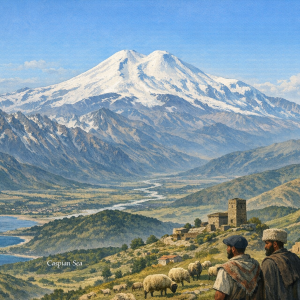
The supplied spelling is a nonstandard form that ordinarily refers to the Caucasus Mountains, the great mountain system situated between the Black Sea and the Caspian Sea. The omitted syllable materially changes the word: Caucasus is the geographical name, whereas caucus is an unrelated English political term for a meeting or organization of party members.
Geographically, the system includes two principal divisions:
- The Greater Caucasus, extending generally northwest to southeast between the Black and Caspian seas. Its highest summit is Mount Elbrus, approximately 5,642 meters or 18,510 feet above sea level.
- The Lesser Caucasus, lying farther south across portions of Georgia, Armenia, Azerbaijan and adjoining highlands.
The Greater Caucasus watershed is often treated as part of the conventional boundary between Europe and Asia. Under that convention, Mount Elbrus is considered the highest mountain in Europe. Continental boundaries, however, are geographical conventions rather than natural rules having universal legal force. Other systems place portions of the Caucasus differently. ([nationalgeographic.org](https://www.nationalgeographic.org/society/national-geographic-map-policy/?utm_source=openai))
The term may denote the mountain system itself or, more broadly, the surrounding Caucasus region. The wider region includes the North Caucasus within the Russian Federation and the South Caucasus, principally Georgia, Armenia and Azerbaijan. Because the geographical, cultural and political meanings do not have precisely identical boundaries, careful writing should specify whether the subject is the mountains, the watershed, the peoples of the region or a governmental territory.
Etymology and Origin
The English name Caucasus came through Latin Caucasus from ancient Greek Kaukasos. The name was known to Greek and Roman geographers, although their maps and descriptions did not always correspond closely to modern geography. The Library of Congress notes that accurate mapping of this topographically and ethnolinguistically complex region developed over many centuries. ([guides.loc.gov](https://guides.loc.gov/caucasus-maps/contents-history?utm_source=openai))
The name’s deeper origin remains uncertain. Pliny the Elder reported a supposed Scythian form often rendered Croucasis and interpreted as referring to a mountain shining or whitened with snow. Other proposed derivations connect the name with ancient words for a mountain, height, rock or heap. These are scholarly proposals rather than established facts, and no single derivation has achieved universal acceptance. ([etymonline.com](https://www.etymonline.com/word/Caucasus?utm_source=openai))
The political word caucus developed in American English during the eighteenth century and has an uncertain etymology of its own. Proposed origins include an Indigenous American word, the name of a Boston political club, and expressions associated with tradesmen or meeting places. None establishes a linguistic relationship with the ancient geographical name. The resemblance is therefore best treated as accidental, and the two words should not be merged. ([etymonline.com](https://www.etymonline.com/word/caucus?utm_source=openai))
Cultural and Historical Context
The mountains have functioned both as a barrier and as a meeting place. High ridges, glaciers, deep valleys and difficult passes limited the movement of armies and administrations, while particular corridors enabled trade, seasonal migration and military campaigns. Routes associated with the Darial Pass, the Caspian corridor near Derbent and other valleys connected the Eurasian steppe with Anatolia, Iran and the lands farther south.
Ancient and medieval sources associated the region with such lands and peoples as Colchis, Iberia, Armenia, Caucasian Albania, the Alans and numerous mountain communities. At different times, parts of the region came under or interacted with Persian, Greek, Roman, Byzantine, Arab, Mongol, Ottoman and Russian power. It would be misleading, however, to speak of the entire mountain system as naturally belonging to any one empire, ethnicity or religion. Political control was repeatedly divided, contested or exercised only indirectly. Encyclopaedia Iranica describes the region as a frontier affected by centuries of Persian, Turkish and Russian rivalry and by extensive cultural and population movements. ([iranicaonline.org](https://www.iranicaonline.org/articles/caucasus-index/?utm_source=openai))
The Caucasus is especially noted for linguistic diversity. Indigenous language families include Kartvelian, Northwest Caucasian and Northeast Caucasian languages, alongside Indo-European, Turkic and other languages introduced or expanded through migration, commerce and conquest. Older descriptions sometimes called the region a “mountain of languages.” That expression captures the extraordinary diversity, but it should not be used to portray the peoples of the region as primitive, isolated or interchangeable. Each community has its own history, law, literature, customary institutions and political experience. ([loc.gov](https://www.loc.gov/resource/gdc.a22000912/?st=brief&utm_source=openai))
From the late eighteenth through the nineteenth century, the Russian Empire extended its authority into the region through diplomacy, wars against the Ottoman and Persian states, and prolonged campaigns against mountain resistance. The treaties of Gulistan in 1813 and Turkmenchay in 1828 transferred substantial territories from Qajar Iran to imperial Russia. The subsequent Caucasian War and related campaigns brought many North Caucasian territories under Russian control and produced death, displacement and large-scale migration, including the departure of many Circassians and other Muslims into Ottoman lands.
After the Russian Revolution, the region experienced short-lived independence movements, Soviet incorporation and the drawing of internal administrative boundaries. The Soviet Union’s dissolution in 1991 transformed many of those internal divisions into international borders or disputed political claims. Modern conflicts in and around Abkhazia, South Ossetia, Chechnya and Nagorno-Karabakh have demonstrated that mountain geography can complicate transportation, civilian protection, border administration and humanitarian access. Historical labels should therefore be used with care and should not be treated as automatic endorsements of modern territorial claims.
Biblical / Torah Context
The Torah does not expressly name the Caucasus mountain system. Genesis 8:4 states that Noah’s ark came to rest upon the Hebrew hare Ararat, meaning the “mountains of Ararat.” The plural expression describes a mountainous district and does not, by itself, identify a single summit. Other biblical references employ Ararat as the name of a land or kingdom. The name is generally connected with ancient Urartu, centered in the Armenian Highlands around Lake Van and neighboring territories. ([mechon-mamre.org](https://mechon-mamre.org/p/pt/pt0108.htm?utm_source=openai))
The Armenian Highlands, the modern peak commonly called Mount Ararat and the Caucasus are geographically related parts of a wider highland world, but they are not identical terms. Mount Ararat stands in present-day eastern Turkey, south of the main Greater Caucasus chain. Consequently, a statement that Genesis specifically names the Caucasus Mountains goes beyond the wording of the text.
Jewish and other ancient interpretive traditions did not always identify the ark’s resting place with the modern summit. Targum Onkelos renders the location as the mountains of Kardu, a tradition associated with a region farther south. Later Jewish, Christian and Islamic traditions developed several proposed locations. The modern identification of a particular volcanic peak with the biblical account is historically important, especially in Armenian religious and national tradition, but remains an interpretation rather than a geographical conclusion expressly stated in the Torah. ([sefaria.org](https://www.sefaria.org/Onkelos_Genesis.8.4?utm_source=openai))
Claims that the mountains are conclusively the location of Eden, the origin of all post-Flood peoples or the proven resting place of surviving ark remains are disputed. Such claims may be maintained as matters of faith or traditional interpretation, but archaeological and textual evidence does not establish them as uncontested historical facts.
Legal Implications
The geographical expression creates no independent doctrine of English or American common law. It does not, merely by being placed on a map, establish sovereignty, citizenship, nationality, title to land or jurisdiction. Legal authority in the region arises from constitutions, domestic legislation, treaties, internationally recognized borders, administrative acts, judgments and, in disputed areas, competing claims whose validity cannot be resolved by a dictionary definition.
Historically, customary law played an important role in many mountain communities. Councils of elders, kinship obligations, village assemblies, customary rules of hospitality and vengeance, religious law and princely or imperial enactments sometimes operated together. These systems should not automatically be called “common law” in the technical Anglo-American sense. They may share features with customary law, but they arose from distinct institutions and legal traditions.
The mountains have affected legal and governmental administration by shaping borders and watersheds. A ridge may serve as a convenient boundary, but a state frontier is created or recognized through legal and political processes, not by terrain alone. Even where a treaty follows a watershed, disputes may arise over the location of the crest, river sources, passes, enclaves, grazing grounds or the interpretation of old maps.
In an Anglo-American deed, contract, statute or historical record, use of the supplied spelling would normally be treated as a possible clerical error or geographical misnomer. A court interpreting such language would examine the entire instrument, its historical setting, maps, surrounding descriptions and other evidence of intended meaning. If only one identifiable mountain system fits the context, the error may not defeat the instrument. If the spelling creates genuine uncertainty between possible places or subjects, extrinsic evidence and the governing jurisdiction’s rules of interpretation may become necessary. No universal outcome can be stated without examining the document and applicable law.
Modern legal issues include environmental protection, tourism regulation, mining, water use, border security, cultural-property protection and the rights of displaced persons. The Western Caucasus in the Russian Federation was inscribed on the UNESCO World Heritage List in 1999 because of its ecosystems, forests, endemic species and relative lack of large-scale human disturbance. UNESCO status does not transfer sovereignty, but it creates international conservation commitments for the state party under the World Heritage Convention. ([whc.unesco.org](https://whc.unesco.org/en/list/900/?utm_source=openai))
Spiritual Meaning
Mountains commonly symbolize endurance, separation, ascent, revelation, refuge and proximity to the divine. Such symbolism can be applied interpretively to the Caucasus, but it is not a single doctrine shared by every people of the region. Local sacred landscapes include Christian churches and monasteries, Islamic shrines, Jewish communities, ancestral places, holy springs, groves and peaks associated with particular traditions.
In Greek mythology, the Caucasus became famous as the remote place where Prometheus was bound after defying Zeus and giving fire to humanity. The story made the mountains a symbol of punishment, rebellion, sacrifice, knowledge and eventual liberation. This is a Greek mythological association, not proof that the mountains had a Greek origin or that local peoples universally accepted the Greek account. ([perseus.tufts.edu](https://www.perseus.tufts.edu/hopper/text?doc=Perseus%3Atext%3A1999.01.0010&utm_source=openai))
Persian and Islamic literature also developed traditions concerning Mount Qaf, a legendary cosmic or world-encircling mountain associated in various accounts with distant realms, spirits and the limits of the known world. Writers sometimes connected Qaf with the Caucasus, but the legendary mountain cannot simply be equated with the physical range. The connection belongs to the history of imagination, poetry and medieval cosmography rather than modern cartography.
From a spiritual interpretive perspective, the mountain system may represent the boundary between worlds: Europe and Asia, steppe and highland, empire and village, the known and unknown. This is the dictionary’s interpretive analysis, not an established religious definition.
Modern Usage
In modern English, the standard geographical forms are Caucasus, Caucasus Mountains, Greater Caucasus, Lesser Caucasus, North Caucasus and South Caucasus. The Russian form Kavkaz and related regional forms such as Kafkas also appear in names, translations and historical writings.
The term is used in geography, geology, climatology, ecology, mountaineering, archaeology, linguistics, history and international affairs. Geologically, the region forms part of an active zone produced by the continuing interaction of major crustal plates. Its dramatic variation in elevation helps create environments ranging from humid Black Sea forests to alpine meadows, glaciers and comparatively dry eastern landscapes.
The Western Caucasus contains extensive forests and significant endemic plant and animal life. UNESCO describes it as one of Europe’s comparatively rare large mountain areas retaining extensive ecosystems with limited historical human disturbance. Conservation concerns include infrastructure development, unregulated construction, habitat fragmentation, tourism pressure, poaching, invasive species and climate-related changes to glaciers and alpine environments. ([whc.unesco.org](https://whc.unesco.org/en/list/900/?utm_source=openai))
The adjective Caucasian properly means relating to the Caucasus, its inhabitants, languages or cultures. In older anthropology and continuing American popular usage, it has also been used as a broad racial synonym for “white.” These meanings should be distinguished. A Georgian, Chechen, Armenian, Circassian, Avar, Azerbaijani, Ossetian or other person from the region may be Caucasian geographically without fitting simplistic American racial assumptions.
Controversies / Criticisms
Spelling and Political Confusion
The shortened spelling invites confusion with a political caucus. A caucus is a meeting, faction or organized group within a political body; it is not the name of the mountain system. Editors should correct the geographical form unless faithfully reproducing a historical document, quotation or title. When preserving an original misspelling, a note such as sic or an editorial clarification may be appropriate.
Continental Boundary
Calling the range the absolute division between Europe and Asia can imply more certainty than exists. Europe and Asia form one continuous landmass, and their boundary is conventional. The Greater Caucasus watershed is a widely used dividing line, but alternative schemes exist. Continental classification should not be confused with the cultural identity or political allegiance of the region’s inhabitants.
Race Terminology
The racial use of Caucasian arose from eighteenth-century European attempts to divide humanity into biological varieties. Johann Friedrich Blumenbach used the name in a classification influenced partly by a Georgian skull and by aesthetic assumptions about peoples of the region. Modern biological anthropology rejects the idea that humanity consists of fixed, pure continental races. The American Association of Biological Anthropologists states that race does not accurately represent human biological variation and that human populations have never been biologically isolated or homogeneous. ([etymonline.com](https://www.etymonline.com/word/Caucasus?utm_source=openai))
Accordingly, Caucasian remains accurate as a regional adjective but is often imprecise or misleading as a universal racial label. Legal or administrative forms may still employ inherited racial categories, yet those classifications are products of particular governmental systems and should not be mistaken for neutral geographical science.
Biblical and Legendary Claims
Another controversy arises when biblical, Greek or Islamic traditions are presented as literal cartography. Ararat, Prometheus and Mount Qaf all contribute to the region’s cultural significance, but they come from different texts and traditions. Responsible interpretation distinguishes scripture from later identification, mythology from local history, and spiritual symbolism from physical evidence.
Geopolitical Labels
Expressions such as “Transcaucasia,” “Russian Caucasus” or “the Caucasus frontier” may reflect the viewpoint of a particular empire or mapmaker. “Transcaucasia,” for example, means the territory beyond the Caucasus from a northern or Russian perspective. Such terms remain useful in historical scholarship, but their directional and political assumptions should be recognized.
Conclusion
The supplied form is best understood as a spelling error for the established name of a major Eurasian mountain system. The corrected term encompasses a complex physical landscape and, in broader usage, one of the world’s most culturally and linguistically diverse regions. Its history includes trade, migration, religious development, imperial rivalry, resistance, displacement and modern state formation.
No single empire, religion, mythology or racial theory adequately defines the mountains. Their biblical connection is indirect through the neighboring lands of Ararat; their Greek and Persian legendary associations are culturally important but should not be treated as geographical proof. Legally, the name does not determine sovereignty or title. Its proper use requires attention to spelling, scale, historical context and the distinction between documented fact, inherited tradition and interpretive symbolism.
Sources / Further Reading
- Encyclopaedia Iranica, “Caucasus and Iran”: https://www.iranicaonline.org/articles/caucasus-index/
- Oxford Classical Dictionary, “Caucasus”: https://academic.oup.com/edited-volume/61673/chapter-abstract/548509076
- Library of Congress, “An Abbreviated History of Maps of the Caucasus”: https://guides.loc.gov/caucasus-maps/contents-history
- UNESCO World Heritage Centre, “Western Caucasus”: https://whc.unesco.org/en/list/900/
- National Geographic Society, Map Policy: https://www.nationalgeographic.org/society/national-geographic-map-policy/
- Online Etymology Dictionary, “Caucasus”: https://www.etymonline.com/word/Caucasus
- Oxford University Press, “The Origin of the Word Caucus”: https://blog.oup.com/2024/01/the-origin-of-the-word-caucus-conclusion/
- Mechon-Mamre, Genesis 8:4, Hebrew and English: https://mechon-mamre.org/p/pt/pt0108.htm
- Sefaria, Onkelos Genesis 8:4: https://www.sefaria.org/Onkelos_Genesis.8.4
- Jewish Encyclopedia, “Ararat”: https://www.jewishencyclopedia.com/articles/1711-ararat
- Perseus Digital Library, Aeschylus, Prometheus Bound: https://www.perseus.tufts.edu/hopper/text?doc=Perseus%3Atext%3A1999.01.0010
- American Association of Biological Anthropologists, “Statement on Race and Racism”: https://bioanth.org/about/aaba-statement-on-race-racism/