Primary Definition
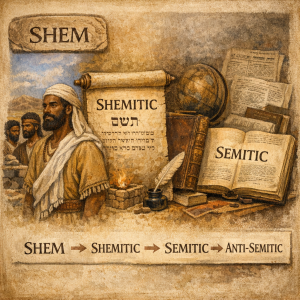
Anti-Semitic (also written antisemitic) is a later constructed adjective whose terminology begins, not with nineteenth-century politics, but with Shem (Hebrew: שֵׁם), the biblical son of Noah whom would be known as now ancient Israelites not Jews that is a term later constructed. The historical progression is:
Shem → Shemitic → Semitic → anti-Semitic / antisemitic.
In the Torah’s genealogical setting, Shem is named among Noah’s sons. Later European scholarship formed terms connected with that biblical name to classify a family of related languages and, less carefully, the peoples believed by older scholarship to be connected with them. Shemitic is an English form visibly connected to Shem; Semitic is the more common later scholarly form transmitted through Greek, Latin, German, French, and other European language traditions. The spelling difference does not create a different biblical root.
Anti-Semitic is therefore not the root term. It is a later expression constructed from anti-, meaning “against,” plus Semitic. Semitic existed first as a broad linguistic and historical designation. It has been used for the language family that includes Hebrew, Aramaic, Arabic, Ge’ez, Akkadian, Ugaritic, Phoenician, and related languages. That linguistic classification was later joined to nineteenth-century racial theories that are now rejected as unsound.
The Common Law Dictionary’s editorial analysis is that the later expression anti-Semitic appropriated and narrowed preexisting Shemitic/Semitic terminology. A broad term derived from Shem and used in language scholarship became attached to a much narrower political label concerning hostility toward Jews. That analysis rests on chronology and construction: Semitic predates anti-Semitic, and the political expression borrowed the older word while assigning it a specialized target. This dictionary does not claim that historians universally call the construction “plagiarism.” In ordinary legal and literary usage, plagiarism usually means uncredited copying of another’s work or expression; the historical evidence more securely establishes borrowing, recasting, and narrowing of terminology than it establishes plagiarism in that technical sense.
Only after that root history is understood should the modern conventional meaning be stated. In present English, anti-Semitic ordinarily describes prejudice, hostility, discrimination, conspiracy theory, exclusion, harassment, or violence directed against Jews because they are Jewish, are perceived to be Jewish, or are associated with Jewish people or institutions. The specialized modern usage arose in nineteenth-century Europe and became especially associated with organized anti-Jewish political movements. Its settled modern meaning is thus narrower than the literal breadth suggested by the earlier word Semitic.
A careful definition must keep both facts in view. It should neither erase the ancient and linguistic history of Shem and Semitic terminology nor deny that modern dictionaries, institutions, scholars, and governments generally use antisemitism to identify hostility toward Jews.
Etymology and Origin
Shem and the Hebrew Form
Shem, שֵׁם (Shem), is the Hebrew name used in Genesis for Noah’s son. In ordinary biblical Hebrew, the same word also means “name,” though the patriarchal name must be understood in its narrative setting rather than treated merely as an abstract noun. Genesis names Shem, Ham, and Japheth among Noah’s sons; Genesis 10 and 11 provide genealogical tables and the line through Shem to Abram/Avraham.
The English spelling Shem uses sh because the initial Hebrew letter shin, שׁ, is ordinarily represented in English transliteration by sh. The variation Sem, from which European forms such as Semitic developed, reflects a different transmission route. The ancient Greek Septuagint rendered the name as Sēm (Σήμ), and Latin followed related forms. German semitisch, French sémite, and English Semitic arose within that European learned tradition. Thus, the absence of the English letter h in Semitic is not proof of deception or theft; it is explainable through ordinary transliteration and transmission between languages.
Shemitic and Semitic
Shemitic is an English-derived form meaning connected with Shem. It remains intelligible because its connection to Shem is apparent, although Semitic became the dominant scholarly spelling. The modern scholarly term is generally traced to German eighteenth-century scholarship, especially August Ludwig von Schlözer’s 1781 use of semitisch for a group of languages associated, under the biblical framework then used by European scholars, with the descendants of Shem.
That classification was an important step in comparative linguistics, but its original biblical-genealogical assumptions must be handled cautiously. Languages can be related without proving that all their speakers descend biologically from one biblical ancestor. Modern linguistics uses Semitic primarily as a language-family term, not as proof of a single race, nation, bloodline, religion, or modern political identity. The old expressions “Semitic race” and “Semitic people,” when used as fixed biological classifications, reflect racialist scholarship rather than a sound scientific account of human variety.
Anti-, Anti-Semitic, and Antisemitismus
The prefix anti- comes through Latin from Greek anti, meaning “against,” “opposite,” or “in opposition to.” The later compound anti-Semitic therefore combines a Greek-derived prefix with a European scholarly form derived ultimately from the biblical name Shem.
German Antisemitismus became the influential political noun in the late nineteenth century. English developed related forms: anti-Semite, anti-Semitic, and anti-Semitism. In contemporary style, many institutions prefer the closed forms antisemitic and antisemitism. The International Holocaust Remembrance Alliance argues that the closed spelling better reflects the word’s established specialized meaning and avoids suggesting that there is a coherent doctrine called “Semitism” opposed by “anti-Semitism.” The hyphenated spelling remains common in historical works, government records, dictionaries, and ordinary writing.
Ancient Israelite and Biblical/Torah Context
The Torah does not contain the modern word anti-Semitic, antisemitism, or Antisemitismus. Those are modern European constructions and should not be projected backward into the ancient text as though the patriarchs used them. The foundational biblical context is instead the genealogy of Shem and the later line described in Genesis: Shem; Arpachshad; Shelah; Eber; Peleg; Reu; Serug; Nahor; Terah; and Abram, later called Avraham.
Within the Torah’s narrative, Avraham’s son Isaac/Yitschaq fathers Jacob/Yaakov, whose name is changed to Israel. Jacob’s descendants become the tribes of Israel, or Israelites. This is the appropriate ancient Israelite setting for discussing the Hebrew line in the biblical account. Ancient Israelites existed many centuries before the nineteenth-century expression Antisemitismus. They should not automatically be called “Jewish,” because “Jew,” “Judahite,” “Judaean,” and later “Jewish” refer to historically developing identities and contexts. Later Jewish identity and Jewish communities are real and important subjects, but they should not be used as an imprecise substitute for every earlier Hebrew or Israelite identity.
The Torah presents oppression of Israelites in Egypt as a pattern in which a governing power portrays a distinct people as dangerous, numerous, and disloyal, then converts suspicion into forced labor and violent policy. Exodus therefore supplies a moral and historical pattern relevant to later collective hatred, though it does not use the modern terminology. The narrative calls men and women to reject false witness, murder, oppression, and unjust judgment. In this dictionary’s Ancient Israelite heritage usage, the Creator is referred to as Yah/Yahuah; the Torah’s commands concerning justice, the neighbor, and the stranger stand against dehumanization and collective punishment.
The Book of Esther, which belongs to the Writings rather than the five books of the Torah, provides another relevant narrative. Haman seeks destruction not merely against Mordecai, with whom he is personally offended, but against an entire people. He represents them as scattered, different, and disobedient to the king’s laws, then seeks governmental authority for their destruction and plunder. The account is not a nineteenth-century theory of antisemitism, but it illustrates collective blame, manipulation of state authority, minority scapegoating, and planned persecution.
Cultural and Historical Context
Hostility toward Jewish communities long predates the word antisemitism. Historians often distinguish anti-Judaism—opposition focused primarily on Jewish religion, scripture, or religious practice—from modern racial and political antisemitism. The distinction is useful, but historical movements often carried older religious accusations into newer political settings.
In medieval Christian Europe, Jews were frequently treated as outsiders because of their worship, communal law, calendar, dietary practices, and continued refusal to convert. False accusations of ritual murder, well poisoning, host desecration, conspiracy, and collective responsibility for the death of Jesus helped fuel expulsions, forced conversions, massacres, and legal disabilities. Such accusations were not established facts; they were recurrent forms of defamatory propaganda.
Economic stereotypes also developed in conditions shaped by law and exclusion. In various places, Jewish men were restricted from landholding, guild membership, and many occupations. Some entered trade, moneylending, or finance; many others remained poor. Opponents then generalized from selected cases to the false claim that Jews as a people possessed unusual wealth or secret financial control. The stereotype hid the prior restrictions that had limited available livelihoods.
During the nineteenth century, nationalism, pseudo-scientific racial theory, and political agitation transformed older anti-Jewish hostility. Jewish men and women could be represented as an alien and permanent “race,” even when secular, converted, assimilated, or patriotic citizens. This racialist framework made religious conversion irrelevant to those who promoted exclusion.
Historical Development
The chronology is important. Shem belongs to the ancient biblical genealogy. Semitic entered modern European scholarship in the late eighteenth century. Antisemitismus emerged afterward as a nineteenth-century political term.
Wilhelm Marr, a German journalist and political agitator, is widely credited with popularizing Antisemitismus in 1879. His pamphlet, Der Sieg des Judenthums über das Germanenthum (“The Victory of Judaism over Germandom”), promoted the claim that Germans and Jews were engaged in an irreconcilable racial conflict. Marr also became associated with the Antisemites’ League. His rhetoric gave old anti-Jewish accusations a modern, secular, nationalistic, and racial appearance.
That terminology did not invent hostility toward Jews; hostility was far older. It did help organize and rename it as a supposedly modern political program. In the twentieth century, Nazi ideology fused racial antisemitism with propaganda, bureaucracy, policing, legislation, and military power. After taking power in 1933, the Nazi regime progressively excluded Jews from public life, citizenship, professions, education, property, and legal protection. The Holocaust culminated in the systematic, state-sponsored murder of six million European Jews by Nazi Germany, its allies, and collaborators.
The Holocaust shows that defamatory classifications can be translated into administrative categories, statutes, confiscation, deportation, forced labor, mass shooting, and industrialized killing. Antisemitism did not end in 1945. It persists in neo-Nazi movements, Holocaust denial, conspiracy propaganda, threats, attacks on synagogues and cemeteries, exclusionary conduct, and ideological movements across differing political and religious settings.
Legal Implications
Historical Common Law and Public Power
Antisemitism was not ordinarily a named offense or tort in historical English common law. Common-law courts instead addressed particular acts: assault, battery, homicide, riot, trespass, property damage, conspiracy, and defamatory publication. Yet English and European Jews were also subjected at various times to royal, ecclesiastical, municipal, and statutory disabilities, taxes, restrictions, and expulsions. It would be inaccurate to portray historical common law as a uniform guarantee of Jewish equality.
Roman law, ecclesiastical law, equity, common law, statutes, and modern civil-rights law are distinct legal sources. A moral accusation of antisemitism does not by itself establish a common-law cause of action. Legal liability ordinarily depends on an actionable wrong and the elements of the applicable law.
Current United States Law
As of August 11, 2026, there is no single general federal crime called “antisemitism.” Federal and state law instead regulate specific unlawful conduct. Title VII of the Civil Rights Act of 1964 prohibits covered employment discrimination based on religion, race, color, and national origin. Anti-Jewish discrimination may implicate religion and, depending on the facts, ancestry, ethnicity, race, or national origin.
- Education: Title VI prohibits discrimination based on race, color, or national origin in federally funded programs. The U.S. Department of Education states that discrimination based on shared ancestry or ethnic characteristics, including discrimination against Jewish students, may fall within Title VI’s protections.
- Criminal conduct: Assault, true threats, vandalism, arson, destruction of religious property, and violence may violate federal or state criminal law. Bias motivation may trigger hate-crime provisions where statutory requirements are met.
- Religious exercise: Government action targeting Jewish worship or practice may implicate constitutional protections, civil-rights statutes, and state law.
- Speech: The First Amendment generally protects even offensive religious and political expression from government punishment. It does not protect every threat, criminal solicitation, incitement meeting the governing legal standard, discriminatory act, or violent conduct.
Executive Order 13899, issued December 11, 2019, directed federal agencies to consider antisemitism in enforcing Title VI. A later executive order of January 29, 2025, reaffirmed that policy and directed federal agencies to identify available civil and criminal authorities regarding campus antisemitism. Executive orders guide executive administration; they do not by themselves make every offensive statement criminal or create an unlimited private right of action.
Spiritual Meaning
Spiritually and ethically, antisemitism replaces individual judgment with inherited accusation. It treats a man or woman as guilty because of ancestry, religious identity, perceived association, or a stereotype imposed upon a whole people. It also relies heavily on false witness: conspiracy claims offer apparent secret knowledge while avoiding careful evidence, personal accountability, and truthful inquiry.
This dictionary’s interpretive position is that opposition to antisemitism requires more than abstaining from explicit slurs. It requires truthful speech, refusal of collective blame, protection of the vulnerable, and moral consistency. Jewish suffering must not be used as a pretext for hostility toward Arabs, Muslims, Palestinians, Christians, immigrants, or any other people. One form of dehumanization cannot morally justify another.
Modern Usage
Modern dictionaries, governments, scholars, and major institutions generally use antisemitic in the specialized sense of hostility toward Jews. Examples include claims that Jews secretly control banks, media, medicine, elections, universities, or world events; allegations that Jewish citizens are inherently disloyal; Holocaust denial or glorification; demands that individual Jews answer for every act of the government of Israel; and attacks upon Jewish institutions in retaliation for events abroad.
Criticism of a particular Jewish man or woman is not automatically antisemitic. Nor is criticism of Judaism, a Jewish institution, Zionism, Israel, or an Israeli government automatically antisemitic. Context matters. Expression may become antisemitic where it relies on historic anti-Jewish myths, imposes collective guilt upon Jews as Jews, treats Jewish identity as disqualifying, denies Jews equal rights, or uses “Zionist” as a substitute for classic anti-Jewish conspiracy claims.
The IHRA Working Definition, the Jerusalem Declaration on Antisemitism, and the Nexus Document all identify traditional stereotypes, collective blame, discriminatory exclusion, and violence as antisemitic. They differ most visibly over the treatment of anti-Zionism, double standards, boycotts, and severe criticism of Israel. None automatically overrides constitutional protections, statutory elements, evidentiary standards, or due-process requirements.
Controversies / Criticisms
A principal controversy concerns the apparent breadth of the root term. Hebrew, Arabic, Aramaic, and other languages belong to the Semitic language family. Critics therefore observe that the literal construction “anti-Semitic” seems broader than its conventional modern meaning. That criticism accurately identifies a tension between etymology and usage. Yet it does not change the established historical meaning of antisemitism, which from its nineteenth-century political development referred specifically to hostility toward Jews.
The Common Law Dictionary’s appropriation analysis addresses that tension. The modern construct borrowed the older Semitic label, then narrowed it to anti-Jewish politics. Historians and linguists may prefer to call the result a misnomer, a racialist neologism, or a historically fixed specialized term rather than plagiarism. The disagreement concerns characterization, not the chronology: the root terminology came first, and the political compound came later.
A second controversy concerns Israel and Zionism. Treating every criticism of Israel as antisemitic makes the term too broad and can chill lawful political speech. Conversely, changing “Jews” to “Zionists” does not remove antisemitic character where a statement repeats blood libel, secret-control myths, collective guilt, or calls for violence against Jews. The responsible inquiry considers words, context, target, pattern, evidence, and whether comparable standards are applied to others.
A third concern is careless accusation. False charges of antisemitism can damage reputations and weaken public confidence in genuine complaints. But the possibility of misuse does not justify dismissing documented anti-Jewish threats, exclusion, stereotypes, or violence. Precision, evidence, proportionality, and fair opportunity to answer disputed allegations are essential.
Conclusion
The historical sequence remains central: Shem → Shemitic → Semitic → anti-Semitic. Shem is the biblical ancestral name in the Torah’s genealogy; Shemitic is a form visibly connected with that name; Semitic became the influential European scholarly form for a language family; and anti-Semitic/antisemitic became a later nineteenth-century political construct formed from anti- plus Semitic.
The root terminology is ancient in source and broad in linguistic association. The later expression is modern in construction and specialized in established usage. Contemporary usage properly identifies hostility, discrimination, conspiracy theory, exclusion, and violence directed against Jews as Jews. A complete definition should preserve that modern meaning while also refusing to conceal the older historical pathway by which a broad Shem-derived scholarly term was borrowed and narrowed into a particular political label.
Sources / Further Reading
- Hebrew Bible, Genesis 10–11, Mechon Mamre: https://mechon-mamre.org/p/pt/pt0110.htm
- Hebrew Bible, Exodus 1, Mechon Mamre: https://mechon-mamre.org/p/pt/pt0201.htm
- Oxford Classical Dictionary, “Semitic”: https://academic.oup.com/edited-volume/61673/chapter-abstract/550498307
- Oxford Academic, The People That Never Were: Linguistic Scholarship and the Invention of the Aryans, “The Emergence of the Aryan Paradigm”: https://academic.oup.com/book/60806/chapter/528996197
- German History in Documents and Images, Wilhelm Marr, “The Victory of Jewry over Germandom” (1879): https://germanhistorydocs.org/en/forging-an-empire-bismarckian-germany-1866-1890/wilhelm-marr-the-victory-of-judaism-over-germandom-march-1879
- United States Holocaust Memorial Museum, “Antisemitism”: https://encyclopedia.ushmm.org/content/en/article/antisemitism
- United States Holocaust Memorial Museum, “Antisemitism in History: From the Early Church to 1400”: https://encyclopedia.ushmm.org/content/en/article/antisemitism-in-history-from-the-early-church-to-1400
- International Holocaust Remembrance Alliance, “Working Definition of Antisemitism”: https://holocaustremembrance.com/resources/working-definition-antisemitism
- International Holocaust Remembrance Alliance, “Spelling of Antisemitism”: https://holocaustremembrance.com/resources/spelling-antisemitism
- Jerusalem Declaration on Antisemitism: https://jerusalemdeclaration.org/
- Nexus Project, “The Nexus Document”: https://nexusproject.us/nexus-resources/the-nexus-document/
- U.S. Department of Education, “Discrimination Based on Shared Ancestry or Ethnic Characteristics”: https://www.ed.gov/laws-and-policy/civil-rights-laws/title-vi/title-vi-key-issues/discrimination-based-shared-ancestry-or-ethnic-characteristics
- U.S. Equal Employment Opportunity Commission, “Religious Discrimination”: https://www.eeoc.gov/religious-discrimination
- U.S. Department of Justice, “Hate Crimes: Laws and Policies”: https://www.justice.gov/hatecrimes/laws-and-policies
- The White House, “Additional Measures to Combat Anti-Semitism,” January 29, 2025: https://www.whitehouse.gov/presidential-actions/2025/01/additional-measures-to-combat-anti-semitism/