Nigga
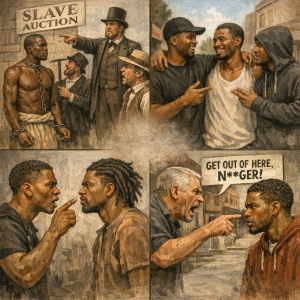
Primary Definition
This term is an informal and highly charged racial expression associated with Black American speech and culture. It developed as a pronunciation-based variant of a far older anti-Black slur. Contemporary dictionaries recognize two central facts that must be held together: first, the term remains offensive to many people because of its relationship to that slur; second, some Black speakers use it among themselves in contexts of familiarity, solidarity, affection, emphasis, criticism, or ordinary reference to a person. Neither fact cancels the other.
Meaning is therefore strongly dependent on speaker, audience, relationship, setting, tone, intent, and history. In some in-group conversations, it can function roughly as an informal address such as “friend,” “man,” or “brother,” although it may also express irritation, mockery, challenge, or disapproval. In an out-group setting—or where it is directed at a Black person as an insult—it can carry the historic force of racial contempt. A dictionary definition should not mistake occasional friendly use for universal permission, nor should it deny the real linguistic distinction some speakers make between this form and the older slur from which it developed.
As a matter of careful usage, the term should be treated as vulgar, socially risky, and frequently unwelcome. A person’s familiarity with Black music, internet culture, or particular friends does not create a general license to use it. Merriam-Webster describes the term as a pronunciation spelling of the older slur and notes both its neutral or positive use by some Black people and the substantial offense its use by non-Black people ordinarily causes. ([merriam-webster.com](https://www.merriam-webster.com/dictionary/nigga?utm_source=openai))
Etymology and Origin
Documented etymology. The modern term is a phonetic and orthographic variant of an English racial slur historically applied to Black people. The older word entered English through forms connected with Spanish and Portuguese negro, French nègre, and ultimately Latin niger, meaning “black.” That remote Latin adjective, however, should not be confused with the social meaning of the later English slur. Words change meaning through actual historical use, and the English racial epithet acquired its distinctive force through colonialism, slavery, racial hierarchy, segregation, and anti-Black violence—not merely through a Latin color word.
The spelling addressed here represents a pronunciation without the final r, a feature that occurs in several English dialects and is not unique to Black American speech. The two spellings nevertheless developed different social patterns of use. Merriam-Webster records this form in 1848 and explains that, during the nineteenth century, the forms began to diverge among some African Americans, with this pronunciation increasingly used in certain neutral or positive self-referential and interpersonal contexts. ([merriam-webster.com](https://www.merriam-webster.com/dictionary/nigga?utm_source=openai))
Interpretive analysis. Etymology explains lineage; it does not settle present meaning in every conversation. A word’s sound, spelling, speakers, audience, and cultural history can all matter. Thus, it is inaccurate to say that the term simply means “friend” in all circumstances. It is equally inaccurate to say that every occurrence carries exactly the same intent or force as the older slur. The historically related forms overlap in painful associations but are not used identically by every speaker or in every community.
Cultural and Historical Context
The term cannot be understood apart from the history of anti-Black racial language in the United States and other English-speaking societies. The older epithet was used during eras of enslavement, legal segregation, exclusion, and racial terror to mark Black people as inferior and outside full civic belonging. Its use was not merely descriptive: it often operated as verbal reinforcement for unequal social, economic, and legal power.
After emancipation, the language of racial degradation did not disappear. It persisted through Jim Crow segregation, discriminatory customs, popular caricature, violence, and unequal treatment in institutions. Historical records preserved by the Library of Congress, including formerly enslaved people’s narratives and recordings, also show why historical language must be handled with care: interview conditions, racial power differences, and editorial intervention could shape what was said and how speech was represented on the page. ([loc.gov](https://www.loc.gov/loc/lcib/9811/slavery.html?utm_source=openai))
Within this broader history, some Black speakers transformed the pronunciation and social use of the term in particular settings. This process is commonly called reclamation, reappropriation, or resignification: members of a group subjected to a label may adapt it for solidarity, irony, defiance, familiarity, or cultural expression. Reclamation is neither automatic nor complete. A reclaimed expression can remain objectionable within the very community connected to it, particularly across differences of age, region, gender, faith, class, family history, and personal experience.
Hip-hop has been especially important in making the term globally recognizable. Music, film, comedy, gaming, social media, and online slang have moved it far beyond the local communities in which particular in-group meanings developed. Commercial circulation has often stripped away context. Hearing a term in a lyric, repeating it while quoting entertainment, or seeing it used online does not necessarily communicate the same relationship, consent, or cultural position as its use within a trusted conversation.
Language, Dialect, and Misconceptions
The spelling should not be used as evidence that African American English is “broken English.” African American English is a studied, systematic variety of English with its own historical development, patterns, and social varieties. Scholarship on African American language emphasizes the importance of examining actual historical sources rather than reducing the language to stereotypes or treating one controversial word as representative of an entire people. ([academic.oup.com](https://academic.oup.com/edited-volume/28056/chapter-abstract/212004105?utm_source=openai))
Nor is the term a racial designation for all people of African descent, all Black Americans, or all members of a supposed homogeneous culture. It is a culturally situated word with highly variable acceptance. Responsible speakers should avoid presuming that any individual welcomes it, uses it, or accepts another person’s use of it.
Biblical / Torah Context
There is no documented Biblical or Torah origin for this English term, and it does not arise from Hebrew, Aramaic, Biblical Greek, or the scriptural vocabulary of Judaism or Christianity. Attempts to assign it a Biblical curse, a Torah derivation, or a theological racial classification are unsupported by the word’s documented etymology.
Some later religious speakers and writers have used racial language in sermons, polemics, or social arguments, including arguments about slavery and segregation. Those later uses are historical examples of people employing religious authority; they do not establish a scriptural definition or origin for the term. A sound dictionary treatment should distinguish the text of a religious tradition from later political, racial, or ideological claims made in its name.
Legal Implications
No Independent “Common Law” Definition
The term is not a technical term of art in English common law, Roman law, equity, military law, or the law of government. It has no inherent legal power merely because it is spoken or written. Historically, common-law systems developed rules concerning defamation, assault, breach of the peace, employment relations, and later civil-rights protections, but the word itself is not a legal status, jurisdiction, contract, or governmental classification.
Where the term appears in legal records, it generally appears as evidence of alleged racial hostility, discriminatory motive, harassment, threats, or historical context. Courts evaluate the surrounding facts: who spoke, to whom, how often, with what authority, whether the conduct was threatening or humiliating, whether it affected employment or another protected interest, and which statute or constitutional rule governs.
Employment and Civil-Rights Law
Under federal employment law, Title VII of the Civil Rights Act of 1964 prohibits discrimination because of race. The Equal Employment Opportunity Commission identifies racial slurs, epithets, ridicule, and similar conduct as possible forms of racial harassment. The EEOC further explains that unlawful hostile-environment harassment depends on whether conduct is unwelcome and sufficiently severe or pervasive to alter working conditions; context matters, and an unambiguous racial epithet may in some circumstances be sufficiently serious even as a single incident. ([eeoc.gov](https://www.eeoc.gov/laws/guidance/section-15-race-and-color-discrimination?utm_source=openai))
This is statutory civil-rights law, not a rule inherited unchanged from old common law. The United States Supreme Court has held that a hostile-work-environment inquiry looks to all circumstances, including frequency, severity, whether conduct is threatening or humiliating, and whether it interferes with work. The standard contains both an objective and subjective component. ([law.cornell.edu](https://www.law.cornell.edu/supremecourt/text/510/17?utm_source=openai))
State law may provide additional or different protections. For example, in Bailey v. San Francisco District Attorney’s Office (July 29, 2024), the Supreme Court of California held that an isolated use of an unambiguous racial epithet can be actionable under California’s Fair Employment and Housing Act if sufficiently severe under the totality of the circumstances. That holding does not mean every utterance automatically establishes liability; it means courts must not apply a categorical rule that a single use can never be serious enough. ([law.justia.com](https://law.justia.com/cases/california/supreme-court/2024/s265223.html?utm_source=openai))
Speech, Threats, and Public Authority
In the United States, offensive speech is often protected by the First Amendment, including speech that many listeners reasonably condemn. The mere use of a racial term does not automatically create a criminal offense. But constitutional protection is not unlimited: true threats, targeted intimidation, harassment under applicable law, discriminatory employment conduct, and speech connected to other unlawful acts may have legal consequences. The Supreme Court has recognized that states may punish intimidation intended to place a person or group in fear of bodily harm or death. ([supreme.justia.com](https://supreme.justia.com/cases/federal/us/538/343/?utm_source=openai))
Government employees, military personnel, students, contractors, and private employees may also be subject to workplace, school, service, or disciplinary rules that are stricter than the minimum boundary of criminal law. Such rules depend on the institution, the governing statute or policy, due-process requirements, collective-bargaining agreements where applicable, and constitutional limits. There is no single universal legal result.
Spiritual Meaning
The term has no inherent spiritual meaning, sacred function, or universally accepted religious significance. Any spiritual interpretation is therefore personal or community-specific rather than lexical fact. Some people may view its in-group use as an expression of survival, communal identification, resistance, or linguistic self-definition. Others may view any use as spiritually harmful because it recalls degradation, trauma, division, or contempt.
A balanced spiritual analysis should avoid declaring either view binding on all people. The defensible general observation is that language can affect dignity, memory, relationships, and conscience. Traditions that emphasize truthfulness, neighborly regard, restraint, repentance, reconciliation, or the moral weight of speech may lead adherents to avoid the term altogether, especially outside a context where its use is clearly welcome.
Modern Usage
In current American English, the term appears in informal speech, recorded music, fictional dialogue, comedy, social media, memes, and quotations about race. It may be used as a noun of address, an expression of affiliation, a rebuke, an intensifier, or a reference to another person. The same spelling can perform sharply different social work: affectionate among close peers, insulting in an argument, provocative in performance, or plainly racist when wielded by someone seeking to demean.
Because written communication removes tone and relationship cues, online use is particularly prone to misunderstanding. Quotation may be necessary in scholarship, journalism, court reporting, historical archives, and dictionary work. Even then, a writer should ask whether full repetition is necessary for accuracy or whether “the N-word” conveys the relevant point without reproducing harmful language. Editorial judgment is not censorship; it is attention to audience, purpose, and avoidable injury.
Controversies / Criticisms
The principal controversy is whether reclamation can successfully separate the term from the history of the older slur. One position holds that in-group use creates a meaningful new social sense that can express closeness, humor, and cultural ownership. Another holds that the term’s history remains so injurious that normalizing it—whether used by Black speakers or anyone else—continues to reproduce harm. Many people hold intermediate views: they recognize in-group linguistic reality while personally declining to use the word.
A related dispute concerns out-group use. Some argue that equal treatment requires identical permission for every speaker. Critics respond that this view ignores unequal historical power and the basic linguistic fact that social meaning changes with speaker identity, relationship, setting, and history. Dictionaries describe usage; they do not grant permission. The practical consensus reflected in major dictionary guidance is that non-Black use is widely regarded as highly offensive, including when presented as imitation, quotation for entertainment, provocation, or casual slang. ([merriam-webster.com](https://www.merriam-webster.com/dictionary/nigga?utm_source=openai))
Another criticism concerns commercialization. Popular media may profit from Black cultural forms while exposing Black speakers to greater professional or social consequences than outsiders who imitate those forms. Conversely, efforts to prohibit every quotation can make historical scholarship, legal reporting, and serious discussion more difficult. The proper response is context-sensitive judgment: distinguish analysis from abuse, quotation from endorsement, and historical documentation from gratuitous repetition.
Conclusion
This term is best understood as a historically burdened, culturally contested expression whose meaning cannot be reduced to a single substitute word. Its etymological connection to a notorious anti-Black slur is documented. Its use by some Black speakers in familiar or self-referential contexts is also documented. These realities do not make the term neutral, universally acceptable, legally privileged, or safe for general use.
In law, it is not a common-law term of art; rather, it may be evidence in cases involving discrimination, harassment, threats, motive, or hostile environment. In religion, it has no Biblical or Torah origin and no inherent sacred meaning. In ordinary life, the most responsible course is to recognize its history, avoid treating Black culture as public permission for imitation, and use precise language that respects the actual people and circumstances involved.
Sources / Further Reading
- Merriam-Webster, “Nigga.” https://www.merriam-webster.com/dictionary/nigga
- Oxford Advanced Learner’s Dictionary, “Nigger.” https://www.oxfordlearnersdictionaries.com/us/definition/english/nigger
- U.S. Equal Employment Opportunity Commission, “Section 15: Race and Color Discrimination.” https://www.eeoc.gov/laws/guidance/section-15-race-and-color-discrimination
- U.S. Equal Employment Opportunity Commission, “Questions and Answers for Employees: Harassment at Work.” https://www.eeoc.gov/questions-and-answers-employees-harassment-work
- U.S. Supreme Court, Harris v. Forklift Systems, Inc., 510 U.S. 17 (1993), via Legal Information Institute. https://www.law.cornell.edu/supremecourt/text/510/17
- Supreme Court of California, Bailey v. San Francisco District Attorney’s Office (2024). https://law.justia.com/cases/california/supreme-court/2024/s265223.html
- U.S. Supreme Court, Virginia v. Black, 538 U.S. 343 (2003). https://supreme.justia.com/cases/federal/us/538/343/
- Library of Congress, “Slavery as Memory and History.” https://www.loc.gov/loc/lcib/9811/slavery.html
- Oxford Academic, “Documenting the History of African American Vernacular English.” https://academic.oup.com/edited-volume/28056/chapter-abstract/212004105