Patriarch
Primary Definition
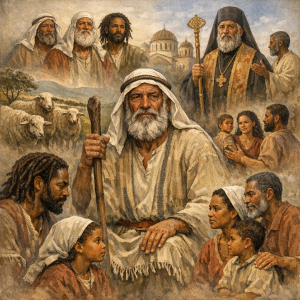
Patriarch commonly means a father, ancestral founder, or respected senior male who stands at the head of a family, tribe, community, institution, or religious body. The word has several distinct but related senses:
- In the biblical sense, it refers especially to the ancestral fathers of Israel—most narrowly Abraham, Isaac, and Jacob.
- In ordinary family usage, it may mean the senior or influential male member of a family.
- In ecclesiastical usage, it is a formal title for certain high-ranking bishops, particularly in Eastern Christian churches.
- In a broader social sense, it may describe a male founder, elder, or leading figure.
The term should not automatically be treated as a legal title. In modern Anglo-American law, patriarch is generally descriptive rather than a defined office carrying inherent civil authority. A man may be called the patriarch of a family in social, genealogical, or religious language without thereby possessing any special legal power over adult relatives, property, or household members.
The related words patriarchal and patriarchy require care. Patriarchal may simply mean “relating to a patriarch,” but it is also used in sociology and political theory to describe systems in which men hold predominant authority in family, political, economic, religious, or legal institutions. That broader usage is evaluative in many contexts and should not be confused with the narrower historical or biblical meaning of patriarch.
Etymology and Origin
The English word patriarch entered Middle English through Anglo-French and Late Latin. Its deeper source is the Greek patriarchēs, formed from elements associated with father, lineage, or clan and archēs, meaning ruler, chief, or leader. In a literal sense, the word carries the idea of a “chief father,” “ruling father,” or fatherly head of a line or people.
This etymology explains why the word naturally developed both family and religious meanings. It does not, however, prove that every father was historically a ruler, that every household followed one uniform patriarchal model, or that modern fathers possess legal authority because of the word’s linguistic roots. Etymology can illuminate the early range of a word; it does not itself create law or establish a present legal right.
The English word was in use by the thirteenth century, initially in the scriptural sense of the ancient fathers of the Hebrew people. Over time, its meaning expanded to include venerable elders, founders, heads of families, and certain church leaders. Modern usage has further broadened it into figurative expressions such as “the patriarch of a business family,” “the patriarch of a political dynasty,” or “the patriarch of a community.”
Cultural and Historical Context
Ancient households and kinship
Many ancient societies organized inheritance, household property, social identity, and political allegiance through kinship networks. Senior men often held substantial authority, but the character and extent of that authority varied widely across time, place, class, religion, and legal system. It is therefore misleading to collapse all ancient family arrangements into a single model.
In the ancient Near Eastern setting reflected in the book of Genesis, the patriarch is principally an ancestor, covenant recipient, household leader, and bearer of a family line. Abraham, Isaac, and Jacob are presented as heads of extended households whose lives involve herds, servants, property, kinship obligations, worship, migration, marriage arrangements, and disputes over inheritance. The biblical narratives nevertheless depict women, younger sons, servants, foreign rulers, and God Himself as active participants in events; they do not reduce all authority to an unrestricted paternal command.
Roman comparison
The Roman paterfamilias is often compared with the patriarch, but the two terms are not identical. Paterfamilias was a technical Roman legal concept concerning the male who stood legally independent within a Roman household. Roman law recognized patria potestas, a form of paternal power over descendants through the male line and certain adopted children. Its content changed through Roman history and was subject to legal forms, social expectations, and practical limitations.
The Roman institution should not be casually imported into biblical interpretation or English common law. The Bible was not written as a Roman-law treatise, and English common law developed through its own medieval and later history. Similar language about fathers, households, ancestry, or headship does not establish that the legal systems were the same.
Ecclesiastical development
Within Christianity, patriarch became a title for certain bishops who held senior standing in important historical centers of the Church. The title is especially associated with the ancient sees of Constantinople, Alexandria, Antioch, and Jerusalem, and with patriarchal structures in Eastern Orthodox, Oriental Orthodox, and Eastern Catholic traditions.
In this setting, “patriarch” is neither merely an honorific for an elderly clergyman nor a synonym for every bishop. It denotes an ecclesiastical office defined by the canons, traditions, and internal governance of the particular church concerned. The jurisdiction of a patriarch is religious and canonical within that church body; it is not a civil office of general governmental rule.
Biblical / Torah Context
The patriarchs of Israel
In Jewish and Christian usage, the biblical patriarchs are most commonly Abraham, Isaac, and Jacob. Jacob is also called Israel, and the twelve tribes of Israel are traditionally traced through his sons. The Hebrew expression Avot means “fathers,” and Jewish tradition often refers to Abraham, Isaac, and Jacob as the fathers of the people of Israel.
The Torah portrays Abraham as called into covenant with God. In Genesis 17, Abram’s name is changed to Abraham in connection with the promise that he would become “father of a multitude of nations.” The narrative joins fatherhood with covenant responsibility, faith, descendants, land, blessing, and the duty to walk before God. In this scriptural setting, patriarchal status is not merely biological seniority; it is tied to a particular covenant history.
Isaac continues the covenant line, and Jacob receives the name Israel after a defining encounter with God. The Torah’s account is not a simple celebration of paternal strength. The patriarchs are shown with serious human weaknesses: Abraham endangers Sarah in foreign lands; Isaac favors Esau; Jacob deceives Isaac and later experiences deception within his own family. The narratives present God’s covenant purposes as operating through imperfect persons rather than treating patriarchs as flawless moral examples.
Matriarchs and family covenant
Although the word patriarch centers male ancestors, the Torah’s covenant narratives cannot responsibly be understood without the matriarchs: Sarah, Rebekah, Rachel, and Leah. Their actions materially affect the family line, inheritance expectations, marriages, migration, and the future of Israel. Jewish tradition commonly honors these women as the Imahot, or mothers.
Accordingly, a biblical use of patriarch should not be used to erase the agency or spiritual importance of women in the Torah. Nor does the existence of patriarchal households mean that every modern social custom claimed in the name of male authority is commanded by Scripture. Interpretations of particular passages differ among Jewish, Christian, feminist, traditionalist, and other readers.
Later biblical usage
In the Christian New Testament, Abraham and the other ancestral fathers are remembered as patriarchs in connection with faith, promise, covenant, and the history of Israel. Christian writers also use the patriarchs typologically, seeing in their lives patterns that point toward later theological claims. Those theological readings belong to Christian interpretation and should be distinguished from the plain historical-genealogical use of the word in the Torah.
Legal Implications
Common law
Patriarch is not generally a technical term of art in the English or American common law comparable to testator, tenant, guardian, or trustee. Calling someone a family patriarch does not, by itself, give that person authority to control another adult’s residence, earnings, marriage, medical choices, religious practice, property, or legal affairs.
Historically, English common law did recognize substantial family-law distinctions between husbands and wives, parents and children, legitimate and illegitimate children, and masters and servants. One well-known historical doctrine was coverture, under which a married woman’s independent legal identity and property rights were heavily restricted in various ways. William Blackstone described husband and wife as “one person in law,” a formulation that reflected eighteenth-century common-law doctrine rather than a timeless rule of justice.
Coverture was gradually dismantled through Married Women’s Property Acts and related reforms in the nineteenth and twentieth centuries. Modern law in the United States does not generally treat a husband as the legal embodiment, owner, or sovereign ruler of his wife. Marriage does not suspend either spouse’s legal personhood.
Parental authority and limits
Modern law recognizes that parents and legal guardians have duties and decision-making authority concerning minor children. That authority is not patriarchal ownership. It is constrained by constitutional rights, family-law statutes, child-protection laws, custody orders, educational requirements, and the child’s welfare. The exact rules vary by state and circumstance.
An adult child is ordinarily a separate legal person. A father’s age, family status, religious office, financial contributions, or designation as “patriarch” does not create an inherent right to command an adult child. Likewise, an elderly father may need a legally valid power of attorney, guardianship order, trust arrangement, or other recognized legal instrument to manage another person’s affairs; family custom alone is usually insufficient.
Roman law, equity, statutes, and current law
Roman patria potestas was a historical institution of Roman civil law, not a rule of American common law. English equity developed separate doctrines concerning trusts, estates, guardianship, and fiduciary duties. Statutes later altered many common-law family and property rules. Current law is therefore determined by applicable constitutions, statutes, regulations, judicial decisions, and valid legal instruments—not by an assumed ancient right of patriarchal dominion.
Where inheritance is concerned, a patriarch may influence succession through a valid will, trust, beneficiary designation, or family business arrangement. But such authority arises from property law and legally effective documents, subject to probate, fiduciary obligations, marital rights, tax law, creditor claims, and rules against fraud or undue influence. It does not arise simply from being the family’s oldest or most respected male.
Spiritual Meaning
Spiritually, the patriarch may symbolize ancestry, continuity, covenant memory, responsibility, blessing, and the transmission of faith across generations. Abraham is especially important in Judaism, Christianity, and Islam as a figure connected with faith in God, obedience, hospitality, family descent, and divine promise. Each tradition interprets his role within its own theological framework.
In Jewish thought, the patriarchs are remembered as foundational ancestors of Israel and participants in the covenant story. In Christianity, they are often treated as witnesses to faith and as part of salvation history. In Islam, Abraham, known as Ibrahim, is revered as a prophet and exemplar of submission to God. These traditions overlap in their regard for Abraham but differ in doctrine, scripture, and interpretation.
The spiritual value of patriarchal language depends on whether it is understood as a call to accountable service rather than an excuse for domination. A father or elder who invokes biblical authority while rejecting justice, mercy, faithfulness, self-restraint, and responsibility departs from the moral demands repeatedly associated with leadership in the biblical tradition.
Modern Usage
In contemporary English, patriarch is used in several ways:
- Family usage: “He was the patriarch of a large family.”
- Historical or biblical usage: “Abraham is regarded as a patriarch.”
- Institutional usage: “The Patriarch leads or serves as a senior hierarch within a particular Eastern church.”
- Figurative usage: “She was the matriarch, while he was the patriarch, of the organization’s founding generation.”
- Critical social usage: “Patriarchal structures” may refer to systems said to privilege men’s authority or interests.
The word may be respectful, neutral, ironic, or critical depending on context. Referring to a beloved grandfather as a patriarch is usually an expression of esteem. Referring to a political, corporate, or religious leader as a patriarch may imply concentrated personal authority. Referring to a social order as patriarchal often signals criticism of unequal gendered power.
Controversies / Criticisms
The principal controversy surrounding the term arises from its relationship to patriarchy. Critics argue that patriarchal family and institutional models have historically contributed to women’s exclusion from property ownership, political participation, education, leadership, bodily autonomy, and equal legal standing. Feminist jurisprudence examines how legal rules and assumptions have sometimes treated male experience as the norm and have reinforced unequal power relations.
Traditionalists, including some religious believers, answer that fatherhood, male headship, or patriarchal language need not mean tyranny or female inferiority. They may argue that distinct family roles can coexist with equal human dignity, mutual obligation, and moral limits on authority. Others reject role-based hierarchy altogether and contend that equality requires shared authority without sex-based offices.
These disputes cannot be resolved merely by defining the word. A careful reader should distinguish: (1) the historical existence of male-centered households and offices; (2) religious interpretations of scriptural texts; (3) moral arguments about family roles; and (4) present legal rights. The fact that a structure existed historically does not by itself establish that it is just, divinely required, legally enforceable, or suitable in every modern setting.
Another recurring error is to claim that “patriarch” automatically establishes a man’s legal sovereignty over his household. That proposition is not supported by modern American law. Religious belief may shape voluntary family practices, but it does not override laws concerning violence, coercion, child welfare, fraud, discrimination, property rights, or the independent legal status of adults.
Conclusion
Patriarch is an ancient and layered word. At its core, it refers to a fatherly ancestor, founder, elder, or senior religious leader. In the Torah and Bible, it most notably identifies the ancestral fathers Abraham, Isaac, and Jacob. In Eastern Christianity, it can identify a defined ecclesiastical office. In ordinary modern speech, it often means the respected senior male of a family or institution.
The word’s history should be handled with precision. It has roots in Greek and later religious language; it is related conceptually, but not legally identical, to the Roman paterfamilias; and it is not a general source of modern civil authority. Any claimed legal power must be established by current law, a valid court order, a legally effective instrument, or recognized parental or fiduciary status—not by the label “patriarch.”
Sources / Further Reading
- Merriam-Webster, “Patriarch”: https://www.merriam-webster.com/dictionary/patriarch
- Sefaria, Genesis 17, Jewish Publication Society translation: https://www.sefaria.org/Genesis.17.11?lang=en
- Oxford Classical Dictionary, “Patria Potestas”: https://academic.oup.com/edited-volume/61673/chapter-abstract/549686905
- Yale Law School Avalon Project, Blackstone, Commentaries on the Laws of England, Book I, Chapter 15: https://avalon.law.yale.edu/18th_century/blackstone_bk1ch15.asp
- Cornell Legal Information Institute, “Feminist Jurisprudence”: https://www.law.cornell.edu/wex/Feminist_jurisprudence
- Vatican, Orientalium Ecclesiarum, sections on Eastern patriarchs: https://www.vatican.va/archive/hist_councils/ii_vatican_council/documents/vat-ii_decree_19641121_orientalium-ecclesiarum_en.html