Pastor
Primary Definition
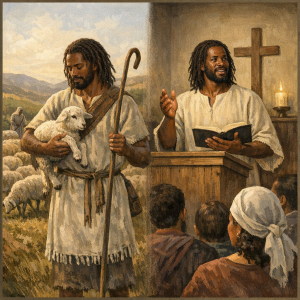
A pastor is, in its primary and oldest sense, a shepherd: one who feeds, guards, guides, gathers, and takes responsibility for a flock. In ordinary modern English, the word most often means a Christian minister entrusted with spiritual care, teaching, worship, counsel, and leadership within a congregation or parish. The central idea is therefore not merely public speaking or administration, but pastoral care: responsible oversight exercised for the good of people entrusted to one’s care.
The term may identify an office, a vocation, a function, or an honorific title. Its precise meaning depends on the church or organization using it. In many Protestant churches, “pastor” commonly denotes the principal minister of a local congregation. In other bodies, a pastor may be one minister among several elders, presbyters, priests, bishops, chaplains, or ministry staff. In Roman Catholic canon law, the pastor of a parish is the priest charged with the parish’s ordinary pastoral care under the diocesan bishop. ([vatican.va](https://www.vatican.va/archive/cod-iuris-canonici/eng/documents/cic_lib2-cann460-572_en.html?utm_source=openai))
A pastor is not, merely by use of the title, a civil officer, judge, magistrate, attorney, legislator, or governmental agent. Neither does the word itself create a universal legal status, authority over another person’s property or conscience, or exemption from ordinary civil and criminal law. The actual authority of a pastor, where any exists, arises from the internal rules of a religious body, voluntary association, employment or membership arrangements, and the limits imposed by applicable civil law.
Etymology and Origin
The English word pastor entered English through Middle English and Anglo-French forms such as pastour. It derives from Latin pastor, meaning a herdsman or shepherd, from pascere, “to feed” or “to cause to graze.” Thus, the literal origin is agricultural rather than governmental, military, judicial, or sacerdotal. The word was first used in English in the fourteenth century, initially with the literal shepherd sense and also in the figurative sense of a spiritual guide. ([merriam-webster.com](https://www.merriam-webster.com/dictionary/pastored?utm_source=openai))
This etymology matters because it guards against a common error: “pastor” did not originally mean ruler, lord, owner, or master. A shepherd may lead a flock, but the image chiefly conveys attentive care, provision, vigilance, and accountability. The later Christian use is metaphorical. It transfers the familiar task of caring for sheep to the responsibility of caring for a community of believers.
Related English words include pastoral, concerning shepherds or the spiritual care of persons; pastorate or pastorship, the office or tenure of a pastor; and pastor as a verb, meaning to serve as pastor or provide pastoral care. The word is also related at a distance to terms concerning pasture and feeding. This linguistic history does not establish a particular theology of church government, but it does establish the basic image from which the theological and institutional usages developed.
Cultural and Historical Context
Shepherding was an important reality and symbol in the ancient Near East. Sheep required regular feeding, water, protection from predators, recovery when lost, and movement between grazing places. Because kings, tribal leaders, and household heads were expected to protect and provide for their people, shepherd language could be used figuratively for political and religious leadership. The image could be positive, but it could also condemn leaders who used the flock for themselves rather than serving it.
Within Christian history, the shepherd image became a durable description of spiritual ministry. Early Christian communities used several overlapping words for leadership, including elder, overseer, deacon, teacher, and shepherd. The English title “pastor” became especially prominent in traditions that emphasize preaching, congregational care, and local ministry. It is now widely used among Baptist, Pentecostal, evangelical, non-denominational, Lutheran, Methodist, Reformed, and many other Protestant communities.
Not every Christian communion uses the word in the same way. Roman Catholic usage may call the parish priest a pastor in the sense of the proper shepherd of a defined parish, while retaining the distinct sacramental and canonical meaning of priesthood. Anglican churches commonly use titles such as rector, vicar, incumbent, priest, or bishop, though they also speak of pastoral ministry and identify bishops as chief pastors within their dioceses. ([vatican.va](https://www.vatican.va/archive/cod-iuris-canonici/eng/documents/cic_lib2-cann460-572_en.html?utm_source=openai))
Accordingly, “pastor” should not be treated as a single, universally defined ecclesiastical rank. It is a broad descriptive title whose institutional meaning varies. One church may call its sole local minister “Pastor”; another may call all ordained clergy pastors; another may reserve the title for a parish priest; and another may understand pastoral work as a shared responsibility of a plurality of elders.
Biblical / Torah Context
The word pastor is Latin-derived and therefore does not occur as such in the Hebrew Torah or the Greek manuscripts of the New Testament. The biblical foundation is the shepherd metaphor. In Hebrew Scripture, shepherd imagery is used literally for those tending animals and figuratively for God, kings, and Israel’s leaders. Psalm 23 famously portrays the LORD as shepherd. The image emphasizes provision, direction, restoration, protection, and trust rather than an abstract title of office.
The prophets use the same image to hold leaders to account. Ezekiel 34 rebukes the “shepherds of Israel” who feed themselves but fail to strengthen the weak, heal the sick, seek the lost, or properly feed the flock. The passage presents a searching moral standard: leadership is judged by whether it serves and protects those under its care, especially the vulnerable. It also declares God’s opposition to self-serving shepherds and describes God as seeking His scattered sheep. ([sefaria.org](https://www.sefaria.org/Ezekiel.34.23?utm_source=openai))
This prophetic material is relevant to a dictionary study because it demonstrates that “shepherd” language in Scripture is not automatically praise for every religious leader. It is also a warning against exploitation, indifference, harsh rule, and leadership for personal gain. A person who bears a pastoral title is not thereby validated; conduct remains subject to moral examination.
In the New Testament, Jesus identifies Himself as the “good shepherd” in John 10. Christian interpretation commonly understands this as presenting Christ as the ultimate model and source of faithful shepherding: He knows His sheep, leads them, and lays down His life for them. ([search.biblegateway.com](https://search.biblegateway.com/passage/?search=Jean+10&version=NIV&utm_source=openai)) The language places human pastoral ministry, where recognized, beneath rather than above Christ’s authority.
Ephesians 4:11 is the principal New Testament verse translated in many English Bibles as referring to “pastors and teachers.” Other translations render the same Greek expression “shepherds and teachers,” making the shepherd metaphor visible. The verse lists these persons or functions among gifts given for equipping believers and building up the body, not as a statement that every congregation must have one modern officeholder styled “senior pastor.” ([biblegateway.com](https://www.biblegateway.com/verse/en/Ephesians%204%3A11?utm_source=openai))
First Peter 5:1–4 addresses elders and instructs them to shepherd God’s flock willingly, without dishonest gain and without domineering, but as examples. It identifies Christ as the “Chief Shepherd.” This is a significant text for the ethical meaning of pastoral work: voluntary service, freedom from greed, humility, exemplary conduct, and recognition that the flock belongs to God rather than to the human leader. ([biblegateway.com](https://www.biblegateway.com/passage/?search=1+Peter+5%3A1-4&version=AKJV%3BNIV&utm_source=openai))
Legal Implications
Common-law perspective. “Pastor” is not a technical term of the historic English common law comparable to terms such as contract, trespass, bailment, or freehold. Historic common law did, however, encounter clergy and ecclesiastical institutions through matters of property, parish rights, marriage, wills, charitable gifts, and the relationship between church and state. English ecclesiastical law and the law of established churches developed distinct offices and titles, including rector, vicar, parson, and bishop. Those historical arrangements should not be confused with a universal common-law office called “pastor.”
Roman law and equity. The word’s Latin origin does not mean that “pastor” is a Roman-law legal category. Latin was the language of many later religious and legal writings, but the lexical origin of a word does not create legal jurisdiction. Likewise, equity does not confer pastoral authority. Equity is a historical body of principles and remedies developed in English law; it is not a source of religious office.
Church law and internal governance. A denomination may define a pastor’s qualifications, appointment, discipline, duties, and authority through constitutions, bylaws, canons, ordination rules, employment policies, or membership covenants. For example, the Roman Catholic Code of Canon Law defines a parish pastor’s role in teaching, sanctifying, and governing a parish under the authority of the diocesan bishop. That is canon law within that church, not a rule imposed upon all religious communities or all persons in civil society. ([vatican.va](https://www.vatican.va/archive/cod-iuris-canonici/eng/documents/cic_lib2-cann460-572_en.html?utm_source=openai))
Current United States civil law. Under the First Amendment, civil government may not establish religion or prohibit its free exercise. Courts generally avoid deciding theological questions, including whom a church should select as a minister. The United States Supreme Court has recognized a constitutionally grounded “ministerial exception” in employment-discrimination litigation involving employees who perform important religious functions. The doctrine protects a religious organization’s selection of its ministers; it does not make pastors immune from generally applicable civil or criminal law, nor does it place every workplace dispute outside judicial review. ([law.cornell.edu](https://www.law.cornell.edu/wex/first_amendment?utm_source=openai))
Whether a person is a minister or pastor for a particular legal purpose is fact-dependent. A self-chosen title may be relevant, but it is not always controlling. Civil law may examine duties, authorization, relationship to the religious organization, and the legal issue involved. For tax purposes, the Internal Revenue Service uses specific rules for ordained, commissioned, or licensed ministers performing ministerial services; those rules do not mean that every person called “pastor” automatically receives every clergy tax treatment.
For example, an eligible, properly designated housing allowance may be excluded from federal gross income within stated limits, but it is generally included for self-employment-tax purposes. The designation must be made in advance, and tax treatment depends upon the particular facts and governing law. Pastors and churches should obtain competent tax and legal advice rather than rely on general descriptions or self-prepared theories of status. ([irs.gov](https://www.irs.gov/faqs/interest-dividends-other-types-of-income/ministers-compensation-housing-allowance?utm_source=openai))
Spiritual Meaning
In Christian spiritual language, a pastor is ideally a servant-shepherd. The role implies feeding people through faithful teaching, offering counsel and comfort, guarding against deception and harm, visiting the afflicted, helping reconcile conflicts, encouraging repentance, and directing attention toward God rather than toward the personality of the minister.
The spiritual meaning is therefore inseparable from responsibility. A shepherd is not the owner of the flock. In the biblical model, people are not possessions, and pastoral care must not become manipulation, financial exploitation, coercive control, or a demand for unquestioning personal loyalty. The strongest spiritual interpretation of the term is service under God, marked by truthfulness, humility, courage, patience, and willingness to protect the weak.
Some Christians understand pastoral ministry principally as a divinely given office. Others regard it more as a gift or function that may be exercised by multiple qualified persons within the congregation. Still others distinguish sharply between a pastor, an elder, a bishop, and a priest. These differences are theological and denominational disputes; the shared shepherd image alone does not conclusively settle them.
Modern Usage
In present usage, “Pastor” is often used before a name as a title of respect, as in “Pastor Smith.” It may refer to a lead pastor, associate pastor, youth pastor, teaching pastor, worship pastor, children’s pastor, campus pastor, or interim pastor. These compound titles generally describe assigned areas of ministry rather than fixed offices recognized by all churches.
The word also appears outside the local-congregation setting. A military, hospital, prison, workplace, or school chaplain may perform pastoral functions, though “chaplain” is the more precise title for the institutional appointment. “Pastoral” is further used in expressions such as pastoral letter, pastoral counseling, pastoral visit, pastoral care, and pastoral theology.
In secular settings, the adjective may retain a nonreligious meaning connected with rural life, grazing land, or an idealized countryside. That literary sense is related to the same Latin root, but it should not be confused with the ecclesiastical title.
Controversies / Criticisms
One continuing controversy concerns whether the New Testament establishes a distinct, continuing office of pastor separate from elder or overseer. Some traditions say it does; others conclude that “pastor” describes shepherding work performed by elders, rather than a separate rank. Ephesians 4:11 and First Peter 5 are important texts in the debate, but faithful interpreters differ about how those texts should be applied to modern church structure.
A second controversy concerns authority. Critics of highly centralized pastoral models warn that a charismatic leader may acquire unchecked influence over finances, doctrine, membership decisions, family life, and personal choices. Defenders of pastoral office answer that congregations need accountable spiritual leadership and orderly teaching. The critical distinction is between legitimate pastoral care and coercive domination. The warning in First Peter against “lording” over the flock is particularly relevant to this question. ([biblegateway.com](https://www.biblegateway.com/passage/?search=1+Peter+5%3A1-4&version=AKJV%3BNIV&utm_source=openai))
A third controversy concerns qualifications, ordination, and gender. Christian bodies differ over whether pastoral office is limited to men, open to women, restricted to ordained clergy, or available through other forms of recognition and commissioning. These are doctrinal disputes that cannot be resolved merely by appealing to the English dictionary definition of pastor.
Finally, abuse scandals, financial misconduct, failures to report wrongdoing, and misuse of spiritual claims have rightly made pastoral accountability a public concern. A title should never be treated as proof of character. Sound safeguards commonly include financial transparency, clear child-protection and reporting policies, plural oversight, external accountability, fair grievance procedures, and compliance with civil law.
Conclusion
Pastor is a shepherd word before it is a church title. Its documented linguistic origin is the Latin word for one who feeds and tends a flock. In Christian use, it became a powerful metaphor for spiritual care and, in many traditions, the name of a recognized ministerial office. Its biblical background contains both comfort and warning: God is portrayed as shepherd, Christ as the Good and Chief Shepherd, and human leaders are judged by whether they feed, protect, seek, heal, and serve rather than exploit those entrusted to them.
In law, the title has no universal magical effect. A pastor’s actual civil or ecclesiastical authority depends on the governing rules, the facts of the relationship, and applicable law. In spiritual and ethical terms, the word carries a demanding standard: care without ownership, leadership without domination, and service accountable both to God and to the people served.
Sources / Further Reading
- Merriam-Webster, “Pastor” — https://www.merriam-webster.com/dictionary/pastor
- Online Etymology Dictionary, “Pastor” — https://www.etymonline.com/word/pastor
- Sefaria Library, Ezekiel 34 — https://www.sefaria.org/Ezekiel.34
- Bible Gateway, Ephesians 4:11–16 — https://www.biblegateway.com/passage/?search=ephesians+4%3A11-16&version=NIV%3BESV
- Bible Gateway, 1 Peter 5:1–4 — https://www.biblegateway.com/passage/?search=1+Peter+5%3A1-4&version=AKJV%3BNIV
- Vatican, Code of Canon Law, Canons 460–572 — https://www.vatican.va/archive/cod-iuris-canonici/eng/documents/cic_lib2-cann460-572_en.html
- Legal Information Institute, First Amendment — https://www.law.cornell.edu/wex/first_amendment
- Supreme Court of the United States, Hosanna-Tabor Evangelical Lutheran Church and School v. EEOC — https://www.supremecourt.gov/opinions/boundvolumes/565bv.pdf
- Supreme Court of the United States, Our Lady of Guadalupe School v. Morrissey-Berru — https://www.supremecourt.gov/opinions/19pdf/19-267_1an2.pdf
- Internal Revenue Service, Ministers’ Compensation and Housing Allowance — https://www.irs.gov/faqs/interest-dividends-other-types-of-income/ministers-compensation-housing-allowance
- Internal Revenue Service, Publication 517 — https://www.irs.gov/publications/p517