Matriarch
Primary Definition
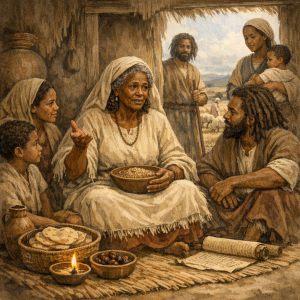
A matriarch is a woman who holds recognized central authority, influence, seniority, or unifying importance within a family, kin group, community, organization, or, less commonly, a political society. In its most ordinary modern sense, the word refers to an elder woman—often a mother, grandmother, widow, founder, or longstanding household leader—whose judgment, memory, labor, property, relationships, or moral standing give her practical leadership within an extended family.
The term does not inherently mean that a woman is harsh, authoritarian, wealthy, elderly, or legally in command. A family matriarch may lead through formal decision-making, but she may also lead through care, mediation, hospitality, preservation of family history, stewardship of property, religious example, or the ability to gather relatives around a shared identity. The word therefore commonly conveys both authority and continuity.
In a broader sociological sense, matriarch may describe a woman regarded as the leading figure of a group. In zoological writing, it is also used for an older female whose experience or social position helps guide a herd or other female-centered animal group. That usage is descriptive, not a legal or scientific rank.
A matriarch is not necessarily the same thing as a mother, matron, female head of household, matrilineal ancestor, or queen. A woman may be a biological mother without becoming a matriarch; conversely, an aunt, grandmother, adoptive parent, clan mother, or respected elder may be called a matriarch because of her established position within the group.
Etymology and Origin
Matriarch is formed from the Latin mater, meaning “mother,” together with the Greek-derived element -arch, meaning ruler, chief, or leader. The structure parallels patriarch, a word built around the idea of a father or male ancestral head. English dictionaries record matriarch in use by the early seventeenth century; Merriam-Webster gives 1606 as its first known use. ([merriam-webster.com](https://www.merriam-webster.com/dictionary/matriarch?utm_source=openai))
The word’s components can suggest “mother-ruler,” but ordinary English usage should not be reduced to that literal construction. A matriarch may be the acknowledged head of a family without exercising governmental power, and she need not be the biological mother of every person in the family. English has long used titles of kinship in an extended sense: a “father” may be a founder, spiritual guide, or senior leader, and a “mother” may be a source of origin, nurture, authority, or communal identity.
The related word matriarchy has generated far more scholarly dispute than matriarch. A matriarch is an identifiable person; a matriarchy is a proposed social order or type of society. Confusion occurs when a respected female family leader is treated as proof that an entire society is ruled by women, or when matrilineal inheritance is assumed to establish female political supremacy. Those are separate questions.
Cultural and Historical Context
Family Memory, Continuity, and Authority
Across many cultures, elder women have held substantial influence within households and kin networks. Their authority has often arisen from experience in childrearing, food production, caregiving, inheritance customs, marriage negotiations, religious observance, oral history, and management of relationships among generations. In this sense, “matriarch” is often an honorific word. It identifies the person who keeps a family’s history, customs, obligations, and bonds from being lost.
The title may be especially meaningful in families shaped by migration, enslavement, war, widowhood, economic hardship, displacement, or the absence of men due to work, military service, imprisonment, death, or abandonment. In such circumstances, women have frequently carried the practical responsibilities of maintaining homes, raising children, transmitting culture, and organizing mutual support. Calling such a woman a matriarch recognizes real social labor and authority, even where formal law did not fully acknowledge it.
Matrilineal Societies Are Not Automatically Matriarchies
A central distinction is between matrilineal and matriarchal. Matrilineal descent means that family membership, inheritance, clan identity, or succession passes through the mother’s line. It does not automatically mean that women exercise exclusive political authority or that men are subordinate. Likewise, matrilocal residence—where a husband joins or lives near his wife’s family—does not alone establish a matriarchy.
Historical and anthropological sources show that women may possess meaningful economic and political functions in matrilineal societies without those societies becoming simple reversals of male-dominated systems. The Library of Congress notes, for example, that among the matrilineal Haudenosaunee or Iroquois nations, women held authority over household land and older women could nominate council leaders and remove chiefs, while men also held defined responsibilities in diplomacy, hunting, trade, and war. ([guides.loc.gov](https://guides.loc.gov/american-women-essays/woman-as-symbol?utm_source=openai))
This distinction matters because nineteenth-century writers sometimes treated every mother-centered, matrilineal, or female-influenced culture as evidence of an ancient universal “rule of women.” Modern scholarship generally rejects that broad evolutionary claim as unproven. The Oxford Classical Dictionary describes the older theory of a universal prehistoric phase of matriarchy as hypothetical and discredited, while emphasizing the persistent confusion between matrilineal descent and female supremacy. ([academic.oup.com](https://academic.oup.com/edited-volume/61673/chapter-abstract/549653585?utm_source=openai))
Nineteenth- and Twentieth-Century Theories
Johann Jakob Bachofen’s 1861 work Mother Right greatly influenced later discussion by proposing historical stages in which maternal descent and female-centered religious life preceded patriarchy. His work was important to the history of ideas, law, religion, and anthropology, but its sweeping reconstruction of human social development is not accepted as established historical fact.
Some later feminist, spiritual, and matriarchal-studies writers have used matriarchy differently. Rather than defining it as female domination, they describe certain societies as mother-centered, egalitarian, consensus-oriented, and organized around reciprocal care or gift exchange. That is an interpretive and contested scholarly approach, not a universally accepted definition. It is useful only if the author clearly states what sense of the word is intended. ([academic.oup.com](https://academic.oup.com/reference/62334/reference-article-abstract/554057699?utm_source=openai))
Biblical / Torah Context
In Jewish usage, the matriarchs of Israel are traditionally Sarah, Rebekah, Rachel, and Leah. They are commonly called the Imahot, “the mothers.” Their lives are principally recorded in Genesis: Sarah in the Abraham narratives; Rebekah in the Isaac and Jacob narratives; and Leah and Rachel in the Jacob narratives. Jewish tradition pairs them with the patriarchs Abraham, Isaac, and Jacob, while preserving their distinct place in the covenantal history of Israel. ([chabad.org](https://www.chabad.org/library/article_cdo/aid/6503070/jewish/Who-Are-the-Matriarchs.htm?utm_source=openai))
The biblical matriarchs should not be reduced to passive wives of male patriarchs. The narratives present them as persons whose decisions shape family, inheritance, covenant, and national identity. Sarah participates in the promise concerning Isaac and speaks forcefully concerning Hagar and Ishmael. Rebekah seeks divine direction during her pregnancy and acts decisively in the blessing narrative involving Jacob and Esau. Leah and Rachel stand at the center of the formation of Israel’s tribes, naming children and contending with questions of marriage, fertility, household status, labor, and belonging.
These accounts also portray hardship rather than an uncomplicated ideal of female power. Barrenness, rivalry, unequal marital arrangements, fear, displacement, and family conflict appear throughout the narratives. The title “matriarch” therefore does not mean that the women lived outside a male-centered ancient social order. Rather, it recognizes their foundational role in the lineage and covenant story of the people of Israel.
In Jewish prayer and tradition, the four matriarchs are remembered with the patriarchs as ancestors of the covenant people. Some discussion exists concerning Bilhah and Zilpah, who bore children within Jacob’s household and are mothers of tribes. Rabbinic tradition generally reserves the formal designation of matriarchs for Sarah, Rebekah, Rachel, and Leah, although broader discussions may acknowledge the significant maternal roles of Bilhah and Zilpah. ([sefaria.org](https://www.sefaria.org/Sheet.88480?utm_source=openai))
For Christians, the women of Genesis are likewise important within the Old Testament and are often interpreted as examples of faith, endurance, maternal care, divine promise, and the complex working of providence through imperfect families. Such theological interpretations belong to particular religious traditions; they should not be mistaken for a secular legal definition of matriarch.
Legal Implications
The Word Is Generally Not a Technical Legal Status
In Anglo-American common law, matriarch is ordinarily not a technical legal term. Calling someone the family matriarch does not, by itself, create legal custody, guardianship, inheritance rights, power of attorney, authority over an adult relative, ownership of family property, or the right to make medical or financial decisions for another person.
Present-day legal rights are determined by applicable constitutions, statutes, regulations, court orders, wills, trusts, deeds, contracts, parentage rules, adoption records, and judicial decisions—not by informal family titles. Family law is primarily governed by state law in the United States and varies substantially by jurisdiction. ([law.cornell.edu](https://www.law.cornell.edu/wex/family_law?utm_source=openai))
Historical Common Law and Coverture
Historically, English common law imposed serious disabilities on many married women through the doctrine commonly called coverture. Under that doctrine, a married woman’s independent legal capacity and control of property were severely restricted in many contexts. The legal history of women’s property rights is therefore highly relevant to understanding why actual women could be family leaders while lacking equal formal standing in court, contract, property, or custody matters.
That historical condition should not be confused with current law. Married Women’s Property Acts and later statutory and constitutional developments substantially dismantled coverture in the United States and other common-law jurisdictions. A United States Supreme Court decision discussing nineteenth-century married-women’s property legislation described the older rule as one under which a married woman could not independently sue for her property at common law, while the statute gave her separate control over property acquired by descent, devise, or otherwise. ([law.cornell.edu](https://www.law.cornell.edu/supremecourt/text/93/674?utm_source=openai))
Thus, a “matriarch” may have been socially central while legally constrained. The difference between household authority and legal personhood is essential to a sound common-law analysis.
Inheritance, Kinship, and Estate Planning
A matriarch’s influence may affect estate planning, family business succession, caregiving decisions, and the preservation of property, but the title itself has no automatic legal force. If a family intends an elder woman to manage assets, make decisions during incapacity, serve as executor, act as trustee, or receive a particular inheritance, those intentions must normally be expressed through legally valid documents and procedures.
Nor should the word be used to make unsupported claims about “common-law inheritance.” In the United States, inheritance rights are generally governed by state probate statutes, valid wills, trusts, beneficiary designations, marital-property rules, and court decisions. Common-law principles may remain relevant in particular jurisdictions, but they do not turn a matriarchal role into a recognized estate status.
Governmental and Military Use
Matriarch is not ordinarily a governmental office, military grade, commission, or constitutional title. A woman may be a political leader, tribal leader, monarch, elected official, or military commander, but those positions arise from the governing law, custom, election, appointment, or command structure of the relevant institution. Describing her as a matriarch may communicate respect or cultural significance, but it does not identify her legal authority unless a specific tradition or governing document gives the title formal meaning.
Spiritual Meaning
Spiritually, the matriarch commonly symbolizes life-giving continuity, wisdom gained through experience, protective care, memory, intercession, and responsibility to future generations. In family and religious settings, the word can honor a woman who embodies steadfastness rather than mere control. The image is often associated with a person who protects the vulnerable, reconciles conflict, teaches moral obligations, and holds a community together through adversity.
These meanings are interpretive rather than universally fixed. Not every woman desires or should be expected to bear the burdens associated with the ideal of the matriarch. A spiritual use of the term is healthiest when it honors voluntary service and genuine wisdom without romanticizing self-sacrifice, silencing younger women, or excusing coercive family control.
Modern Usage
Modern English uses matriarch most frequently for the senior woman at the center of a family. Obituaries, biographies, community histories, and family reunions may describe a grandmother as “the matriarch of the family” to recognize her legacy and influence. The word can also apply to founders of businesses, leaders in artistic communities, respected elders, and women whose careers have established an enduring lineage of mentorship.
In journalism and popular culture, the term is sometimes used loosely for a prominent mother in a wealthy or famous family. That usage can be respectful, but it may also flatten a woman’s identity into her relationship to relatives. Careful writing should identify her own work, achievements, choices, and authority rather than treating “matriarch” as a substitute for a full description.
In animal behavior writing, an older female elephant, orca, or other socially influential female may be called a matriarch. This use generally emphasizes experience, kin-based leadership, and group knowledge, especially where older females guide movement, feeding, or care. It remains a descriptive label rather than a claim that human family structures and animal social systems are identical.
Controversies / Criticisms
- Conflation with matriarchy: A matriarch is an individual woman; matriarchy is a disputed description of a social system. The terms should not be treated as interchangeable.
- Confusion of descent with rule: Matrilineal inheritance and female-centered residence patterns do not, without more evidence, prove female political domination.
- Romanticization: Describing a family as ruled by a matriarch can idealize invisible caregiving labor or place unreasonable expectations upon one woman to solve every family problem.
- Stereotyping: The word may be used negatively to portray an assertive woman as domineering merely because she exercises authority that would be viewed differently in a man.
- Unsupported historical claims: Claims that all early societies were matriarchal, that a universal female-ruled civilization existed, or that a particular religion or legal system originated in matriarchy require strong historical evidence. Such claims remain contested and should not be stated as settled fact.
Conclusion
A matriarch is best understood as a woman whose recognized position gives her lasting influence within a family or community. The word can honor maternal ancestry, earned wisdom, practical stewardship, and the transmission of identity across generations. Its strongest and clearest use is personal and relational: the woman whose presence helps hold a people together.
For legal purposes, however, the term is ordinarily descriptive rather than dispositive. A matriarch may exercise profound moral and social authority, but legal authority must rest on actual law, valid documents, recognized kinship, office, appointment, or judicial order. Historically careful use also requires distinguishing the revered woman called a matriarch from the separate and debated theory of matriarchy as a social order.
Sources / Further Reading
- Merriam-Webster, “Matriarch.” https://www.merriam-webster.com/dictionary/matriarch
- Oxford Classical Dictionary, “Matriarchy.” https://academic.oup.com/edited-volume/61673/chapter-abstract/549653585
- Library of Congress, “Woman as Symbol in America, 1590–1800.” https://guides.loc.gov/american-women-essays/woman-as-symbol
- Cornell Legal Information Institute, “Family Law.” https://www.law.cornell.edu/wex/family_law
- Kibbe v. Ditto, 93 U.S. 674 (1876), Cornell Legal Information Institute. https://www.law.cornell.edu/supremecourt/text/93/674
- Chabad.org, “Who Are the Matriarchs?” https://www.chabad.org/library/article_cdo/aid/6503070/jewish/Who-Are-the-Matriarchs.htm
- Sefaria Library, “Four are the Mothers? Bilhah and Zilpah the Forgotten Matriarchs.” https://www.sefaria.org/Sheet.88480