Hebrew Israelite
Primary Definition
The expression Hebrew Israelite has two related but importantly different uses. In its ancient-scriptural sense, it may refer generally to a person of the ancient people called Hebrews or Israelites in the Hebrew Scriptures: the descendants and covenant community identified with the patriarchs Abraham, Isaac, and Jacob/Israel. In that setting, “Hebrew” and “Israelite” are overlapping terms, but they are not always exact synonyms. “Israelite” ordinarily identifies a member of Israel—the people named for Jacob—while “Hebrew” can function as an older ethnic, linguistic, or outsider-facing designation.
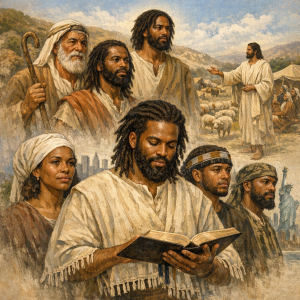
In modern usage, the expression usually identifies a diverse family of religious and cultural movements, especially in the United States, whose adherents profess an Israelite identity and commonly maintain that people of African descent—and, in some groups, Native American, Caribbean, and Latin American peoples—include descendants of the ancient tribes of Israel. The label is not the name of one centralized church, race, nation, legal status, or uniform doctrine. Congregations differ sharply regarding the Messiah, the authority of the Torah, Sabbath observance, diet, dress, prayer, ancestry, relations with Jewish communities, and political questions.
A careful definition must therefore distinguish three matters: (1) the ancient Israelites of the biblical and ancient Near Eastern setting; (2) later Jewish and rabbinic communities, which developed through long historical processes after the biblical period; and (3) modern Hebrew Israelite religious movements. Equating all three without qualification obscures history and can create needless conflict. The ancient Israelite heritage is the chronological starting point; the modern movement is a later interpretation and reclamation of that heritage.
Etymology and Origin
Hebrew
The English word Hebrew translates the Biblical Hebrew term ʿivri (עִבְרִי). In the Torah, Abram is called “the Hebrew” in Genesis 14:13. The precise historical origin of ʿivri remains debated. Some interpreters connect it with the Hebrew root ʿavar, “to cross over” or “pass through,” yielding an interpretive sense such as one from “beyond” or one who crossed over. Others connect it with Habiru/Apiru, a term appearing in ancient Near Eastern texts for socially marginal, displaced, or dependent groups. That proposal is suggestive but not settled: Habiru was not simply another spelling of “Israelite,” and the populations described by that term were broader than the biblical people of Israel.
“Hebrew” also became the conventional name for the language of much of the Torah, Prophets, and Writings. In that linguistic sense, Biblical Hebrew belongs to the Northwest Semitic family and is closely related to languages such as Moabite, Phoenician, and Aramaic. Thus, “Hebrew” may describe a people, a language, or—in later religious usage—a heritage.
Israel and Israelite
Israel (יִשְׂרָאֵל, Yisra’el) is the covenant name given to Jacob after his struggle at Penuel in Genesis 32:28. The Torah presents his descendants through twelve sons as the tribes of Israel. An Israelite is therefore, in the primary biblical sense, a member of that people. The ancient name is not a synonym for every later religious, ethnic, or national community that identifies with the Bible.
The name Israel also appears outside the Bible. The Egyptian Merneptah Stele, usually dated around 1208–1207 BCE, contains the earliest widely accepted extra-biblical reference to “Israel.” Its Egyptian grammatical marker indicates a people rather than a settled city-state. Later Iron Age inscriptions, including the Mesha Stele, provide independent evidence that Israel existed as a named political and cultural entity in the southern Levant. These inscriptions do not prove every detail of the biblical narratives, but they show that “Israel” was not merely a late invented label. ([oi.uchicago.edu](https://oi.uchicago.edu/sites/default/files/uploads/shared/docs/oimp31.pdf?utm_source=openai))
Cultural and Historical Context
In the ancient Israelite setting, identity was ordinarily communal rather than modern-racial. It involved kinship, land, language, covenant, worship, household, tribe, and political allegiance. The Torah describes Israel as a people brought out of bondage and called into covenant with Yah—the Creator named in the Hebrew text by the four consonants YHWH. English Bibles often render that title as “LORD” in small capitals. Where “Lord” is used as a title for Adon or Adonai, its ordinary English sense is “master” or ruler; it should not be confused with a personal name.
The biblical narrative distinguishes the tribes of Israel from surrounding peoples while also recognizing foreigners, resident sojourners, intermarriage, alliances, conflict, and adoption into the covenant community. The command to love the resident sojourner appears beside Israel’s own remembrance that it had been a sojourning people in Egypt. Therefore, the ancient Israelite record cannot fairly be reduced to either a modern biological-race theory or a purely abstract religion detached from ancestry and peoplehood.
Following the division of the monarchy, the northern kingdom was commonly called Israel and the southern kingdom Judah. The Assyrian conquest of the northern kingdom in the late eighth century BCE and the Babylonian conquest of Judah in the early sixth century BCE profoundly shaped later memory of scattering, exile, restoration, and the tribes. These events supplied important scriptural language later used by many displaced or oppressed communities—including, but not limited to, Hebrew Israelites—to interpret their own historical suffering.
Modern Hebrew Israelite movements arose in the United States principally from the late nineteenth century onward. Historians identify early founders and communities in the period after emancipation, including movements connected with Frank Cherry and William Saunders Crowdy. Their teachings emerged amid African American biblical interpretation, Holiness and Pentecostal currents, Black institution-building, migration, racial violence, and the search for dignity, sacred history, and self-determination. Scholarly accounts emphasize that there has never been one single Hebrew Israelite history: the movement includes congregations nearer to forms of Judaism, groups shaped by Christianity or Messianic belief, separatist communities, and Torah-observant bodies with very different practices. ([cambridge.org](https://www.cambridge.org/core/elements/abs/black-hebrew-israelites/88E127963EB4F0990717BE6BD47044C8?utm_source=openai))
Biblical / Torah Context
The Torah uses Hebrew and Israelite identity within a covenantal narrative. Abraham is called a Hebrew; Jacob becomes Israel; and the children of Israel become a people bound by covenant at Sinai. The covenant includes worship of Yah alone, Sabbath rest, moral duties, judicial standards, feast days, dietary boundaries, priestly service, restitution, care for the poor, and commands concerning the stranger within the gates.
The biblical witness places great weight on conduct as well as descent. Deuteronomy repeatedly calls Israel to hear, obey, remember, pursue justice, and reject oppression. The prophets condemn idolatry, dishonest trade, exploitation of the poor, corrupt rulers, and empty ritual. Accordingly, any modern claim to Israelite identity that treats lineage as a license for contempt, violence, dishonesty, or exemption from moral responsibility stands in tension with the ethical demands of the Torah and Prophets.
Several modern Hebrew Israelite teachers read the covenant curses of Deuteronomy 28—especially language concerning scattering, captivity, ships, bondage, and loss of identity—as a prophecy of the Atlantic slave trade and the African diaspora in the Americas. This is a religious interpretation held sincerely by some adherents. It is not, however, a conclusion established by the plain historical setting alone. In its immediate Torah context, Deuteronomy addresses ancient Israel’s covenant obligations and warns of national calamity for disobedience. Whether its language also foretells a later specific historical event is a theological question on which interpreters disagree.
The claim that all, or a defined majority, of present-day African Americans, Indigenous Americans, or Latin American peoples are the biological descendants of particular ancient Israelite tribes is likewise disputed. Historical records, migration patterns, genealogical evidence, and population genetics do not presently supply a universal proof for such sweeping tribal assignments. Ancient-DNA research can illuminate population history in the Bronze and Iron Age southern Levant, but it cannot by itself identify a present-day person as belonging to Reuben, Judah, Ephraim, or another biblical tribe. Such tribal identifications remain matters of tradition, faith, family history, or interpretive argument rather than demonstrated legal or scientific status. ([sciencedirect.com](https://www.sciencedirect.com/science/article/pii/S0092867420304876?utm_source=openai))
Legal Implications
“Hebrew Israelite” is not a legal nationality, citizenship class, diplomatic office, tribal enrollment category recognized by the United States, or exemption from generally applicable law. A person’s sincere religion is protected by constitutional and statutory principles of religious liberty, subject to the ordinary limits of law. In the United States, the First Amendment protects free exercise of religion and prohibits government establishment of religion; additional protections may arise under statutes such as the Religious Land Use and Institutionalized Persons Act (RLUIPA), particularly in institutional settings.
Courts have considered claims by Hebrew Israelite prisoners involving dietary accommodation, religious names, worship, and equal treatment. Such cases do not make a court the judge of theology. Rather, courts generally consider sincerity, the burden imposed by a governmental rule, institutional interests, and the governing constitutional or statutory test. For example, federal litigation has recognized that a Hebrew Israelite prisoner’s religious dietary practice may be legally relevant, while the availability of a remedy depends on the facts and applicable law. ([law.justia.com](https://law.justia.com/cases/federal/appellate-courts/F3/474/118/561249/?utm_source=openai))
It is necessary to distinguish religion from “sovereign citizen” or pseudo-legal claims. Some individuals who use Hebrew Israelite language have asserted that they are “sovereign,” foreign diplomats, “state nationals,” or otherwise outside state or federal jurisdiction. Those assertions do not reflect a rule of historic English common law, American constitutional law, equity, international law, or statutory law. United States courts have repeatedly rejected theories that private declarations of sovereignty, ancestry, religious status, or self-issued documents remove a person from court jurisdiction or excuse compliance with licensing, tax, criminal, civil, or procedural law. In Yashar’al v. Hopper, for example, the Seventh Circuit rejected a claimed immunity based on being a “sovereign Hebrew Israelite” and affirmed remand of the state criminal case. ([law.justia.com](https://law.justia.com/cases/federal/appellate-courts/ca7/21-1298/21-1298-2021-06-07.html?utm_source=openai))
Historic common law developed through judicial decisions and inherited legal principles; it did not create a personal right to opt out of jurisdiction by declaring oneself a biblical descendant, national of a self-created republic, or private ambassador. Equity concerns remedies and fairness within a court’s lawful jurisdiction; it is not a separate system by which a person may defeat otherwise valid statutes. Religious conviction may support lawful requests for accommodation, but it does not by itself annul laws of general application.
Spiritual Meaning
For many adherents, Israelite identity has spiritual meaning beyond ancestry. It expresses awakening, repentance, return to the commandments, recovery of biblical names, restoration of family order, Sabbath observance, dietary discipline, and hope for Yah’s promised redemption. For communities formed under conditions of dispossession and racial degradation, the Israelite story can provide a powerful language of divine remembrance: the oppressed are not forgotten, bondage is not the final word, and obedience to Yah has communal as well as personal consequences.
This spiritual force should be understood without assuming that every expression of the movement is the same. Some communities emphasize prayer, Scripture study, modest dress, dietary practice, mutual aid, and peaceful family life. Others employ confrontational street preaching or exclusivist rhetoric. The label alone does not disclose a person’s character, theology, or conduct.
Modern Usage
Current usage varies. “Hebrew Israelite,” “Black Hebrew Israelite,” “Black Israelite,” “African Hebrew Israelite,” “Israelite,” and similar names may be self-descriptions, outside descriptions, or contested labels. Some members reject “Black Hebrew Israelite” because they view it as externally imposed, overly racialized, or too closely associated with groups whose teachings they do not share. Others use it openly as a description of Black-led Israelite religious identity.
Modern communities may observe the seventh-day Sabbath, biblical feast days, circumcision, dietary restrictions, Hebrew names, head coverings, modesty standards, and forms of Torah instruction. Beliefs concerning the Messiah vary: some hold Christian or Messianic convictions, some follow Jewish forms of practice, some reject the New Testament, and some maintain teachings that do not fit neatly within Jewish or Christian classifications. The term should consequently be used with specificity whenever possible: identify the particular congregation, teaching, or claim rather than assigning every Hebrew Israelite the beliefs of the most visible group.
Controversies / Criticisms
The principal controversies concern ancestry claims, relations with Jewish communities, racial teaching, and public conduct. Jewish organizations and many Jewish individuals object when a group claims that contemporary Jews are impostors, fraudulent descendants, or enemies by nature. Such claims are historically sweeping, religiously polemical, and capable of promoting antisemitism. Likewise, teachings that depict white people, Arabs, Africans, Jews, or any other people as inherently evil, permanently cursed, or fit for collective punishment conflict with equal human dignity and foster hostility.
At the same time, it is inaccurate to classify every Hebrew Israelite as antisemitic, violent, or extremist. Major civil-rights organizations that monitor extremist factions expressly distinguish the movement’s many non-extremist adherents from particular groups that spread antisemitic or racist teachings. Responsible analysis must name and oppose hateful doctrines where they occur while refusing collective guilt or stereotypes. ([adl.org](https://www.adl.org/resources/backgrounder/extremist-sects-within-black-hebrew-israelite-movement?utm_source=openai))
A further criticism concerns historical method. Biblical passages about Israel’s exile, curses, and restoration are often interpreted through later events in ways that scholars, Jewish readers, Christians, and other Hebrew Israelites dispute. A dictionary treatment should not dismiss religious conviction merely because it is religious; neither should it present a contested interpretation as proven archaeology, genealogy, or law. The distinction between confession, historical probability, and verifiable evidence is essential.
Conclusion
In its foundational sense, the expression points back to the ancient Hebrews and Israelites of the Torah and the wider ancient Near Eastern world: a people identified with the covenant of Yah, the tribes of Israel, and a scriptural history of deliverance, law, exile, repentance, and restoration. In its prevailing modern sense, it describes diverse religious movements that reclaim that heritage, especially within the African diaspora.
The term should be used carefully. Ancient Israelite identity, later Jewish history, and modern Hebrew Israelite movements are historically connected but not interchangeable. Claims of personal or communal descent may carry profound spiritual meaning, yet broad genealogical claims remain debated and do not create a separate legal status. A sound use of the term respects sincere religious practice, insists on truthful historical distinctions, rejects racial hostility and pseudo-legal claims, and recognizes that justice, humility, mercy, and obedience remain central themes of the Torah.
Sources / Further Reading
- Michael T. Miller, Black Hebrew Israelites, Cambridge University Press
- Jacob S. Dorman, Chosen People: The Rise of American Black Israelite Religions, Oxford University Press
- Michael T. Miller, “Black Judaism(s) and the Hebrew Israelites,” Religion Compass
- University of Chicago Institute for the Study of Ancient Cultures, material on the Merneptah Stele and ancient Israel
- British Museum, “The Mesha Stele”
- Agranat-Tamir et al., “The Genomic History of the Bronze Age Southern Levant,” Cell
- Yashar’al v. Hopper, U.S. Court of Appeals for the Seventh Circuit
- Madison v. Commonwealth of Virginia, U.S. Court of Appeals for the Fourth Circuit
- Anti-Defamation League, “Extremist Sects Within the Black Hebrew Israelite Movement”