Hell
Primary Definition
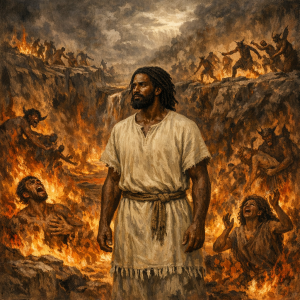
Hell is an English noun with several related meanings. In its principal religious sense, it denotes the realm, condition, or final consequence of divine judgment associated in many religious traditions—especially popular and historical Christian usage—with punishment after death. In broader English usage, it may mean a place or condition of extreme misery, violence, suffering, disorder, or oppression; hence such expressions as “a living hell,” “hell on earth,” and “all hell broke loose.” It also functions informally as an oath, exclamation, intensifier, or expression of anger, surprise, emphasis, or dismissal.
The term should not be treated as though it had one fixed meaning in every Bible translation, theology, court record, or ordinary conversation. Its meaning depends heavily on context. In particular, the English word hell has historically been used to translate several distinct Hebrew and Greek terms whose meanings overlap in some respects but are not identical. A careful reader should therefore distinguish the English word from the original-language words found in particular biblical passages.
As a matter of dictionary analysis, hell can signify:
- the abode of the dead or underworld in older Germanic and English usage;
- a place or state of punishment of the wicked in certain religious doctrines;
- a figurative condition of severe suffering, danger, misery, conflict, or chaos;
- an emphatic colloquial expression, sometimes considered profane or rude; and
- in specialized contract language, part of the idiom “hell or high water,” indicating an obligation intended to be unconditional.
Etymology and Origin
The modern English word derives from Old English hel or helle, later Middle English helle. It is cognate with words in other Germanic languages, including Old Norse hel, Old High German hella or hellia, Old Saxon hellia, and Gothic halja. These words were associated with an abode of the dead or underworld.
Lexicographers commonly connect the Germanic word family with a verbal root concerning covering, concealing, or hiding. The proposed sense is therefore something like “the hidden place” or “the concealed realm.” That connection is traditional and plausible, but should be described with appropriate caution: the precise original sense of the reconstructed Germanic noun is not known with certainty. It is not sound etymology to claim that the English word simply means “grave,” “burial,” “hidden,” or “covering” in every context merely because of a possible ancestral root. Words develop meanings through actual usage, not by etymology alone.
The word’s Germanic ancestry also does not establish that later Christian teaching about final judgment came from Norse religion, nor does it prove that biblical writers taught Norse ideas. English-speaking translators used an existing English word for concepts expressed in Hebrew and Greek. A shared or comparable word for an underworld is not evidence that all underlying religious concepts are identical.
Old Norse tradition includes Hel, a figure and a realm associated with the dead. The similarity between Old Norse Hel and English hell reflects their common Germanic linguistic background. However, it is important to distinguish linguistic relationship from theological identity. The biblical terms later rendered “hell” arise from Hebrew and Greek textual settings and must be interpreted within those settings.
Cultural and Historical Context
Ideas about the dead, judgment, punishment, restoration, and the world to come have appeared in many cultures. Ancient Mesopotamian, Egyptian, Greek, Roman, Jewish, Christian, Islamic, and other traditions each developed their own concepts and imagery. Similar images—darkness, fire, abyss, imprisonment, separation, destruction, descent, or a realm below—do not by themselves prove direct borrowing from one culture to another. Historical influence must be demonstrated through evidence, not assumed because symbols resemble one another.
In early English, hell could refer broadly to the abode of the dead. As Christianity became central to English religious life, the term increasingly became associated with the punitive destination of the unrepentant or wicked. Medieval preaching, art, drama, and poetry strongly shaped popular imagination. Images of fire, devils, monsters, pits, torture, and torment became culturally powerful, though not every image arose directly from Scripture. Later literary works—most famously Dante Alighieri’s Divine Comedy, as well as medieval mystery plays and subsequent religious art—helped form the common Western picture of hell.
That popular picture often blends together biblical language, later theology, folklore, artistic imagination, and literary symbolism. For example, the frequent notion that Satan rules hell as its king and personally administers punishments is a familiar cultural image, but it should not automatically be treated as a simple biblical statement. In several biblical passages, the devil is instead portrayed as subject to God’s judgment.
In English-speaking culture, the word also became highly productive outside formal religion. “War is hell,” “give someone hell,” “hell-bent,” “hellraiser,” “to hell with it,” and “what the hell?” demonstrate the word’s movement from theological vocabulary into emotional, rhetorical, military, and everyday speech. In the phrase “war is hell,” the word is figurative: it describes the destructive and traumatic realities of war rather than asserting that combat literally is an afterlife realm.
Biblical / Torah Context
Hebrew Bible and Torah: Sheol
The word hell does not appear in the Hebrew Torah as an original Hebrew term. English Bibles sometimes use “hell” to translate Sheol (Hebrew: she’ol), especially in older translations. In much of the Hebrew Bible, Sheol is the realm of the dead, the grave, the pit, or the condition of death. It is often presented as the destination of human beings generally, rather than solely as a place of fiery punishment for the wicked.
Accordingly, translating every appearance of Sheol as “hell” can lead modern readers to import later ideas of eternal torment into passages that may instead concern death, burial, mourning, the depths, or the unseen abode of the dead. Many modern translations retain the word Sheol, translate it as “the grave,” or use a context-sensitive rendering. This does not eliminate theological debate about life after death; it simply recognizes that the original term has a broader range than the popular modern use of hell.
The Valley of Ben-Hinnom, south of Jerusalem, is also significant. Hebrew passages refer to grievous child-sacrifice practices connected with this valley and with Topheth, and prophetic texts announce judgment upon it. These passages form part of the historical and prophetic background for the later term Gehenna.
New Testament Terms
Older English Bible translations, including the King James Version, sometimes render multiple Greek words as “hell.” The distinction matters:
- Hades is the Greek term commonly corresponding to Hebrew Sheol in the Greek Septuagint. Depending on context, it can refer to the abode of the dead, death’s domain, or the underworld. It is not automatically equivalent to the final state of punishment in every passage.
- Gehenna is the Greek form associated with the Valley of Hinnom. In the sayings of Jesus, it is used in warnings concerning judgment and destruction. It is the New Testament term most closely connected to the later ordinary English religious sense of “hell.”
- Tartarus appears in verbal form in 2 Peter 2:4 concerning angels who sinned and are held for judgment. It is not a general New Testament word for the final destination of all wicked human beings.
- Lake of fire, chiefly in Revelation, is apocalyptic imagery connected with final judgment. Whether it is to be read as a literal location, symbolic depiction, or both is disputed among interpreters.
The New Testament includes solemn language of judgment: fire, darkness, exclusion, destruction, death, punishment, weeping, and the separation of the righteous from the wicked. Christian readers agree that these texts are morally serious; they disagree about the nature, duration, and mechanics of the judgment described.
Major Interpretive Positions
Three broad positions are commonly found in Christian discussion. Eternal conscious punishment holds that the finally impenitent endure everlasting conscious punishment or exclusion from God. Conditional immortality or annihilationism holds that the wicked are ultimately destroyed rather than kept alive forever in torment. Universal reconciliation holds, in differing forms, that God will finally restore all persons, sometimes after corrective judgment. These views appeal to different biblical texts, theological premises, and interpretations of such terms as “eternal,” “destruction,” “death,” and “all.”
Judaism does not speak with one voice on the afterlife. The Hebrew Bible’s treatment of Sheol differs from later Jewish discussions of Gehenna, resurrection, judgment, and the world to come. It is therefore inaccurate to say either that Judaism has no doctrine of judgment or that all Jewish teaching is identical to a later Christian doctrine of hell.
Legal Implications
Hell is not a technical term of art in historic English common law. Common law developed through judicial decisions and custom; it did not create a civil or criminal legal jurisdiction called “hell,” nor does ordinary use of the word establish a legal status, contract, trust, citizenship category, or governmental power. Religious beliefs about eternal judgment may influence a person’s moral convictions, but they are not themselves rules of civil law.
Historical ecclesiastical courts in England dealt with matters such as marriage, probate, church discipline, and morality under church jurisdiction. Their religious framework included doctrines of sin, salvation, and judgment. Yet a theological doctrine of hell should not be confused with a rule of the secular common-law courts. Roman law, English common law, equity, statutes, and modern constitutional law are distinct legal sources and should be identified separately.
In modern United States law, government ordinarily may not establish an official religious doctrine of hell or compel acceptance of a particular theological interpretation. The First Amendment protects religious exercise while limiting governmental establishment of religion. Courts may encounter references to hell in evidence, speech, religious accommodation disputes, defamation claims, or contractual language, but the word itself has no independent legal force apart from the relevant legal context.
“Hell or High Water” Clauses
A genuine modern legal use occurs in the expression hell or high water clause. This is a contract provision—often found in commercial finance leases—under which one party’s payment or performance obligation is intended to be absolute and unconditional after specified conditions are met. The phrase means that the obligated party must perform despite adverse circumstances, defenses, or disputes that the agreement places outside the obligation.
Such clauses are not unlimited. Their enforcement depends on the governing statute, the contract’s wording, the nature of the transaction, the parties’ sophistication, consumer-protection rules, fraud, unconscionability, public policy, and other applicable defenses. Article 2A of the Uniform Commercial Code recognizes irrevocable and independent promises in qualifying finance leases, while preserving important distinctions, including protections involving consumer leases. Therefore, “hell or high water” does not mean that every contractual promise is enforceable regardless of fraud or law; it identifies an allocation of commercial risk that courts may enforce within legal limits.
Spiritual Meaning
Spiritually, hell is often understood as a warning that moral choices matter and that evil, injustice, cruelty, and rejection of truth carry real consequences. For believers who affirm a final judgment, the doctrine is commonly connected with divine justice, human freedom, repentance, mercy, accountability, and the hope of reconciliation with God.
Some Christian traditions emphasize hell primarily as separation from God: not merely an externally imposed penalty, but the final result of freely and persistently rejecting divine love and goodness. Other traditions stress punitive judgment, while still others understand biblical fire as purifying, corrective, or symbolic. These are theological interpretations, not definitions that can be settled by English etymology alone.
A responsible spiritual use of the term should avoid treating hell as a weapon for intimidation, personal condemnation, or claims of private certainty about another individual’s eternal destiny. Many religious traditions place final judgment in God’s hands and combine warnings of judgment with calls to mercy, repentance, justice, humility, and love of neighbor.
Modern Usage
In modern English, hell remains both a serious religious word and a common informal expression. Context determines tone. In a sermon, religious study, or theological discussion, it may refer to final judgment. In ordinary conversation, it often serves as an intensifier: “cold as hell,” “busy as hell,” “hurts like hell,” or “no way in hell.” It may also express anger or contempt, as in “go to hell.” Because many speakers consider it profanity or religiously offensive, careful speakers should consider audience and setting.
Figurative uses include “living hell,” meaning sustained misery or abuse; “hell on earth,” meaning an environment of extraordinary suffering; and “all hell broke loose,” meaning sudden chaos. In military, humanitarian, and journalistic contexts, the word is frequently used metaphorically to describe extreme violence, deprivation, trauma, or devastation. Such language communicates intensity, but it can also obscure precise facts if used in place of clear description.
Controversies / Criticisms
The doctrine and language of hell have long been contested. Critics argue that everlasting punishment is incompatible with divine love, proportional justice, or human freedom. Advocates of eternal punishment respond that divine justice, the gravity of evil, and the seriousness of moral agency cannot be reduced to temporary consequences. Conditionalists argue that final destruction better accords with biblical terms such as death and perishing. Universalists argue that divine judgment may be real and severe while ultimately serving restoration. None of these disagreements is resolved merely by choosing one English translation.
Another controversy concerns translation. Critics of older English renderings observe that translating Sheol, Hades, Gehenna, and Tartarus alike as “hell” can conceal significant textual distinctions. Defenders of traditional wording may answer that “hell” became a conventional theological umbrella term in English. The most careful approach is to state which original-language term is being discussed and then explain the interpretive question.
There is also criticism of manipulative religious rhetoric. Invoking hell to control people, justify abuse, create panic, or silence sincere questions is inconsistent with careful scholarship and may cause spiritual injury. Conversely, dismissing every doctrine of judgment as mere superstition fails to engage the substantial biblical, philosophical, and theological arguments that believers have offered across centuries.
Conclusion
Hell is an old Germanic English word whose meaning has broadened and changed over time. It may refer to an abode of the dead, final divine judgment, severe earthly suffering, an exclamation, or a specialized contractual idiom. In biblical discussion, it is especially important not to flatten Sheol, Hades, Gehenna, Tartarus, and the lake of fire into a single identical concept without examining context.
In legal discussion, the word generally has no independent common-law definition or civil authority, except where it appears in ordinary language or specific contractual phrases. In spiritual discussion, it remains a profound and disputed term connected with justice, mercy, accountability, repentance, death, and humanity’s ultimate relationship to God. Sound interpretation requires linguistic care, historical humility, and a clear distinction between documented textual facts, theological conclusions, and popular imagery.
Sources / Further Reading
- Merriam-Webster Dictionary, “Hell” — https://www.merriam-webster.com/dictionary/hell
- Encyclopaedia Britannica, “Hell” — https://www.britannica.com/topic/hell
- Bible Gateway, Encyclopedia of the Bible, “Hell” — https://www.biblegateway.com/resources/encyclopedia-of-the-bible/Hell
- Sefaria, Hebrew Bible texts concerning the Valley of Ben-Hinnom, including Jeremiah 7 and Jeremiah 19 — https://www.sefaria.org/Jeremiah.7?lang=bi
- The Holy See, Catechism of the Catholic Church, “Hell,” paragraphs 1033–1037 — https://www.vatican.va/content/catechism/en/part_one/section_two/chapter_three/article_12/iv_hell.html
- Legal Information Institute, Cornell Law School, Uniform Commercial Code resources — https://www.law.cornell.edu/ucc
- District of Columbia Code, § 28:2A-407, “Irrevocable promises: finance leases” — https://code.dccouncil.gov/us/dc/council/code/sections/28:2A-407
- Wells Fargo Bank, N.A. v. BrooksAmerica Mortgage Corp., 419 F.3d 107 (2d Cir. 2005) — https://law.justia.com/cases/federal/appellate-courts/F3/419/107/617446/