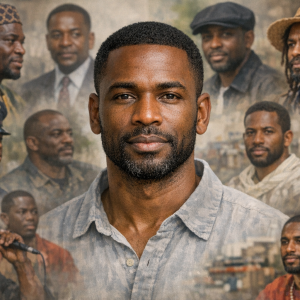
Primary Definition
Black man ordinarily means an adult man who identifies as Black or is socially understood as belonging to a Black racial, ethnic, or cultural community. In the United States, the expression frequently refers to an African American man, but its broader meaning includes men of African descent throughout Africa and the African diaspora, including Afro-Caribbean, Afro-Latino, Black Canadian, Black British, and other communities.
The term combines two distinct classifications. Black, when capitalized, functions as a racial, cultural, and historical identifier rather than merely as a description of color. Man identifies an adult male or an adult person whose gender identity is male. The expression therefore should not be reduced to skin pigmentation, physical appearance, nationality, or a single genetic ancestry. Black populations encompass a wide range of complexions, languages, religions, national origins, cultures, and family histories.
Modern dictionaries generally recognize capitalization of Black when the word identifies a people or culture. They also caution that using Black alone as a singular noun for a person may be offensive or dehumanizing; constructions such as “a Black man,” “a Black person,” or “Black people” are ordinarily preferred. ([merriam-webster.com](https://www.merriam-webster.com/dictionary/black?utm_source=openai))
In federal statistical usage, “Black or African American” is a category for individuals with origins in the Black racial groups of Africa. The category includes, among others, people identifying as African American, Jamaican, Haitian, Nigerian, Ethiopian, or Somali. This governmental definition is designed for statistics, program administration, and civil-rights monitoring. It is not a complete definition of personal identity and does not establish a separate biological species or legally inferior class. ([census.gov](https://www.census.gov/about/our-research/race-ethnicity/standards-updates.html?utm_source=openai))
Etymology and Origin
The English adjective black descends from Old English blæc or blac, meaning black or dark. It is related to Germanic words associated with burning or scorching. English sources used the word for dark-skinned people long before the development of modern racial classifications, but that early descriptive use did not carry one uniform social or legal meaning. ([merriam-webster.com](https://www.merriam-webster.com/dictionary/black?utm_source=openai))
Man comes from Old English mann, which could mean a human being or person without necessarily specifying sex. By approximately the end of the Old English period, it was also used specifically for an adult male, gradually replacing the older sex-specific word wer. The modern phrase consequently joins a population identifier with a term of adulthood and gender. ([etymonline.com](https://www.etymonline.com/word/man?utm_source=openai))
Terminology for people of African descent has changed repeatedly. English-language records have used such terms as African, Negro, colored, Afro-American, Black, and African American. Some were imposed through colonial administration and racial hierarchy; others were adopted, revised, or rejected by Black communities themselves. Negro, derived through Spanish or Portuguese from Latin niger, was once a standard formal designation and was often capitalized in the twentieth century. It declined sharply after the 1960s and is now dated and often offensive outside historical names, quotations, and discussions. ([etymonline.com](https://www.etymonline.com/word/Negro?utm_source=openai))
The modern affirmative use of capitalized Black gained particular force during the civil-rights and Black Power eras. Advocates used it to express dignity, solidarity, political self-determination, and connection with the African diaspora. In 2020, several major news organizations formally adopted the capital letter to recognize Black as a cultural and historical identity rather than a mere color adjective. Capitalization had nevertheless appeared in Black writing and political thought long before that editorial change. ([apstylebook.com](https://www.apstylebook.com/blog_posts/15?utm_source=openai))
Cultural and Historical Context
The meaning of “Black man” cannot be separated from the history of racialization. European colonial powers did not invent differences in complexion, ancestry, or geography, but they converted selected differences into an extensive hierarchy of labor, property, citizenship, and political power. During the Atlantic slave trade, diverse African peoples were forcibly grouped under broad racial labels that obscured their distinct nations, languages, and cultures.
In British North America and the United States, Black men lived under sharply different legal conditions: enslaved, indentured, manumitted, free-born, fugitive, subject to re-enslavement, or recognized as citizens in particular jurisdictions. Colonial statutes progressively made African ancestry and enslavement hereditary categories. Racial identity thereby became not merely descriptive but legally consequential, affecting movement, marriage, testimony, property, education, military service, and political participation.
Black men also participated in every major period of American public life. Enslaved and free Black men served during the Revolutionary War. Approximately 180,000 African American soldiers later entered the Union Army during the Civil War, while many thousands more served in the Union Navy. Their service strengthened the demand that emancipation be accompanied by citizenship and equal political rights. Black military history continued through the Buffalo Soldiers, the world wars, and later conflicts, despite segregated units and discriminatory treatment. President Harry S. Truman’s Executive Order 9981, signed July 26, 1948, declared equality of treatment and opportunity in the armed forces without regard to race, color, religion, or national origin. ([loc.gov](https://www.loc.gov/collections/gladstone-african-american-military-collection/articles-and-essays/timeline/?utm_source=openai))
During the twentieth century, the phrase acquired additional cultural meanings through literature, music, family life, labor organizing, religious leadership, sports, military service, civil-rights activism, and debates about masculinity. It could signify solidarity and pride, but it was also used by outsiders as a stereotype. Responsible usage therefore recognizes Black men as individuals rather than treating them as a uniform social type.
Biblical / Torah Context
The Torah does not employ “Black man” as a modern racial category. Biblical peoples are generally identified by family, tribe, nation, homeland, language, covenant, or political allegiance. Terms such as Cush and Cushite have geographical and ethnocultural associations, but they should not automatically be translated into contemporary American racial classifications.
Numbers 12:1 reports that Moses had married a Cushite woman. Miriam and Aaron spoke against Moses concerning that marriage, after which Miriam was punished. Interpretations differ concerning the identity of the woman and the precise reason for the dispute. The passage does not establish a doctrine that dark complexion signifies inferiority, divine rejection, or servile status.
Genesis 9:25 has frequently been misrepresented as a divine “curse of Ham” upon Black people. The text actually records Noah saying, “Cursed be Canaan,” naming Ham’s son rather than Ham, Africa, or a racial class. It says nothing about changing anyone’s skin color. Later interpreters connected Ham, dark skin, and perpetual slavery, and such claims were employed to defend racial bondage. Scholars dispute the stages by which that interpretation developed, but the proposition that Genesis itself imposes a racial curse upon Black people is unsupported by the wording of the passage. ([jewishencyclopedia.com](https://www.jewishencyclopedia.com/articles/7116-ham?utm_source=openai))
Genesis 1:26–27, by contrast, places humanity collectively within the image of God. From a biblical interpretive standpoint, a Black man possesses the same human dignity and moral accountability as every other person. This is a theological judgment, not a specialized civil status created by the phrase.
Legal Implications
Common Law and Colonial Law
There is no timeless common-law definition that fixes who is a Black man for every legal purpose. English common law did not develop a comprehensive racial code equivalent to the slave statutes enacted in the colonies. In Somerset v. Stewart in 1772, the Court of King’s Bench held that James Somerset could not lawfully be forced out of England for sale into slavery. The exact breadth of Lord Mansfield’s ruling has been debated, but the judgment established that such coercive slave authority required positive law and was not simply presumed from English common law. ([english-heritage.org.uk](https://www.english-heritage.org.uk/visit/places/kenwood/history-stories-kenwood/somerset-case/?utm_source=openai))
American racial slavery was constructed primarily through colonial and state legislation, constitutional arrangements, commercial practice, and judicial enforcement. It should not be attributed indiscriminately to “the common law.” Colonial lawmakers created special rules that converted African ancestry into presumptions concerning bondage and status. Some of these rules drew upon older legal concepts, including the civil-law maxim partus sequitur ventrem, under which a child’s status followed that of the mother.
Citizenship and Civil Rights
In Dred Scott v. Sandford in 1857, the United States Supreme Court declared that the class of people descended from Africans imported and enslaved was not included within federal constitutional citizenship as the Court interpreted it. The decision treated racial ancestry as a ground for political exclusion and protected slave property. The Thirteenth Amendment abolished slavery, while the Fourteenth Amendment constitutionalized birthright citizenship and equal protection. The Fifteenth Amendment prohibited denying the vote on account of race, color, or previous condition of servitude, although violence, poll taxes, literacy tests, and other devices continued to suppress Black voting. ([archives.gov](https://www.archives.gov/milestone-documents/dred-scott-v-sandford?utm_source=openai))
Subsequent laws prohibited racial discrimination in contracts, employment, education, public accommodations, voting, housing, and other areas. For example, 42 U.S.C. § 1981 guarantees all persons equal rights concerning contracts and legal proceedings, while Title VII of the Civil Rights Act of 1964 prohibits employment discrimination because of race, color, religion, sex, or national origin. The Fair Housing Act prohibits covered housing discrimination because of race or color and other protected characteristics. ([justice.gov](https://www.justice.gov/crt/laws-we-enforce?utm_source=openai))
Under contemporary equal-protection doctrine, governmental racial classifications are generally subject to strict scrutiny. A government must demonstrate that such a classification serves a compelling interest and is narrowly tailored. This rule applies even when officials claim that a racial classification is intended to help a historically disadvantaged group. ([constitution.congress.gov](https://constitution.congress.gov/browse/essay/Amdt14-S1-8-1-1/ALDE_00000816?utm_source=openai))
For legal analysis, “Black man” may describe both race and sex, but the phrase itself does not prove discrimination, ancestry, nationality, citizenship, or damages. The governing statute, evidentiary record, jurisdiction, and factual circumstances remain controlling. Race may be established through self-identification, official records, community understanding, or evidence showing how another person perceived and treated the claimant. A person may therefore experience racial discrimination because he was perceived as Black even where his precise genealogy is disputed.
Spiritual Meaning
No single spiritual meaning attaches to every Black man. Black men may be Christian, Jewish, Muslim, practitioners of African or African-diasporic traditions, members of other religions, agnostic, or atheist. It is therefore inaccurate to treat Black identity as a religious office, a mark of divine election, or a sign of divine condemnation.
Within African American religious history, however, Black manhood has often been interpreted through themes of dignity, deliverance, fatherhood, moral responsibility, resistance to oppression, and service to community. Enslaved people adapted biblical narratives—especially Exodus, captivity, judgment, and liberation—to express both faith and hope for earthly freedom. African American spirituals developed as religious folk songs that communicated sorrow, endurance, worship, and expectation. ([guides.loc.gov](https://guides.loc.gov/spirituals-folklife?utm_source=openai))
Independent Black churches became centers not only of worship but also of education, mutual aid, political organization, leadership development, and resistance. Black ministers and laymen have held important roles in these institutions, although women have likewise been indispensable to their survival and growth. Any spiritual account of Black manhood that erases women, imposes rigid masculinity, or assumes that all Black communities share one theology is incomplete. ([pbs.org](https://www.pbs.org/wgbh/americanexperience/features/godinamerica-Black-church/?utm_source=openai))
As an interpretive matter, the phrase can symbolize the reclamation of personhood after systems that treated Black males as labor units, property, threats, or social problems. That symbolic meaning is culturally significant, but it should not be confused with a universally binding religious definition.
Modern Usage
In contemporary respectful usage, Black is generally capitalized when referring to racial or cultural identity. African American and Black overlap but are not identical. An African American is ordinarily an American with African, especially Black African, descent. A Black person may instead be Nigerian, Jamaican, Haitian, Brazilian, British, or from another national community. Conversely, not every person from Africa identifies as Black.
The latest federal statistical standards, adopted on March 28, 2024, place “Black or African American” among seven coequal race and ethnicity categories and permit respondents to select multiple categories. Multiracial men may identify as Black together with one or more additional identities. Federal categories exist for consistent data collection and civil-rights enforcement; they do not settle every personal or community question about identity. ([census.gov](https://www.census.gov/about/our-research/race-ethnicity/standards-updates.html?utm_source=openai))
Modern science generally treats race as a social and historical classification rather than a set of sharply separated biological divisions. Genetic ancestry is real, but human variation is continuous and does not conform neatly to ordinary racial labels. Race remains socially consequential because institutions and individuals have assigned meaning to appearance, ancestry, and identity. ([pmc.ncbi.nlm.nih.gov](https://pmc.ncbi.nlm.nih.gov/articles/PMC8604262/?utm_source=openai))
Controversies / Criticisms
- Capitalization: Many editors capitalize Black to recognize a shared historical and cultural identity. Others argue that racial terms should be capitalized consistently or not at all. Capitalization is an editorial convention, not proof that every Black person shares one culture.
- Black versus African American: Preferences differ according to nationality, generation, politics, and individual choice. When speaking about a specific person, that person’s stated identification is ordinarily the best guide.
- Biological essentialism: Treating every Black man as biologically, intellectually, temperamentally, or morally alike is unsupported and perpetuates racial mythology.
- Stereotyped masculinity: Black men have been alternately portrayed as unusually dangerous, athletic, sexual, emotionally invulnerable, irresponsible, or naturally dominant. Even apparently complimentary stereotypes deny individuality and may influence policing, employment, education, medicine, and interpersonal treatment.
- External classification: Historical “one-drop” rules and similar practices assigned Black identity through ancestry while denying people control over their own classification. Such rules served racial hierarchy and are not universal standards of identity. ([pmc.ncbi.nlm.nih.gov](https://pmc.ncbi.nlm.nih.gov/articles/PMC3951706/?utm_source=openai))
- Overgeneralization: The experiences of an African American man descended from United States slavery may differ substantially from those of a recent African immigrant, an Afro-Latino man, or a Black European. Shared racialization does not eliminate differences in class, language, religion, nationality, disability, politics, or culture.
Conclusion
“Black man” is best understood as a human, social, cultural, and historically conditioned description: an adult man who identifies as, or is perceived as, Black. It is not a separate species, an inherited civil disability, a biblical curse, or a complete statement of character. Its meaning developed through language, African-diasporic history, slavery, racial classification, resistance, cultural self-definition, and the continuing pursuit of equal citizenship.
At common law and in modern law, the individual remains a person rather than merely a racial category. Historical legal systems often denied that principle in practice, but contemporary civil-rights law generally treats racial identity as a protected characteristic rather than a lawful basis for inferior status. Sound usage preserves the dignity and individuality of the person while recognizing the genuine historical and social consequences associated with being a Black man.
Sources / Further Reading
- Merriam-Webster, “Black”: https://www.merriam-webster.com/dictionary/black
- Online Etymology Dictionary, “Man”: https://www.etymonline.com/word/man
- U.S. Census Bureau, “Updates to Race/Ethnicity Standards for Our Nation”: https://www.census.gov/about/our-research/race-ethnicity/standards-updates.html
- National Archives, “Dred Scott v. Sandford (1857)”: https://www.archives.gov/milestone-documents/dred-scott-v-sandford
- National Archives, “Executive Order 9981”: https://www.archives.gov/milestone-documents/executive-order-9981
- Library of Congress, “African American Military Service Timeline”: https://www.loc.gov/collections/gladstone-african-american-military-collection/articles-and-essays/timeline/
- Congress.gov, Constitution Annotated, “Overview of Race-Based Classifications”: https://constitution.congress.gov/browse/essay/Amdt14-S1-8-1-1/ALDE_00000816/
- Cornell Legal Information Institute, 42 U.S.C. § 1981: https://www.law.cornell.edu/uscode/text/42/1981
- English Heritage, “The Somerset v Stewart Case”: https://www.english-heritage.org.uk/visit/places/kenwood/history-stories-kenwood/somerset-case/
- David M. Goldenberg, The Curse of Ham: Race and Slavery in Early Judaism, Christianity, and Islam: https://www.jstor.org/stable/j.ctt7rm4x
- Library of Congress, “African American Spirituals”: https://guides.loc.gov/spirituals-folklife
- National Museum of African American History and Culture, “The Foundations of Black Power”: https://nmaahc.si.edu/explore/stories/foundations-black-power