Niger
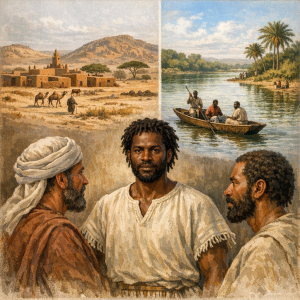
Primary Definition
Niger is principally a proper geographical name. In modern English it ordinarily denotes the Republic of Niger, a landlocked country in the Sahel region of West Africa, or the Niger River, one of West Africa’s major river systems. The country takes its name from the river, not directly from the Latin adjective niger.
In a separate classical and biblical usage, Niger is a Latin cognomen or descriptive byname meaning “black,” “dark,” or “swarthy.” The New Testament applies it to “Simeon who was called Niger” in Acts 13:1. In that passage, it functions as a personal identifier, not as the name of the modern African republic and not as a legal status, nationality, caste, or spiritual office.
The word must therefore be read according to context:
- Geographical context: the Republic of Niger or the Niger River.
- Classical Latin context: an adjective meaning black or dark.
- Biblical context: a surname or cognomen attached to Simeon of the church at Antioch.
- Legal or governmental context: the sovereign state named Niger, its people, territory, public institutions, laws, or official acts.
These meanings are related in spelling but should not be carelessly collapsed into one another. In particular, the modern country’s name is not established as a Latin declaration about the color of its people, its land, or its river.
Etymology and Origin
The Latin word
In classical Latin, niger was an adjective meaning “black,” “dark,” or “black-colored.” Latin grammar varied the form according to gender and case: niger was a masculine nominative form, while nigra and nigrum were related forms. It could describe color, darkness, complexion, objects, animals, or figurative conditions. Like many ancient color terms, its precise force depended upon context rather than carrying a fixed modern racial classification.
The Latin adjective later contributed to scientific and European-language vocabulary involving blackness or darkness. That linguistic history is real. It does not, however, prove that every modern place-name spelled Niger derives from the Latin word.
The river and country name
The origin of the name of the Niger River remains disputed. European writers associated the river’s name with Latin niger at an early stage, and this association has often been repeated. Modern etymological scholarship, however, generally treats a direct Latin derivation as uncertain or unlikely. One significant explanation connects the name to Tuareg expressions commonly rendered as something like “river of rivers,” while other proposed local derivations exist. The difficulty is increased because the river has long had many names in the languages spoken along its course, including names translated as “great river” or simply “the river.”
The documented fact is that the country derives its name from the river. The proposition that the river was originally named from the Latin adjective meaning “black” is not established fact and should be described as an older or disputed explanation, not as a certainty. The apparent similarity between the Latin word and the river’s European name likely encouraged that explanation and may have affected later spellings or interpretations.
Historical sources record forms resembling Niger in classical geographical traditions, although ancient writers did not possess modern geographical knowledge of West Africa’s river systems. By the sixteenth century, the form Niger was used in European descriptions of Africa. The precise path by which that written form became standard remains a subject of historical and linguistic inquiry.
Cultural and Historical Context
The Niger River has been a central geographical feature of West Africa for centuries. Its waters and floodplains have supported agriculture, fishing, trade, migration, and urban settlement. Its great inland bend helped connect regions of the western Sahel with trans-Saharan commercial routes. Cities associated with the broader Niger basin, including Timbuktu, Djenné, Gao, and later trading centers farther south, became important to political, intellectual, commercial, and religious history.
The present Republic of Niger lies largely within the Sahara and Sahel, with the river passing through its southwestern portion. The country’s historical populations include, among others, Hausa, Zarma-Songhay, Tuareg, Fulani, Kanuri, Toubou, and Gurma communities. These peoples possess distinct languages, legal customs, social institutions, religious traditions, and histories. Therefore, the name of the state should not be treated as though it identifies a single ethnic people or a single cultural origin.
France incorporated much of the territory into its colonial administration in the late nineteenth and early twentieth centuries, eventually within French West Africa. Niger became independent on August 3, 1960. Its post-independence history has included republican governments, military governments, constitutional changes, political instability, and recurring efforts to establish or restore representative institutions.
The name also requires careful differentiation from Nigeria, the neighboring country to the south. Both names are connected to the Niger River, but Niger and Nigeria are separate sovereign states with different colonial histories, constitutional arrangements, populations, and legal systems. Likewise, Niger State is a constituent state of Nigeria and is not the Republic of Niger.
Pronunciation and respectful usage
English pronunciation varies by region and speaker. The country name is commonly pronounced with either a long or short initial vowel in English-language speech. In French, the official language historically used in state administration, the pronunciation differs from common English pronunciations. When precision matters, speakers should follow the pronunciation preferred by Nigeriens or by the relevant institution.
Because the spelling resembles a severe English racial slur, the name sometimes causes confusion or discomfort for English speakers. The proper name of the country, river, and biblical figure is not itself that English slur. Nevertheless, mature usage requires attention to context, pronunciation, and the dignity of persons addressed. Deliberately exploiting the resemblance for mockery, harassment, or racial provocation is neither linguistically accurate nor respectful.
Biblical / Torah Context
The Torah does not use the modern country-name as a designation for the Republic of Niger. Nor should later Latin vocabulary be projected backward into Hebrew Scripture as though it were a Torah term. Biblical references to lands, peoples, colors, and regions must be interpreted in their own Hebrew, Aramaic, Greek, and historical contexts.
The principal biblical occurrence is in Acts 13:1, where the church at Antioch included “Simeon who was called Niger” among its prophets and teachers. The Greek text preserves a Latin name or cognomen. In this setting, Niger means “black” or “dark” in Latin and appears to distinguish this Simeon from others bearing the same or similar name.
What exactly the byname communicated is not certain. It may have referred to a dark complexion, dark hair, an ethnic or geographic association, or another identifying feature that was understood by the Antioch congregation. Some interpreters infer that Simeon may have had African ancestry or a North African connection. Others note that the text itself does not expressly identify his ancestry, birthplace, or race. The suggestion that Simeon Niger was the same person as Simon of Cyrene, who carried Christ’s cross in the Gospels, is possible but unproven. It should remain a conjecture, not a settled biblical fact.
Acts 13:1 nevertheless provides meaningful historical context. Antioch’s leadership list includes people associated with different regions and social backgrounds: Barnabas of Cyprus, Lucius of Cyrene, Manaen with a connection to Herod’s household, Simeon called Niger, and Saul of Tarsus. The immediate biblical emphasis is not a modern racial theory. It is the worshiping, fasting, praying, teaching, and missionary life of an early Christian congregation from which Barnabas and Saul were set apart for a mission directed by the Holy Spirit.
Legal Implications
No special common-law definition
In historical English common law, Niger was not a technical legal word comparable to “estate,” “trespass,” “consideration,” “indictment,” or “natural person.” It does not create a legal capacity, jurisdiction, title, immunity, nationality, or right merely by appearing in a person’s name, a biblical text, or a discussion of etymology. No general rule of common law gives the Latin adjective niger independent legal force in private disputes.
In legal writing, the word most commonly operates as a proper noun: the name of a foreign state, a river, a geographic region, an entity, or occasionally a historical person. Its legal significance therefore arises from the document and context in which it appears. For example, a treaty, immigration record, commercial contract, court filing, statute, or diplomatic communication may use the name to identify the Republic of Niger or a person connected with it.
Distinguishing legal traditions
The Republic of Niger should not be described as a common-law jurisdiction simply because an English-language dictionary discusses it. Its formal legal development has been substantially shaped by the French civil-law tradition inherited through colonial history. Civil-law systems generally give central importance to constitutions, codes, statutes, regulations, and written legal texts. This differs in structure from the English common-law tradition, in which judicial precedent has historically played a distinctive formal role.
That distinction should not be overstated. Niger’s legal order has also interacted with local customary practices, Islamic legal traditions in social life, administrative law, international obligations, and changing constitutional arrangements. “Customary law” means norms recognized through community practice or formal legal recognition; it is not identical with English common law. “Islamic law” refers to jurisprudential and religious legal traditions; it is not identical with either Roman law or French civil law. “Equity,” in the technical Anglo-American sense of a distinct body of chancery-derived doctrines and remedies, is likewise not the organizing label for Niger’s national legal system.
Current constitutional caution
Legal references to Niger require date sensitivity. The Constitution of November 25, 2010 was an important constitutional text of the Seventh Republic and declared French to be the official language. Following the military seizure of power in July 2023, the former constitutional order was suspended. On March 26, 2025, authorities promulgated the Charte de la Refondation, a foundational transitional charter stated to have constitutional value during the refoundation period. Accordingly, a researcher should not assume that a citation to the 2010 Constitution alone accurately states the operative public-law framework after March 26, 2025.
This is a matter of current public law, not a claim that a change in governmental control automatically alters all private rights, contracts, property claims, family relations, or international obligations. Particular legal questions require the applicable text, dates, court decisions, implementing measures, and competent legal advice.
Spiritual Meaning
The word has no universally binding spiritual meaning apart from the meaning supplied by a particular faith tradition, text, or speaker. Scripture does not present “Niger” as a secret spiritual code, a mystical legal formula, or a special designation granting authority over persons or nations. Such claims require proof from the relevant religious text and should not be manufactured from etymology alone.
Within Christian reflection on Acts 13:1, Simeon called Niger may be remembered as part of a diverse body of leaders in the Antioch church. The spiritual lesson commonly drawn from the passage is that God’s work and the early Christian mission were not confined to one social class, birthplace, language group, or ethnic background. The text directs attention to worship, fasting, prayer, service, and obedience to divine calling.
That application should be held with appropriate restraint. The verse does not provide a complete biography of Simeon, nor does it authorize readers to build a detailed racial, national, or political doctrine upon one cognomen. Its strongest spiritual significance arises from its place in the larger narrative of the church’s missionary sending of Barnabas and Saul.
Modern Usage
Today, the ordinary formal use of the term is as the English name of the Republic of Niger. The adjective Nigerien commonly refers to the country, its citizens, institutions, or culture. Care is necessary: Nigerien concerns Niger, whereas Nigerian concerns Nigeria.
The name appears in diplomacy, international development, humanitarian reporting, geographical study, migration records, trade, environmental discussion, and security analysis. The Niger River remains important to regional water management, agriculture, food security, transportation, and ecological systems across multiple West African countries.
In religious publishing, the term may appear in translations and commentaries on Acts 13:1. In academic writing, it may also occur in Latin quotations, taxonomy, historical records, or discussions of Roman naming practice. Readers should identify whether the writer means the country, the river, the Latin adjective, or Simeon’s byname before drawing conclusions.
Controversies / Criticisms
The principal controversy is etymological. A popular explanation says that the country or river was named from the Latin word for “black.” That explanation is plausible at first glance because of the spelling, but the evidence does not permit it to be asserted without qualification. The country is named after the river; the river-name’s deeper origin remains uncertain; and local-language explanations have substantial support. A careful dictionary entry should resist converting a debated origin into a certainty.
A second concern is racial language. The Latin adjective and the proper name are historically distinct from the later English racial slur with a similar appearance and partly related linguistic history. Context matters. A proper geographical name, a biblical cognomen, and a hateful insult do not have the same meaning or social function. At the same time, historical awareness and ordinary respect require avoiding flippant usage that exploits their resemblance.
A third concern is overinterpretation of Acts 13:1. Some readers treat Simeon Niger as conclusive proof of a specific ethnic identity, while others deny that the byname can indicate anything about appearance or origin. The more responsible position is narrower: the cognomen means “black” or “dark” in Latin; it likely served as a distinguishing label; but the biblical text does not supply enough information to establish Simeon’s complete ancestry, nationality, or identity with Simon of Cyrene.
Conclusion
The term is best understood as a context-dependent word with distinct geographical, linguistic, biblical, and legal applications. As a country-name, it refers to the Republic of Niger, named for the Niger River. As a Latin adjective and biblical cognomen, it means “black” or “dark.” These senses intersect in spelling and historical reception, but they should not be confused.
In law, the word has no independent common-law magic or special status. Its effect arises only from the legal instrument, jurisdiction, and factual setting in which it is used. In biblical interpretation, it identifies Simeon in Acts 13:1 but does not justify unsupported claims about his biography. In modern public use, accuracy, cultural respect, and attention to the distinction between Niger, Nigeria, and Niger State are essential.
Sources / Further Reading
- Encyclopaedia Britannica, historical reference material on the Niger River: https://en.wikisource.org/wiki/1911_Encyclop%C3%A6dia_Britannica/Niger
- Online Etymology Dictionary, “Niger”: https://www.etymonline.com/word/Niger
- AfricaBib, C. K. Meek, “The Niger and the Classics: The History of a Name”: https://www.africabib.org/rec.php?RID=190926406
- NET Bible, Acts 13:1 and translation notes: https://classic.net.bible.org/passage.php?passage=Act+13%3A1&theme=wiki
- United Nations, core document concerning Niger’s history and independence: https://digitallibrary.un.org/record/453619/files/HRI_CORE_1_Add.45_Rev.1-EN.pdf
- Library of Congress Law Library, civil-law systems in French-speaking jurisdictions: https://blogs.loc.gov/law/2024/07/finding-the-civil-code-in-french-speaking-jurisdictions-worldwide/
- WIPO Lex, Constitution of the Republic of Niger of November 25, 2010: https://www.wipo.int/wipolex/en/legislation/details/11402
- Refworld, Charte de la Refondation of March 26, 2025: https://www.refworld.org/legal/legislation/natlegbod/2025/fr/122645