Q
Primary Definition
q is the seventeenth letter of the modern English alphabet and of the basic Latin alphabet used by English and many other languages. Its uppercase form is Q; its lowercase form is q. In English orthography, it ordinarily appears in the digraph qu, as in question, quick, and equal. In most native and long-established English words, that spelling historically represents a consonant sequence commonly pronounced /kw/, although pronunciation varies by word, dialect, and borrowed origin.
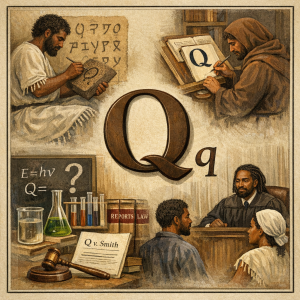
The letter is not itself a word in ordinary English prose, but it functions as a graphic sign with several context-dependent uses. It may identify an alphabetic position, label an item in a sequence, stand for an abbreviation, represent a variable in mathematics and science, identify a legal reporter or court, or serve as a conventional symbol in specialized fields. Meaning therefore depends on the document, discipline, and surrounding text. A letter alone does not create a legal status, obligation, office, jurisdiction, or spiritual doctrine.
In technical character encoding, the uppercase character is assigned Unicode code point U+0051, “LATIN CAPITAL LETTER Q,” and the lowercase character is U+0071, “LATIN SMALL LETTER Q.” This standardized encoding concerns digital representation; it does not prescribe a universal substantive meaning for the character.
Etymology and Origin
The English name cue is the conventional spoken name of the letter. The character’s historical ancestry is much older than English. The usual account traces the Latin letter through Greek koppa or qoppa, which in turn derived from the Phoenician letter qoph. In Semitic alphabets, the corresponding letter represented a consonant distinct from the ordinary k-like sound—a deeper, back-of-the-mouth consonant commonly transliterated q.
The precise pictorial origin of the earliest qoph-shaped sign is not settled. Suggestions have included an image associated with a needle’s eye or with the back of a head and neck. Such proposals concern remote graphic prehistory and should not be confused with proven etymology. What is well documented is the broad line of transmission: Semitic qoph influenced Greek koppa; forms of Greek alphabet transmitted into Italy influenced the Etruscan and then Latin alphabets; and the Roman alphabet became the principal ancestor of the English alphabet.
Early Greek usage of koppa was limited. It was associated with a k-type sound before certain back vowels in some alphabets and later survived chiefly as a numeral sign for ninety. Latin retained the related form but gave it a specialized spelling function. Classical Latin used q especially before u, preserving the written sequence qu for a labiovelar consonant, conventionally reconstructed as /kʷ/. Latin spelling also used c and, more rarely, k for related k-like sounds. Thus, the modern English tendency to associate the letter with u is chiefly a development inherited through Latin spelling, not an inherent law of the alphabet.
English did not always follow the present pattern. Old English commonly wrote the sound sequence with cw, as in cwen, the ancestor of queen. After the Norman Conquest, French-influenced spelling practices restored and popularized qu. By the later Middle English period, qu had largely displaced cw in standard written English. The retained spelling records linguistic history even where modern pronunciation no longer transparently reflects it.
Cultural and Historical Context
The letter’s comparative rarity has made it culturally conspicuous. English readers learn early that it is usually followed by u; this rule is useful but incomplete. Words such as Qatar, Qin, qi, qigong, burqa, and niqab show that English also uses q in transliterations and loanwords without the traditional qu pattern. In such words, spelling often seeks to preserve an original-language consonant or established transliteration rather than conform to English phonetic expectation.
In standard English, qu has more than one sound value. In quick, it is commonly /kw/. In words of French or Latin transmission such as unique, antique, and plaque, the u may not be pronounced as a separate /w/ sound. In mosque and cheque, pronunciation differs across varieties of English. These variations demonstrate that letters are conventions of writing, not fixed sound-producing objects.
The visual form of the lowercase letter is also notable. Unlike the lowercase forms of many letters, q normally has a descender: a stroke extending below the baseline. In handwriting and typography, the direction, curvature, and connection of that descender may vary. Such variation does not usually alter the identity of the letter, provided the form remains legible in context.
Historically, the letter has also appeared in numerals, names, and shorthand. Greek koppa was used as a numerical sign for ninety. In Roman naming practice, the initial could abbreviate Quintus, a common personal name. Medieval and early modern scribes used single letters and contractions extensively to conserve space and speed writing. Those local practices do not mean that every modern occurrence of the letter carries a hidden historical or legal meaning.
Biblical / Torah Context
The Latin letter is not a letter of Biblical Hebrew, Torah Hebrew, or the original Greek text of the New Testament. Its relevant Hebrew counterpart is qoph (ק), the nineteenth letter of the Hebrew alphabet. Qoph traditionally has the numerical value of one hundred in Hebrew letter-number usage. The letter is generally transliterated q in scholarly systems to distinguish it from kaph (כ), although English Bible translations often do not preserve that distinction in ordinary spelling.
Psalm 119 is arranged as an alphabetic acrostic in the Hebrew text. Its qoph section comprises Psalm 119:145–152. Each verse in that eight-verse stanza begins with qoph. The stanza speaks in the language of wholehearted calling, prayer, hope, attentiveness, and confidence in the enduring truth of God’s testimonies. The literary fact is the alphabetic structure; any claim that the letter itself independently imparts a fixed doctrinal message goes beyond what the text expressly states.
In Christian New Testament scholarship, capital Q has a separate and unrelated use: it denotes a hypothetical source proposed by many scholars to explain material shared by Matthew and Luke but absent from Mark. The label comes from the German Quelle, meaning “source.” This scholarly “Q source” should not be confused with the alphabetic letter’s Semitic ancestry, with Hebrew qoph, or with a physical manuscript known to exist. No surviving manuscript identified as the Q source has been discovered, and the hypothesis remains a model used in debates concerning the Synoptic Problem.
Some scholars favor the Two-Source Hypothesis, under which Matthew and Luke used Mark and a further sayings source. Others argue that Luke may have used Matthew, that oral tradition may account for some shared material, or that the literary relationships among the Gospels are more complex. Therefore, “Q” in this setting is a scholarly designation, not a settled item of Biblical canon and not a revealed name found in Scripture.
Legal Implications
The letter has no independent force in common law. Under common-law reasoning, a symbol takes legal effect only when a recognized legal rule, statute, contract, pleading, judgment, regulation, citation system, or other operative instrument gives it effect. A solitary letter on a page ordinarily proves little without evidence of its intended use and context.
Legal writing frequently employs letters as labels. A court may designate exhibits “A,” “B,” and “C”; a contract may define parties by letters; a statute may use paragraph lettering; and a case may identify anonymous or protected persons by initials. In each instance, the letter is an index or placeholder. Its legal consequence arises from the document and governing law, not from the letter’s alphabetic character.
Common-Law and Report-Citation Usage
In British legal history and legal citation, Q.B. traditionally abbreviates Queen’s Bench. The historic Court of King’s Bench or Queen’s Bench was a major English common-law court, with the title changing according to the sex of the reigning sovereign. Its decisions remain important sources for the historical development of English common law and may be cited where relevant in jurisdictions influenced by that tradition, including the United States.
Modern court organization must be distinguished from historical common-law courts. The nineteenth-century Judicature reforms reorganized England’s superior courts within the High Court of Justice. The relevant modern division is styled the King’s Bench Division under a king and the Queen’s Bench Division under a queen. Accordingly, older reports may properly contain Q.B., while present-day terminology may instead use K.B. or a fuller court title. Citation conventions should be checked against the date and reporter involved.
Other legal abbreviations containing the letter have entirely separate meanings. For example, Q.E.D. is a Latin abbreviation for quod erat demonstrandum, “which was to be demonstrated.” It is most familiar in mathematics and formal argument, but may appear in legal or academic writing to signal that an asserted proposition has been established. It is rhetorical shorthand, not a substitute for admissible evidence, legal authority, or judicial reasoning.
Statutes, Equity, and Current Law
No general rule of United States statutory law or English common law provides that the letter, its placement in a name, its capitalization, or its numerical position automatically changes a person’s rights, citizenship, legal capacity, property interest, court jurisdiction, or contractual obligations. Claims to the contrary require a specific, verifiable legal authority and a factual fit between that authority and the matter at issue.
Equity likewise does not attach special universal significance to the character. Equity historically developed as a body of principles and remedies administered alongside, and later within, the common-law court system. Whether a court grants equitable relief depends on such matters as jurisdiction, the parties’ conduct, available remedies, and applicable statutes and precedents—not upon alphabetic symbolism.
Spiritual Meaning
Some religious and mystical systems attach symbolic associations to letters, including Hebrew qoph. Interpretations may connect its traditional numerical value, form, position in the alphabet, or occurrence in Psalm 119 with themes such as prayer, holiness, transformation, awakening, or perseverance. These are interpretive and devotional readings. They may be meaningful within a particular faith community or school of thought, but they are not established merely by the existence of the letter.
A careful spiritual reading distinguishes three levels: the documented linguistic fact that qoph is a Hebrew letter; the textual fact that it heads a Psalm 119 acrostic stanza; and the further spiritual interpretation assigned by a reader or tradition. Conflating those levels can turn a personal symbol into an unsupported historical claim. Neither Biblical Hebrew nor common law supplies a universal mystical code for the Latin character.
Modern Usage
Modern usage is broad and necessarily context-specific. In ordinary English, the letter chiefly appears in spelling. In dictionaries and linguistic study, q may transliterate Hebrew qoph, Arabic qāf, or related consonants. In the International Phonetic Alphabet, however, q has a specialized phonetic meaning: a voiceless uvular stop, a sound made farther back in the mouth than the English /k/. That phonetic use should not be assumed when reading ordinary English.
In mathematics and logic, a letter may be chosen as a variable, proposition, point, or set name. In physics and engineering, lowercase q may represent electric charge, heat transfer per unit mass, a coordinate, or another quantity according to the author’s definitions. Uppercase Q may have different meanings, including a quality factor or heat quantity. None is universal across all scientific disciplines.
In publishing, testimony, education, and digital communication, “Q.” commonly labels a question, often paired with “A.” for answer. In government and military materials, letters may identify forms, plans, units, classifications, or operational items, but the specific meaning must be obtained from the issuing agency’s definitions. The alphabet provides a convenient labeling system; it does not itself create governmental authority or military command.
Controversies / Criticisms
The most common misunderstanding is treating the letter as though it has one secret, permanent meaning across law, religion, government, and language. That approach overlooks the ordinary rule of interpretation: symbols receive meaning from usage and context. The same character can be a spelling element, a Hebrew transliteration, a court-report abbreviation, a scientific variable, or a scholarly hypothesis without those meanings being connected.
A second issue concerns speculative origin stories. The transmission from Semitic qoph through Greek and Latin writing is broadly recognized, but proposed pictures behind the earliest sign remain uncertain. Claims that the letter conclusively originated in a particular religious object, occult emblem, governmental mark, or hidden code should be treated as disputed unless supported by competent linguistic, epigraphic, and historical evidence.
Finally, the New Testament “Q source” remains controversial precisely because it is hypothetical. It is a useful scholarly explanation for certain patterns in the Gospels, but it is not a recovered document and should not be presented as an extant ancient text. Responsible discussion identifies both the explanatory purpose of the hypothesis and the continuing scholarly disagreement over it.
Conclusion
The letter is a durable alphabetic sign whose history reaches from Semitic qoph through Greek koppa and Latin writing into modern English. Its familiar association with u reflects the inheritance of Latin and French spelling practices, not an absolute rule. In Hebrew and Biblical study, its cognate qoph has genuine alphabetic and acrostic significance; in New Testament scholarship, “Q” may denote a disputed hypothetical source; and in legal materials, combinations such as Q.B. may identify historical courts or law reports.
The sound approach is contextual: identify the field, read the surrounding instrument or text, and distinguish documented history from interpretive symbolism. The character can be important, but it does not independently carry a universal legal, governmental, military, or spiritual power.
Sources / Further Reading
- Unicode Consortium, Basic Latin Code Chart: https://www.unicode.org/charts/nameslist/n_0000.html
- Online Etymology Dictionary, “Q”: https://www.etymonline.com/word/Q
- Oxford Classical Dictionary, “Alphabet, Greek”: https://academic.oup.com/edited-volume/61673/chapter-abstract/548074837
- Legal Information Institute, Cornell Law School, “Queen’s Bench”: https://www.law.cornell.edu/wex/queens_bench
- Legal Information Institute, Cornell Law School, “Q.E.D.”: https://www.law.cornell.edu/wex/qed
- Cardiff Index to Legal Abbreviations, “Q.B.”: https://www.legalabbrevs.cardiff.ac.uk/abbreviations/abbsearch/asearch/Q.B./atype/Exact
- Bible Gateway, Encyclopedia of the Bible, “Q”: https://www.biblegateway.com/resources/encyclopedia-of-the-bible/Q
- Oxford Bibliographies, “Q”: https://academic.oup.com/reference/62341/reference-article-abstract/554104117
- Psalm 119:145–152, qoph stanza: https://www.easyenglish.bible/bible/easy/psalm/119%3A145-152/