Ensign (Sign)
Primary Definition
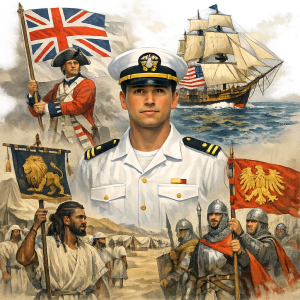
An ensign is, in its principal and oldest English sense, a visible sign of identity, authority, allegiance, rank, or gathering. The word may refer specifically to a flag, banner, standard, badge, emblem, or other device by which a person, people, military body, ship, institution, or sovereign power is recognized. In maritime usage, an ensign is ordinarily the national flag flown by a vessel to indicate the nation whose protection, registration, and authority the vessel claims. In military usage, it may mean a unit’s colors or standard. In a separate rank sense, an ensign is a junior commissioned naval officer in the United States Navy and Coast Guard.
The common idea uniting these meanings is public identification. An ensign is not merely decoration. It is a sign displayed so that others may know whom, what, or which authority is represented. Merriam-Webster accordingly defines the word as a national flag, a badge of office or power, an emblem or sign, and a naval officer rank. ([merriam-webster.com](https://www.merriam-webster.com/dictionary/ensign?utm_source=openai))
In ordinary modern American speech, “ensign” most often means either (1) a naval officer of the grade O-1 or (2) a flag flown aboard a vessel. In older religious, literary, heraldic, and political language, it frequently means a banner, rallying point, elevated sign, or emblem of authority.
Etymology and Origin
Ensign entered English in the early fifteenth century through Middle English and Anglo-French forms such as ensigne and Old French enseigne. Those forms meant a mark, symbol, signal, banner, standard, or pennant. The French word ultimately came from the Latin plural noun insignia, meaning distinguishing marks, badges of office, or standards. The English words ensign and insignia are therefore close linguistic relatives, sometimes described as doublets: different English forms descended from related forms of the same Latin source. ([etymonline.com](https://www.etymonline.com/word/ensign?utm_source=openai))
The Latin background also explains the connection between ensign and sign. A sign is broadly a mark that conveys meaning. An ensign is a more particular kind of sign: one that visibly identifies, summons, distinguishes, or represents a person, community, office, vessel, or authority. The terms overlap in historical usage, but they are not always interchangeable. A roadside sign, for example, is not normally called an ensign; a national flag or military standard may properly be called one.
By the early sixteenth century, ensign could also refer to the soldier who carried a unit’s flag. That development is logical: the person entrusted with bearing the standard came to be called by the name of the object borne. From that history arose the former infantry rank of ensign in British and early American military practice. The United States Navy later adopted ensign as the title of its lowest regular commissioned officer grade; the naval sense dates in the United States to the nineteenth century. ([etymonline.com](https://www.etymonline.com/word/ensign?utm_source=openai))
Cultural and Historical Context
Banner, Standard, and Public Identity
Before modern electronic communications, elevated flags and standards served immediate practical purposes. They identified friendly forces, marked a commander’s location, directed movement, aided the reassembly of troops, and made allegiance visible across a distance. A military ensign could be a rallying point in confusion or battle. Its loss might be understood as humiliation or defeat because the captured banner represented the captured honor, identity, or command of the body that flew it.
The ensign’s importance was therefore both practical and symbolic. A banner can coordinate a people; it can also express a people’s memory, laws, lineage, faith, office, or political allegiance. Heraldry, civic seals, coats of arms, royal standards, regimental colors, and ship flags all developed within this larger human practice of representing identity through visible signs.
At sea, the ensign acquired special importance. Ships may be far from their home ports and beyond immediate recognition by speech or local custom. A flag at the stern or other prescribed position supplies a visible declaration of nationality and affiliation. The term “flag state” reflects the legal and administrative importance of that relationship: under international maritime practice, a vessel’s nationality is associated with the state in which it is registered and whose flag it is entitled to fly. ([justice.gov](https://www.justice.gov/archives/usam/criminal-resource-manual-670-maritime-jurisdiction?utm_source=openai))
Military and Naval Development
Historically, the person who bore the colors occupied a position of trust. Carrying the standard exposed that person to danger, but also placed him near the center of the unit’s identity and command. This helps explain why ensign became an officer title. In the former British infantry system, an ensign was among the lowest commissioned ranks; the title was associated with the officer responsible for the regiment’s colors. The rank was eventually replaced in the British Army, while naval uses continued in several countries. ([etymonline.com](https://www.etymonline.com/word/ensign?utm_source=openai))
In the United States, “Ensign” is now a statutory Navy officer grade. Title 10 of the United States Code lists ensign after lieutenant (junior grade) in the hierarchy of Navy commissioned grades above chief warrant officer, W-5. The Department of Defense identifies Ensign as “ENS,” and Navy historical material equates the rank with second lieutenant in the Army and Marine Corps. ([govinfo.gov](https://www.govinfo.gov/content/pkg/USCODE-2020-title10/pdf/USCODE-2020-title10-subtitleC.pdf?utm_source=openai))
The rank should not be confused with an enlisted sailor’s rate, a naval academy student’s status, or the person who merely carries a flag at a ceremony. A United States naval ensign is a commissioned officer, with authority and duties arising from a lawful commission, applicable statutes, regulations, orders, and the officer’s assigned position—not from the word alone.
Biblical / Torah Context
The English word ensign appears prominently in older English Bible translations, especially the King James Version. It is a translation choice, not an assertion that ancient Israelites used the later English word or the modern naval rank. In the Hebrew Scriptures, the underlying concepts include banners, standards, signals, elevated markers, and signs used for assembly, recognition, warning, or proclamation.
One significant Hebrew term is nes, commonly rendered “banner,” “standard,” “signal,” or, in older translations, “ensign.” The image is often that of a raised object visible from afar. In Isaiah 11, the King James Version speaks of the root of Jesse standing “for an ensign of the people,” and later says that the Lord will “set up an ensign for the nations” in connection with gathering the dispersed of Israel and Judah. Modern translations frequently use “banner,” “signal,” or “signal flag,” which conveys the gathering and public-call aspect of the Hebrew imagery. ([biblegateway.com](https://www.biblegateway.com/passage/?search=Isaiah+11&version=KJV%3BASV%3BNASB%3BNIV&utm_source=openai))
This biblical use is substantially richer than a simple flag reference. The ensign is a public point toward which people look, gather, seek guidance, or recognize a divine summons. In Isaiah 11:10–12, the image joins kingship, restoration, the nations, and the regathering of Israel. Jewish readers may understand the passage within Isaiah’s prophetic vision of restoration and righteous Davidic rule. Many Christians read the “root of Jesse” messianically and connect the passage with Jesus, especially because Romans 15:12 cites Isaiah 11:10. These are theological readings of Scripture, not dictionary proof that every use of “ensign” carries the same messianic meaning.
The Torah also contains the related practical theme of tribes gathering and traveling according to their standards. Numbers 2 describes the tribes of Israel camping “by his own standard” and by the banners of their ancestral houses. English translations commonly use “standard” or “banner” there rather than “ensign.” The relevant Hebrew terminology is not identical in every passage, and a careful study should not flatten distinct Hebrew words into one English term. Nevertheless, the cultural principle is plainly related: visible signs ordered communal identity, location, and movement.
Exodus 17 provides another important banner image. After Israel’s conflict with Amalek, Moses names an altar YHWH-nissi, commonly translated “The LORD Is My Banner.” The expression presents the Lord—not a human institution, military emblem, or material object—as Israel’s ultimate source of victory and identity. The passage should not be used to teach that every modern flag, government, or military action bears divine approval. Rather, in its scriptural setting, the banner image directs dependence and honor toward God.
Legal Implications
Common Law, Admiralty, and Statutory Law
In legal language, an ensign may be relevant as evidence of a vessel’s declared nationality or official affiliation, but it is not a universal legal talisman. English common law, maritime custom, admiralty law, statutes, treaties, regulations, and court decisions each developed in different ways. It is inaccurate to treat “common law” as though it means a single body of rules existing apart from constitutions, legislation, courts, and lawful governmental institutions.
Historically, English common law developed through judicial decisions and custom. Admiralty and maritime law developed with distinct procedures and subject matter concerning navigation, shipping, commerce, prizes, collisions, seamen, and waters. Roman law also had legal ideas concerning commerce and the sea, but the modern American legal meaning of a vessel’s flag or nationality is not derived simply from a supposed Roman-law rule. Current United States maritime law depends on the Constitution, federal statutes, treaties, regulations, judicial decisions, and, where applicable, recognized general maritime law.
A ship’s flag has real legal relevance because ship registration and flag-state authority matter in international and domestic maritime regulation. But flying a particular flag does not automatically exempt a vessel from the law of waters, ports, or nations in which it operates. The United States Department of Justice has explained that a foreign vessel entering a United States port is generally subject to the laws of the country whose territory it has entered, subject to applicable maritime principles and limitations. ([justice.gov](https://www.justice.gov/osg/brief/spector-v-norwegian-cruise-line-amicus-merits?utm_source=openai))
For civilian display of the United States flag, federal law codifies rules and customs concerning display and use in Title 4 of the United States Code. Those provisions concern the national flag and public customs; they do not create a general rule that every flag displayed in a building changes the legal character of the building, court, person, or proceeding. ([govinfo.gov](https://www.govinfo.gov/app/details/USCODE-2024-title4/USCODE-2024-title4-chap1-sec5?utm_source=openai))
Ensign as an Officer Grade
When “Ensign” identifies a U.S. Navy officer, it is a formal statutory grade. The title has legal consequences only within the governing framework of military law and administration. Rank may affect precedence, command relationships, pay, duties, uniform insignia, and eligibility for assignments, but an ensign’s actual authority depends on lawfully assigned office and command—not merely personal assertion or uniform appearance.
No Automatic Jurisdictional Effect
An ensign or flag does not, by itself, establish a court’s jurisdiction. Jurisdiction arises from constitutional and statutory grants, territorial and subject-matter rules, lawful service and procedure, and the facts of a case. Nor does the presence of a flag transform an ordinary civil or criminal court into a military tribunal or an admiralty court.
Spiritual Meaning
As interpretive analysis, the ensign is a powerful spiritual image because it joins visibility, allegiance, direction, and gathering. A raised banner can symbolize a truth made public, a call to unity, a standard of conduct, or the identity under which a people assemble. In biblical usage, the image may point beyond physical warfare toward divine deliverance, restoration, and the gathering of those who respond to God’s call.
This symbolism must remain subordinate to the text and context from which it is drawn. A spiritual interpretation is not automatically a legal conclusion, and a national or military emblem is not automatically sacred. The dictionary’s interpretive use of “ensign” may therefore emphasize that what people elevate publicly reveals what they honor, follow, and represent; however, such reflection should not be confused with a claim that a material flag possesses independent spiritual or legal power.
Modern Usage
- Naval rank: “She was commissioned as an ensign after completing officer training.”
- Maritime flag: “The vessel raised its national ensign.”
- Military or ceremonial colors: “The regiment preserved its ensign as part of its history.”
- Figurative emblem: “The organization adopted the dove as an ensign of peace.”
- Biblical or religious language: “The prophet’s ensign calls scattered people to gather.”
In most contemporary writing, flag, banner, standard, emblem, and insignia are more common than ensign. The older word remains especially useful where the emphasis is national identity at sea, military tradition, ceremonial display, Scripture, or an elevated sign of authority and assembly.
Controversies / Criticisms
Some modern claims attach extraordinary legal consequences to flags, particularly to the United States flag displayed with gold fringe. Such claims sometimes allege that a fringed flag proves that a courtroom operates under admiralty, military, commercial, or foreign jurisdiction. These propositions are contested in the strongest sense: courts have repeatedly rejected them as legally frivolous. A federal court has stated that a court’s jurisdiction is conferred by the appropriate legislative authority, not by fringe on a flag; Department of Justice guidance likewise records that courts uniformly reject the “gold-fringed flag” theory. ([govinfo.gov](https://www.govinfo.gov/content/pkg/USCOURTS-caed-1_14-cv-01019/pdf/USCOURTS-caed-1_14-cv-01019-0.pdf?utm_source=openai))
Related assertions may invoke “common law,” “maritime law,” “the law of the flag,” or a supposed distinction between an “American flag of peace” and a “war flag.” Such arguments often mix historical vocabulary with unsupported conclusions. Maritime law is real and significant, but it concerns actual maritime subject matter and lawful jurisdiction. It does not arise merely because a national flag, an ensign, a seal, gold fringe, or a nautical term is present in a courtroom or public building.
It is also misleading to claim that the word ensign proves a pagan, Roman, ecclesiastical, military, or governmental origin for every flag or sign. The documented linguistic origin is Latin insignia, received into English through French and Middle English. That etymology explains the word’s historical development; it does not, by itself, settle theological, political, constitutional, or moral questions about every institution that uses a banner or insignia.
Conclusion
An ensign is a visible sign that identifies and gathers. Its historical meanings—banner, national flag, badge of office, military standard, standard-bearer, and naval officer—are connected by the idea of public representation. In Scripture, older English translations use the word for a banner or raised signal through which peoples may be summoned or restored. In maritime and military practice, it marks nationality, authority, rank, and organized allegiance.
In law, the ensign may have practical evidentiary and administrative importance, especially at sea and in military rank structure, but it does not independently create jurisdiction, erase rights, or convert a civil court into an admiralty or military tribunal. The sound use of the term requires attention to its actual context: language, history, Scripture, maritime custom, statute, and law each speak in their own proper sphere.
Sources / Further Reading
- Merriam-Webster Dictionary, “Ensign”
- Online Etymology Dictionary, “Ensign”
- United States Code, Title 10, § 8111, Navy Officer Grades
- United States Department of Defense, “U.S. Military Rank Insignia”
- Naval History and Heritage Command, “Insignias, U.S. Navy Uniform”
- Bible Gateway, Isaiah 11
- Sefaria, Steinsaltz on Isaiah 11:10
- United States Department of Justice, Criminal Resource Manual, “Maritime Jurisdiction”
- United States District Court, Eastern District of California, Lafayette v. Superior Court
- United States Department of Justice, Criminal Tax Manual, Chapter 40